

9 lead generation strategies that actually convert leads in 2026
TL;DR: The lead generation strategies B2B teams need to know
- 80% of B2B leads never convert, usually because they were wrong from the start. The shift in 2026 is quality over quantity.
- Stop tracking MQL volume 📉 Track lead-to-customer conversion rate to align marketing and sales around revenue.
- Conversion-ready leads share 3 traits 🎯 Fit (ICP match), Intent (buying signals), and Timing (active projects or budget).
- Intent data is the highest-leverage tactic. First- and third-party signals (funding, hiring, tech shifts) prioritize buyers already researching solutions.
- Cold email still works. When personalized, technically sound, and value-first, top campaigns reach 5–8% reply rates.
- Website optimization lifts existing traffic 📈 Faster load speed, shorter forms, and instant scheduling double meeting conversions.
- LinkedIn drives 80% of B2B social leads 🤝 Combine social selling with targeted ads and Lead Gen Forms for stronger results.
- ABM dominates high-value deals 🏢 Best for long sales cycles and complex buying committees.
- Retargeting recovers lost demand 🔁 Visitors exposed to retargeting ads are significantly more likely to convert.
Here’s a tough stat: around 80% of B2B leads never become customers. And no, it’s not because there aren’t enough leads, it’s because the leads often aren’t the right ones.
Chasing vanity metrics like “total leads generated” might look good in a report, but it rarely drives real results. Sales teams end up burning nearly half their time on weak prospects who were never serious in the first place.
The fallout? Frustrated reps, wasted spend, and missed targets.
The shift happening in 2026 is simple but powerful: quality beats quantity. Every time.
So would you rather have 1,000 random contacts, or 100 people who are actually ready to buy? That’s where this guide comes in.
We’re diving into 9 lead generation strategies that actually work in 2026: smart, focused, and built for high-intent prospects who are ready to turn into paying customers.
Why most lead generation strategies fail to convert
Most B2B lead generation efforts fall short because priorities are off. Marketing teams celebrate big MQL numbers, but research shows that only 25% of marketing-generated leads are truly sales-ready.
The rest? Either the wrong fit or not even close to ready to buy.
The follow-up delay makes things worse. Leads contacted within 5 minutes are 10x more likely to qualify than those left waiting half an hour.
Yet 41% of companies admit they struggle to follow up fast, usually because of workflow gaps or disconnected systems.
Then there’s the classic friction point: sales and marketing rarely agree on what a “qualified lead” actually means. Surveys show that only 9.1% of sales reps consider marketing leads to be high quality, and 42% complain about poor lead quality overall.
This disconnect kills conversions before they even start.

Stop tracking how many leads you generate and start tracking lead-to-customer conversion rate. That one metric will align your marketing and sales teams around what really matters: revenue.
Quality over quantity: Why 100 good leads beat 1,000 bad ones
Here’s the math that every marketer should know:
- 100 high-quality leads converting at 30% = 30 customers
- 1,000 low-quality leads converting at 2% = 20 customers
The takeaway? Smaller, better-targeted lists produce more revenue for less effort.
Companies that focus on lead quality see measurable results. And according to Forrester Research, firms nurturing qualified leads generate 50% more sales-ready opportunities at 33% lower cost. High-fit, intent-driven leads also convert up to five times higher than generic ones.
And sales teams feel the difference too. When reps receive only high-quality leads, they spend half their time actually selling, not prospecting dead ends.
What makes a lead "conversion-ready"? 3 qualifying factors
A “conversion-ready” lead meets three simple but powerful criteria: Fit, Intent, and Timing.
- Fit: Does this contact match your ideal customer profile (ICP)? Look at firmographics like company size, industry, and revenue, plus job title and authority level. The closer the match, the higher the conversion rate.
- Intent: Are they showing real buying interest? Cold leads posting on LinkedIn about needing X, growing their team (hiring for X specialist roles), or attending events/webinars in your space are much more likely to convert. These signals mean they're actively solving problems you can fix.
- Timing: Are they ready to buy soon? Leads from active projects with confirmed budget and decision-making authority convert at a much higher win rates.
When Fit, Intent, and Timing line up, you’re not chasing, you’re closing.
9 lead generation strategies shat convert in 2026
Modern B2B buyers are more self-directed than ever. And according to Worldwide Business Research, 57% to 70% of the buying journey happens before speaking with a sales rep.
During that time, they research, compare, and evaluate options across 10 different channels on average.
So a single lead generation tactic no longer delivers results. Buyers expect multiple touchpoints before they make a decision.
👉 Below are nine strategies that consistently deliver results in 2026, so let’s start with the most data-driven one: intent-based lead generation.
1. How to use intent data for B2B lead generation
Intent data shows which prospects are actively researching your type of solution right now. That insight lets you focus your outreach on leads already signaling interest, a proven way to boost conversion rates and lower acquisition costs.
Intent data comes in two key forms:
- First-party signals: activity on your own channels (website visits, content downloads, email opens).
- Third-party signals: behavioral data collected from other sites, aggregated by providers such as Clay, Cognism, Zoominfo, etc. (we personally love using Clay for lead gen, it’s our favorite!)
Clay enrichment can give you goldmine signals like:
- Website speed (perfect if you're a website optimization agency targeting slow-loading sites)
- Headcount growth (companies hiring fast need more tools and services)
- Funding raised (fresh capital means budget to spend)
- Website traffic (high traffic + slow speed = a clear pain point to solve)
- G2 / Google reviews (spot common complaints you can fix, or see what competitors are missing)
These data points tell you exactly who has the problem you solve and the budget to fix it!
AI has made this approach incredibly precise. Modern intent platforms analyze hundreds of data sources daily with up to 99.5% accuracy in detecting active buying behavior, which also makes building a targeted lead list for cold emailing way more precise than it used to be.
🔥 Bottom line: Intent data helps you prioritize the right prospects, reach them at the right time, and start conversations that actually lead to deals.


2. Does cold email still work for lead generation in 2026?
Absolutely. Cold email still works in 2026 when it’s done with precision, personalization, and technical care (which is exactly why we put together our cold email strategy guide for teams tired of getting ghosted).
While average reply rates hover between 1–3%, the best-performing campaigns reach 5–8% when every message feels personal and relevant.
Email continues to be the preferred outreach channel for 61% of decision-makers, outperforming LinkedIn messages and cold calls.
Why? Because when done right, it delivers value fast and respects the recipient’s time.
The formula for success hasn’t changed much, just refined:
- Research each prospect before reaching out.
- Personalize the context around their role, company, industry or current focus.
- Avoid templates that sound generic.
- Send from a trusted domain with clean technical setup (and make sure you know how many cold emails to send per day to protect that trust).
💡 In short: Cold email still converts because it creates a direct, value-based conversation. When teams prioritize authenticity and precision, it remains one of the most dependable B2B lead generation tools.
Email deliverability best practices for 2026
Even the best email won’t work if it never reaches the inbox. Cold email deliverability is now the real performance metric.
To boost your chances of landing in the inbox:
- Authenticate your domain with SPF, DKIM, and DMARC. These validate your identity and build trust with email providers.
- Warm up your domain gradually before large sends to avoid spam flags (a good warm up tool makes this process much easier).
- Verify every contact and remove inactive addresses to protect your sender score.
- Stick to clean, text-based emails. Avoid excessive links or HTML.
- Include a simple unsubscribe line instead of flashy buttons or tracking pixels.
Brands that follow these practices see measurable improvements in reply rates because more messages actually reach prospects. In other words, deliverability is your campaign’s foundation.
Everything else depends on it.
If you're looking to bulletproof your cold email infrastructure, our detailed guide on cold email deliverability best practices walks you through authentication, infrastructure, and sending behavior that keeps you inbox-bound.
And if you're already dealing with deliverability problems, check out our breakdown of the 9 critical email deliverability issues and exactly how to fix them.
Writing cold emails that actually get replies
Cold emails that convert share a few simple traits: they’re short, personal, and relevant.
Here’s what consistently drives higher response rates 📈:
- Short emails win. Make your messages under ~120 words if possible, definitely under 200.
- Personalized subject lines significantly improve reply rates.
- Relevance matters. Mention a specific pain point or goal your contact cares about.
- Use friendly, natural language. Informal tone increases replies by around 15%.
- End with one simple CTA. Asking, “Would you like me to share a short insight?” works far better than multiple requests.
⚡ Simple always wins. The goal isn’t to sell in one message but to start a conversation. When prospects feel you understand their needs and respect their time, they’re far more likely to reply.
If you're wondering what separates cold emails that get ignored from ones that book meetings, our detailed guide on how to write the best cold email covers everything from subject lines to CTAs that convert.
3. Website optimization tactics that capture more leads
Your website has far more lead potential than most teams realize. Many B2B sites convert only 1 to 2 percent of visitors, yet optimized pages often reach 3 to 5 percent or higher. These gains usually come from small changes that improve clarity and reduce friction.
Speed is the first place to look.
When a page takes longer than 3 seconds to load, up to 40 percent of visitors leave, which reduces conversions on desktop and mobile. Shorter forms also help, since fewer fields give visitors fewer reasons to abandon the page.
And many organizations report around 25 percent higher site-wide conversions after updating form length, CTA clarity, and navigation. These updates turn existing traffic into more qualified leads without adding new spend, which always feels like a small victory.
Make it ridiculously easy to book a meeting
Booking friction loses qualified buyers faster than almost anything else.
Traditional contact forms often slow visitors down because they wait for a reply, which hurts momentum. Half of buyers choose the vendor who replies first, and about 40 percent of demo requests never turn into meetings when scheduling happens through email.
Instant scheduling tools solve this problem quickly.
When visitors can select a meeting time right away, conversion rates jump. Many teams see 70 to 80 percent of demo requests convert into held calls, which nearly doubles the number of conversations from the same inbound volume.
And since we are here, let talk also about CTAs. They matter more than most teams think, and they directly influence meeting bookings.
- Pages with one clear CTA convert better than pages with several competing choices.
- Homepage CTAs placed above the fold often lift conversions by up to 20 percent.
- Sticky CTAs on product pages keep the next step visible as visitors scroll, which helps guide them toward booking.
- Adaptive CTAs, which adjust to a visitor’s stage, show over twice the submission rate of static options.
These placements work beautifully with instant scheduling tools because visitors can act as soon as they feel ready.
So place your scheduling link on high-intent pages, confirmation emails, and even your navigation so it is impossible to miss.
4. How to use gated content for B2B lead gen
Gated content continues to perform well in 2026 because buyers still trade contact details for content that delivers real value.
Landing pages offering gated assets convert between 15% and 40% of visitors, and high-value formats like research reports or webinars reach the upper end of that range.
Buyers are still selective, yet 66 percent will share their name and work email when the content solves a problem they care about.

Every download also signals intent: someone completing a form has already expressed genuine interest in your topic.
When nurtured correctly, 10–20% of these leads later become sales-ready. Reports, guides, and webinars not only build authority but also feed a steady stream of qualified prospects who match your target audience.
Here is what consistently works:
%20(2)%20(1).webp)
💡 Key takeaway: Yes gating still works, as long as the content solves a real business problem and feels worth the exchange.
5. How to generate B2B leads on LinkedIn
LinkedIn continues to be one of the most effective places to generate B2B leads because people show up ready to talk business.
The platform drives 80 percent of all B2B social leads, and four out of five members influence decisions inside their organizations. Pretty strong audience, right?
The strongest results come from a two-pronged approach that blends personal engagement with broader awareness.
- One-to-one social selling through personal profiles
- One-to-many content and paid campaigns to increase reach
Employee activity has a huge impact. Content shared by employees earns two times higher click-through rates than posts from company pages, so your team can extend reach far more effectively than brand accounts.
LinkedIn Lead Gen Forms also provide a strong boost.
These forms convert at around 13 percent, while standard landing pages often sit closer to 4 percent. The ease of auto-filled information makes a noticeable difference in how many prospects complete the form.
Social selling that doesn't feel salesy
Social selling works best when it feels like a real interaction instead of a pitch. Buyers can tell the difference instantly, and the data backs it up.
Highly active accounts generate 45 percent more opportunities, and they are 51 percent more likely to hit quota.
The key is steady, genuine engagement. Here is what consistently helps:
- Commenting thoughtfully on posts (not just “Great insights!”)
- Sharing useful ideas that match your audience’s interests
- Referencing mutual connections in a natural way
- Sending messages that feel personal instead of scripted
These small actions compound in your favor. Context-aware messages earn reply rates around 30 percent, while generic outreach usually falls below 10 percent.
6. When should you use account-based marketing (ABM)?
ABM shines when every account represents meaningful revenue potential. If your deals typically reach six or seven figures, ABM usually becomes the most efficient way to focus your time and budget.
ITSMA reports that ABM delivers the highest ROI of any B2B marketing strategy, and 87 percent of marketers say it outperforms their other programs. Not bad for a targeted approach.
So, when is ABM the right choice?
Look for these conditions:
- Long sales cycles, usually 6 to 18 months
- Large buying committees with 6 to 10 stakeholders
- High-value accounts where personalization is worth the effort
- Finite prospect lists, such as Fortune 500 companies or niche leaders
ABM works in these situations because it keeps your top accounts engaged through personalized multi-touch campaigns. Each stakeholder receives content that speaks to their specific role, which helps maintain momentum across longer buying journeys.
7. How to use retargeting ads to capture lost leads
Retargeting remains one of the most reliable ways to recover leads who slipped away on their first visit. And it gives you those extra chances by showing tailored ads as they browse other sites.
Better yet, visitors who see retargeting ads are 70 percent more likely to convert, and these ads can earn up to ten times higher click-through rates than standard display ads.
The audience already knows your brand, so the message feels familiar instead of intrusive.

Once a visitor has seen your product, even briefly, retargeting keeps you top of mind without overwhelming them.
Why website visitors don't convert
Visitors leave for many reasons, and most of them are completely normal. A large portion are still researching.
Around 67 percent of the buyer journey happens before anyone talks to sales, so it makes sense that first visits rarely result in a form fill.
Others need more clarity, internal approval, or stronger trust signals. Retargeting helps address these gaps by matching follow-up messages to what visitors viewed.
How to re-engage website visitors who left:
- Capture them with tools like RB2B or Vector.io
They pull LinkedIn URL, job title, company, and email from anonymous visitors. No more guessing who stopped by.
- Make sure they match your ICP!
No point chasing competitors snooping around your site or companies outside your target locations/industries. Filter out the noise, focus on real prospects.
- Shoot them an email or retarget them with ads
Send a quick email letting them know you can answer any questions about your service. Or retarget them with Google/LinkedIn ads to stay top-of-mind. Either way, you're back in front of people who already showed interest.
These visitors already know who you are. They're warmer than cold leads. Don't waste that.
8. Do webinars generate quality B2B leads?
Webinars continue to deliver strong B2B leads because they attract buyers who want real insight and practical information. They pull in mid and late-stage prospects who are actively comparing solutions, which means the audience already has intent.
And that’s important.
Webinar attendees convert at higher rates for a simple reason: they spend focused time with your content, ask questions, respond to polls, and willingly share registration details.
These are reliable engagement signals that help teams identify serious buyers.
Many B2B teams report that webinars bring in some of their highest-quality leads, especially when the topic matches a real buyer problem. Webinars also support longer buying cycles, since they give prospects more context as they progress through research and evaluation.
Here is what consistently works:
- Choose topics that reflect real buyer pain points
- Promote across multiple channels, especially email and retargeting
- Use engagement tools like polls, chat, and Q&A to keep attention
- Follow up within 24 hours with the recording and related resources
Many attendees will not act immediately, so follow-up is essential. A simple CTA, such as a consultation link or a related guide, often boosts conversions because it gives attendees an easy next step.
9. How to automate lead nurturing with CRM sequences
Most leads need time before they are ready to buy. Only 2 to 10 percent convert immediately, which means the other 90 percent require steady nurturing.
This is simply the ongoing process of staying in touch through helpful and timely communication. When follow-up is manual, things fall through cracks. (We have all been there.)
Automated CRM sequences prevent that by keeping every prospect engaged consistently.
B2B buying is rarely simple. It usually involves multiple stakeholders, longer evaluation periods, and higher investment. That is why nurturing exists in the first place. Prospects need different support depending on their situation:
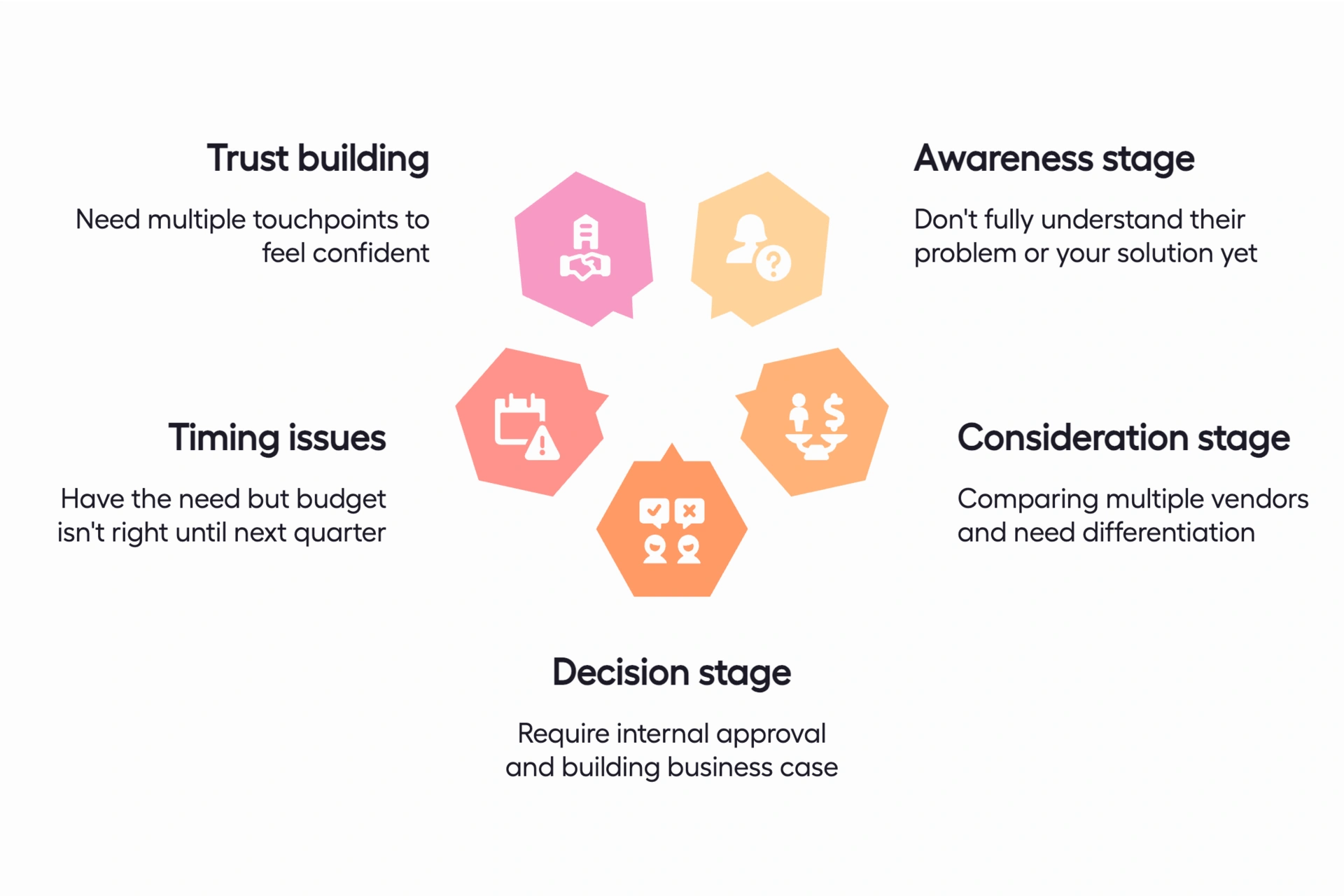
It typically takes around 8 touchpoints to secure an initial meeting, and 80 percent of sales require 5 to 12 follow-ups. This is exactly where CRM sequences shine.
They let you deliver timely, personal communication at scale without overwhelming your team.
The company that stays top-of-mind usually wins when timing finally lines up. A prospect may download your ebook in January but only begin evaluating vendors in Q3. Without nurturing, you risk being forgotten.
To sum up
We have covered a lot, and by now you can clearly see what separates lead generation that produces revenue from campaigns that quietly drain your budget.
The difference is simple: High-performing teams focus on conversion-ready prospects, not vanity metrics.
The 9 strategies we shared are proven tactics that deliver real results in 2026 (when executed properly). But the hard truth is that most companies struggle to scale these strategies while maintaining the personalization and quality that actually drive results.
That’s where things fall apart.
That’s why we've built our business around 2 of these strategies: intent-based cold email that converts.
We analyze over 100 prospect signals to pinpoint leads who are ready to convert. Then, we craft personalized outreach that lands in inboxes (not spam folders) and sparks real replies.
We take care of the entire backend: domain setup, authentication, deliverability optimization, follow-up sequences, you name it.
And your sales team? They focus on what they do best: closing deals, not chasing dead ends.
So do you want to stop wasting money on leads that don’t go anywhere? Let’s build you a lead generation system that consistently fills your pipeline with qualified, conversion-ready opportunities. (Seriously, no more dead ends!)
Frequently asked questions
There is no universal winner here. The best strategy depends on your ideal customer profile, your sales cycle, and your deal size. Companies selling high-value enterprise solutions usually see the strongest results with a mix of account-based marketing and intent data because these approaches focus your effort on accounts most likely to convert. Mid-market companies often perform well with a blend of content marketing, cold email, and LinkedIn outreach, since those channels reach buyers at different stages of the journey.
Inbound brings prospects to you through SEO, content, webinars, and social activity. These leads often show clearer intent because they searched for answers on their own. Outbound is the opposite. It takes your message directly to specific prospects through cold emails, calls, and targeted ads. Outbound helps you reach decision-makers who are not actively searching yet, which is valuable when you want predictable outreach volume.
A few areas make the biggest difference. The first is targeting. When you focus on ideal customer profile accounts rather than broad pools of prospects, you can see conversion rates increase up to five times. The second factor is response speed. Leads contacted within five minutes are about ten times more likely to qualify than those contacted after half an hour, so quick follow-up has a real impact. The third area is nurturing. Companies that excel here often generate 50 percent more sales-ready leads while lowering cost by roughly a third.
The timeline varies depending on which channels you use and how long your average sales cycle runs. Outbound tactics such as LinkedIn outreach and cold email can produce leads within days or weeks, which makes them great for immediate pipeline needs. Paid advertising usually starts showing traction within the first month as campaigns stabilize. Content marketing and SEO take longer, usually six to twelve months, since organic authority builds at a slower pace. Webinars fall somewhere in the middle. They typically show ROI within one to three months.
The most reliable way to measure success is by tracking revenue-focused metrics, not just lead volume. Instead of relying on total leads or MQLs, focus on lead-to-opportunity rate, opportunity-to-customer conversion rate, and cost per acquired customer. High-performing teams also monitor sales velocity (how fast leads move through the pipeline) and meeting-to-close ratios. If a strategy consistently produces leads that turn into real sales conversations and closed deals, it’s working. If it only inflates top-of-funnel numbers without impacting revenue, it’s time to rethink the approach.
Don’t miss these
Get your first lead this month
14 days to get started. 7 days to get your first lead on average.


