

The M&A pipeline explained: Guide to deal flow in 2026
TL;DR: What you need to know about the M&A pipeline
- Eight core stages drive the pipeline: strategy development, sourcing, outreach, NDAs, due diligence, negotiation, closing, and integration
- Top-performing advisors build pipeline intentionally, defining strategy and deal criteria before sourcing to avoid wasted time on misaligned targets.
- Consistent deal flow starts with effective sourcing, using exit-readiness signals and intent data rather than generic databases shared by every advisor.
- Cold outreach is a core driver of modern M&A pipelines, enabling advisors to create conversations with companies not actively for sale.
- Structured outbound generates 4-8 additional closed deals annually without replacing referrals
- Pipeline visibility requires M&A-specific CRM systems and real-time tracking metrics
- Conversion matters more than volume, qualify targets properly and maintain consistent follow-up
- Technology scales repetitive tasks but can't replace strategic judgment on fit and value creation
Consistent deal flow is what sets apart top-performing M&A advisors from those stuck in one-off wins.
So if you're seeing peers close multiple transactions every year, it's not some magical referral chain. They’ve built structured, repeatable acquisition pipelines that surface qualified targets month after month (without waiting around for luck to strike). 🔁
Global M&A hit $4.8 trillion in 2025, up 40% from the year before. 📈 Yet even with that spike, 47% of advisors say they’re struggling to find high-potential targets, and 46% are facing longer transaction timelines than they’d like. These are real bottlenecks.
The problem? Most M&A content skips over how deals actually enter your funnel. It focuses on what to do once the LOI is signed. This guide flips that script.
👉 We’ll break down the key m&a pipeline stages, walk through how to build an acquisition pipeline that brings in consistent deal flow, and share the strategies top advisors rely on to close 4–8 transactions annually (yes, really).
What is an M&A pipeline?
Your M&A pipeline is the operational system that tracks and advances every acquisition opportunity, from initial outreach all the way to post-close integration.
It’s not just a list of leads; it’s a living deal map. Think of it as a dynamic portfolio of in-progress acquisitions, each at a specific stage of development.
Here’s how it typically flows:
- Deal sourcing (finding targets)
- Strategic fit and planning
- Initial engagement and negotiation
- Confidentiality agreements & sharing information
- Due diligence and terms
- Closing and integration
A strong pipeline doesn’t just track these steps, it creates alignment. Everyone on your team knows where each opportunity sits, what’s next, and who’s responsible.
This visibility is critical when you’re managing multiple deals at once (and let’s be real, you most likely are). 📋
How does an M&A pipeline differ from an M&A funnel?
People use these terms interchangeably, but they mean different things.
- The pipeline focuses on sequential stages deals move through from sourcing to closing. It's about the journey each deal takes.
- The funnel highlights attrition and conversion rates, showing how many opportunities drop off at each stage. It's about understanding your drop-off rates.
Pipeline language for operations ("Where's the Smith Manufacturing deal?") and funnel language for planning ("If we need 10 closed deals, how many sourced opportunities do we need?").
In short: pipelines are for process control, funnels are for forecasting.
What are the key stages of the M&A pipeline?
The M&A pipeline typically runs through eight core stages, though the labels can vary across firms.
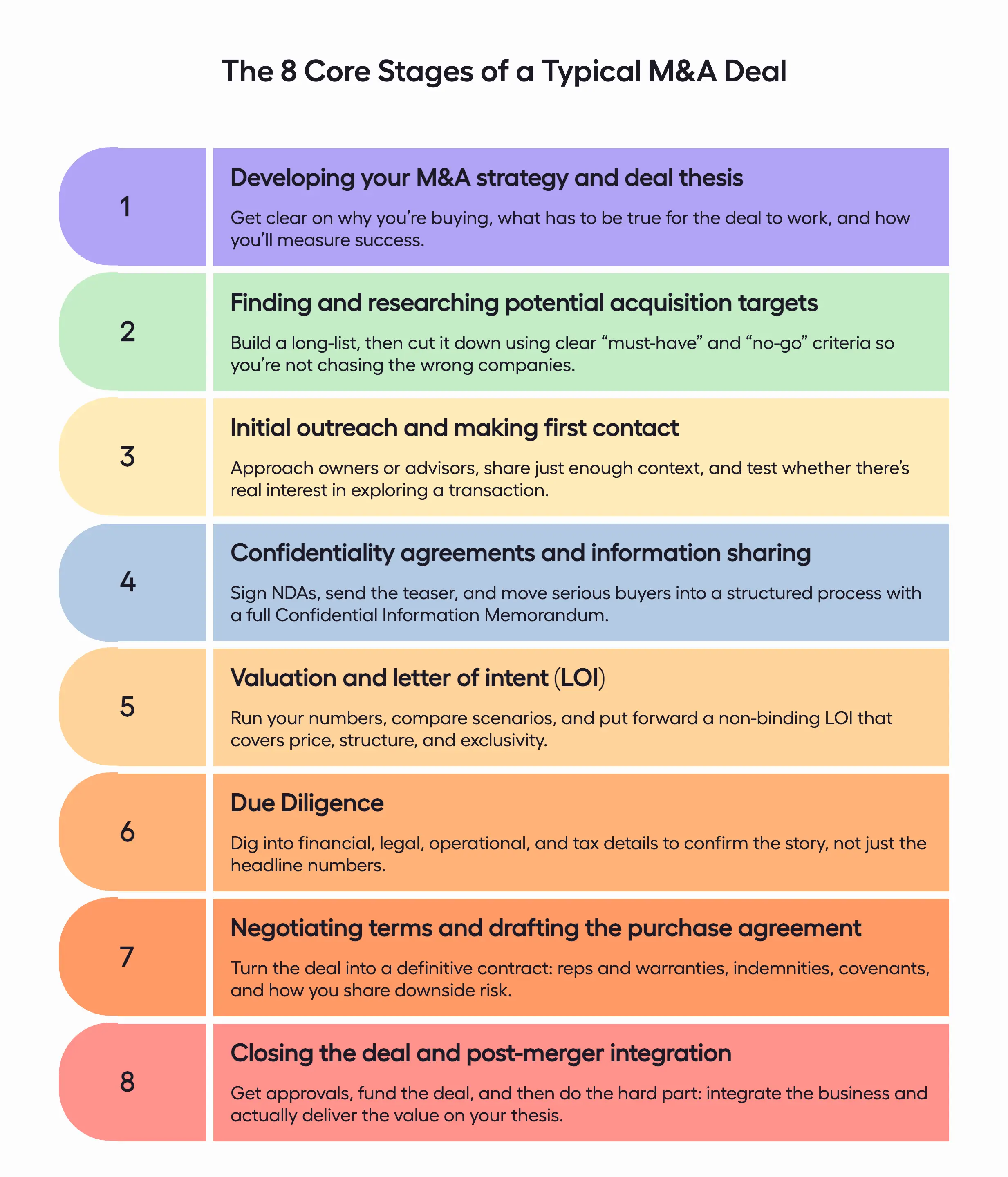
Each phase brings specific decisions, timelines, and friction points. So if your deal flow slows, chances are one of these steps is under-resourced or overlooked.
Let’s break down each stage, what it involves, and where most advisors hit bottlenecks.
Stage 1: Strategic M&A pipeline development
This is the foundation. Before a single target is sourced, you define the kind of deal you want. That includes your acquisition thesis, criteria for fit (financial, operational, cultural), and your rationale for buying in the first place.
📊 In 2025, more than 85% of M&A leaders updated their pipeline strategy, often in response to changing tech stacks or shifts in their sector focus. Why? Because without clear filters, you’ll end up reviewing inbound noise or chasing targets that don’t align.
Use this stage to:
- Establish your investment criteria
- Identify non-negotiables (like minimum EBITDA, customer concentration, tech risk)
- Clarify what makes a target strategic vs. opportunistic
Stage 2: Building your M&A deal pipeline through effective sourcing
Sourcing starts once strategy’s locked. The goal here is to surface qualified targets, not just names, but companies that actually fit and might actually transact.
Nearly 50% of M&A advisors cite lack of promising targets as their biggest operational challenge, which explains why systematic sourcing matters so much.
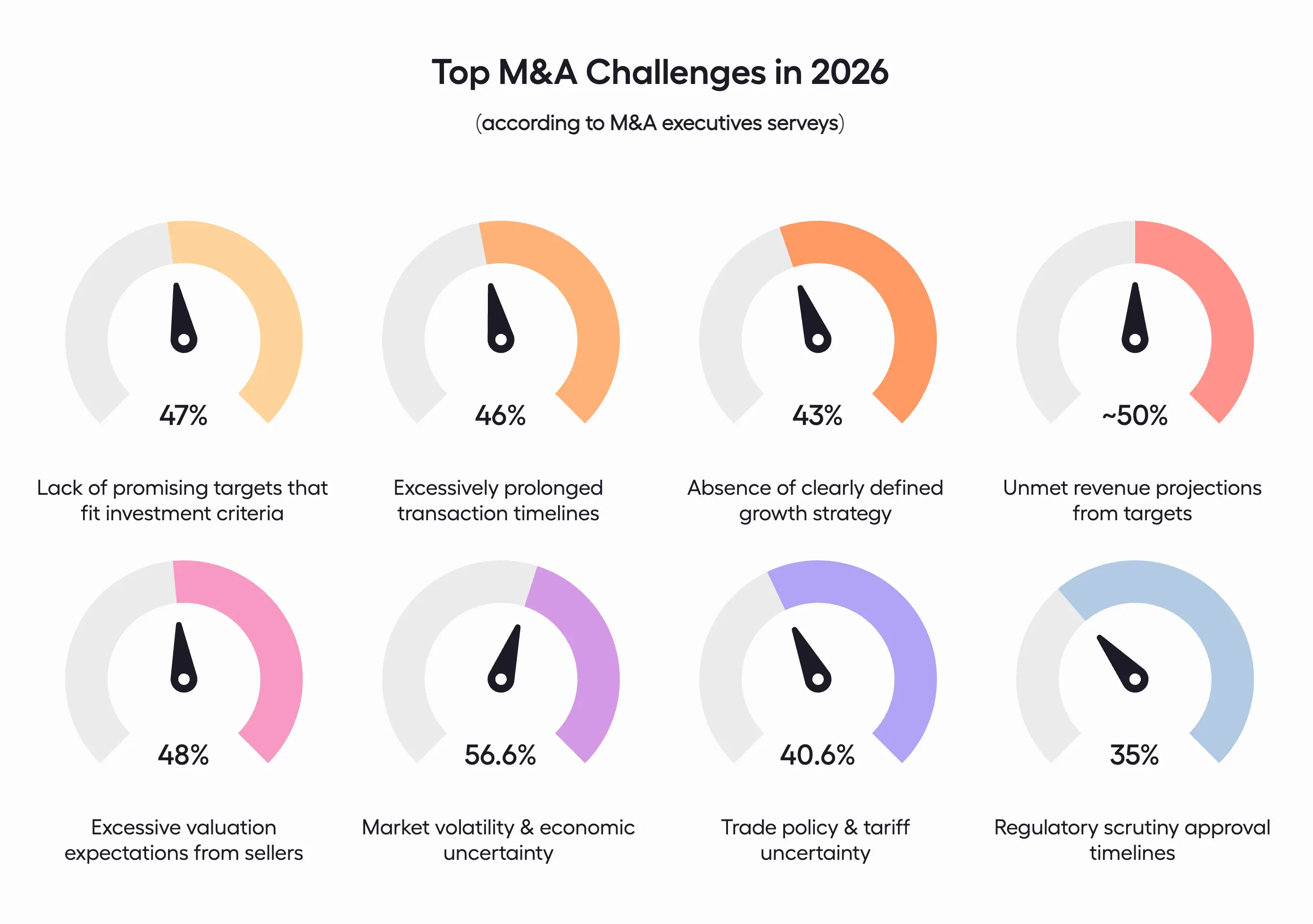
This means you need more than scrolling databases. You need a system that picks up on behavioral cues that signal exit interest.
When we’re helping M&A advisors here’s how we think about it:
Exit-readiness indicators:
- CEO tenure (15+ years often signals openness to succession planning).
- Company age (15–25 years tends to be the sweet spot).
- Recent funding rounds (especially Series B or C).
- Headcount changes (steady growth or recent contractions).
These inputs go well beyond firmographics, they point to sellers who are more likely to respond and engage.
📚 If you're sending the same message to every target regardless of where they are in their business lifecycle, email segmentation can dramatically improve engagement, we cover 15 strategies that work.

Structured deal sourcing makes M&A teams 2.5x more likely to hit their transaction goals compared to firms without a defined pipeline process.


Stage 3: Initial outreach and pipeline qualification
Once you've identified promising targets, initial conversations figure out if real acquisition interest exists and whether terms might work for both sides.
This usually happens through existing relationships, industry contacts, or direct outreach to gauge seller interest.
How we approach it:
- Each message references specific milestones from the target's LinkedIn or recent press.
- The messaging clearly explains the M&A advisory role upfront.
- Plain text format. No logos, no HTML, no marketing fluff.
Example:
"Saw your new VP of Ops announcement after 18 years of organic growth. I work with PE firms and strategics looking to acquire companies in [vertical]. Based on your [specific signal], wanted to see if you'd ever consider a conversation about acquisition down the road."
That's cold email personalization in action: specific, relevant, and impossible to ignore. Reads like a colleague sent it, because that's what gets responses from busy CEOs.
📚 Struggling to get replies from busy founders? Our guide walks through how to write cold emails that actually get opened and answered, with real examples from M&A outreach.
Stage 4: NDAs and information sharing
Before sharing sensitive business info, parties sign non-disclosure agreements (NDAs) protecting the information exchanged during early negotiations.
The seller provides confidential details so you can figure out if you want to acquire their business, and the NDA protects everyone involved.
What the NDA should cover:
- What counts as confidential (documents, conversations, emails).
- Who’s allowed to see what (internal and external stakeholders).
- Non-circumvention terms (stops buyers from contacting targets directly).
NDAs typically gets signed before due diligence starts, before executing term sheets, or before any definitive documentation.

If you're engaging sellers directly (before investment banks get involved) there may be no formal data room yet. Keep conversations high-level until mutual interest is clear.
Stage 5: Valuation and letter of intent
Once there’s mutual interest, you move into valuation and LOI negotiation.
The buyer calculates valuation based on financial history, projected performance, growth upside, growth potential, and market comparables.📊
Then comes the LOI. It outlines key deal terms: price, structure, exclusivity, and conditions.
While mostly non-binding, the LOI locks in confidentiality and ensures alignment before expensive due diligence begins,
Stage 6: Due diligence
Due diligence is your full examination of the target's financials, operations, legal standing, and market position.
It usually takes 2-4 months with multiple workstreams running at once.
You're looking at:
- Financial review (audited statements, working capital, revenue quality)
- Operations (processes, supply chains, tech infrastructure)
- Legal (contracts, regulatory compliance, litigation)
- Tax (historical liabilities, potential exposure)
- Commercial (market position, competitive dynamics)
In 2024-2025, smart dealmakers doubled down on diligence, using this phase to stress-test value creation and evaluate new stuff like supply chain resilience and ESG compliance. That shift explains why even mid-market deals take longer.
Stage 7: M&A deal structuring and pipeline negotiations
After due diligence wraps up, you move into substantive negotiation. Purchase price is the obvious variable, typically expressed as a multiple of EBITDA.
But price is only part of it. Negotiation also covers:
- Working capital adjustments (making sure the seller delivers appropriate cash, receivables, inventory)
- Escrow provisions (usually 10-15% held back for 12-18 months)
- Earn-outs (tying portions of the price to post-acquisition performance)
- Reps and warranties (who bears risk for identified issues)
These provisions create real tension. Sellers want to limit exposure. Buyers want comprehensive coverage. So deals can get contentious here if both sides aren't reasonable.
Stage 8: closing deals in your M&A pipeline
Closing means satisfying remaining conditions, securing regulatory approvals, and actually completing the transaction.
For deals over $2 billion, the period from signing to closing hit an average of 191 days (about six months). That's a long time to keep momentum and stakeholders engaged.
And extended timelines can create real problems:
- Momentum stalls out
- Everyone gets tired of the process
- Target company performance can slip
- Financing gets complicated (especially with debt)
How do you build an M&A pipeline from scratch (without relying on referrals)?
Referrals can bring in good deals. No one’s denying that. But they’re unpredictable, hard to scale, and nearly impossible to forecast against targets.
If your pipeline is built around “who knows who,” you’re reacting to the market, not driving it.
Systematic outbound gives you another channel beyond waiting for introductions. It supplements referrals (which remain valuable), not replaces them.
The advisors we work with still get referral deals. But they've added a second channel generating 4-8 additional closed transactions annually on top of their existing network-driven business.
Curious if this approach works for advisors who already have strong referral networks? Sutton Capital Partners was in the same position - in their testimonial, they walked through how they supplemented (not replaced) their existing deal flow.
What are the best practices for building an M&A pipeline that actually converts?
Building pipeline volume means nothing if opportunities don't convert to closed deals.
And the difference between top-performing M&A advisors and everyone else comes down to consistency. That means qualifying targets properly, following up with structure, and keeping momentum over long cycles.
Here’s how to do it:
1. Define clear investment theses before sourcing targets
Your thesis acts as the filter for everything that follows.
At a minimum, define three components:
- Strategic fit: Does the target expand reach, fill a capability gap, or deepen vertical strength?
- Financial profile: Set guardrails around revenue, margin, growth rates, and capital structure.
- Operational alignment: Ask if their delivery model, systems, or tech stack would complement yours—or cause friction.
2. Use intent-based targeting, not generic lists
Generic lists from Apollo or ZoomInfo get sold to multiple PE firms using identical data. Every advisor on those platforms sees the same companies. You're competing over publicly visible targets before you even reach out.
That’s why we run monthly research cycles to generate fresh contacts based on current signals. And then build a quality lead lists for cold outreach around exit-readiness indicators instead of recycled firmographics.
Each new list is built from scratch and never repurposed. If a company shows signals in February, they get added then, not reused in April. And lists never get reused or resold to other advisors.
If you wondering whether this works outside of specific deal sizes or sectors, Winston Dunn tested it in a competitive vertical and still generated consistent pipeline. We recommend checking it out!
3. Maintain a consistent follow-up cadence
Initial outreach rarely gets immediate responses. Instead of abandoning the lead, we recommend:
- A structured sequence across 3–4 touchpoints
- Follow-ups that reference relevant milestones (funding rounds, new hires, press)
- Tone that stays interested, not pushy
“Just wanted to reconnect after noticing your expansion into the Southeast, wondering if your growth plans now include liquidity conversations.”
These messages get replies from busy founders who skipped your first note (then circle back once timing aligns).
4. Multi-thread every deal
One contact ≠ one opportunity.
So don't rely on single-person relationships. Build relationships with multiple decision-makers and influencers in target organizations.
This definitely increases deal momentum and reduces the chance that one person's opposition kills everything.
Engage executive leadership, financial decision-makers, operational management, and board reps where possible.
5. Apply qualification frameworks consistently
Use frameworks like BANT (Budget, Authority, Need, Timeline) or MEDDIC. But the key is using them consistently, especially once a lead enters active conversation.
Watch for:
- Recent back-and-forth within 7–14 days
- Buyers who show engagement through responsiveness and info sharing
- Multi-stakeholder engagement
How can you improve visibility across your M&A deals?
Managing multiple live deals means one thing: complexity.
Visibility breaks down when you can’t see where each opportunity stands, what actions are pending, or which deals carry higher risk (this happens more often than most teams admit).
Start with real-time pipeline dashboards that show deal stage, ownership, and next steps in one place. M&A-specific CRM systems matter here because they provide functionality specifically designed for complex, multi-party negotiations with lengthy cycles (no, a generic sales CRM won’t cut it).
From there, track three core areas:
- Pipeline conversion rates: Track pipeline conversion rates showing how well prospects move from initial contact to serious consideration. Low conversion rates signal you need to refine qualification criteria.
- Time-in-stage metrics: Monitor how long deals sit in each phase. Slow movement signals friction that needs attention.
- Top-of-funnel activity: Know how many targets you've contacted, response rates, and qualification rates. When you see these metrics in real-time (through cold email analytics showing deliverability, engagement, and reply patterns), you spot problems early before they impact downstream pipeline.
And finally, review source-level performance to see which channels consistently produce higher-quality opportunities.
How can you track M&A deal progress more effectively?
Tracking deal progress requires structure. Random check-ins won’t cut it when multiple deals are active across long timelines.
So use a layered review system built around purpose and role:
- Weekly rep-to-manager reviews
Focus on deal inspection and check for actual movement:
- Decision-maker engagement
- Preliminary financial info exchanged
- NDA signed
- Follow-up scheduled
- Monthly forecast reviews
These are commitment checkpoints. Managers back forecasts with data. Senior leaders challenge assumptions and validate the approach.
And always monitor key metrics including pipeline value (total potential deal value across stages), weighted pipeline (adjusting for closure probability), velocity (how quickly deals move), and conversion rates between stages.
How can technology streamline M&A deal flow?
Technology helps scale repeatable tasks across the M&A pipeline, but it can’t replace sound judgment around fit and value creation.
Start with M&A-specific CRM systems. These platforms support long-cycle deals with features built for multi-stakeholder coordination, pipeline stage tracking, and execution workflows. Some include native integrations with deal databases or AI tools to streamline sourcing and outreach.

Examples of good CRM systems are Hubspot, Salesforce, Arx CRM M&A, Dealroom, and Affinity.
What most advisors overlook:
Tech isn't only for mid-pipeline tracking. It's also critical for generating consistent M&A lead generation at top-of-funnel.
Cold outreach at scale requires good infrastructure:
- Multiple sending domains
- Email authentication (SPF, DKIM, DMARC)
- Inbox warm-up sequences
- Cold email deliverability monitoring 📬
Without this layer, even the best outreach strategy underperforms.
So the main goal is using tech to scale repetitive work (research, outreach, tracking) so you focus on strategy and relationship-building that tech can't replicate.
Your M&A pipeline is only as strong as your deal flow
Every advisor we talk to knows how to close. That’s not the problem.
The problem is inconsistent pipeline generation. Too many advisors rely on referrals, then find themselves idle when those leads disappear for months. It’s unpredictable and hard to scale.
The advisors winning in 2026 aren’t waiting around. They’ve built repeatable sourcing systems that surface qualified conversations every week (not once a quarter).
So if you’re serious about building a more reliable pipeline and you’re tired of playing catch-up every quarter, we’re here to help.
Because your pipeline isn't broken. Your top-of-funnel is. Fix that, and everything else becomes easier.
Frequently asked questions
HubSpot offers customizable pipeline management with built-in automation. Specialized platforms like Arx provide purpose-built M&A functionality. Affinity delivers relationship intelligence with automated contact tracking. And Midaxo offers cloud-based solutions with real-time dashboards and stage-gates.
HubSpot works exceptionally well for advisors managing deal pipelines with its flexible customization and automation capabilities. Midaxo and Arx offer specialized M&A functionality. For deal sourcing, Sourcescrub provides AI-powered identification.
For deals over $2 billion, signing to closing averages 191 days (about six months). Middle-market transactions move faster. Due diligence alone takes 2-4 months. Plan for 6-18 months complete progression.
Track pipeline value, weighted pipeline (adjusted for closure probability), velocity, and conversion rates between stages. Monitor source effectiveness, average time in each stage, and deal-to-close ratios. Revenue metrics and retention rates assess post-acquisition performance.
Keep pipeline value equaling 3-5 times annual acquisition targets. Healthy pipelines include substantial volume in early identification stages, meaningful count in advanced evaluation, and smaller numbers in signed or near-closing stages across diversified sectors.
Don’t miss these


Get your first lead this month
14 days to get started. 7 days to get your first lead on average.


