

.avif)
7 LinkedIn Outreach Strategies We Use for 120+ B2B Teams
TL;DR: 7 LinkedIn Outreach Strategies Explained
- Blank connection requests outperform noted invites: Sending empty invites yields a 2x higher acceptance rate by eliminating premature judgment. 📊
- Profile-as-a-Landing-Page is mandatory: Overhauling headlines from "Helping X do Y" to operator credentials readies your profile for evaluation. 🎯
- Signal-based triggers protect sender accounts: Timing outreach around job changes, funding, or hiring posts keeps domain health high and responses strong. 📈
- Multi-channel beats single-channel silos: Layering LinkedIn touches onto non-responsive cold email leads generates 2-3x higher reply rates in finance and healthcare. 💡
- Permission-based pitches eliminate call friction: Asking to send a 2-minute teardown beats forcing a 30-minute calendar call. 🧵
- Enterprise deals require multi-threading: Reaching 2-3 decision-makers simultaneously prevents pipeline bottlenecks on non-owner accounts. 🔍
- Hiring posts signal active pipeline pain: Mining job listings target buyers who have publicly admitted an operational problem. 🛠️
Getting a reply in a cold LinkedIn inbox has never been harder.
The decision-maker you are trying to reach likely logged in today to find dozens of unread DMs begging for attention. AI automation tools have flooded inboxes with generic pitches, but they have also raised the bar for real expertise.
Here is the reality of outbound in 2026: if you want to be taken seriously by a human, you must show up as a human.
Most B2B outbound campaigns stall because agencies confuse raw volume with actual pipeline performance. Scaling connection requests on un-optimized profiles with generic pitch notes tanks acceptance rates below 10% and risks account restriction.
In this guide, we break down the exact 7 LinkedIn outreach strategies we run across 120+ client accounts at Hypergen to build predictable meeting pipeline without burning sender accounts.
Does LinkedIn still work for outreach in 2026?
Yes, but the playbook has fundamentally changed. Mass automation and low-quality AI generators raised the bar for authenticity, which acts as a modern filter for true intent and domain expertise.
While cold email inbox delivery faces strict technical hurdles, decision-makers in high-friction verticals (finance, healthcare, SaaS, and professional services) use LinkedIn daily. Across active B2B campaigns, LinkedIn reply rates in email-hostile industries run 2-3x higher than cold email baselines.

Mass AI spam forced an evolution in how cold outreach works. Buyers spot template pitches in seconds, turning LinkedIn into a high-intent, precision-driven channel. High meeting volume now comes strictly down to list quality, trigger accuracy, and positioning your profile as an operator rather than a vendor.
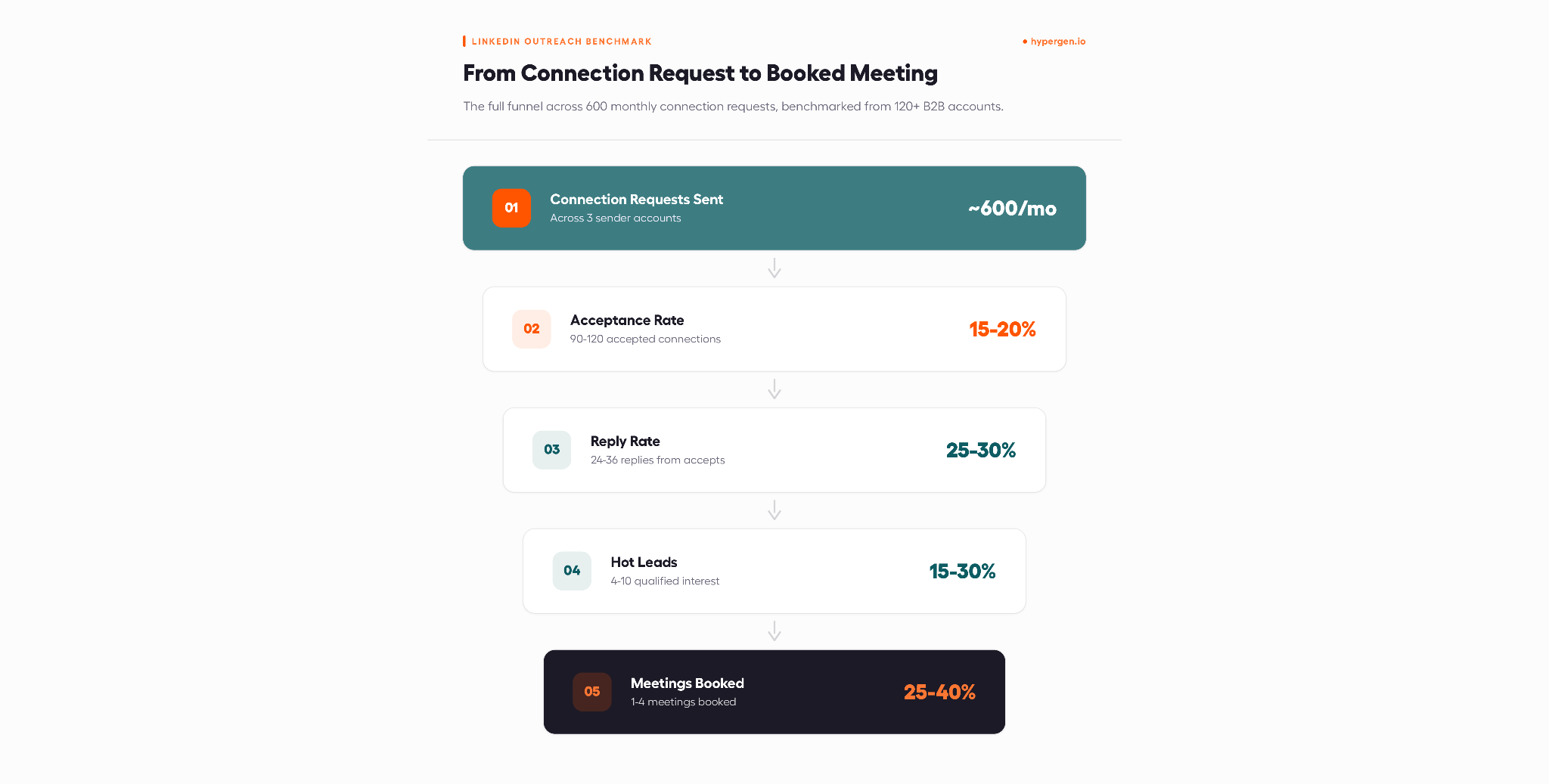
Across a mature three-sender LinkedIn setup, we typically work with around 600 connection requests per month. Around 15-20% are accepted, with 25-30% of accepted connections replying, ultimately generating roughly 4-10 hot leads and 1-4 meetings booked.
Benchmarks only hold if your prospect list is screened for recent platform activity. Offline sectors like local services or trades yield single-digit acceptances simply because decision-makers haven't opened their accounts in years. We screen for posting frequency and engagement before queuing a single connection request.
Strategy 01: Why Blank Connection Requests Beat Personalized Notes
Standard LinkedIn guides preach adding a customized 20-word note to every connection request. Across 120+ active accounts, our data shows the exact opposite. Sending blank connection requests yields a roughly 2x higher acceptance rate than sending invites attached with intro notes.
Adding a note forces the prospect to evaluate a pitch before you have earned a real conversation. In our campaigns, an unnoted request has typically created less initial friction, while a noted invite can prompt prospects to evaluate the pitch before they have even accepted the connection. Instead, we save the core hook for the Day 1 post-acceptance message.

If your acceptance rate drops below 10%, stop tweaking your outreach copy. A sub-10% accept rate almost always points to three specific issues: your sender profile reads like a bot, you attached a note to the invite, or your target list is not LinkedIn-active.
Strategy 02: Turn Founder Profiles into Operator Landing Pages
When a prospect receives your connection invite, they click your profile and decide within 3 seconds whether you are an operator or a vendor.
Headlines built around generic "Helping X do Y" positioning read like sales ads and trigger instant rejection.
Named-deal proof on sender profiles increases reply rates to 3.2%, compared to 0.8% for generic positioning claims.
Strategy 03: Signal-Based Triggers That Prevent Account Restrictions
Sending high volumes of poorly targeted connection requests increases account risk while wasting activity on prospects with no clear reason to engage.
Reaching out based on real-time organizational signals ensures message relevance before an outreach sequence even launches.
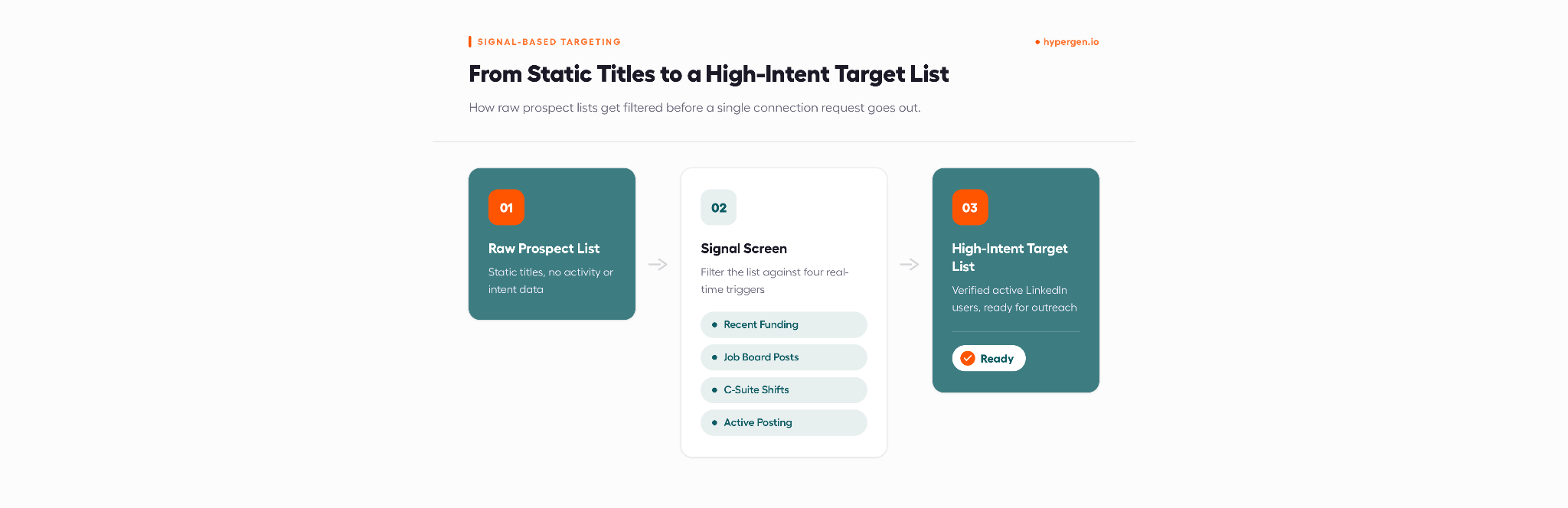
Always filter out inactive profiles before queuing connection requests. Target verticals like SaaS, finance, and professional services yield strong benchmark acceptance rates (15-20%), whereas offline sectors yield single-digit acceptances simply because decision-makers rarely log in.
Supporting Tactic: How to Warm Up a LinkedIn Prospect Before Reaching Out
Intent signals tell you when to reach out, but account value determines how much upfront effort a prospect deserves.
For standard prospect lists, direct outbound remains the correct playbook: screen for activity, send a blank connection request, and trigger messaging post-acceptance. For high-value accounts, creating light familiarity before sending an invite improves acceptance rates without turning outbound into a slow social selling campaign.
The 4-Step Pre-Outreach Touchpoint Ladder
- View the Prospect's Profile: This is the lowest-friction touchpoint. It creates a subtle point of recognition for prospects who check their profile viewers.
- Following the Prospect: Logical for active decision-makers who post regularly. Following them gives you visibility into future posts, buying signals, and relevant opportunities to engage before you reach out.
- Engage with Relevant Content: Likes and reactions are light, low-weight signals. A single like will not build immediate trust, but it adds a visible touchpoint.
- Leave One Thoughtful Comment: This is the highest-value warming step. Avoid generic replies like "Great post" or "Totally agree". Add a concrete professional perspective, ask a sharp question, or tie the post to an industry observation.
Prospect Tiering: When to Warm vs. When to Send Direct
Use light engagement strictly to build familiarity, never to pitch. Save your core value hook for post-acceptance messaging once the connection is established.
Strategy 04: Multi-Channel Retargeting for Non-Responsive Email Prospects
Treating LinkedIn as an isolated silo limits campaign performance.
Retargeting non-responsive cold email leads on LinkedIn unlocks decision-makers in heavily filtered, email-hostile industries like finance and healthcare.
The Multi-Channel Sequence Architecture
When cold email sequences encounter silent prospects, pivot the account to a soft LinkedIn retargeting workflow rather than blasting additional emails:
Days 1-7 (Cold Email Sequence): Launch your primary email value proposition. Monitor for opens or click activity without forcing immediate follow-up blasts.
Days 8-9 (Soft Profile View): View the prospect's LinkedIn profile using a secondary sender account. This may create a profile-view notification and gives prospects a chance to recognize your name.
Day 10 (Blank Connection Request): Send an unnoted connection request. Leveraging prior email touchpoints increases acceptance rates without sales friction.
Day 11+ (Permission-Based Messaging): Once the prospect accepts, trigger your first post-acceptance message offering a zero-friction asset.
Moving non-responsive email prospects onto LinkedIn leverages established brand familiarity. Across active campaigns in email-hostile verticals, layering LinkedIn touches onto silent email leads increases overall pipeline engagement without expanding initial target lists.
For a broader breakdown of how different channels and tactics work together across an outbound campaign, explore our guide to outbound lead generation tactics.
Strategy 05: Permission-Based Pitches That Cut Call Friction
Asking a cold prospect for a 30-minute calendar call creates immediate friction. Permission-based offers switch the dynamic from asking for calendar time to offering immediate value.
Lengthy explanations can hurt cold outreach performance. Decision-makers often review LinkedIn messages quickly and between other tasks, leaving little patience for dense blocks of text.
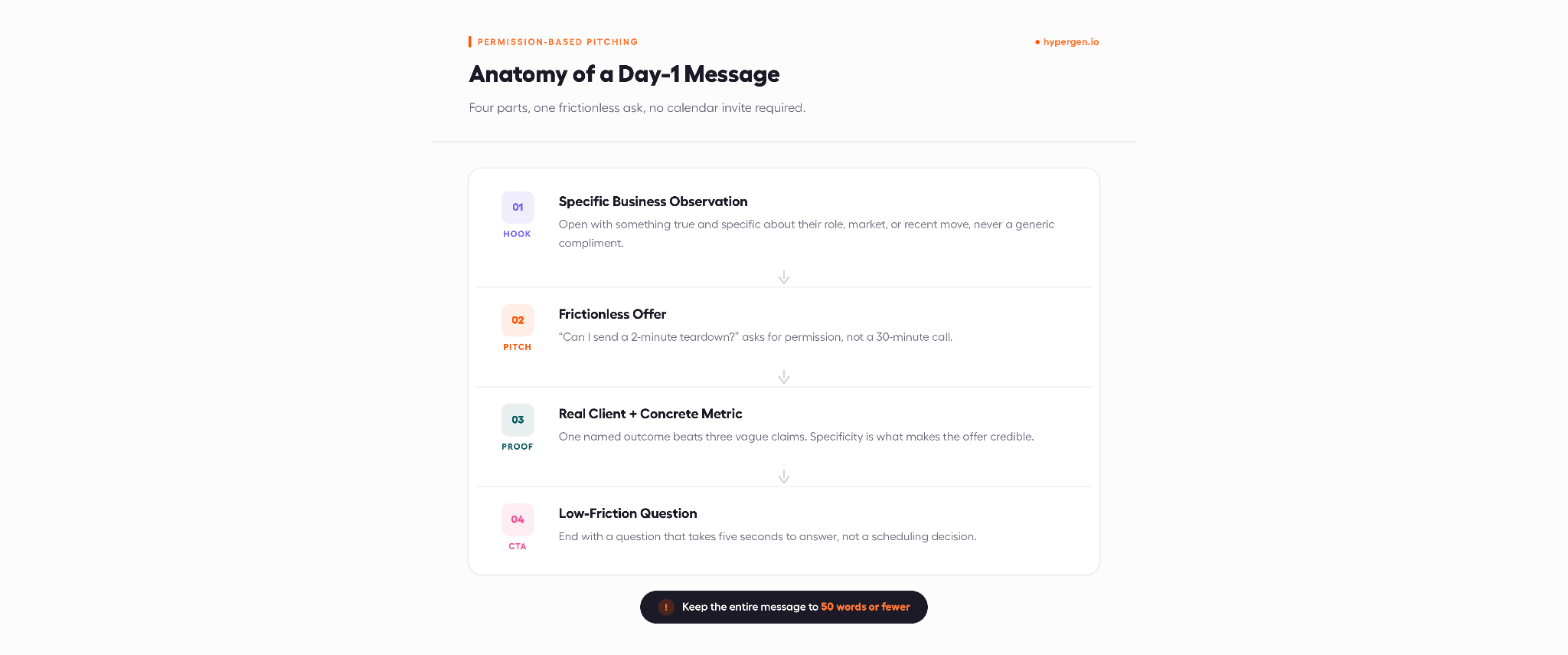
We keep the Day-1 message to 50 words or fewer, structured around a specific business observation, a frictionless offer, proof from a real client with a specific metric, and a low-friction question.
Never include external links in your Day-1 message. LinkedIn actively throttles delivery on messages containing external URLs, tanking your reach before anyone reads your offer.
What to Do After a Prospect Accepts Your Connection Request
The moment a prospect accepts your invite is the highest-intent window of the entire sequence. They have just seen your name and evaluated your profile landing page.
How you handle the first message determines whether you start a sales pipeline or get ignored.
1. Timing: Send the Day-1 Message Promptly
- The Rule: Trigger your first message within 2 to 24 hours of acceptance.
- Why It Works: Waiting several days destroys context and warmth. Sending within the first day leverages immediate brand recall while your profile is fresh in their mind.
2. Function: Permission-Based Offer Over Small Talk
- The Rule: Skip artificial conversational openers. Lead with a specific business observation tied to a permission-based asset.
- Why It Works: B2B buyers spot fake small talk instantly. Asking permission to share a 2-minute audit or specific teardown respects their time while offering immediate value.
3. What NEVER to Do on Day 1
- Do Not Pitch a Calendar Call: Asking for a 30-minute demo on message #1 creates massive friction.
- Do Not Include External Links: LinkedIn algorithmically throttles reach on messages containing outbound URLs.
- Do Not Send Generic Automated Follow-ups: Mass automation without role relevance triggers instant blocks.
Market advice suggests building rapport over weeks of messaging. Our data shows prospects prefer direct transparency. State a relevant observation, offer a zero-friction resource, and let them decide whether to engage.
How to Follow Up Without Repeating the Same Pitch
A follow-up sequence should introduce new value and fresh context, not serve as an automated reminder that you previously pitched.
Silence from a prospect rarely means they need to read your original offer a second time. It usually means your initial touchpoint arrived when their attention was occupied by higher-priority tasks.
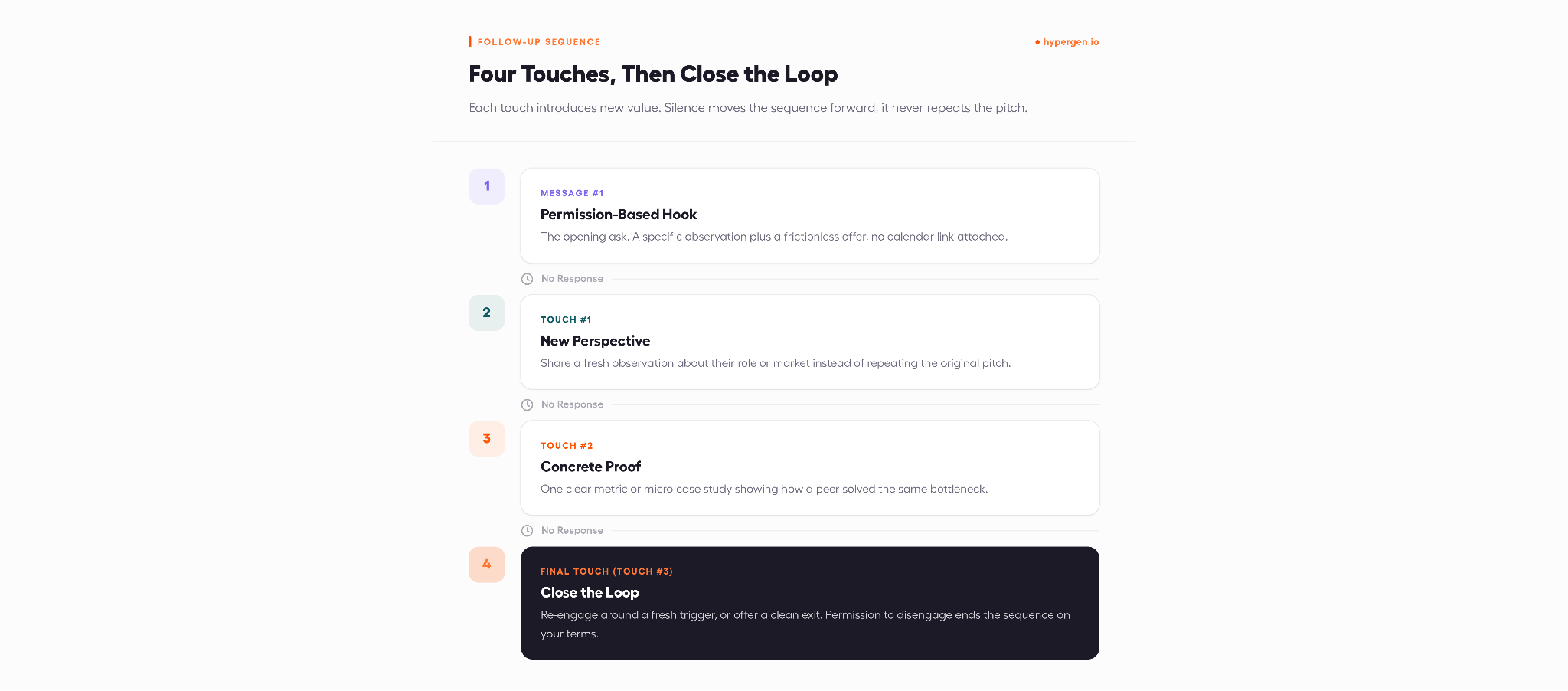
The 4-Angle Follow-Up Framework
Instead of counting days on a calendar, structure every touchpoint around a distinct reason to reply.
Market guides often suggest extending outreach sequences to 5 or more follow-ups. Across 120+ client accounts, our data shows response rates drop sharply once a prospect has received more than 4 total touchpoints. Quality touchpoints with clear value outperform high-frequency nudges every time.
When to Stop Following Up
Managing cold outreach requires strict cadence limits to maintain sender account health and reduce spam and account restriction risks.
- Cap your sequence at four total touchpoints (1 initial message + 3 follow-ups). Sending more than four LinkedIn messages to a non-responsive prospect yields diminishing returns and increases spam flagging risks.
- Space your touchpoints strategically across 14 to 21 business days. Avoid sending daily follow-ups.
- If a high-value prospect remains silent on LinkedIn after your final disengagement message, pause execution for 60 to 90 days. Alternatively, transition the account to a verified email infrastructure sequence triggered by fresh buying signals.
Strategy 06: Enterprise Multi-Threading to Prevent Deal Blockage
Targeting a single decision-maker in mid-market or enterprise accounts creates single-point failures.
Multi-threading is vital for enterprise accounts where buying authority is split across departments.
For small owner-operator targets with a single decision-maker, single-recipient outreach remains the correct approach.
Strategy 07: Job Listing Signal Mining for Immediate Pipeline Pain
Posting an open job listing is a public admission of operational friction.
When a target account advertises for a specialized role (such as hiring 2 outbound SDRs or a Head of Demand Gen), they publicly confirm two critical facts: they have an active operational need and are allocating resources toward solving it.
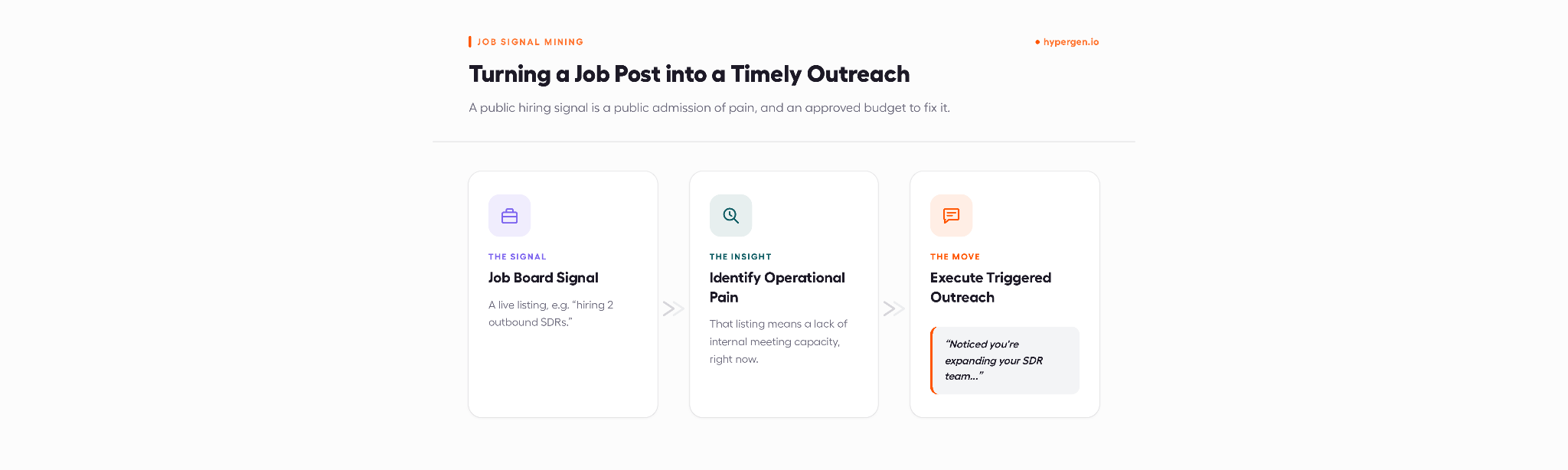
Pitching decision-makers without knowing their current hiring priorities is an uphill battle.
Mining active job listings allows outreach teams to step in at the exact moment a buyer's operational problem is most acute.
Reach out to the hiring decision-maker (e.g. VP of Sales), not HR. Frame your service as an immediate bridge to hold them over while their internal recruitment and onboarding takes months.
LinkedIn signals are only one part of a broader outbound strategy. The strongest campaigns combine timing, targeting, positioning, and channel-specific execution into a coordinated sales process. For more frameworks, see our guide to outbound sales strategies.
Common LinkedIn Outreach Mistakes to Avoid
Scaling LinkedIn outreach can involve automation, but automation should support workflow orchestration and prospecting, not replace human judgment or automate activity in ways that violate LinkedIn's rules.
Plus, if your outreach feels manufactured, target prospects will ignore it.
- Neglecting Account Activity: Sending invites to accounts that have not posted or engaged in months tanks acceptance rates below 10%.
- Using Generic Variables: Relying solely on {first_name} and {company} tokens fails to create authentic connection.
- Ignoring Pending Invites: Accumulating hundreds of unaccepted connection requests quietly throttles your daily invite limits. Withdraw invites older than 30 days automatically.
- Single-Account Scaling: Pushing max daily volume through a single account risks restrictions. Rotate outreach across minimum 2-3 sender profiles capped at 25 invites per day each.
How to Diagnose Your LinkedIn Outreach Metrics
A low number of booked meetings is not the root problem. It is simply the final symptom of a breakdown at an earlier stage of your outreach funnel.
To fix an underperforming campaign, trace your performance step-by-step through each stage of the funnel:
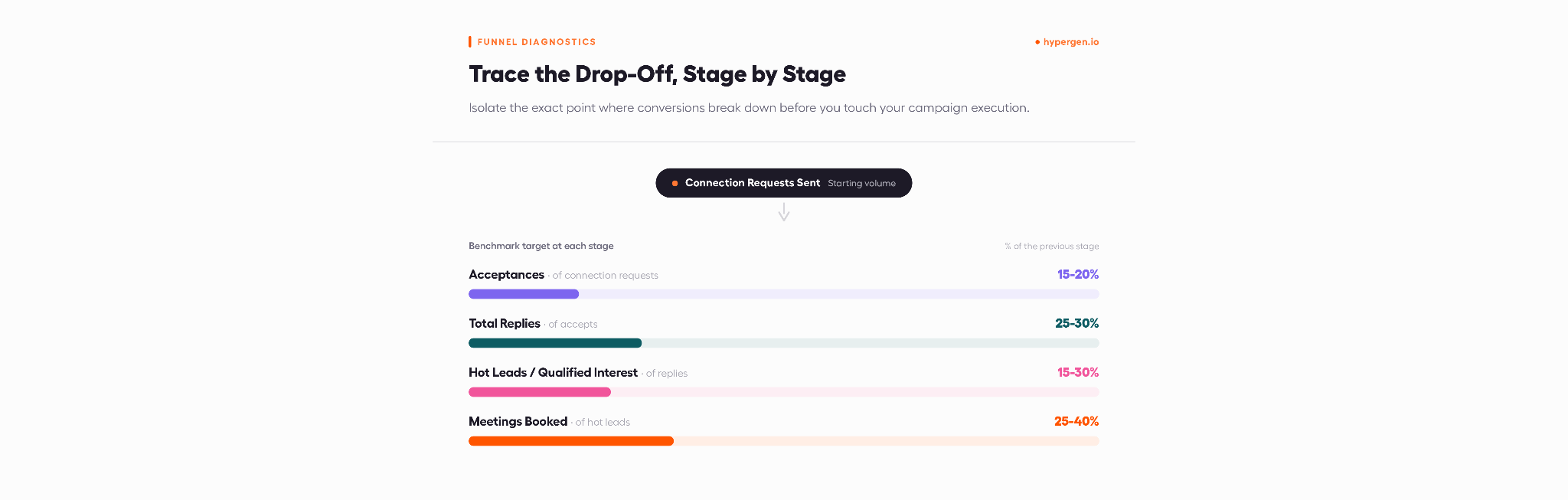
Isolate the exact stage where conversions drop off before changing your campaign execution.
Note: Start with the most obvious issue first. Only audit deeper execution variables (invite volume, automation settings, pending requests, and account limits) when performance drops across the entire campaign.
Don't Fix a Funnel Problem With More Volume
Scaling output over a broken conversion point accelerates account restrictions and damages sender credibility.
If your connection acceptance rate sits below 10%, sending 1,000 additional invites simply burns through your addressable market faster. If prospects accept but remain silent, increasing automation volume will not generate replies.
Locate the specific stage where performance breaks down, apply the targeted structural fix, and verify benchmark performance before increasing daily activity.
Teams switching from high-volume blasts to signal-driven diagnostics cut total monthly send volume by half while increasing verified meeting bookings. Fixing target list hygiene and profile authority yields predictable pipeline growth without relying on aggressive volume.
Outbound Systems Beat High-Volume Automation
Scaling a B2B pipeline is an engineering task, not a volume game. Capping daily connection requests at 25 per sender profile, removing sales hype from headlines, and queueing triggers based on active buying signals helps create more predictable meeting volume without relying on aggressive activity.
Across our campaign audits, teams switching from high-volume blasts to signal-driven, multi-account outreach reduced unnecessary send volume while improving meeting conversion. Building the system around active prospects, relevant triggers, and controlled execution turns cold lists into active buyer conversations.
Want to audit your outreach setup? If your team needs help building and managing the underlying system, explore our B2B lead generation services.
We build intent-driven LinkedIn and cold email infrastructure for B2B teams. If you want to benchmark your target lists, profile positioning, or domain setup against active campaigns, explore our framework.


Frequently asked questions
Yes, when the audience is genuinely active on LinkedIn. Hypergen's benchmark for a three-sender setup is around 600 connection requests per month, with 15-20% accepted, 25-30% of accepted connections replying, and roughly 1-4 meetings booked. LinkedIn performs particularly well in verticals such as finance, healthcare, SaaS, and professional services. For trades, dental, and local services, where buyers may rarely use LinkedIn, the channel is less effective.
LinkedIn outreach is a direct prospecting process that uses connection requests and messages to start conversations with potential buyers. At Hypergen, the process starts with a credible sender profile, followed by a connection request, a short message after acceptance, and targeted follow-ups. The approach also uses signals such as job changes, new hires, funding, and leadership moves to identify relevant prospects. A typical sequence is a blank connection request, a Day-1 message of up to 50 words, a Day-3 bump, a Day-7 wrong-person ask, and an InMail around Day 10 for unaccepted invites.
LinkedIn outreach is a direct, person-to-person prospecting motion, while LinkedIn advertising uses paid placements to reach an audience at scale. In outreach, the prospect sees a named sender's profile and can respond directly to the person contacting them. Hypergen uses LinkedIn outreach as a credibility layer, often alongside cold email, rather than as a standalone advertising channel.
Results depend on list quality, sender profile, targeting, and campaign setup. Hypergen's mature three-sender benchmark is around 1-4 meetings per month, with 15-20% connection acceptance and 25-30% reply rates among accepted connections. Campaigns are also tested and adjusted using defined thresholds, such as reviewing variants after 300-500 sends. The first meaningful indicators are usually acceptance and reply rates before meetings accumulate.
Not necessarily. The Hypergen playbook focuses on list quality, LinkedIn activity, sender profile quality, targeting, and relevant signals rather than treating Sales Navigator as a prerequisite. Hypergen screens prospects for indicators such as posting frequency, follower count, and engagement before sending invites. The available client insight does not establish that Sales Navigator is required for effective outreach.
Don’t miss these

Get your first lead this month
14 days to get started. 7 days to get your first lead on average.


