

Outbound Sales: 12 Strategies to Find High-Quality Prospects
TL;DR:
- Outbound sales strategies only work when targeting and timing are precise. Most pipeline issues come from weak signals, not lack of tactics.
- Only ~3% of your market is actively buying at any moment 🎯 Your job is to find that segment before competitors do.
- Build a signal-enriched ICP 📊 Go beyond job titles and track triggers like funding, leadership hires, and tech changes.
- Tier your accounts strategically 🧩 Focus high-touch effort on top-value prospects and automate lower-priority segments.
- Act on buying signals fast ⏱️ Timing windows are short (30–90 days), and late outreach misses active demand.
- Cold email still drives pipeline 📬 Short, personalized, signal-based messages consistently outperform generic outreach.
- Follow-ups generate most replies 🔄 Around 42% of responses come after the first email, not from it.
- Multi-channel sequences increase visibility 📈 Combining email, LinkedIn, and calls improves response rates significantly.
- Referrals are the highest-converting channel 🤝 Referred leads convert up to 4x more than cold outreach.
- RevOps determines whether pipeline converts 🧹 Clean CRM systems, lead routing, and follow-up workflows prevent revenue leakage.
Every team we onboard has a list of outbound strategies. Cold email, LinkedIn, ABM, cold calling… most have tried all of them.
And we can say that the outbound strategies are never the problem.
What's missing is almost always the same two things: a clear signal for who to reach, and a precise sense of when to reach them. The copy, the tools, the channels: all of it is downstream of those two decisions.
We've built outbound systems for B2B companies across SaaS, M&A advisory, insurance, and digital marketing. And yes, we’ve seen all of it.
So the 12 strategies below are the ones that consistently surface high-quality prospects, not just more pipeline noise. 👇
What makes a prospect "high-quality" in outbound sales?
A high-quality outbound prospect has four things: a clear ICP match, a buying signal that indicates timing (funding round, leadership change, tech stack migration), decision-making authority, and a problem your product directly solves.
Before we get into the tactics, we need to answer one question: what does a high-quality prospect actually look like?
Because it's not just someone who fits your ICP on paper. It's someone who fits your ICP and is showing signs that right now is the right moment for them.
Because fit without timing means low urgency. Timing without fit means wasted calls. So you need both.
The four things we look for before reaching out to anyone:
- ✅ Clear ICP match (industry, company size, tech stack, revenue)
- ✅ A buying signal that indicates timing (more on this shortly)
- ✅ Decision-making authority (or a clear path to the decision-maker)
- ✅ A problem our client's product directly solves
At any given moment, only about 3% of your target market is actively buying. And no, that's not pessimism. It's a targeting instruction.
Your job is to find that 3% before your competitors do.
With that definition in place, here are the 12 strategies that help you find those people, and reach them first.
What are the most popular outbound sales strategies in 2026?
The most popular outbound sales strategies in 2026 are: signal-based ICP targeting, multi-channel sequencing, account-based selling for high-value targets, referral systems, and RevOps infrastructure that converts what outbound opens.
And the teams consistently filling their pipelines aren't necessarily running more tactics than you.
But there one thing we've seen across every client onboarding: the teams that get results fastest aren't the ones with the biggest email tools budget or the most polished copy. They're the ones who nail the ICP first, layer in real buying signals, follow up more than once, and have a CRM that captures what those sequences open.
So the 12 strategies below follow that same logic.
Some will confirm what you're already doing well. And at least one will explain why your pipeline is harder to predict than it should be. 🤫
Strategy 1: Build a signal-enriched ICP (not just a list of job titles)
Most ICPs are built once and never revisited. The firmographics are set, the job titles are defined, and the team runs with it for 12 months without ever checking if the ICP actually predicts their best customers.
So try to validate your ICP backward.
Pull your top 15-20 customers by retention, deal size, and ease of implementation. Map what they had in common at the moment they first signed, not just who they are today.
That almost always surfaces signal-level patterns you weren't tracking: they had a new CRO within the past 90 days, they'd just raised a Series B, they were hiring aggressively in sales.
Those are your real targeting criteria, not just "VP of Sales at a 50-200 person SaaS company."
When we use Clay-powered targeting with three or more active buying signals layered in, companies convert to meetings at 40-50%. Teams still targeting by demographics alone see 10-15%.
👉 If you want a step-by-step process for building your first signal-enriched list, our guide to building a quality lead list for cold emailing walks through the exact process.
Once your ICP is tight at the signal level, the next question is how to allocate effort across all the accounts that match it, because they don't all deserve the same treatment.


Strategy 2: Create tiered target account lists
Here's something most teams skip: not every ICP-matching company deserves the same outreach effort.
- Tier 1: 20-50 accounts that perfectly match your ICP and represent your biggest potential deals. High-touch, multi-stakeholder outreach across multiple channels at once.
- Tier 2: 100-200 accounts with strong but not perfect ICP fit. Personalized outreach, moderate channel coverage.
- Tier 3: 500-2,000 accounts that broadly match. More automated, lighter personalization, optimized for volume.

Tiering forces your team to stop treating a $10K prospect the same as a $200K one. And this alone changes your close rate.
The right split depends on your average contract value.
Enterprise deal? Most of your energy belongs in Tier 1.
High-velocity mid-market? Tiers 2 and 3 do more of the heavy lifting.
And while tiers tell you how much effort to give each account, signals tell you when to reach them.
So let’s go to timing.
Strategy 3: Track buying signals and intent triggers
This is the strategy most teams know about in theory but execute poorly in practice.
And the issue usually isn't identifying signals, but knowing which signals have the shortest decay window and acting on them before they expire.
Most signals have a timing window.
A funding announcement is hottest in the first 30 days.
A new executive hire is hottest in the first 60 days (they're building their stack and making early decisions before political capital runs out).
A competitor G2 review can stay warm for 2-3 months (active evaluation, just not loudly).
Which means, that reaching out 90 days after the trigger fired often means you're already too late.
Here are the six signals we monitor most closely:
- Leadership changes (new C-suite or VP hires)
- Funding events (Series A, B, or PE investment)
- Tech stack migrations (switching CRM, changing email platform)
- Job postings signaling new initiatives underway
- Headcount growth in specific departments
- Competitor reviews on G2 or Capterra
Acting on these in real time matters a lot: companies that align outreach to buying signals report 38% higher sales win rates compared to teams using demographic targeting alone. And it compounds with every campaign you run.
But good targeting gets you in front of the right people. You still need to say the right thing, on the right channels, often enough to get a response.
That’s what the next few strategies are for.
Strategy 4: Write cold emails that earn replies
Cold email is still the highest-volume outbound channel in B2B.
According to Instantly's 2026 benchmark report, the platform-wide average reply rate is 3.43%, while top performers exceed 10%. And the gap between those two numbers is almost entirely explained by targeting precision and how the email opens.
And no, cold email personalization that earns replies doesn't mean mentioning their company name. It operates at three distinct levels:
- Role-level: Speak to the pressures a VP of Sales specifically faces, not generic executive pain
- Company-level: Reference something real and recent about their business
- Buyer-to-buyer: Connect your solution to their customers or their pipeline, not just their internal operations
Our step-by-step cold email writing guide covers the full formula: subject lines, body structure, CTAs, using exactly what we send for clients. So it’s worth bookmarking.

And one thing we have to say before moving on: none of this matters if your emails land in spam.
So SPF, DKIM, and DMARC need to be configured. You need to send from secondary domains, not your main one. And your domains need to be warmed up before you push volume.
Our
email deliverability guide
covers the setup side in detail.
Strategy 5: Build follow-up sequences that don't give up too early
Here's a stat worth sitting with: according to Growth list 70% of cold email senders never send a single follow-up. One email, no reply, on to the next contact. And somehow they're surprised the pipeline isn't growing.
Meanwhile, 42% of all replies come from follow-up steps, not the first email.
So the sweet spot for sequence length is 4-7 touchpoints.
Under four and you're giving up before most prospects are even ready to respond. Over seven and you need a genuinely new angle at every step, otherwise you're just confirming you have nothing new to say.
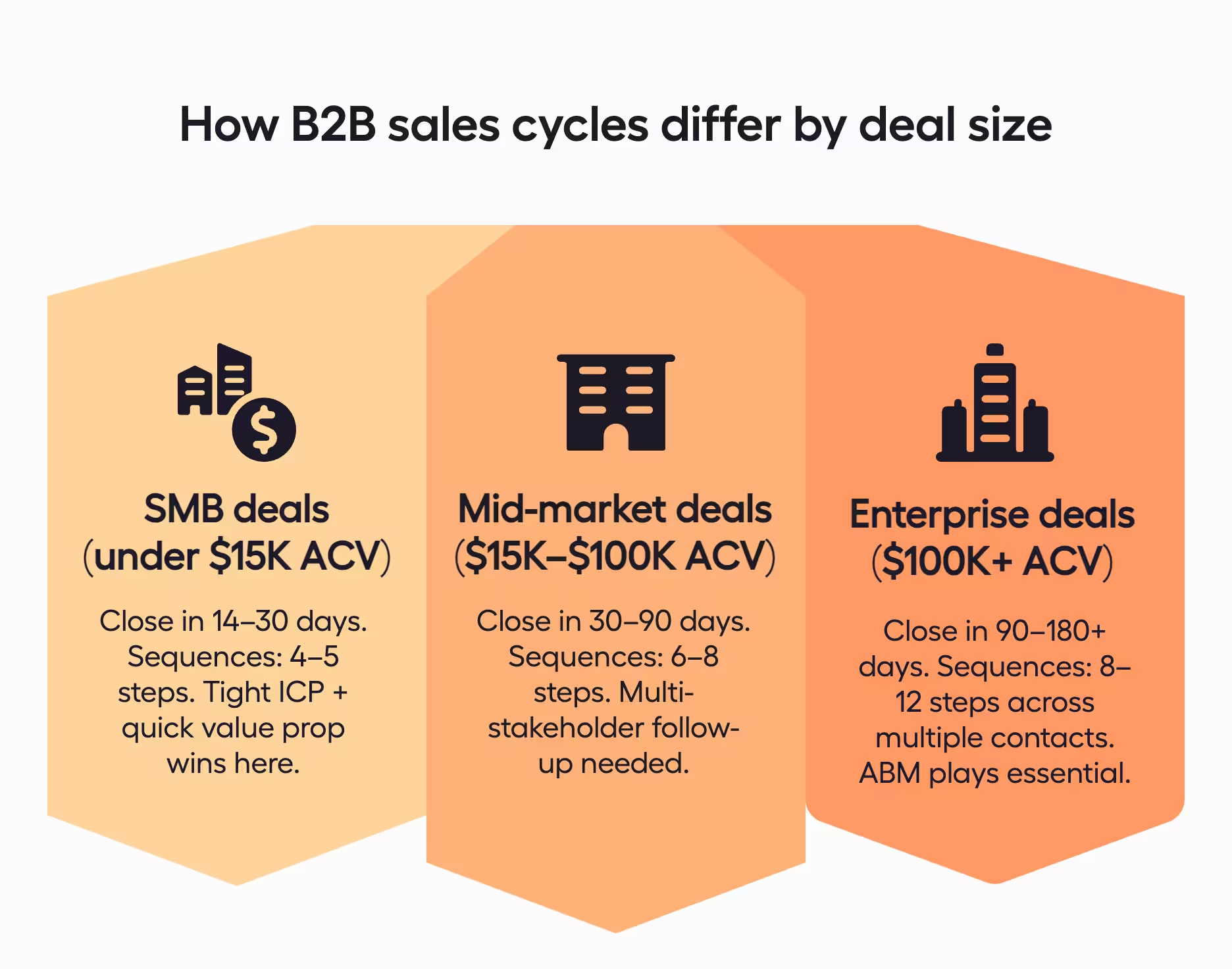
And that's the real distinction between good follow-up and forgettable follow-up: the best ones don't feel like follow-ups. They feel like a fresh reason to reply (that could be a different angle on the same problem or maybe a result from a similar company you didn't mention in step one).
What it's not a good follow-up:
"Just checking in." "Circling back." "Wanted to follow up on my previous email."
These phrases signal you have nothing new to add, which is the fastest way to get deleted.
👉 And if you're not sure what to actually write when a prospect goes quiet, this guide on follow-up emails after no response covers the frameworks we use to keep conversations alive without being annoying.
Strategy 6: Coordinate multi-channel outreach sequences
Email alone is one signal. Layer in LinkedIn and phone in a coordinated sequence and the results get harder to ignore.
So here's how we recommend doing this:
- Email first: low-friction intro, single ask, under 100 words
- LinkedIn connection or comment second: a second impression with social context attached
- Phone call third: by the time you call, they've already seen your name in two places
Which channel lands best depends entirely on your ICP. For example, some buyers live in their LinkedIn inbox. Others only respond to calls.
And if you don't know which your ICP prefers, testing it is your next move.
Multi-channel only works when every touchpoint feels deliberate. If your LinkedIn message is completely disconnected from your email… no, you're not running a coordinated sequence. You're just creating noise on more platforms.
Within that multi-channel mix, LinkedIn deserves its own conversation. Most B2B teams are using it at about 20% of its actual potential, and they don't even realize it.
Strategy 7: Use LinkedIn for social selling alongside cold outreach
Most teams use LinkedIn passively: liking posts, accepting requests, occasionally sending a generic DM.
Well, that's definitely not social selling. That's just being online. 😅
Active social selling means your reps (and ideally your founder!) post consistently, comment on target accounts' content before reaching out, and send connection requests that reference something specific about the prospect's recent work or announcement.
For example, our founder Alexander posts on LinkedIn a lot. That visibility creates warm context for every outreach that follows, and when a prospect sees a connection request from someone whose content they've been reading, that's a completely different conversation than a cold DM from a stranger.
And research covering 151 million outreach data points found LinkedIn outreach doubles the response rate of cold email when the two channels are used in combination.
So no, Linkedin doesn't replace email. But it multiplies it.
Strategy 8: Cold call at trigger moments, not random ones
Cold calling isn't dead. It's just being done at the wrong time, with nothing contextual to say.
Here is an example of two calls to the same prospect, a VP of Sales at at a 200-person software company.
- Call one (no trigger): "Hi, I'm reaching out because we help companies like yours build outbound pipeline..."
- Call two (48 hours after they posted a VP of Revenue hire): "Hi, I saw [Company] just brought on a new VP of Revenue, and we work with a lot of teams right at that transition point, when they're building the stack and figuring out what outbound looks like under new leadership. Wanted to see if it's worth a quick conversation."
The second call isn't actually so cold, it's contextual. So the prospect already has a reason to engage, you just showed up with the right frame at the right moment.
If you're still weighing whether to prioritize calls or email for your specific ICP, we broke down the full cold calling vs cold emailing comparison here, including which one wins for different deal sizes, buyer types, and sales cycles.
Strategy 9: Run account-based selling for your Tier 1 targets
For high-value accounts, ABM means treating each target like its own campaign: messaging tailored per role, outreach coordinated across every stakeholder simultaneously, and sometimes bespoke assets (custom ROI calculators, one-pagers built for that specific account's situation) created before the first email goes out.
Personalized, research-driven messages produce 32.7% more replies than generic outreach, and that gap widens as the deal size grows.
But the thing most teams get wrong with ABM is sequencing.
They reach out to the CFO, get no reply, then two weeks later reach out to the VP of Sales, with no connection between the two touches.
But a proper account-based play reaches all three contacts in the same two-week window, with each message tailored to their specific priorities and role in the decision.
So ABM is powerful because it's personal. But there's one prospecting channel that's even more personal, and most B2B teams leave it almost entirely to chance. 👇
Strategy 10: Build a referral prospecting system
Referred leads convert at four times the rate of cold outbound and deliver higher lifetime account value.
And they're also the most underused prospecting channel in B2B sales.
But most teams leave referrals to chance. They mention it vaguely when a contract is signed, or ask "do you know anyone?" at a client dinner.
Here's what a real referral system looks like:
- 📌 Who to ask: current clients who've seen real results and match your ICP
- ⏰ When to ask: 30 days into onboarding, or within a week of a meaningful result delivered
- 💬 How to ask: specifically. "Do you know anyone at [company X] in a similar role dealing with the same problem?" performs significantly better than an open-ended ask.
Referrals work because trust transfers. A prospect introduced by someone who's already seen results skips the skepticism phase entirely. That's why they convert at 4x the rate.
Strategy 11: Clean your CRM before you scale outbound
Most outbound optimization conversations focus on top of funnel: better targeting, sharper copy, more channels.
But if your CRM is broken, none of it sticks.
When we audit client HubSpot or Salesforce setups before launching campaigns, we see the same patterns repeatedly: warm leads from previous campaigns sitting idle because ownership wasn't defined, contacts enriched months ago with data that's now stale, and deals stuck at "proposal sent" for six weeks with no activity logged.
And yes, outbound fills the top of the funnel. But RevOps makes sure it doesn't leak underneath.
So before you scale any outbound volume, audit where deals are actually stalling.
Is it the SDR-to-AE handoff?
Is it closed-lost reactivation that never triggers?
Is it reps building workarounds in spreadsheets because the CRM workflow doesn't match how they sell?
With a clean CRM capturing what your outbound opens, the last piece is figuring out which parts of that outreach are actually driving pipeline, so you can do more of it.
Strategy 12: A/B test sequences to find what works in your market
Top outbound teams treat sequences like products, always in development. One element changed at a time (subject line, opening hook, CTA phrasing), tested across 200-300 touches per variant over 2-4 weeks.
And here's the part most people get wrong: they optimize for open rates. That’s something we definitely do not recommend.
Because open rate is a vanity metric. It can spike from a misleading subject line that earns zero replies, or drop because of deliverability issues that have nothing to do with your messaging.
The metrics that actually matter:
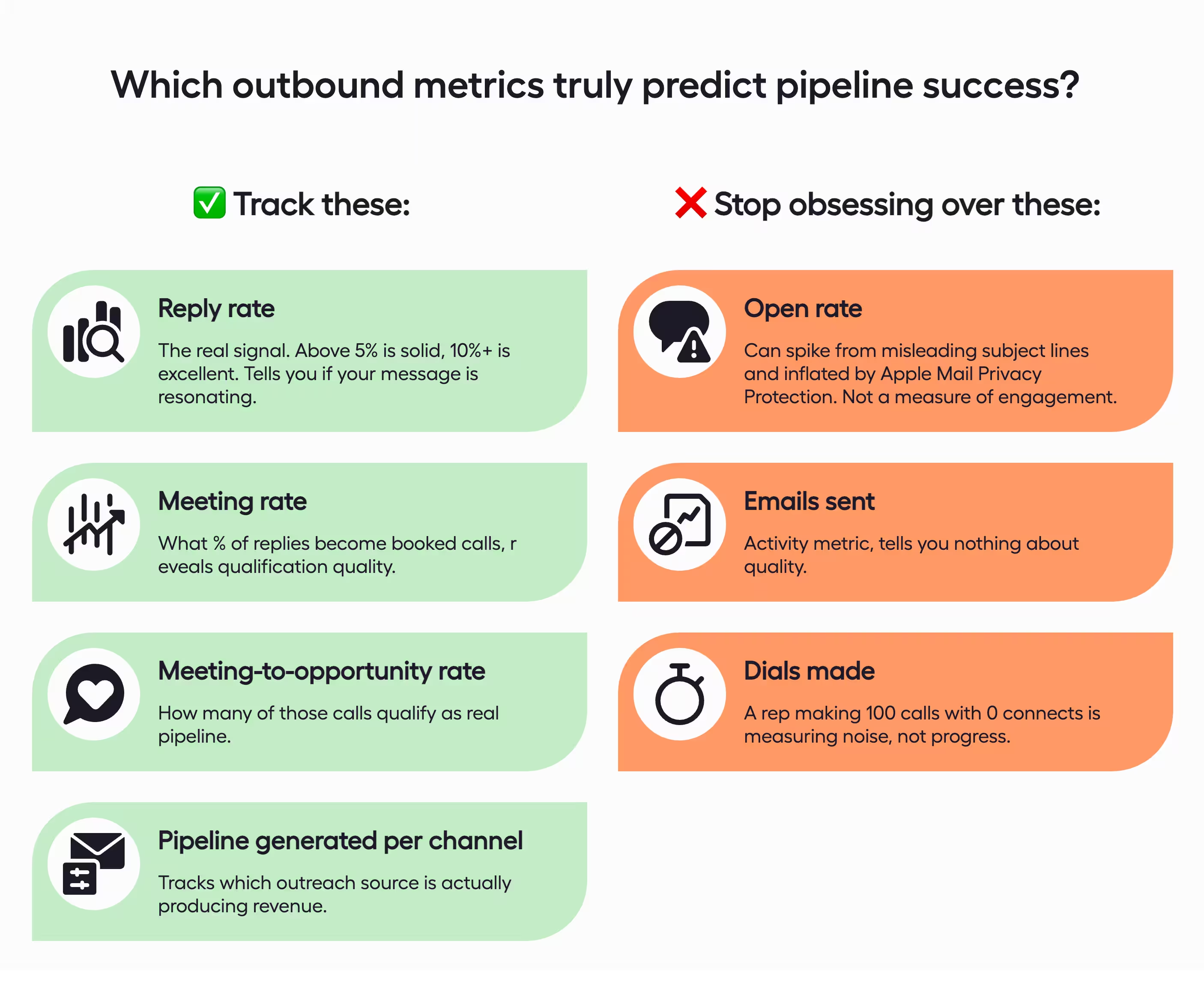
The right cold email software makes A/B testing systematic rather than ad hoc. So if your current tool can't run proper variant tests across sequence steps, that's definitely worth fixing before you scale volume any further.
Which outbound sales strategies work best for long-term pipeline growth?
The outbound strategies that build pipeline over the long term are signal-based ICP targeting, structured multi-step follow-up sequences, referral programs, and RevOps infrastructure that captures what outbound opens.
Unlike campaign-based tactics, these four compound over time: signals get sharper, referrals multiply as your client base grows, and a clean CRM means nothing leaks on the way to close.
Here's what "compounding" actually looks like for each of these:
- 🎯 Signal-based ICP targeting: the more campaigns you run, the better you learn which triggers predict your best-fit buyers. Your targeting sharpens with every send, not in spite of failure but because of it.
- 🔄 Structured follow-up sequences: once built and tested, they run without your team having to figure out what to say every cycle. The compounding is in the consistency, not the creativity.
- 🤝 Referral programs: this is the one channel that literally grows on its own. Every client you close becomes a potential referral source. Most teams never build a system around it, which means most teams leave a huge amount of warm pipeline on the table.
- 🧹 RevOps alignment: outbound fills the funnel. RevOps makes sure it doesn't drain out the bottom. Lead routing, follow-up SLAs, re-engagement workflows for closed-lost contacts: when these work, the pipeline you generate today actually converts.
We've seen what this looks like when it clicks. Jordon Rowse, CEO of Set 2 Close, came to us with an inconsistent outbound motion. Within months of running a proper signal-based system, Hypergen was generating more than half of his company's total revenue.
And no, those results didn’t come from a single great campaign. They came from a system that kept getting better.
What are the most effective cold email strategies for B2B startups?
For B2B startups, the most effective cold email strategies are tight ICP targeting validated on 200-300 sends before scaling, emails under 100 words with trigger-based personalization, and 4-7 step follow-up sequences.
As a B2B start up you have one real advantage here: speed. You can pivot your ICP in a week.
A 200-person org takes three months. So use that speed to learn, not to blast.
The mistake we see most: scaling before validating. We've watched founders send 10,000 emails before figuring out who buys from them. And that’s three months of learning that could've taken two weeks.
What to watch for at each stage instead:
- 📋 Validation round: look for what replies have in common: trigger type, company stage, job title. Three to five genuine replies from 200-300 sends is enough signal to act on.
- 🔍 Iterating on copy: one variable at a time. Most startups test too many things at once and can't tell what moved the needle.
- ⚠️ Before scaling: resist the urge until you can explain in one sentence exactly who is replying and why.
- 🏗️ Infrastructure: you can fix your copy tomorrow. But a damaged domain reputation takes months. So warm secondary domains before you need them.
The pipeline belongs to whoever reaches first
Twelve strategies is a lot to take in. And if you've worked in outbound long enough, you know that the teams who try to fix everything at once usually fix nothing.
So here's what we'd actually recommend: look at where your current setup breaks down first.
Is it targeting?
Deliverability?
A CRM that leaks?
Start with the layer you're most confident is broken. And once that one's working, stack the next. Because the compounding starts faster than most people expect.
Not sure which layer that is? No worries, you don't have to figure it out alone. Book a free GTM audit, 30 minutes and zero pitch, and we'll show you exactly where your pipeline is leaking.
Fair warning: it's usually not where you think it is. 👇
Frequently asked questions
ABM works best with multi-stakeholder sequencing and role-specific messaging for each buying committee member, timed to land in the same window. Research-driven, account-specific outreach consistently produces 32.7% more replies than generic messages.
Signal-based targeting and multi-channel sequences work best for high-growth tech. Reach new VPs or CTOs within their first 60-90 days. New executives spend 70% of their budget in that window, making it the highest-converting moment.
First replies typically arrive within 7-14 days and first meetings within 2-4 weeks, assuming a validated ICP and clean sending infrastructure. For long-term compounding pipeline, plan for a 3-6 month horizon.
Most meetings are booked after 3-5 touchpoints, but sequences should run 4-7 steps. But 42% of all replies come from follow-ups. So teams that stop after one email leave most of their pipeline on the table.
Outsourcing is faster and more cost-effective for most companies under $10M ARR. A fully loaded in-house SDR costs $100-150K annually with a 14-month average tenure, creating constant hiring and retraining cycles.
Don’t miss these
.avif)
Get your first lead this month
14 days to get started. 7 days to get your first lead on average.


