


We took over outreach for 120+ B2B teams - Here's the honest truth
TL;DR: Outsourced lead gen, what you need to know
- The first 30 days are infrastructure, not outreach. Dedicated domains, inbox warm-up, and ICP research all happen before a single email goes out. ⚙️
- Outsourcing amplifies what is already there. No defined ICP, validated offer, or sales bandwidth means even a well-run campaign generates zero pipeline.
- Signal-based targeting reaches the 5% of your market actively in buying mode. List-based outbound sends to the other 95% and hopes timing aligns. 🎯
- CRM integration from day one separates pipeline from conversations. Teams with tight handoffs see 30-40% faster speed-to-connect than those working from spreadsheets.
- Clients with a defined ICP see 5-7 booked meetings in month one. Those still unclear on targeting run 60-80% lower reply rates through month two. 📅
- Lead follow-up speed determines whether replies become revenue. Responding within 5 minutes converts at 4x the rate of same-day follow-ups. ⚡
Most founders think outsourcing lead generation means handing it off and waiting for meetings to land.
Well… it doesn't. The first 30 days are infrastructure, not outreach.
And the agencies that skip that setup, the ones that launch within a week of signing, are almost always the agencies behind the "we tried outsourcing and it didn't work" conversations we hear regularly.
After running outbound for 120+ B2B teams across SaaS, M&A, financial services, real estate and more, we've seen the same failure pattern play out often enough to know exactly what drives it.
And here's our most honest take of what it actually takes.
What should happen before an outsourced lead gen campaign goes live?
Before a single cold email goes out, a serious outsourced lead gen team builds dedicated sending infrastructure, defines your ICP with real precision, and runs a 2-3 week warm-up on every single mailbox.
And no campaign goes live until warm-up clears. Agencies that launch within days of signing are almost always operating from shared IPs, with no real strategy behind their targeting.
Here's exactly what we do during the first 14 days👇
Days 1-3: Kickoff and ICP collection
The first three days are about three things:
- ICP definition
- Value proposition
- CRM access
No copy gets written yet, not even close.
We run a kickoff call to capture who you're actually trying to reach, how your sales team works, and what CRM you're using. We go through your full sales process (how leads get assigned, what stages they move through, how reps like to be notified) so that every automation we build fits the workflow you already have, not some generic template that creates more chaos.
We also ask about warm campaigns right away: event attendees you haven't followed up with, closed-lost deals from the past 12 months, past customers who've moved to new companies.
These always go first. They're one of the fastest path to early results, and most clients don't realise they're already sitting on a goldmine here.

If an agency doesn't ask about your closed-lost database in the very first call, that's a red flag. It means they're treating your whole engagement as a cold outreach problem, when it's partly a re-engagement opportunity.
Days 4-10: Infrastructure build
This is where most of the invisible (but absolutely critical) work happens.
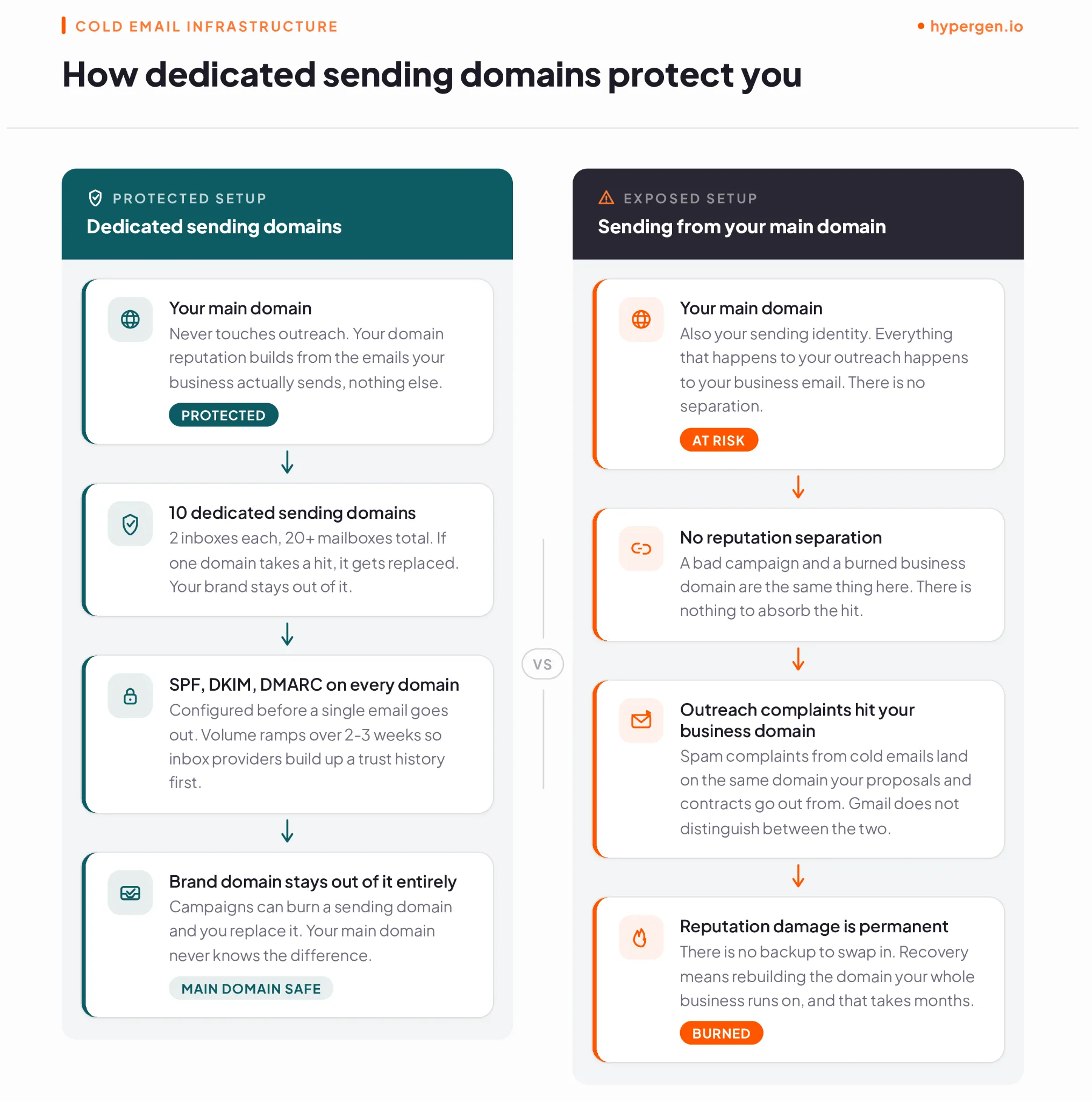
We register dedicated sending domains (never touching your primary domain) and configure SPF, DKIM, and DMARC on every single one.
For a standard starting volume of 7,500 prospects per month, that means 10 domains and 2 inboxes per domain, giving us 20+ mailboxes before a single email goes out. Warm-up starts immediately, ramping from 10-15 emails per inbox per day up to 30-40, with spam placement monitored daily.
Why does all of this matter? Because teams without proper cold email infrastructure see deliverability rates drop from 95% to under 50% within 3-6 months of scaling.
So the foundation is genuinely everything.

A SaaS client came to us after a previous agency had blasted 50,000 emails from their main domain in three weeks. Open rates had collapsed to 4% and Gmail was routing everything straight to spam.
We started completely fresh: new domains, new IPs, new infrastructure. We also whitelisted their original domain across our sending accounts to help Google start treating it as reputable again. It took four full weeks before we could send at any meaningful volume.
It took months to partially recover.
The reason it happened is actually very simple to see laid out:
Unfortunately that's not even an edge case. We've rebuilt infrastructure for multiple clients in exactly this situation.
Days 11-14: Lead list and sequence build
While warm-up is running in the background, the team builds the lead list and writes the first sequences.
And no, this window isn't downtime.
We use it to research your industry, study your competitors, and understand the language your prospects actually use in the wild. (The difference between an email written by someone who genuinely knows your vertical and one written by someone who Googled it for 20 minutes is immediately obvious to the person receiving it, by the way!)
First sequence drafts go back to you for review and alignment on timing and tone.
By day 14, we're technically ready to go, but we still wait until warm-up clears.
What an outsourced lead gen setup needs to actually work
Outsourced lead generation fails very often because of the client, not the agency. Yes, we said it.
Before any campaign can generate real pipeline, four things need to be confirmed from the client side: a defined ICP, a validated offer, genuine sales bandwidth to work the leads, and a functional CRM.
- ✅ A defined ICP: you can describe your ideal buyer in one sentence, confidently and consistently
- ✅ A validated offer: you've sold this before and you know what resonates with your target audience
- ✅ Sales bandwidth: someone on your team can actually respond to leads and run calls (this one bites more often than you'd think)
- ✅ A functional CRM: somewhere for qualified conversations to land that isn't a spreadsheet
Without these in place, even the best infrastructure in the world generates qualified conversations that go absolutely nowhere.
And we've told companies they're not ready. It's an uncomfortable conversation, but it's a necessary one.
The question that cuts through everything:
"Who exactly are you trying to reach, and what problem do you solve for them specifically?"
ICP precision exists on a spectrum. Here is an example:
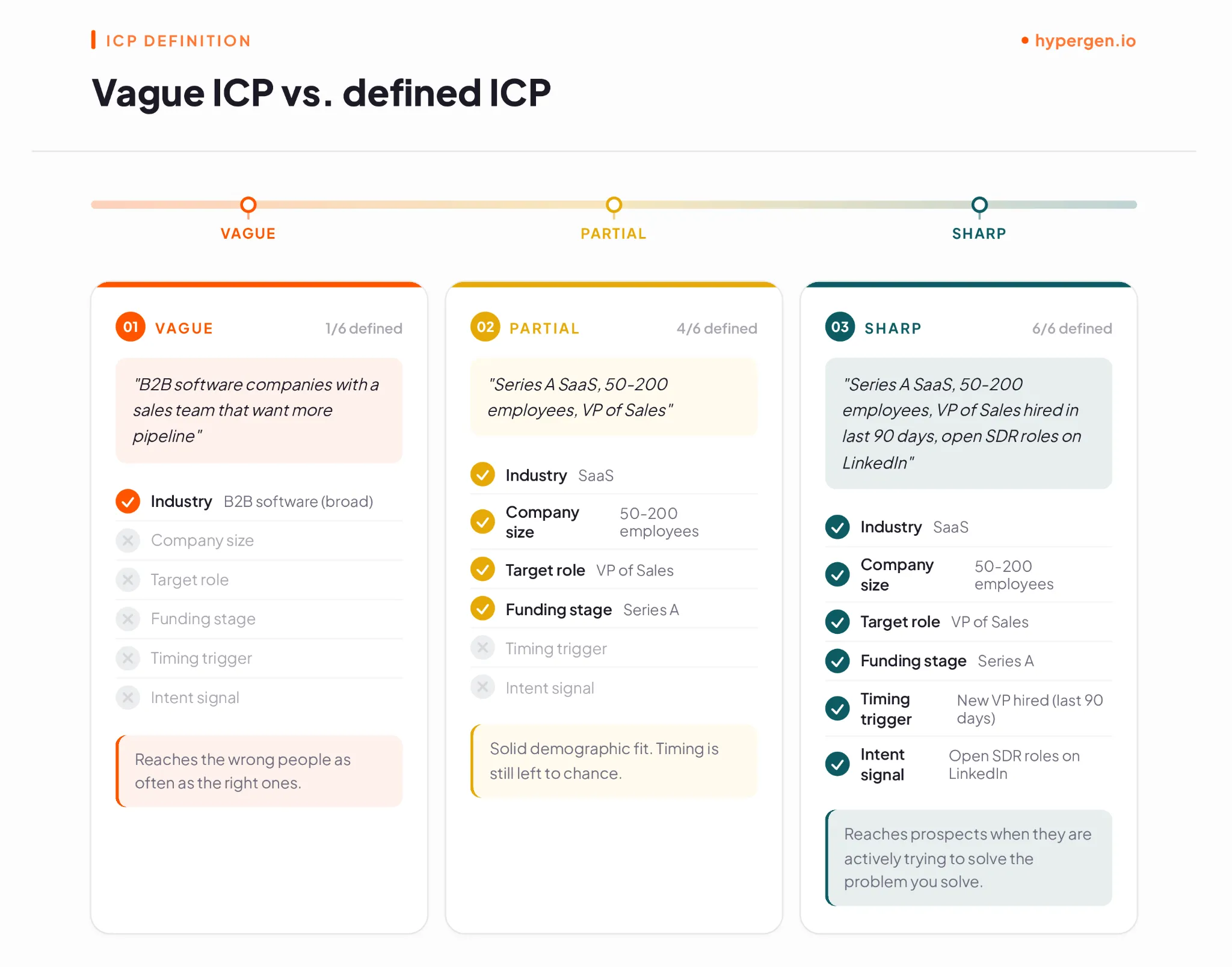
So if we can't get a clear, consistent answer to that in the first call, we slow down. We've walked away from engagements because the ICP was still shifting week to week. Because at that point we can't do our best work, and continuing to bill for it wouldn't be right.

Outsourcing lead gen amplifies what's already there. If your sales motion is broken, we make the problem more visible, not better.
We don't fix it, we accelerate it.
Two cases that illustrate this better:
- Case 1, the founder who couldn't close:
A B2B software company with a genuinely strong offer on paper. We put 27 qualified meetings on the calendar in 60 days. Pipeline generated: zero.
What happened was that the founder was personally handling every sales conversation, with no CRM to track anything, no defined stages, and no real follow-up process. So prospects had good first calls, but then waited in silence, and of course, they moved on.
When the partnership ended, the diagnosis was "the leads weren't good enough."
But no, that wasn't it.
- Case 2, the CEO who couldn't show up:
A consulting firm where the CEO was the only closer, juggling six other priorities and routinely unavailable for weeks at a stretch.
So we booked meetings consistently, but the client ghosted their own prospects. And the engagement eventually went on pause.
The pattern across both: no real sales infrastructure, the entire closing function sitting on one person's shoulders with no bandwidth, and nothing connecting outreach activity to what happened next.
Which confirms that using B2B lead generation services can fill your top of funnel faster than almost anything else. But the bottom of that funnel still has to work.


What separates signal-based from list-based lead gen outsourcing
Signal-based lead gen targets the ~5% of your market that's actively in-market right now by tracking behavioral events like funding rounds, leadership changes, and tech stack migrations.
List-based lead gen sends to everyone who fits a demographic profile, regardless of timing.
And this distinction matters more than most founders realise when evaluating agencies.
The Ehrenberg-Bass Institute's research makes the timing problem concrete: at any given moment, only about 5% of your total addressable market is actively looking to buy.
So to put the difference in simple words:
Traditional outbound sprays messages at the other 95% and hopes to get lucky. Signal-based targeting watches for the cues that a company has just entered that 5% window, then reaches out while it's open.
That timing distinction is the whole reason signal-based reply rates hold at 10%+ while the platform average has been declining every year since 2019.
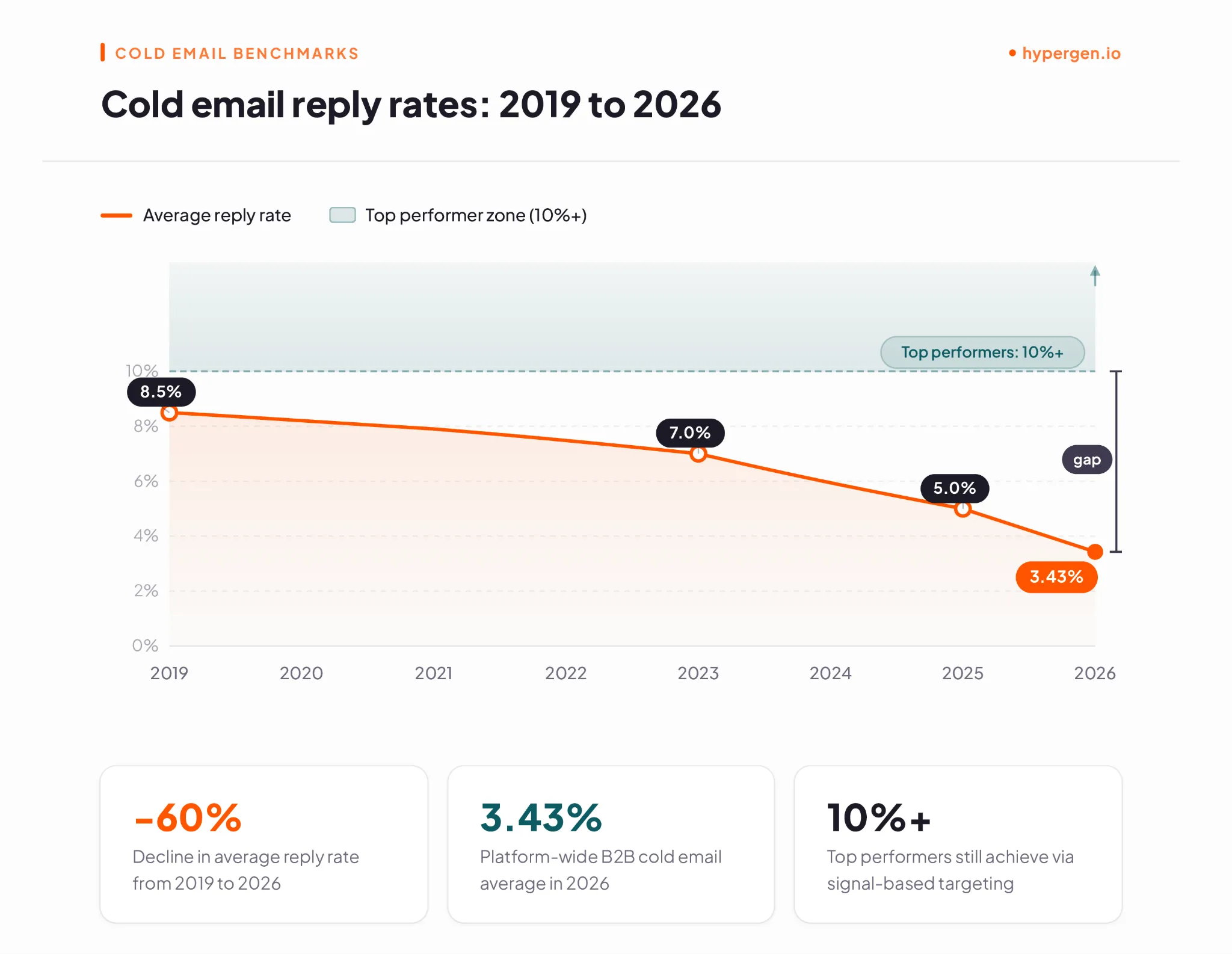
Sources: Instantly, Reachoutly
Here are the signals we track through Clay, across a client's full target market in real time:
- 💰 Funding events: a company that just raised is almost always in buying mode
- 👔 Leadership changes: new CRO, VP of Sales, or CMO means a new agenda and new budget
- 🔧 Tech stack migrations: switching CRM or adding a new tool signals active process investment
- 📈 Headcount growth: rapid hiring in sales or marketing is a clear intent signal
- 💼 Job postings: open SDR or BDR roles = pipeline problem they're actively trying to solve
- 🔍 Competitor reviews: someone researching your competitors on G2 or Capterra is in evaluation mode
The signals we track also differ by vertical.
For example for an M&A firm, we're watching deal announcements, leadership transitions, and company size thresholds. But for a SaaS client, it’s funding announcements, hiring velocity, and tech stack shifts.
We put together a full playbook on how this plays out end-to-end for cold email for SaaS, including how we used this exact signal stack to close three enterprise deals in six months. Definitely worth checking out!
How outsourced lead gen fits into your existing CRM and RevOps stack
A properly integrated outsourced lead gen engagement connects directly to your CRM( HubSpot, Salesforce, etc.) from day one. Every positive reply automatically creates a deal in the right pipeline stage, with the full conversation thread attached and the assigned rep notified immediately.
We’ve seen it more times than we would like to admit: once signals are driving the targeting and campaigns are live, this is where a lot of outsourced setups quietly fall apart.
Because getting a reply is only half the job. What happens next determines whether that reply becomes revenue.
We've inherited two failure patterns from previous agency setups more times than we can count. 😬
- The first is a timing problem.
A prospect replies positively ("interested, let's talk"), but that reply lands in an inbox nobody's actively watching. Someone spots it eventually, manually drops the contact into a spreadsheet, and by the time a sales rep picks up the phone two or three days later, the moment has passed.
And that's not a lead quality issue, but a process gap that quietly gets blamed on the campaign.
- The second is a context problem.
Leads arrive in HubSpot with no history attached: no record of what was said, no indication this person already expressed interest. The rep goes in cold, the prospect feels like they're starting from scratch, and the conversion rate reflects it.
Here's what we do instead so neither of these ever happens:
We connect directly to your CRM via API, so when a prospect replies positively, a deal gets created automatically in the right pipeline stage, the lead source gets tagged as Hypergen, and the full email thread is appended as a note on the contact.
The assigned sales rep gets a notification the moment it lands and the deal is assigned to them. This way they know exactly what was said and when before they ever reach out.
On top of that, what we can do to help is:
- Reply templates so reps aren't starting from a blank page when a new lead comes in
- Segmented nurturing sequences for contacts that don't convert right away: a lead that went cold over pricing gets different follow-ups than one who was lost to a competitor, both running automatically over the coming months with the goal of eventually getting back in front of them
Most companies have those leads sitting in their CRM and do nothing with them. Among the 40+ clients where we've built this properly, those with tight CRM handoffs see 30-40% faster speed-to-connect than those still working from spreadsheets.
How to vet an outsourced lead generation agency before you sign
Before signing with any outsourced lead generation agency, ask four questions: how they monitor sending infrastructure health, what they do when a campaign underperforms, whether they write ICP-specific copy or use templates, and where their data comes from.
- Question 1: "How do you monitor the health of your sending infrastructure?"
Inbox placement rates, spam monitoring cadence, how they detect when a domain's reputation is slipping: if they can't answer this in specifics, they're almost certainly on shared IPs. You'll find out, just not until after the damage is done.
- Question 2: "Walk me through what you do when a campaign isn't performing after three weeks."
The answer here tells you everything. Adjusting copy is the surface-level response. The right answer covers ICP reassessment, offer repositioning, infrastructure checks, and testing at the sequence level.
Agencies that only have one lever to pull are improvising. And your budget is what's funding the improvisation.
- Question 3: "Do you write copy specific to my ICP or do you use templates?"
Templates with a few personalised fields swapped in look identical across verticals. So if everything they show you feels interchangeable… well, it probably is. Generic messaging sent to a targeted list is just marginally more targeted spam.
- Bonus question 4: "Where does your data come from and how do you verify it before outreach?"
This matters regardless of market, but it's especially important if you're targeting European buyers, where GDPR requirements add real legal exposure. An agency that can't walk you through their data sourcing and verification process is a compliance risk, not just a quality one.
Ask them to connect you with a current client in a similar space. Not a testimonial on their website, but an actual conversation. A good agency should be comfortable making that introduction without hesitation. That one call will tell you more than three hours of sales meetings ever could.
Here are the red flags we've seen from clients who came to us after bad experiences with other agencies:
- Generic copy blasted to completely untargeted lists: one client came to us after their previous agency had sent to 60,000 contacts, not one of whom had any meaningful connection to what they were actually selling
- Vanity metrics dressed up as results: agencies presenting open rates and click-through data as proof of progress, with zero booked calls to show after three months of activity
- Campaigns that launched within days of signing: which can feel like efficiency but almost always signals that no real ICP work, warm-up, or sequencing strategy happened at all
We cover the failure patterns in much more detail in why most cold email agencies fail to deliver ROI. And if you're actively shortlisting options right now, how to evaluate a cold email agency is worth reading before you make any decisions.
What results should you actually expect from outsourced lead generation?
Most B2B teams with a clear ICP and validated offer see first qualified replies within weeks 1-2 of campaign launch, 5-7 booked meetings in month one, and a consistent, optimised pipeline by month three.
Yet clients who arrive still working out their targeting average 2-4x slower ramp time and 60-80% lower reply rates in the first 60 days. So the biggest variable isn't the agency, but it's what you walk in with.
Here's the honest month-by-month breakdown from our actual experience: 📅
What is the single biggest factor in hitting results faster? How quickly your team responds to replies.
Yes, sales responsiveness. Leads followed up within 5 minutes of responding convert at 4x the rate of leads followed up the same day. And this isn't a lead gen problem, but a process problem, and it's fully within your control to fix.
Something we say to every founder early on: cold email isn't performance advertising. So there's no day-30 ROAS equivalent. Anyone guaranteeing meetings in week one is selling you a timeline, not a methodology.
If your deals run six months or longer, the pipeline math looks entirely different. We cover exactly how to approach that in cold email for long sales cycles.
That said, the results are genuinely impressive when the conditions are right:
- Gray Falkon: 16X ROI and $900K+ in revenue, with an average deal size of $78K
- Dingus & Zazzy: $4.5M in 18 months and a 15X ROI
- Prezzee: 619+ leads and 24 deals closed in 12 months, $270K+ in revenue, Fortune 500 meetings booked, and reply rates of 15-20% (7-8X what they were getting before)
- Blings.io: 180 leads and 3 enterprise deals closed in 6.5 months, including Fortune 500 and Fortune 1000 brands, with a 6-8X expected ROI from those three deals alone
- Sutton Capital Partners: 1 client signed in under 2 months and 50+ leads generated in their first 60 days, breaking into a national market after relying entirely on local referrals
👉 For a look at what those campaigns involved at the tactical level, the outbound lead generation tactics breakdown cover that in detail.
The honest question to ask before you outsource anything
Own most honest truth about outsourcing lead generation is this: the agency sets the ceiling, but what you bring into the engagement sets the floor.
The teams that see qualified meetings in week two don't have bigger budgets. They have a sharper ICP, a CRM that works, and a sales rep who responds within the hour. That combination consistently outperforms targeting advantages, even at lower volumes.
Which means: before you evaluate agencies, evaluate your own setup.
Are the conditions actually in place for a campaign to work?
We handle the infrastructure, the signals, the copy, and the CRM handoff. You handle the calls.
That's the deal. And we confirm it works surprisingly well when both sides show up ready.
Frequently asked questions
With a defined ICP and validated offer, expect first qualified replies within weeks 1-2 of campaign launch. The first two weeks go into infrastructure and sequence build (no outreach yet). Consistent pipeline typically forms between days 30 and 90.
It should, but not every agency does it. A serious partner registers dedicated sending domains, configures SPF/DKIM/DMARC, warms mailboxes over 2-3 weeks, and monitors spam placement daily. Ask to see their inbox placement rates before signing.
Yes, any agency worth working with integrates directly from onboarding. Positive replies should auto-create deals in the right pipeline stage, with full email context attached and your rep notified immediately. A spreadsheet handoff is a red flag.
Strong agencies use waterfall enrichment, running contacts through multiple providers and keeping only results that pass email verification. This matters practically: a 5% bounce rate damages your domain reputation and can tank deliverability across an entire campaign.
Full-service retainers run $3,000-$10,000 per month, vs. $9,800-$14,200 for a fully loaded in-house SDR before recruiting and ramp. At Hypergen, our plans start at $5,000/month. The real metric isn't cost, but qualified meetings delivered per dollar spent.
Don’t miss these
.avif)
.avif)

Get your first lead this month
14 days to get started. 7 days to get your first lead on average.


