

.avif)
9 еffective outbound lead generation tactics for 2026
TL;DR:
- Outbound lead generation fails when teams skip the foundation. Bad data, weak targeting logic, and poor deliverability kill campaigns long before copy has a chance to work.
- Start with a real ICP, not loose demographics 🎯 “VP of Sales at a SaaS company” is not enough; situational fit and buying context matter.
- Static lists underperform fast 📉 Data decays quickly, so signal-based targeting beats old prospect lists every time.
- Buying signals change everything 🔍 Funding rounds, new CRO hires, hiring surges, tech-stack changes, and competitor research show who is likely in-market now.
- Clay helps operationalize signal-based outbound ⚙️ It turns scattered trigger data into live prospect lists your team can actually use.
- Infrastructure comes before scale 📬 Dedicated sending domains, warm-up, SPF/DKIM/DMARC, and low-volume inbox caps protect deliverability.
- Short, problem-first emails win replies ✍️ Keep outreach under 80 words, tie it to a real signal, and use a soft CTA.
- Deliverability is a growth lever, not a technical side task 🔐 Fixing authentication and sender health can lift response rates before you touch the copy.
- ABM should be reserved for high-value accounts 🧠 Treating top accounts like markets of one increases deal size and improves conversion quality.
- Your CRM can quietly waste pipeline 🧹 Lead routing, fast follow-up, and closed-lost reactivation are essential if you want outbound lead generation to compound instead of leak.
Somewhere between "we need more pipeline" and "let's send some cold emails," a lot of outbound programs go quietly off the rails.
Not because cold email doesn't work. Not because the channel is dead.
But because the team skips the parts that aren't fun: the ICP work, the infrastructure setup, the CRM cleanup. And jumps straight to writing copy. 🎯
Well, we've onboarded enough clients to know the pattern. And the messaging isn't the issue. The layer underneath it is.
So these 9 outbound lead generation tactics fix the whole system: from how you define who to target, to how you make sure your emails actually land, to what happens to a lead after it replies.
Why most outbound lead generation fails
Before we get into the tactics, let's quickly name the actual culprits. (Spoiler: it's not your copywriting.)
The three things that kill outbound campaigns before they start:
- Bad data. B2B contact data decays at up to 70% annually. If your list isn't verified and refreshed, you're damaging your sender reputation before you've sent a single email.
- No targeting logic. "VP of Sales, 50–200 employees, SaaS" is a demographic filter, not a targeting strategy. Without a signal layer on top of it, you're guessing who's actually ready to buy.
- Inbox fatigue. Mailshake's Cold Email Report 2026 found that only 5% of senders personalize every email, but they get 2–3x better results. Meanwhile, 61% of decision-makers say cold emails fail simply because they're irrelevant.
So, where do you actually start?
The answer is always the same: with who you're targeting and why they're worth reaching out to right now.
How do you identify the right target accounts for outbound lead generation?
Target accounts for outbound start with a narrow ICP, layered with situational signals like leadership changes, new funding, competitor reviews, and hiring surges.
Companies with three or more active buying signals convert to meetings at 40–50%, compared to 10–15% for demographic-only targeting. And signal fit is what separates a qualified lead from a cold name.
So that's the principle. Here's how to actually build it.
Tactic 1: Build an ICP that goes beyond job titles 🎯
Most ICPs are half-baked and we'll say it. "VP of Sales at a tech company" is not a targeting strategy. It's a starting point.
A meaningful ICP adds situational criteria on top of firmographics:
- Companies actively hiring in sales (they're scaling, they have budget)
- Recent funding events (fresh capital, new pressure to show results)
- A specific tech stack (signals compatibility or a pain you can solve)
- Entering a new market (new problems, new vendors needed)
Response rates shift significantly depending on who you're targeting and how many people at the same company you're reaching. So here’s an overview:
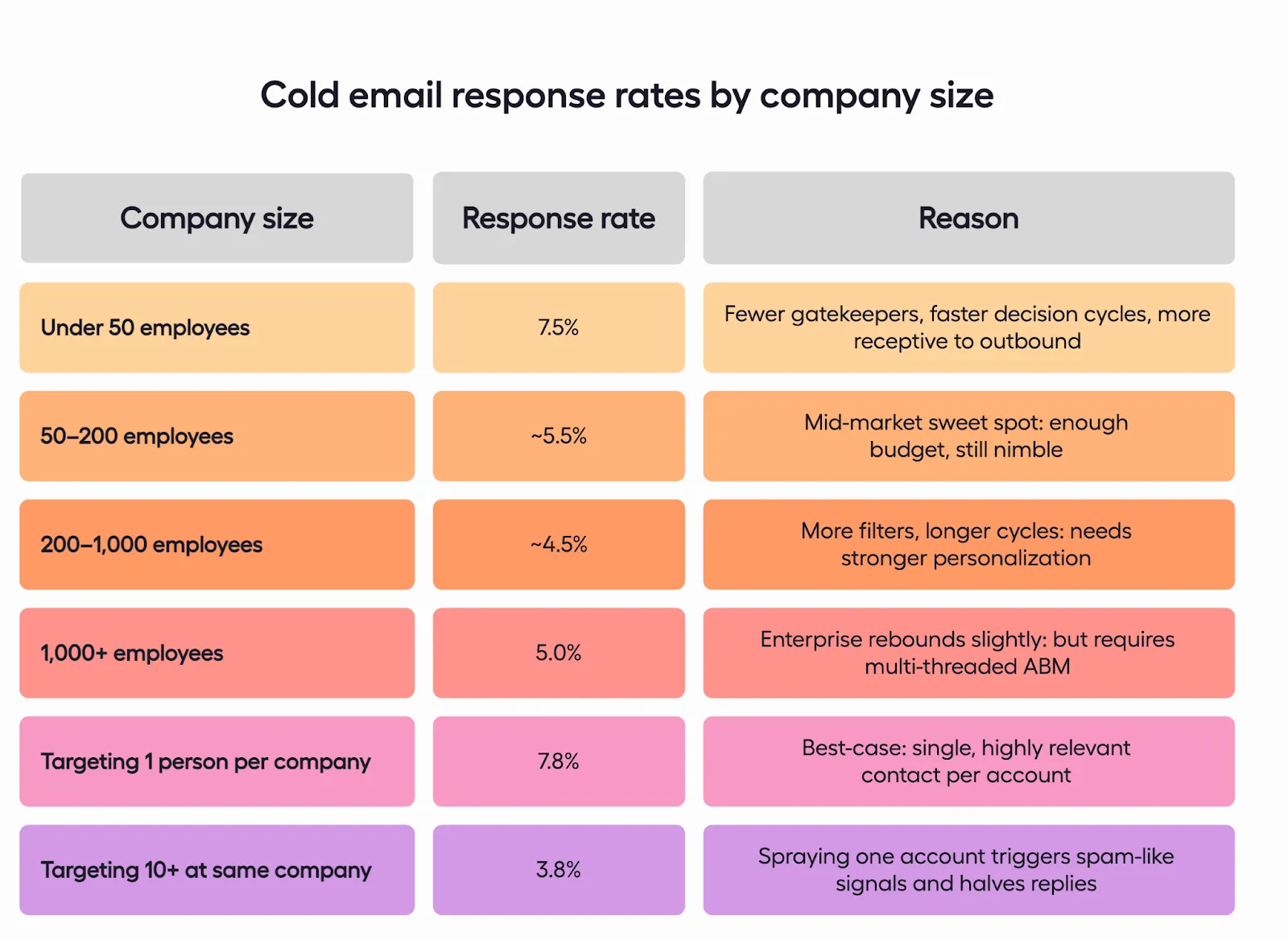
Every contact on your list should be there because you have a specific hypothesis about their situation, not just because they match a job title. That discipline alone changes your reply rates.
💡 If you want a step-by-step process for how to build a quality lead list for cold emailing, we've broken that down in detail.
And the numbers back it up: according to Hunter's State of Cold Email 2026, sequences targeting 21–50 recipients outperform sequences of 500+ by 158% on reply rate.
But here's the catch: even with a razor-sharp ICP, a static list will let you down. Because people change jobs, switch tools, and make buying decisions on their own timeline, not yours. That's where signals come in.


Tactic 2: Replace static lists with buying-signal triggers
A static list is a snapshot in time. By the time your sequence runs, some of those contacts have changed jobs, switched tools, or already signed with a competitor.
Signal-based outreach builds around events that show a company is actively evaluating solutions right now:
- New CRO or VP of Sales. A new hire in a leadership role spends 70% of their budget in their first 100 days. That's a live buying trigger.
- Funding announcements. Fresh capital means fresh budget and pressure to deploy it fast.
- Competitor reviews on G2 or Capterra. If they're comparing your category publicly, they're in active evaluation mode.
- Hiring surges in sales. A company posting 15 new SDR roles is scaling their outbound. That's a direct signal if you sell sales tools, training, or lead gen.
- Tech stack migrations. Moving off a tool you complement? Warm prospect.
The data on this is pretty striking: Cognism's research on signal-based selling found that 75% of B2B sales engagements in 2025 originated from signal-based triggers, and signal-personalized emails achieved 18% response rates (a 5.2x improvement over generic outreach).

A single signal is noise. A website visit alone could be a competitor. But that same company visiting your site after their CRO changed, posting five new SDR roles, and showing up in a competitor's G2 review? That's a signal stack worth acting on immediately.
Of course, pulling all of this together manually across multiple data sources is how teams waste a lot of time.
So the obvious next question is: how do you actually operationalize signal tracking at scale?
Tactic 3: Use Clay to find prospects when they're actually in-market 🎯
Pulling signals manually from multiple sources is how teams waste 15+ hours a week. Using Clay for lead gen give you tables which are a live feed of who's showing purchase intent right now.
Here's what a working Clay setup actually monitors for a typical SaaS or agency client (not as a theoretical framework, but as the specific table we build and maintain):
- Funding rounds via Crunchbase (budget just unlocked, typically a 60–90 day window)
- Job postings by specific role: three open SDR roles usually means they're building an outbound motion and need what you sell
- Tech stack changes via BuiltWith (swapping away from a competitor tool is the clearest in-market signal that exists)
- Competitor reviews on G2 (actively evaluating alternatives right now)
- C-suite changes via LinkedIn (a new VP or CRO means fresh priorities and a much more open evaluation window)
When two or more of these signals align for a single account, the outreach sequence triggers automatically. No manual research. No lists that were built six months ago and are now 40% stale.
Plus, Clay surfaces 2–3x more high-intent prospects than manual list-building and saves 15+ hours per week on research.
To put a number on it: one of our productized marketing agency clients generated 8,512 leads, closed 215 deals, and achieved a 15x ROI over 18 months. And that output came from reaching the right accounts the moment the signal fired, not from higher email volume or better copy in isolation.
Once you know who to reach, the next question is how to actually reach them, and in what order. That's where your sequences and infrastructure come in.
What does an effective outbound lead generation sequence actually look like?
An effective outbound sequence runs 3–4 touches over 14–21 days. 58% of replies come from the first email, and 42% from follow-ups, so persistence is built into the math.
Each email stays under 80 words, leads with the prospect's problem (not your product!), and ends with a single soft CTA. Your infrastructure has to also be in place before any sequence runs.
And that last part? Most teams skip it entirely. So let's start there.
Tactic 4: Set up dedicated sending infrastructure before your first campaign
We cannot stress this enough: do not send cold outreach from your primary domain.
When your primary domain gets flagged (and it will, eventually), it's not just your cold email that suffers. It's every email your business sends. Customer comms, invoices, replies to inbound leads, all of it takes a hit.
A proper sending setup looks like this:
- Secondary domains with a clean naming convention (yourbrand-sales.com, yourbrand-outreach.com)
- 2 to 3 inboxes per domain
- SPF, DKIM, and DMARC configured and aligned on each domain
- 4 to 6 weeks of domain warm-up before sending any real volume
- A hard cap of 20 to 25 emails per inbox per day
On that last point: the most common follow-up question is about how many cold emails to send per day without burning your sender reputation. The short answer: don't treat inbox limits as a target. Treat them as a ceiling to stay comfortably below.
If you're starting from scratch, comparing the top cold email infrastructure providers before you commit to a stack will save you from rebuilding everything three months in. And if you need help picking a warm-up tool, our guide to email warm-up tools covers the 11 best options with honest pros and cons for each.
With the infrastructure solid, you've earned the right to be in the inbox. Now you need to make that first impression count.
Tactic 5: Write emails under 80 words, problem-first ✍️
Most cold emails fail because they're written for the sender, not the prospect. They open with "We are a leading provider of..." and spend two sentences describing a company the prospect has never heard of.
Flip it.
The formula that consistently works:
- One specific, relevant observation tied to a signal (a job change, a funding round, a recent hire). This shows you did your homework.
- One sentence connecting that to a problem they likely have. Not a feature. A problem.
- A soft, low-friction CTA. Not "can we schedule a 30-minute call?" Try: "Worth a few minutes to talk through this?"
Instantly's 2026 benchmark data puts the optimal email length at under 80 words consistently. Longer emails get scanned and deleted. And short, relevant emails get replied to.
On the topic of subject lines: generic "Quick question" patterns are fatigued in most industries. So specific beats clever. 64% of people decide whether to open based on the subject line alone, so make it count.
On follow-ups: don't give up after one email. 42% of total replies come from follow-up emails. But a second follow-up doesn't need to re-pitch everything. A two-line "quick follow-up on my note below, worth a look?" often outperforms a formal re-pitch by 30%.
For a full walkthrough of the copy structure, our guide to writing cold emails that actually get responses covers the formula step by step.
Good copy is the engine. But even the best-written email does nothing if it never reaches the inbox. That brings us to the single most overlooked step in any outbound audit.


Tactic 6: Fix your deliverability before you blame the copy 🔧
Tactic 4 gets you set up. This tactic keeps you healthy once you're live.
And here's the mistake most teams make: they do the setup once, launch, and assume the infrastructure takes care of itself. Well… it doesn't.
Deliverability drifts. Domains get flagged. Complaint rates creep up.
And by the time the open rates tank, the damage is already weeks deep.
About 17 percent of cold emails never reach the inbox due to poor domain authentication alone. So if that's happening to you, better copy will not move the needle. At all.
Here's what to audit first:
- SPF, DKIM, DMARC: must be present AND correctly aligned (not just technically set up)
- Spam complaint rate: keep it under 0.1%
- Bounce rate: keep it under 2%
- Blacklist monitoring: check your sending domains weekly
- Custom tracking domains: stop using the shared tracking domain your platform assigns by default
Fixing authentication and infrastructure can improve outbound response rates by up to 30.5 percent, before you touch a single word of copy.
📚 For the full checklist, our 12 email deliverability best practices guide covers every step.
With your infrastructure clean and your copy dialed in, you've built a solid foundation. The next question is how to scale it all without letting quality slip.
How do you scale outbound lead gen without losing quality?
Scaling outbound without losing quality means automating research and enrichment, not personalization. For high-value accounts, ABM-style treatment delivers 47% larger deal sizes than standard outreach.
Thats’ why the three tactics below cover every angle of the scaling problem: going deeper on your highest-value accounts, recovering warm pipeline you've already paid for, and fixing the CRM that quietly converts (or kills) everything coming in.
Tactic 7: Apply ABM to your highest-value accounts 🎯
ABM isn't a separate strategy from outbound. It's what outbound looks like when you treat your best target accounts as markets of one.
Most outbound sequences treat each account like a single person. But in reality, you're almost always selling to a committee.
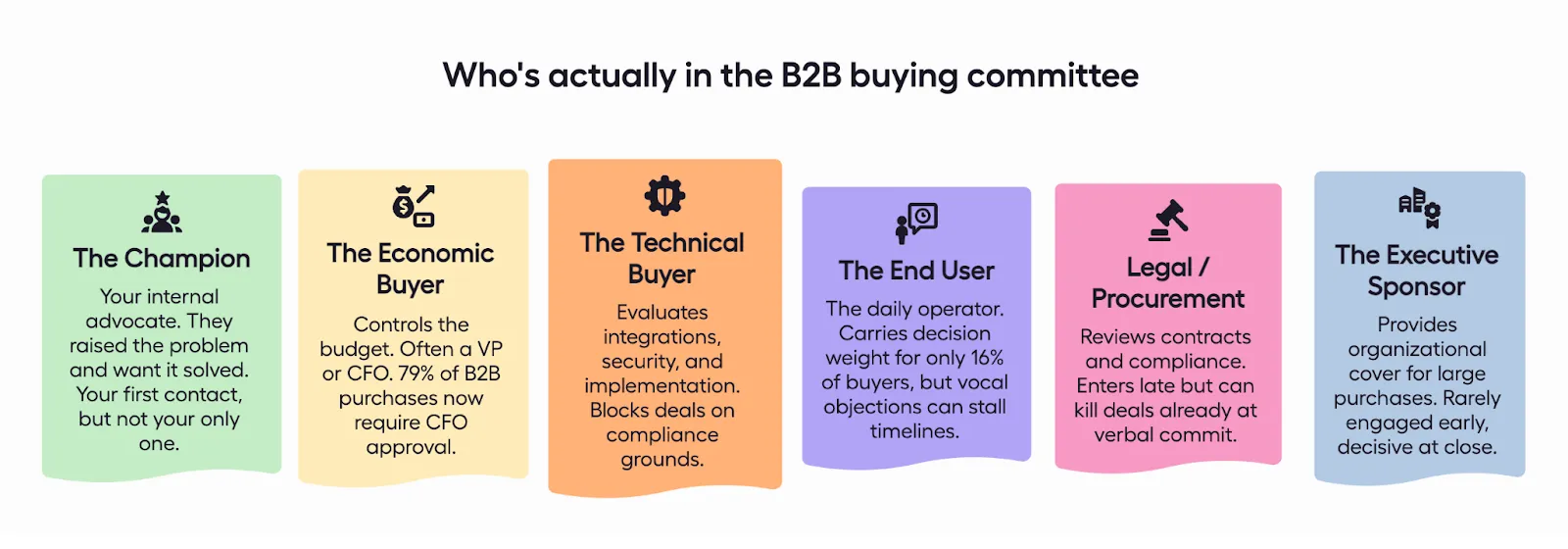
For Tier 1 accounts, that means:
- Identifying 3–5 stakeholders per company (champion, economic buyer, potential blocker)
- Running coordinated sequences across channels, with messaging tailored per persona
- Pre-building a full account map in Clay: each stakeholder enriched, signals noted, personalization hooks ready before the first email goes out
But you can't run full ABM on 500 accounts at once. That's why the signal layer from Tactics 2 and 3 matters: it tells you which accounts deserve the ABM treatment right now.
Gray Falkon is a good example: a SaaS company whose sales team was brilliant at closing but spending 85% of their time just finding prospects, with only 15% left to actually sell. We took over the targeting and outreach, and mid-campaign they proposed a new strategy around who to target.
We adopted it completely, and according to their CRO Doug Dent, it doubled their leads. After 16 months: 174 qualified leads, 12 new customers, $900K+ in revenue, and a 16x ROI.
Speaking of existing pipeline: while you're working your target account list, there's a goldmine sitting in your CRM that most teams completely ignore.
Tactic 8: Re-engage closed-lost deals and past customers at new companies
The highest-converting list you already own is sitting idle in your CRM.
We're serious. Every deal you lost, every customer who churned, every client from 18 months ago. These are warm prospects.
They've evaluated your solution. Their situation has probably changed. And most teams have zero follow-up sequence attached to any of them.
Closed-lost reactivation works for two simple reasons:
- The contact already knows you. No cold introduction needed.
- Their situation has changed. Budget cycles shift. New decision-makers come in. Problems get worse.
When we use Clay for reactivation, we layer in job-change triggers on top. When a past champion moves to a new company, that's a warm outbound opportunity at both companies. Their replacement at the old company may be evaluating vendors. And your champion at the new company may need your solution again.
Two warm leads from one trigger event.


Tactic 9: Fix your CRM before you scale anything
We know, we know. This one isn't glamorous. But it's where a huge percentage of pipeline quietly disappears, and nobody talks about it.
Here's the pattern we see when we onboard new clients: the outbound engine is generating leads, but the CRM can't handle them. Duplicate contacts. Deals stuck with no next action. Closed-lost records from 12 months ago with zero follow-up. Reps working around the system instead of inside it.
Outbound generates pipeline. RevOps converts it. Both have to work, or you're filling a leaky bucket.
The specific failure modes that cost the most:
- No lead routing logic. A qualified lead arrives and nobody picks it up because ownership isn't defined.
- No follow-up SLA. Тhe chance of conversion drops by 80% if follow-up takes longer than 5 minutes. Most CRMs have no alert for this.
- Contradicting reports. When marketing and sales measure pipeline differently, nobody trusts the data, so nobody acts on it.
The fix isn't a shiny new CRM. It's almost always a cleanup and a workflow problem.
We typically start with a HubSpot or Salesforce audit: mapping where leads land, where they get stuck, where they fall out, and what's running on closed-lost contacts. In most cases, you can unlock a significant amount of additional pipeline just by fixing what's already in the system.
And yes, that's pipeline you already paid to generate, sitting completely idle.
The teams winning at outbound aren't sending more. They're building better.
Here's what we know after years of running this for B2B companies: outbound isn't hard because the channel is broken. It's hard because most teams are fixing the wrong layer.
Pick the one from this list that you know isn't working. Fix that one first. Then move to the next. And don't try to rebuild everything at the same time. You'll just lose track of what actually moved the needle.
You need help knowing which layer is broken? That's why we start with a GTM audit. It's free, it's specific, and it usually takes one conversation to identify where your pipeline is leaking. So we’ll be more than happy to help!


Frequently asked questions
Focus on positive reply rate, meeting rate, and pipeline created, not emails sent or dials made. A solid benchmark is 5%+ positive replies on targeted campaigns and 10%+ on signal-based outreach. Stage-to-stage conversion tells you far more than activity volume.
The core stack: Clay for signal-based enrichment and list building, a cold email platform like Plusvibe, Instantly, or Smartlead, LinkedIn Sales Navigator for prospecting, and HubSpot or Salesforce for CRM. Email warm-up tools are non-negotiable before any campaign goes live.
Partially. Research, enrichment, signal monitoring, and sequence sending can all be automated. What cannot be automated is positioning strategy, messaging judgment, and the conversations that come back once a prospect replies. Automation scales the process. Humans close the deals.
Traditional outreach targets accounts by demographic fit alone. Signal-based outbound targets accounts actively showing purchase intent through leadership changes, funding events, and hiring surges, reaching prospects when they're already evaluating solutions. Response rates jump from under 4% to 18%.
Most well-targeted campaigns see replies within 3-4 touches, with 58% coming from the first email and 42% from follow-ups. Sequences shorter than 4 touches give up too early. Securing a senior B2B meeting typically takes 8-12 touchpoints across multiple channels.
Don’t miss these
Get your first lead this month
14 days to get started. 7 days to get your first lead on average.


