

We Run Cold Email AND LinkedIn Outreach for 120+ B2B Teams - Here's What Each One Actually Does
TL;DR: LinkedIn vs. Cold Email Outreach Explained
- Cold email = volume. 5,000-10,000 sends/month and roughly 20-50 booked meetings. 📧
- LinkedIn = credibility. Around 600 invites/month across three senders and roughly 1-4 meetings.
- Watch the denominator. LinkedIn's 25-30% reply rate among accepted connections is roughly 4-6% when measured against total invites. 💼
- Channel fit matters. Email tends to win on scale; LinkedIn can outperform in finance and healthcare. 📊
- The channels complement each other. The second channel expands reach beyond what the first can cover. 🔄
Cold email is the volume engine. LinkedIn is the credibility engine.
Cold email can support 5,000-10,000 sends a month when the underlying infrastructure is built for scale. LinkedIn is fundamentally more limited, with roughly 600 connection invites a month across a three-sender setup. But LinkedIn puts a real person, title, and profile in front of the prospect before the sales conversation starts.
That difference changes how the channels should be evaluated. The right choice depends on how effectively each channel reaches your audience, how much volume you need, and whether credibility or deliverability is the bigger constraint.
In this guide, we'll break down the benchmarks Hypergen sees across active B2B campaigns, when each channel outperforms the other, and how the two can work together.
LinkedIn vs. Cold Email Outreach: The Short Answer
The short answer from 120+ active campaigns is that cold email and LinkedIn do not compete for the same job.
Cold Email Is the Volume Engine
Cold email handles total market coverage. Campaigns can support 5,000 to 10,000 sends per month when the underlying infrastructure and deliverability are properly managed. The setup requires sending infrastructure, deliverability management, and clean target data.
Across Hypergen's campaigns, cold email typically sees a 2.5% to 4% reply rate and generates 20 to 50 meetings per month, with a $50 to $150 cost per lead. If a business can only fund a single channel to fill its pipeline from scratch, cold email is the baseline choice.
LinkedIn Is the Credibility Engine
LinkedIn handles high-trust engagement. Platform limits cap daily activity at 25 connection requests per account, which translates to roughly 600 invites per month across a three-sender setup. There is no way to brute-force additional volume.
However, a prospect sees a face, a title, and an operator profile before they ever read a pitch. That lower-volume, high-trust dynamic typically generates 1 to 4 meetings per month across three senders.
Why They're Not Actually Substitutes
Treating email and LinkedIn as direct replacements breaks pipeline math.
Relying solely on 600 monthly LinkedIn touches cannot generate enough volume to feed a full sales team. Conversely, relying solely on email in heavily filtered industries leaves your best prospects behind.
Email brings the volume required to build pipeline, LinkedIn provides the credibility needed to unlock high-value buyers.
LinkedIn vs. Cold Email Outreach: The Numbers From 120+ B2B Campaigns
Cold Email vs. LinkedIn: Performance Comparison
The biggest difference between cold email and LinkedIn outreach is how much volume each channel can support.
The difference in volume is substantial. Cold email can reach thousands of prospects each month, while LinkedIn outreach is constrained by platform limits. A three-sender LinkedIn setup generates roughly 600 connection invites per month, compared with 5,000-10,000 monthly email sends.
That gives each channel a different role in the outbound system: email provides scale, while LinkedIn provides a more credibility-driven touchpoint.
Why LinkedIn Reply Rates Are Often Misleading
LinkedIn reply rates need to be read alongside the denominator used to calculate them.

Hypergen typically sees LinkedIn reply rates of around 25-30% when measured against accepted connections. But accepted connections represent only a fraction of the total invites sent. When the same performance is calculated against total invites, the reply rate is closer to 4-6%.
That distinction matters when comparing LinkedIn with cold email. A 30% reply rate on accepted connections can make LinkedIn appear dramatically more responsive than email, even though the total-invite figure tells a different story.
So when comparing outreach benchmarks, always ask:
What exactly is the percentage calculated against?
For LinkedIn, that usually means distinguishing between accepted connections and total invites sent.
Volume vs. Conversion: What the Numbers Actually Mean
The comparison becomes clearer when you look at both volume and conversion.
Cold email can support 5,000-10,000 sends per month, producing roughly 20-50 booked meetings. A three-sender LinkedIn setup handles around 600 invites per month and typically generates 1-4 meetings.
The practical takeaway is that a higher percentage does not automatically translate into more pipeline. Volume determines how many qualified prospects a channel can put into the funnel in the first place.
This is why Hypergen evaluates channel performance across both conversion and capacity. Cold email has the capacity to drive significantly more outreach volume. LinkedIn operates at a smaller scale, but can become more effective when the audience is active on the platform, credibility is an important part of the buying process, or email deliverability limits your ability to reach the right prospects.
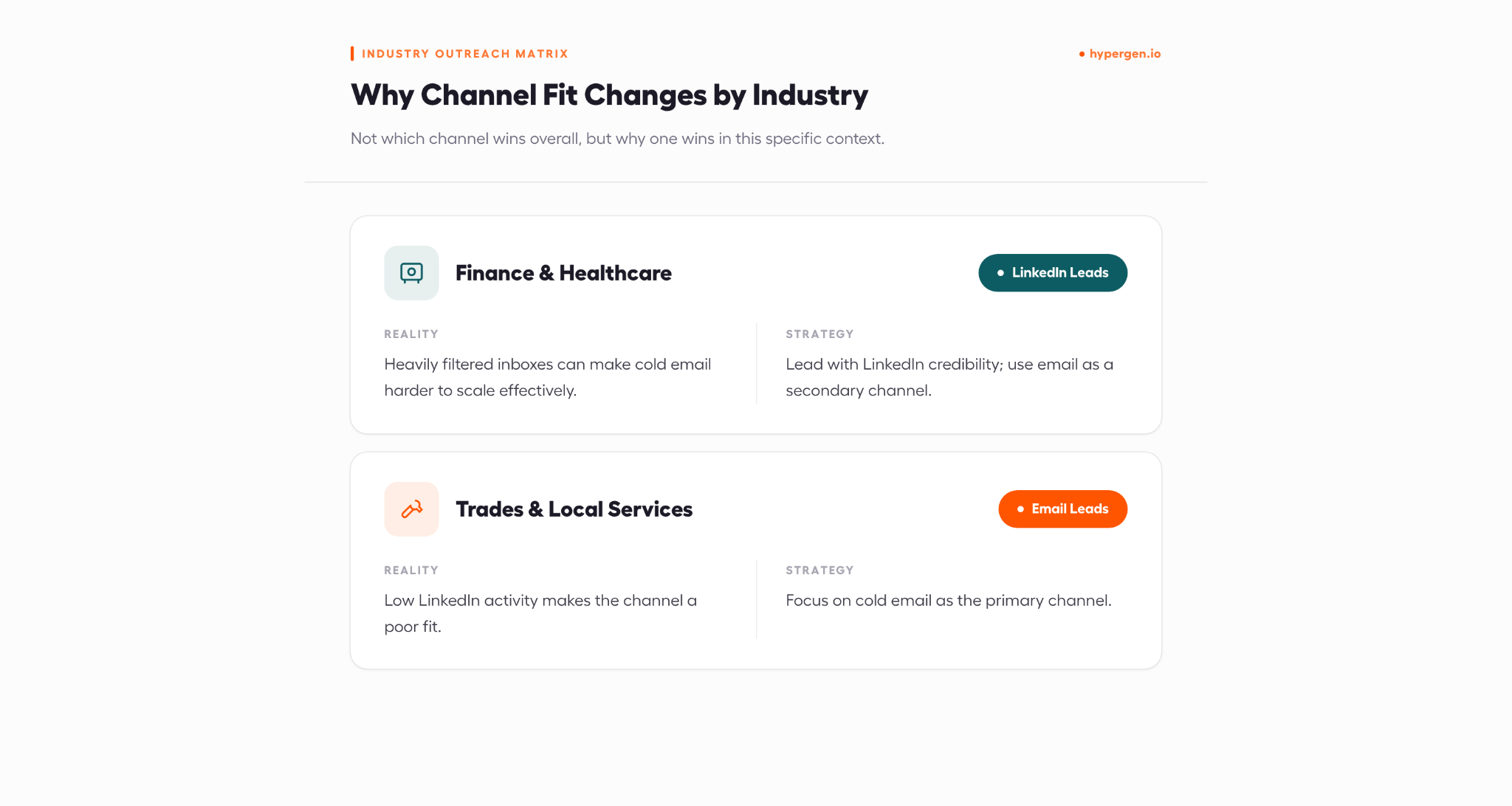
The matrix below shows how channel fit changes across different B2B industries.
When Cold Email Outperforms LinkedIn
Reaching Thousands of Buyers at Scale
Cold email is structurally built to reach thousands of qualified targets per month. When you're launching outbound prospecting campaigns into large Total Addressable Markets (TAMs), email can reach decision-makers at scale without the platform-enforced activity limits that constrain LinkedIn outreach.
LinkedIn's daily limit of 25 connection requests per account means that three senders can reach roughly 600 prospects per month. That makes LinkedIn highly useful for targeted outreach, but difficult to use as the only channel when you need to cover a broad market.

If your total addressable market exceeds 10,000 accounts and you need 20 to 50 booked meetings a month to hit revenue targets, cold email should be your primary baseline channel. Relying exclusively on LinkedIn for high-volume pipeline creates a structural capacity bottleneck.
Scaling Safely Without Account Restrictions
Scaling cold email volume requires the right sending infrastructure. That typically means using secondary sending domains, warmup protocols, and distributing volume across multiple inboxes.
If a campaign requires 10,000 monthly sends to hit revenue targets, sending capacity can be distributed across multiple inboxes rather than concentrated in a single account. LinkedIn, by contrast, has much tighter activity limits.
Never attempt to bypass LinkedIn's activity limits with unauthorized automation. Attempts to artificially increase activity can lead to account restrictions or suspension. Cold email, by contrast, can scale through additional sending infrastructure.
While LinkedIn provides high-trust engagement, cold email remains the primary workhorse for scalable outbound pipeline.
When Your Buyers Aren't Active on LinkedIn
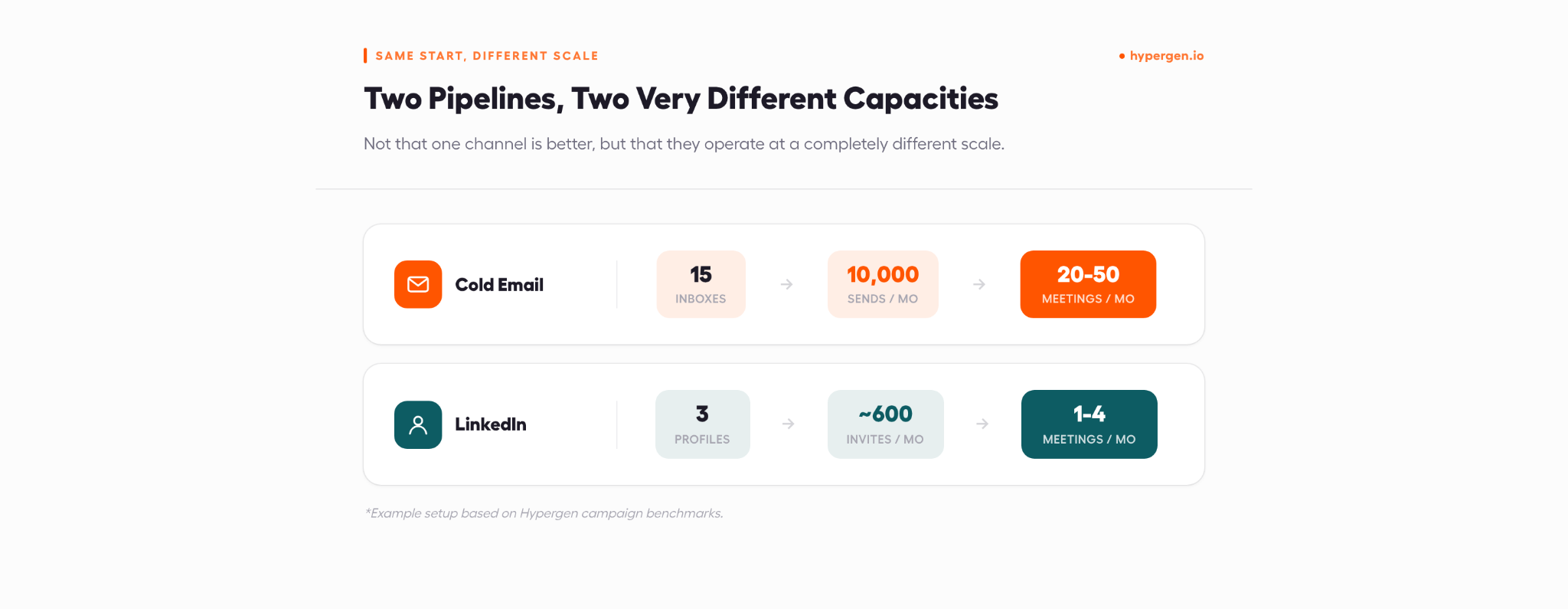
Not every B2B audience is equally active on LinkedIn.
For some segments, LinkedIn simply isn't where enough of the target market spends time or responds to outreach. Trades, local services, and dental are examples where LinkedIn activity can be low, making cold email the more practical primary channel.
Hypergen doesn't force LinkedIn into every campaign. If the audience isn't active there, the channel may not justify the additional effort.
The best outreach channel isn't necessarily the one with the highest response rate. It's the one that can reliably reach your specific audience.
Lower Cost Per Lead & Budget Efficiency
Cold email also tends to win on cost efficiency.
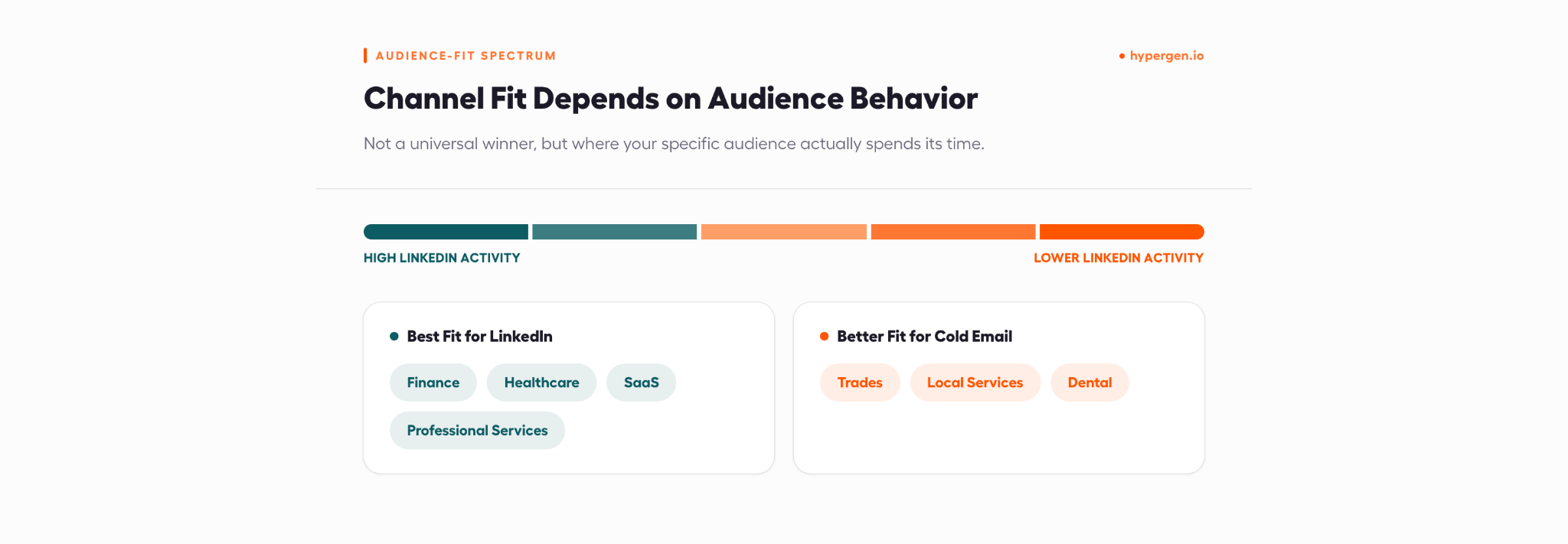
Hypergen's client benchmarks put cold email at roughly $50-$150 CPL, with campaigns typically sending 5,000-10,000 emails per month and generating around 20-50 booked meetings.
LinkedIn requires more manual activity per prospect and operates within much tighter volume limits. Across three senders, Hypergen typically works with around 600 monthly invites, generating roughly 1-4 meetings per month.
That makes cold email particularly attractive when the primary objective is generating a large number of opportunities while keeping acquisition costs under control.
When LinkedIn Outperforms Cold Email
Cold email excels at broad market distribution, but LinkedIn can outperform when buyer behavior, email deliverability, or the need for upfront credibility becomes the bigger constraint.
- Reaches buyers outside the email inbox in industries where corporate filtering can make cold email harder to deliver.
- Puts credibility in front of the buyer before the pitch through your profile, role, track record, and shared connections.
- Works particularly well for complex deals where buyers need more context and trust before engaging.
Reaching Buyers with Strict Email Security
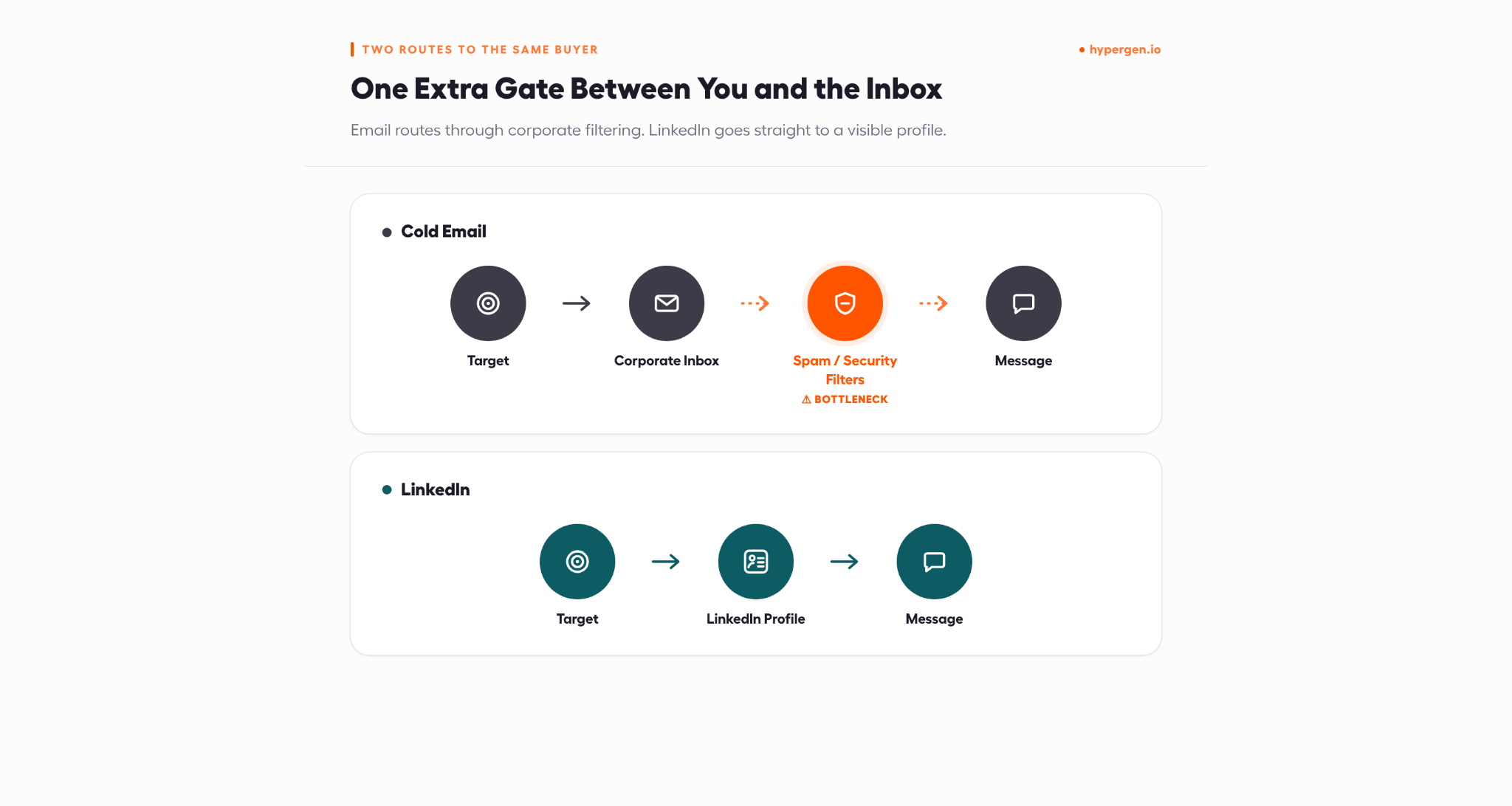
Standard cold email depends on getting a message through the recipient's inbox. In heavily filtered sectors such as finance and healthcare, that can become a structural constraint.
LinkedIn gives you another route to the same decision-makers. Instead of competing with corporate inbox filters, outreach happens directly on a platform where the prospect can also evaluate the person behind the message.
In email-filtered verticals like finance and healthcare, LinkedIn reply rates run 2x to 3x higher than cold email baselines. When email deliverability becomes the limiting factor, LinkedIn can become the stronger primary channel.
Winning Enterprise Deals Through Social Proof
For complex services, high-ACV SaaS, and M&A or enterprise services, the buyer often needs more context before engaging with an unfamiliar vendor.
LinkedIn gives prospects that context immediately. They can evaluate your role, experience, company affiliation, shared connections, and the substance of your profile before deciding whether to respond.
That makes the sender profile part of the outreach itself. A strong LinkedIn profile helps establish credibility before the conversation starts.
Treat your LinkedIn profile as a landing page, not a résumé.
Hypergen's client data shows a 3.2% reply rate for profiles using named-deal proof and concrete operator metrics, compared with 0.8% for profiles using generic positioning claims.
LinkedIn can also support multi-threading (reaching multiple stakeholders within the same account). For complex enterprise deals, reaching 2-3 relevant stakeholders can reduce the risk of a single contact becoming a bottleneck.
When Buyer Signals Matter
LinkedIn is also useful when there is a visible reason to contact someone now rather than later.
Instead of relying only on static demographic targeting, you can use cold email personalization and public signals to identify accounts where the timing is more relevant:
- Hiring Posts: A company hiring multiple SDRs may be signaling an active pipeline or sales capacity problem.
- Executive Shifts: A newly appointed C-suite leader may be looking for quick wins and operational changes.
- Funding Events: Fresh funding can signal new growth priorities and increased willingness to invest.
These signals don't guarantee buying intent, but they can give the outreach a stronger reason to happen now.
Why the Best B2B Outreach Uses Both
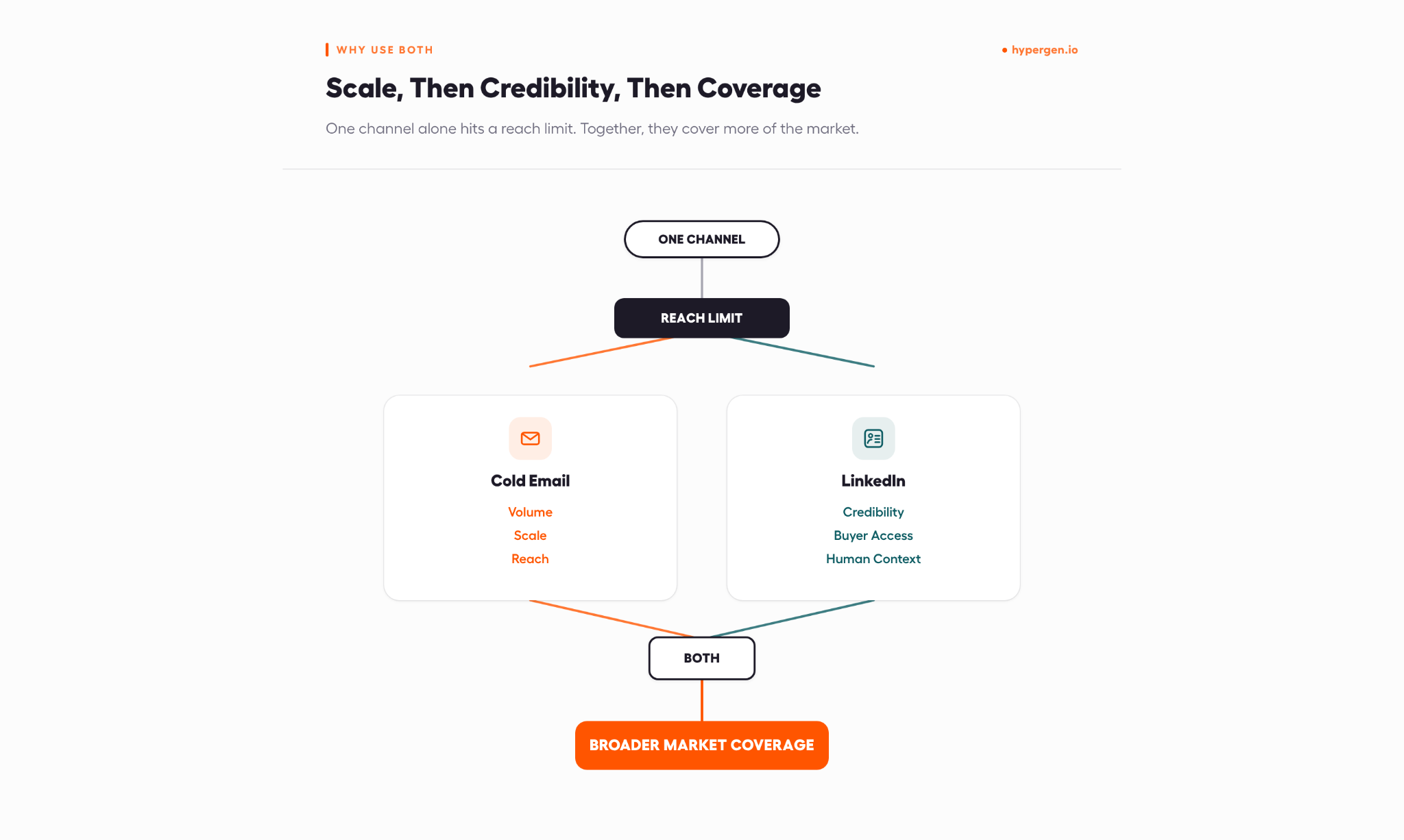
While cold email handles broad market coverage and LinkedIn adds a credibility layer, combining both channels gives you a way to reach more of the market than either channel can cover alone.
The Hybrid Engine: LinkedIn First, Email Around Day 10
- LinkedIn goes first. Email follows around Day 10. The connection request and first LinkedIn message put a face and a title in front of the prospect before anything reaches their inbox.
- The Day 10 email reaches prospects the LinkedIn motion couldn't touch, while also following up with prospects who did engage on LinkedIn.
- Coordinate both channels around the same prospect status so the sequence doesn't create duplicate or conflicting touches.
Hypergen's hybrid approach starts with LinkedIn and brings email into the sequence around Day 10.
The logic is deliberate: LinkedIn establishes the person and the profile first, while email provides the volume and reach that LinkedIn cannot.
HYBRID OUTREACH SEQUENCE
DAY 0 - Connection Request
Send the LinkedIn connection request.
DAY 1 - LinkedIn Message
Send a message of 50 words or fewer using a hook + pitch + proof + CTA structure.
DAY 3 - Short Bump
Send a brief follow-up of 20 words or fewer.
DAY 7 - Wrong-Person Ask
If there is still no response, use a wrong-person ask to turn silence into a potential referral.
DAY 10 - Email + InMail
Email prospects who never accepted the LinkedIn connection, while using InMail for the relevant LinkedIn audience.
The Day 10 email serves two purposes: it reaches prospects the LinkedIn motion could not touch and adds another touchpoint for the accounts already exposed to the LinkedIn sequence.
LinkedIn is priced and sold as a layer on the email retainer, not as a standalone replacement for email. The email volume fills the pipeline; the LinkedIn layer adds credibility and helps expand coverage on the accounts you care most about.
Why LinkedIn Goes First
In high-friction verticals, high-ACV enterprise deals, or heavily email-filtered industries like Finance and Healthcare, launching outreach on LinkedIn before sending an email can change how the buyer evaluates the outreach.
When a prospect sees an email from an unknown domain, their default reaction may be skepticism. Starting on LinkedIn establishes a credibility layer first: the prospect sees a verified operator profile, named-deal credentials, and mutual connections before a sales pitch reaches their inbox. When the same name appears in their inbox later, the sender is no longer completely unfamiliar.
What the Second Channel Actually Adds
Adding a second outreach channel is not about stacking duplicate touchpoints or spamming prospects across multiple inboxes.
The second channel exists to reach the exact market segment the first channel could not touch:
- Email-hostile industries: LinkedIn can provide another route to decision-makers when corporate email filtering limits reach.
- LinkedIn-inactive audiences: Cold email can reach prospects who rarely engage on LinkedIn.
- Unreached prospects: Email can pick up prospects who never accepted the LinkedIn connection, extending coverage beyond the LinkedIn audience.
Case A: Email-Only → Added LinkedIn
A US inspection-software company was running a 1,200-contact campaign through email only.
Their buyers included partnership heads, CEOs, founders, and AI/innovation leaders - people who are typically active on LinkedIn.
What we changed:
- Same list: We kept the original 1,200-contact prospect list.
- Same targeting: The audience and targeting criteria stayed the same.
- Two channels: We added LinkedIn alongside the existing email campaign rather than treating it as a separate program.
- Named senders: The client supplied team member profiles to use as LinkedIn senders.
- Low-risk test: We ran the first month free so the client could evaluate the approach based on data rather than a sales pitch.
The reason this worked for this ICP was straightforward: partnership and innovation titles were more likely to respond to a named person on LinkedIn than to an unknown inbox.
Adding a second channel doesn't necessarily mean sending more messages to the same prospects. In this case, LinkedIn added a different type of access to an audience already being targeted through email.
Case B: LinkedIn-Only → Added Email
A B2B company was initially running a LinkedIn-only campaign targeting 5,000 prospects.
The campaign focused on senior decision-makers, with LinkedIn used as the primary outreach channel. But the team quickly reached a practical limitation: LinkedIn could not provide enough sending capacity to cover the full addressable market.
What we changed:
- Same LinkedIn campaign: We kept the original 5,000 LinkedIn prospects and targeting approach.
- Email added: We introduced email as a second channel rather than replacing LinkedIn.
- Additional reach: Email enrichment added 17,000 more prospects who could not be reached through the original LinkedIn campaign.
- Senior-title filtering: The additional records were filtered for relevant senior titles to maintain the quality of the target audience.
- Different jobs: LinkedIn continued to provide the higher-touch, credibility-focused channel, while email absorbed the additional volume LinkedIn could not handle.

When LinkedIn reaches its practical volume limit, email doesn't just create another touchpoint. It can dramatically expand the number of relevant prospects you can reach.
The Pattern: The Second Channel Expands Reach, Not Just Touches
The two campaigns started from opposite directions - one began with email and added LinkedIn, while the other began with LinkedIn and added email.
The common pattern was the same: the second channel expanded what the campaign could reach.
This is why we don't treat LinkedIn and cold email as competing channels. They solve different problems.
How to Choose Between LinkedIn and Cold Email
Choose Cold Email If...
Cold email should be your primary channel when reach and volume are the main priorities.
Choose cold email if:
- You need to reach a large market. Email can handle 5,000-10,000 sends per month, making it the stronger option for broad market coverage.
- Your audience isn't active on LinkedIn. Trades, dental, and local services are examples where LinkedIn activity can be too low to justify making it the primary channel.
- You have a limited budget and need one channel. Based on Hypergen's campaign data, cold email typically generates significantly more meetings per month at a lower cost per lead.
- You need predictable pipeline volume. Email is built to scale, while LinkedIn's activity limits make it difficult to generate the same volume of opportunities.
If you can only fund one outbound channel, start with cold email. Add LinkedIn when it solves a specific reach or credibility gap.
Choose LinkedIn If...
LinkedIn should be your primary channel when credibility and access to the right buyers matter more than volume.
Choose LinkedIn if:
- Your buyers are active on LinkedIn. If the people you're targeting regularly use the platform, LinkedIn gives you a direct way to reach them in a professional context.
- Your audience is concentrated in senior or relationship-driven roles. Founders, executives, partnership leaders, and innovation leaders can be particularly well suited to a named-person outreach model.
- Credibility matters before the first conversation. A prospect can evaluate your profile, experience, company, and shared connections before deciding whether to engage.
- Email deliverability is a constraint. In heavily filtered verticals such as finance and healthcare, LinkedIn can provide an alternative route to the same decision-makers.
Use LinkedIn when the person behind the message is part of the value proposition. If your buyer needs to trust who they're talking to before they engage, LinkedIn deserves a primary role.
So, When Should You Choose Both?
Choose both when neither channel can cover your addressable market effectively on its own.
A hybrid approach makes the most sense when:
- You need scale and credibility. Email gives you the volume to reach a large market, while LinkedIn puts a real person and professional context behind the outreach.
- Your audience is mixed. Some prospects may be highly active on LinkedIn, while others are easier to reach through email.
- One channel has a clear limitation. LinkedIn may not provide enough volume, while email may struggle with deliverability or lack the credibility needed for a high-friction sale.
- You want broader market coverage. The second channel can reach prospects the first channel cannot effectively cover, rather than simply sending another message to the same people.
Decision Matrix: LinkedIn vs. Cold Email
Choose the channel that best matches your audience and your biggest constraint - then add the second channel when it solves a gap the first one can't.
The Cost of Cold Email vs. LinkedIn Outreach
Cost isn't just what you pay to generate a lead or book a meeting. Each channel also comes with a different mix of technical setup, human time, and operational effort.
For most campaigns, that makes cold email the more cost-efficient channel when scale is the priority. LinkedIn becomes more compelling when the additional credibility and direct access to buyers justify the higher cost per touch.
In practice:
- Choose cold email when you need volume and predictable pipeline coverage.
- Choose LinkedIn when credibility and buyer access matter more than volume.
- Choose both when one channel leaves a meaningful gap in your reach.
The Best Outbound Strategy Doesn't Choose Between Email and LinkedIn
The best outbound strategy depends on what each channel can do for your business.
Cold email gives you the reach and volume to build pipeline at scale. LinkedIn adds credibility, direct access, and another way to reach buyers who may be harder to engage through email alone.
When one channel leaves a meaningful gap in your reach, adding the second can expand the market you can actually engage. The right combination depends on your audience, your sales motion, and where your primary channel reaches its limits.


Frequently asked questions
For most B2B campaigns, cold email performs better on volume and cost per meeting. Hypergen typically sees 5,000-10,000 email sends and 20-50 booked meetings per month, compared with around 600 LinkedIn invites and 1-4 meetings across a three-sender setup. LinkedIn can outperform cold email in heavily filtered verticals such as finance and healthcare, where LinkedIn reply rates run 2-3x the email baseline.
Start with cold email when the market is large, the audience is not active on LinkedIn, or predictable outreach volume is the priority. Start with LinkedIn when buyers are active there, senior decision-makers need more credibility before a conversation, or email deliverability is a structural challenge. For many campaigns, the strongest approach is to use LinkedIn as a credibility layer and cold email as the volume engine.
The two channels serve different roles, so combining them is less about doubling activity on the same prospects and more about expanding market coverage. Hypergen typically runs around 600 LinkedIn invites across three senders alongside 5,000-10,000 monthly email sends. In documented client campaigns, adding the second channel allowed teams to reach prospects and companies the first channel could not effectively cover.
LinkedIn can be more effective when senior decision-makers are active on the platform, and credibility matters before the first conversation. A named person, their title, and a real professional profile give the prospect context before the pitch. Cold email remains more effective when the priority is reaching a larger number of prospects and creating predictable outreach volume.
Outsourcing makes sense when a team needs the infrastructure, operational capacity, and ongoing execution required to run both channels consistently. Cold email requires domains, warmup, deliverability monitoring, list validation, and scalable sending infrastructure, while LinkedIn requires ongoing manual activity within strict volume limits. If the team does not have the time or systems to manage those requirements internally, an experienced outbound partner can take on the operational layer while the internal team focuses on sales conversations and closing.
Don’t miss these
.avif)

Get your first lead this month
14 days to get started. 7 days to get your first lead on average.


