


We source M&A deals via cold email - here's the full playbook we use for deal teams
TL;DR: How M&A deal teams source acquisitions with cold email
- Referral-only deal sourcing is not a strategy, it is a waiting game. Programmatic acquirers are 1.4 times more likely to reach out first. 🎯
- Timing beats targeting for M&A cold email. Signal-based outreach pulls 15 to 25% response rates, versus 5 to 10% for generic outreach.
- Four signals predict a real exit conversation. Business age over ten years, family ownership, founder tenure, and independence from a parent company.
- Clay layers over 100 data sources to build the target list. No single database lookup replaces cross-referencing signals against each other. 🔍
- M&A cold email works best in plain text, not HTML. No links or tracking pixels, so it reads like a real message.
- The channel compounds instead of converting overnight. Advisors close four to eight deals a year, with first signed engagements usually landing in three to six months. 📈
Why does your firm still depend on someone else's rolodex to find deals? 🤔
It's a fair question, and most people in M&A don't love the answer: because that's just how it's always been done. Referrals come in, you follow up, and if nothing comes in that month, you wait.
McKinsey looked at what the best acquirers actually do differently, and the answer wasn't luck or connections. Programmatic acquirers are 1.4 times more likely than their peers to proactively reach out to prospective targets instead of sitting back and hoping the phone rings.
That's what M&A lead generation through cold email actually does for you.
It’s not a replacement for your network, but a second channel that works even on the months your network doesn't come through.
Below is the exact process we use to run this for our own M&A clients, from the first name on the list to the first reply in an inbox.
(We've also written up the full M&A process if you want the bigger picture first.)
Does cold email actually work for M&A deal sourcing?
Short answer: yes, but only when it's built around exit-readiness signals instead of some broad industry filter. Founders who are genuinely open to talking about their business don't respond to generic outreach (who would? 🙄).
Timing-based outreach built around real signals pulls 15 to 25% response rates, compared to a measly 5 to 10% for generic cold outreach aimed at that exact same pool of companies.
And that gap right there is basically the whole argument for this entire blog post.
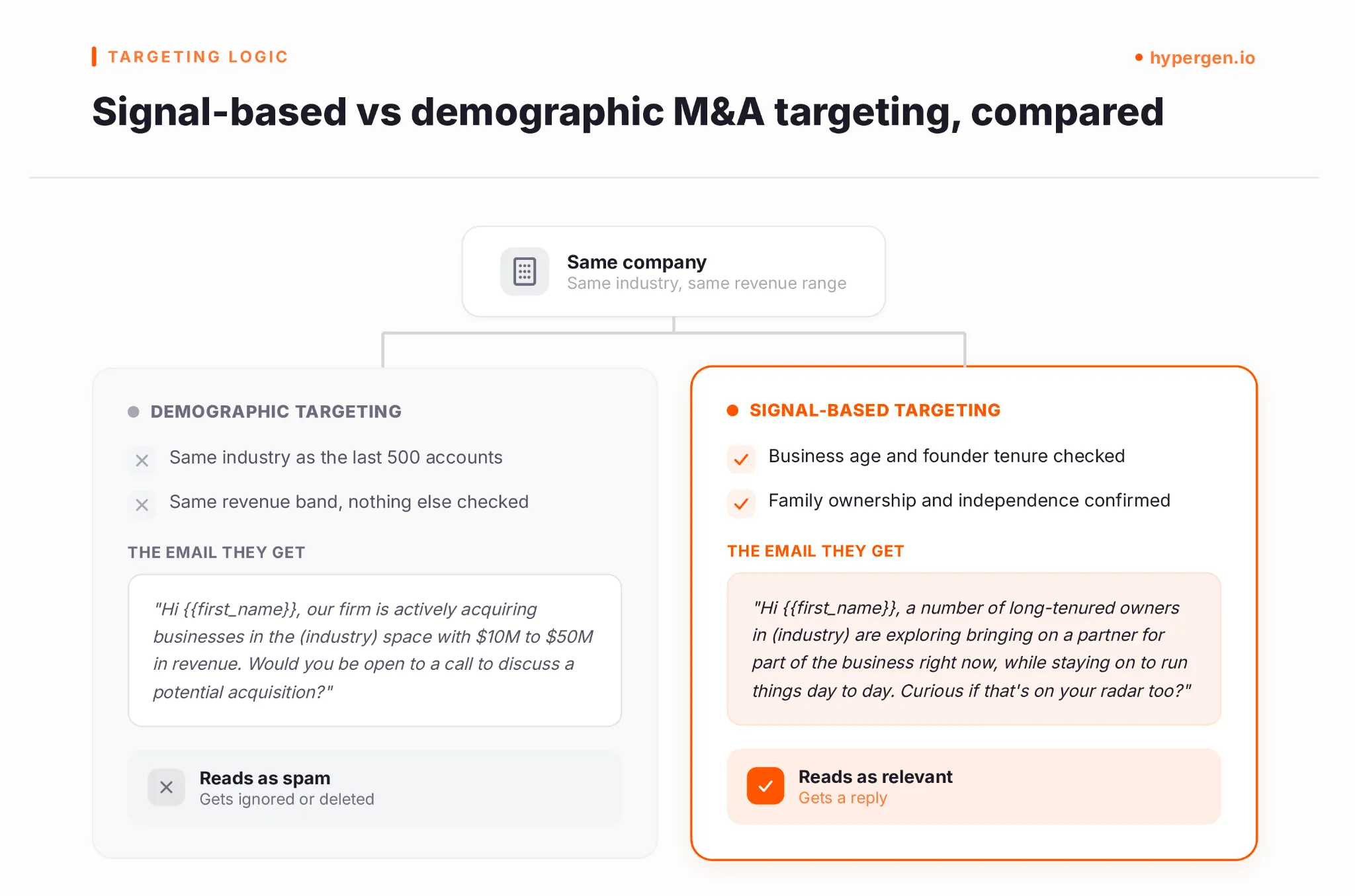
Same industry. Same revenue range. Wildly different outcomes, all depending on whether the message landed at the right moment.
Now here's the part most teams don't love hearing: the average private equity firm evaluates 80 opportunities for every single deal it closes. That's a conversion rate of about 1.25%. Ouch.
But this isn't a failure of effort, it's just what happens when volume gets substituted for precision.
Most M&A cold email fails for one simple reason. Demographic targeting (same industry, same revenue band) treats every company like it's equally ready for an exit conversation. But it isn't.
Timing is the variable that actually predicts whether you get a reply.
And also worth remembering too: M&A outreach is a totally different from standard SDR prospecting. You're not selling software to some faceless buying committee.
You're opening a private, high-stakes conversation with one person who's spent a decade or more building the exact thing you're asking about, and that conversation might not turn into a mandate for a year or longer. That's exactly why outreach built for long sales cycles looks so different from a typical SaaS sequence.
And if timing beats targeting, the next question is how you actually build a system around it.
How do agencies scale M&A lead generation beyond warm referrals?
Agencies scale M&A lead generation by swapping referral dependency for a structured outbound system: a clearly defined target list, signal-filtered contacts, a sequenced follow-up cadence, and dedicated cold email sending infrastructure.
Why does referral-only sourcing hit a ceiling?
Referral-only sourcing hits a ceiling because it's reactive by design. You genuinely can't plan a pipeline around "let's just wait and see who calls." 🤷
Most general B2B lead generation advice out there assumes you're chasing volume, but M&A plays by different rules entirely: fewer, better-qualified conversations beat a stuffed inbox.
That distinction matters because M&A deal flow doesn't scale the way a typical sales funnel does.

You're not trying to fill a calendar with demos. You're trying to find the handful of founders (out of thousands of companies) who are actually approaching a real transition point right now.
Leading acquirers do still pull a meaningful share of deal flow from inbound and referral sources. But the firms building actual predictability lean into outbound and proprietary channels instead of relying on their network alone.
What a scaled outbound program actually adds
A scaled outbound program for M&A adds a few things a referral network simply can't:
- A research function that runs continuously
- A list refresh cycle so your target universe stays current
- A follow-up cadence that doesn't rely on someone's memory to circle back
This is the difference between hoping the right founder calls you, and knowing exactly which 500 founders you're reaching this month, and why. Building this kind of consistency is what separates ad-hoc prospecting from a proper built lead generation strategy.
None of this works, though, without knowing which signals actually predict a real exit conversation.
How intent-based data identifies better M&A acquisition targets
Intent-based data helps you find better M&A acquisition targets by filtering for exit-readiness signals (measurable clues that a founder is approaching a transition point) instead of just filtering by industry and revenue. This narrows a universe of thousands of companies down to a shortlist of founders actually worth reaching right now. 🔍
What signals predict a real M&A exit opportunity?
The four signals that predict a real exit conversation are business age, family ownership, founder tenure, and independence. Each one on its own is a decent clue, but they get genuinely powerful once you start layering them together.
- Business age (10+ years).
A company that's been running for a decade or more is a lot more likely to have a founder thinking about what's next. Our team even has a saying for this 😏: “if they're too new, they're probably not going to be interested in exiting”
- Family-owned status.
Honestly, this is our single most reliable signal. We check for it by scanning the company's website for "family owned" or "family operated" language, or by cross-referencing executive last names for shared surnames.
Ownership structure completely changes the emotional context here. A family exit is about legacy, employees, and often retirement, not just a number on a spreadsheet.
- Founder or CEO tenure (10+ years).
Founders who've stuck around for the long haul are statistically more likely to be weighing their next chapter. Tenure also tends to signal decision-making power. A founder who's run the same company for over a decade usually doesn't need to check with anyone before saying yes to a quick call.
- Independence (not already acquired).
This one's a filter, not a bonus point: before any contact goes on our list, we double-check the company isn't already owned by a parent corporation. We look for "owned by [parent corp]" language on their site, or confirmation that the business calls itself independent. Reaching out to a subsidiary just wastes your outreach and dings your email sender reputation with someone who has zero authority to say yes anyway.
How does Clay combine these signals into a target list?
Clay's signal-based targeting ties these signals together by pulling from over 100 data sources at once and layering them against each other, so the pattern (not any single data point) decides who actually makes your list.
So by the time you're reaching a founder, you already know what's shifted at their company (and why now might genuinely be the right moment to reach out).
None of this works without clean data behind it, though (yes, we cannot stress this enough 😅).
A signal is only as good as the data enrichment layer that verifies it, which is exactly why the Clay data enrichment gets treated as its own dedicated step, not some afterthought bolted onto list building.
Signals tell you who to look for. Here's the process that turns that into an actual list.


How are acquisition target lists built for cold outreach?
Acquisition target lists for M&A cold outreach get built in stages: define the thesis, apply signal filters to the universe, enrich and verify contact data, run a pre-send scrub, and get deal team approval before a single email ever goes out.
The goal is a curated shortlist, not a downloaded database dumped into a spreadsheet.
Here's exactly how that plays out, step by step:
- Define the acquisition thesis
Verticals, revenue range (we typically work in the $5M to $100M deal size band), geography, ownership type (founder-owned versus PE-backed), and explicit exclusions like recently acquired companies or subsidiaries.
- Apply signal filters
We layer business age, family ownership status, founder tenure, and an independence check, all run through AI prompts against the company's own website. In practice, that means checking a site for language around being family owned, verifying the industry itself, and figuring out the exact niche in just a couple of words (think residential HVAC versus commercial HVAC, that kind of specificity).
- Segment by signal combination
We build separate lists for family-owned versus non-family-owned companies, different revenue bands, and different niches within the same industry. Each segment gets its own copy, one generic sequence for everyone doesn't work here 🙃
That's the whole logic behind building a quality lead list instead of just a big one.
None of this matters, though, if the list just sits in a spreadsheet. The entire point of the qualification work is to hand a deal team a small enough universe that outreach actually happens.
Once the list is built and approved, the work shifts from research mode to execution mode.
That's where a solid outbound sales strategy comes in, since finding the right founders and actually reaching them well are two different skill sets.
What does a data-driven M&A outreach strategy actually look like?
A data-driven M&A outreach strategy opens a conversation about the founder's business, not a pitch for advisory services. The message reflects the founder's specific signal profile without ever spelling out how you found them, and it stays plain, direct, and hyper-specific to their industry and revenue range rather than dancing around the actual point of the email.

Founders can tell within one sentence whether they're reading a templated pitch or a real message.
Vagueness reads as spam, but specificity reads as someone who actually did their homework, and that's the whole premise behind cold email personalization that goes beyond a basic first-name merge field.
What does a high-converting M&A cold email include?
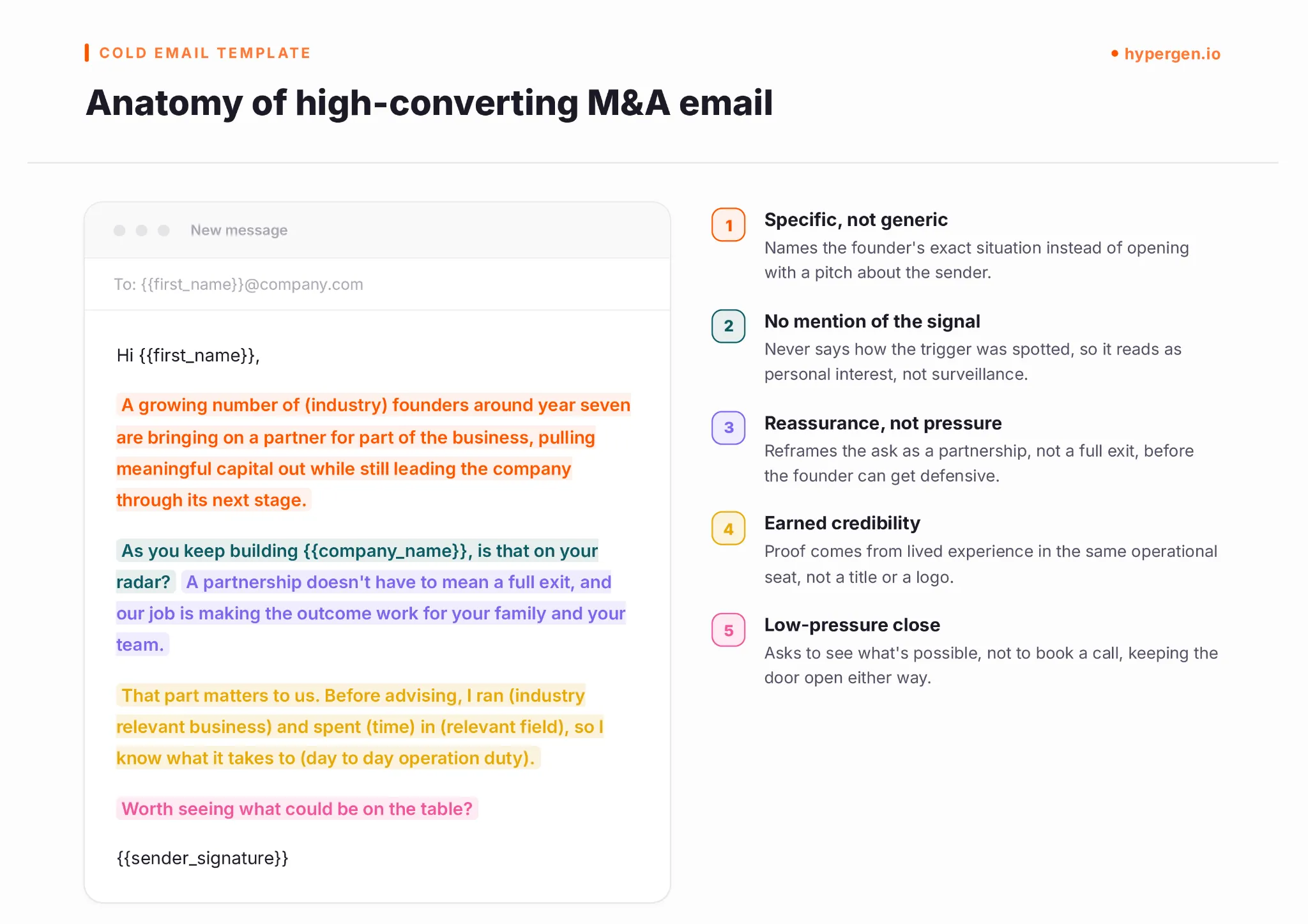
An M&A cold email opens with something specific to the founder's situation, never mentions how you found them, and closes with a low-pressure ask instead of a hard pitch.
Here's a real (anonymized, obviously) template we've used on one of our M&A campaigns:
Hi {{first_name}},
A growing number of (industry) founders around year seven are bringing on a partner for part of the business, pulling meaningful capital out while still leading the company through its next stage.
As you keep building {{company_name}}, is that on your radar? A partnership doesn't have to mean a full exit, and our job is making the outcome work for your family and your team.
That part matters to us. Before advising, I ran (industry relevant business) and spent (time) in (relevant field), so I know what it takes to (day to day operation duty).
Worth seeing what could be on the table?
{{sender_signature}}
Notice everything that's missing from that email: no mention of the signal that triggered outreach, no "hey, I noticed you're family owned," no pressure whatsoever. The copy speaks to the founder's likely situation without ever sounding like you've been watching them 👀
For family-owned segments, we lean into legacy (something like asking what's next for their family after they exit).
For non-family-owned companies, the angle shifts toward stakeholder returns and value realization instead.
So it’s the same underlying signal logic, but a completely different emotional entry point.
How many follow-up emails should an M&A sequence include?
The sequence itself runs four touches over roughly two weeks, moving from a signal-based hook to a light value-add, a respectful nudge, and a final no-pressure close.
- Email 1: the signal-based hook above, plus a soft question about what's next
- Email 2 (day 4): a light value-add, one relevant data point about their sector
- Email 3 (day 9): a respectful follow-up that acknowledges they're busy
- Email 4 (day 16): a final, no-pressure touch that leaves the door open
Subject lines stay plain and non-promotional, and we rotate them every two weeks so spam filters don't start recognizing a pattern (they're smarter than people give them credit for).
And because most M&A outreach often doesn't land on the very first send, a structured follow-up after no response sequence matters just as much as the opening email does.
Why cold email infrastructure matters for M&A deal sourcing
Cold email infrastructure matters A LOT for M&A, because contact volume is lower and every relationship is worth more. Sending from a poorly authenticated setup, or your main domain, risks deliverability damage that takes months to repair.
And one spam flag from a key target can close a door that's hard to pry back open. 😬
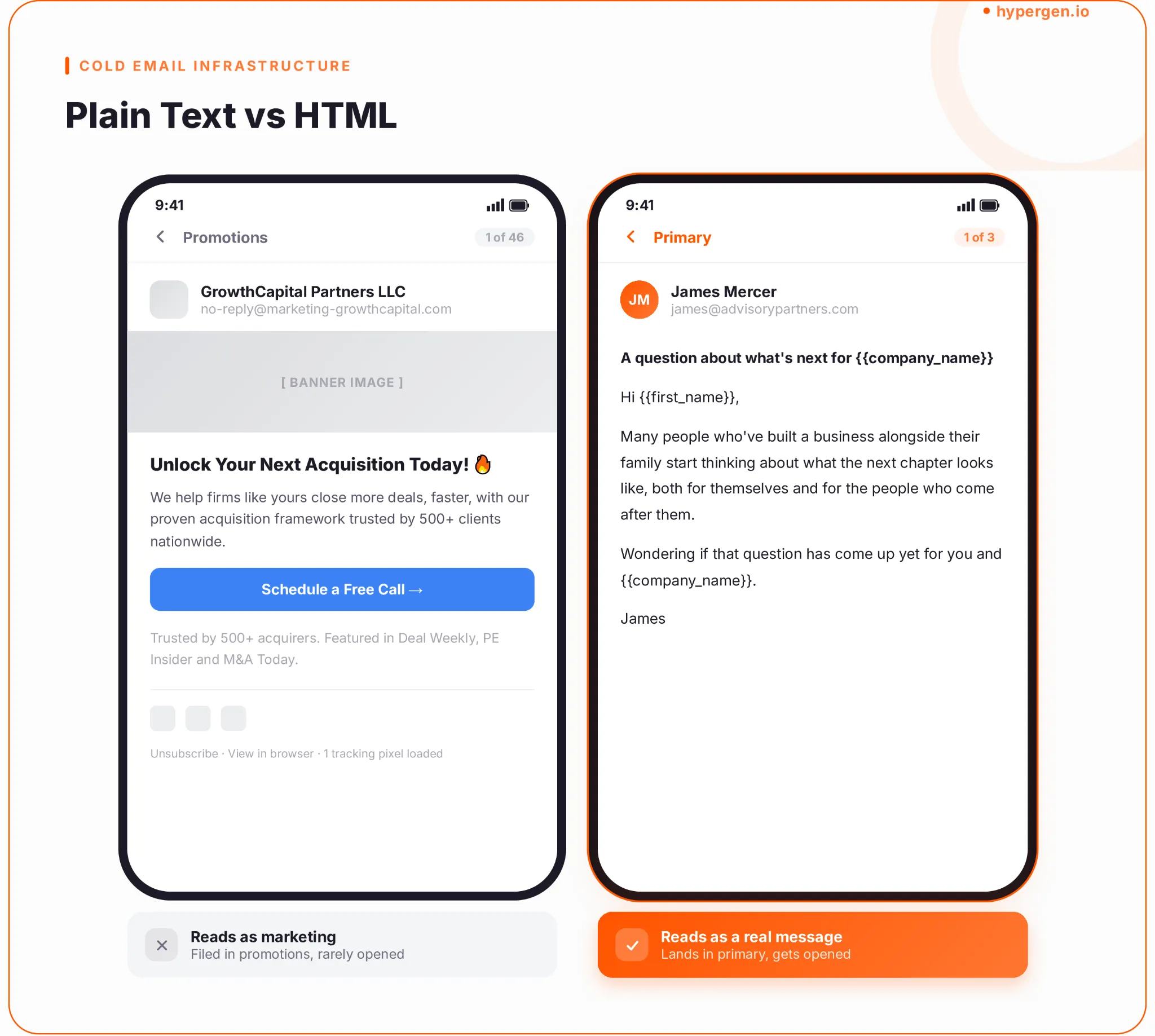
For M&A campaigns, we send plain text only.
No images, no links, no tracking pixels. We don't track opens on purpose, because there's nothing to click in these emails, and that's intentional so they land in the primary inbox where a real person sees them.

There's a reason this matters more for M&A than for standard B2B outreach: founders are sophisticated recipients.
An HTML-formatted email from an unfamiliar sender reads as mass marketing on sight. But plain text reads as a direct message from a real human, because that's exactly what it's designed to look like.
The infrastructure basics still apply regardless of format:
- Dedicated secondary domains (never send from your main one)
- Full SPF, DKIM, and DMARC authentication
- A proper warm-up period before launch
- A bounce rate kept under 2%
We manage over 2,650 inboxes across our client campaigns and consistently hit a 95%+ inbox placement rate, and honestly, that number is the entire point of getting the technical side right before you even start worrying about copy.
Our take: Most M&A advisory firms don't have the bandwidth to monitor this themselves, and one deliverability failure can wipe out months of careful list building overnight. That's the real argument for outsourcing infrastructure specifically.
What ROI should you expect from outsourced M&A lead generation?
For M&A advisory firms, outsourced lead generation ROI gets measured in mandates and closed transactions, not cost per lead. Advisors running a structured outbound program close four to eight deals per year on average from this channel, and given typical advisory economics, a single closed deal can genuinely pay for the entire year's program.
Response volume grows in a pretty predictable way as a campaign matures:
- Month one: roughly 5 to 10 responses
- Month two: 10 to 15 responses
- Month three: 15 to 20 or more, as sequences mature and the target list gets refined
First signed engagements typically land somewhere in months three to six. So it’s very important to note here, that this is pipeline building, not a quick win, and firms that treat it like a sprint tend to walk away before the channel even gets a real chance to compound.
What results have Hypergen's own M&A clients seen?
Real results vary by firm, but two of our M&A clients show both ends of the timeline. One built a long, compounding pipeline over 16-plus months. The other saw real traction inside the first sixty days.
- The Winston Dunn partnership shows that long arc pretty well: four deals closed over 16-plus months, averaging around 25 leads a month, with their President now expecting six to eight more closes in the year ahead as the pipeline keeps maturing.
- Sutton Capital Partners shows the other end of the spectrum: within the first sixty days of launching, they'd already generated 50-plus leads and had multiple high-quality prospects sitting in active pipeline, proof that early traction is genuinely possible even while the full pipeline is still building out.
So what actually drives the gap between those two outcomes?
A few things: deal size range, sector specificity, how tightly the target list is filtered, and how fast the deal team follows up once a founder actually replies (a perfect list with a slow follow-up process still underperforms, unfortunately 😬).
That follow-up speed usually comes down to whether the M&A pipeline itself is being managed properly once a founder responds. A clean M&A pipeline with clearly defined stages catches replies before they go stale, while a messy one lets warm conversations quietly die in someone's inbox.
Referrals will only get you so far
We're not telling you to drop your referral network, it's earned its keep and it'll keep working. We're just saying it shouldn't be your only channel.
Cold email won't replace your network, but it gives you a second way in, one that doesn't sit around waiting for someone else to make an introduction.
The firms with the strongest pipelines aren't smarter, they're just earlier. They find the founder before anyone else does, and they stay in touch long enough to matter.
So there's a decent chance your next mandate is sitting in a company nobody on your team has emailed yet.
Frequently asked questions
Optimizing pipeline tracking means configuring your CRM around M&A-specific stages: initial contact, conversation started, NDA signed, mandate engaged, and deal in process. Each record should log the signal that triggered outreach and the last follow-up date, so teams can see which combinations actually produce mandates.
RevOps builds the infrastructure that keeps deal flow manageable: clean contact records, automated follow-up reminders, and reporting that shows where conversations stall. Without it, deal teams lose track of warm leads and miss follow-up windows on founders who replied once and went quiet.
M&A teams find reliable support by looking for agencies with documented M&A-specific experience, not general cold email providers who occasionally work with advisory firms. Key criteria: signal-based targeting rather than list downloads, M&A copywriting experience, dedicated infrastructure, and a deal team review step before launch.
CRM integration connects outreach activity directly to the deal pipeline, so every reply and booked meeting logs automatically against the right contact. This closes the gap between the outreach tool and the deal log, and enables automated re-engagement for founders who replied once but never booked a call.
The strongest setups combine a company database with continuous signal monitoring rather than relying on either alone. Platforms like Grata surface private companies using industry fit and growth signals that don't always show up in standard databases, while enrichment tools layer in verified contact data.
Don’t miss these
.avif)



.avif)
Get your first lead this month
14 days to get started. 7 days to get your first lead on average.


