

Follow-up emails after no response + 7 B2B templates
TL;DR: Sending follow up emails after no response
- The first email is just the opener. Roughly 70% of total replies come from follow-ups 2–4, not the initial send
- Sequences outperform single sends. Structured follow-ups can lift reply rates by up to 85% compared to one-off outreach.
- Timing isn’t fixed, it’s contextual. Cold prospects, warm leads, SMBs, and enterprise buyers all require different follow-up gaps.
- Silence ≠ disinterest. Cognitive overload, decision paralysis, and risk aversion are usually the real blockers.
- Every follow-up must add net-new value. Case studies, hiring triggers, industry shifts, or reframed outcomes move the conversation forward.
- Reduce commitment over time. Smaller asks (15 minutes, quick question, brief audit) lower friction and increase replies.
- Optimize for brevity and clarity. 60–100 words hits the sweet spot between substance and respect for time.
- Cap your sequence strategically. 4–7 total touches maximize opportunity without damaging deliverability.
- Cold outreach works when it’s engineered. Intent signals, engagement-based timing, and disciplined follow-up turn missed emails into qualified pipeline.
You hit send on what felt like the perfect email. Nothing. You wait, send a follow-up email after no response, still nothing. Sound familiar?
What most people don’t realize is this: the majority of replies don’t come from the first email. In fact, 70% of responses come from follow-ups 2-4, not your first email. ✅
After refining our own approach across countless campaigns, we started noticing patterns. What works isn’t always what you’d expect.
So the goal is not “send more”, it is follow up with a plan.
Next, you’ll get a simple cadence, the psychology behind it, and ready-to-use templates that move prospects from no reply to real conversations. 📩
Why your follow-up emails after no response aren't working?
Let's start with some truth: your follow-up email didn’t fail because it was “bad”, it got buried in cognitive overload. 🧠
So your message isn’t competing with other emails, it’s competing with everything.
In practice, most follow-ups underperform for four predictable reasons:
- Reps treat follow-ups like an afterthought.
- They repeat the same message.
- They ignore buyer psychology.
- They stop too soon.
And here’s the data point that should change your approach. 44% of salespeople stop after one attempt.
When we tested across our campaigns, we saw the same pattern in multiple industries. Email two generates about 25% to 35% of the remaining replies, and timing plays a real role in capturing them.
Research also shows 50% of B2B sales go to the vendor that responds first, yet average lead response time sits at 42 hours. That delay creates a window where deals stall, or disappear.
Do follow-up emails really increase reply rates in B2B sales?
Yes. Dramatically. Not "a little better." Dramatically. ✅
Follow-up sequences drive 85% higher reply rates than single emails. Not 8% higher. Not 15% higher.
We're talking about nearly doubling your chances of getting a response.
Let’s ground this in the numbers. 📊
- 44% of salespeople stop after one try, and they lose the second wave of replies
- Top performers get 42% of total replies from follow-ups, not the first email
- Average cold email reply rate is 3.43%, elite performers push past 10%
- 58% of replies come from the first email, which means 42% come later
That last one is critical. Nearly half of your potential responses will never happen without a follow-up system.
Across industries, prospect types, and deal sizes, we saw the same dividing line: systematic follow-up separates top performers from everyone else. The difference between a 3% reply rate and a 10% reply rate often comes down to having a real follow-up strategy instead of hoping your first email works.
So the question isn't whether follow-ups work. The question is why you're not using them yet?
When should you send a follow-up email after no response?
The standard advice of "wait 3 days" ignores critical variables.
Timing depends on:
- Relationship warmth: A cold prospect needs more space than someone who expressed interest
- Deal complexity: SMB decisions happen fast, enterprise deals move slow
- Engagement signals: Someone who opened your email 3 times is different from someone who never opened it
- Industry norms: Tech companies move at warp speed, manufacturing takes its time

We adjust timing based on industry, relationship stage, and engagement signals rather than using one-size-fits-all intervals. Testing across tech, manufacturing, healthcare, and professional services clients shows timing needs vary significantly.
How long to wait before sending your first follow-up email
Instead of generic rules, here's your actual decision framework based on the situation you're in:

If someone opened your email multiple times but didn't reply, they're interested but paralyzed. Your follow-up should remove friction (make the ask smaller, clarify a detail, offer a different format), not add more information. They've already consumed your pitch. 🎯
The psychology of why people don't respond (and how to use it)
Now that you understand the timing, let's talk about what's actually happening in your prospect's head when they see your email and don't respond.
As we’ve said, people aren't ignoring you because they're rude or disinterested. They're drowning in a specific type of cognitive burden that prevents action.
Here’s what you need to know:
- Decision paralysis hits when prospects face cognitive overload.
Your email requires a decision: "Is this worth my attention?" The mental effort needed to make that call, combined with uncertainty about the outcome, tips the balance toward inaction.
This is status quo bias in action. Prospects prefer keeping things as they are rather than making a change, even when change might help. Each follow-up must reduce the friction of decision-making by making it easier to say yes.
- Loss aversion also plays a bigger role than you think.
People feel the pain of a potential loss roughly twice as strongly as the pleasure of an equivalent gain. For B2B decision-makers, this means the fear of choosing wrong creates powerful resistance to engagement.
- Your follow-ups should reduce perceived risk over time. 📩
Show that similar companies have already decided to engage and benefited (social proof removes risk). When prospects see competitors or respected companies taking action, your ask shifts from "unusual decision" to "normal business move."
- Cognitive load matters more than timing.
People respond more when their mental bandwidth is lighter. That is why emails sent between 9 and 11 AM outperform 4 PM emails. When you follow up mid-morning on a Wednesday, you reach them before fatigue sets in.
Bottom line: The easier you make it for prospects to understand your message and take the next action, the more likely they are to respond. Short, focused emails demand less cognitive effort to process, understand, and decide upon.


What should you say in your follow-up email after no response?
Alright, you've got the timing down and you understand the psychology. Now let's talk about the actual words you put in your follow-up email.
Here's the critical part most people miss: each follow-up should add genuinely new information.
Not a repeat of your first email with different words. Not the same pitch from a slightly different angle.
Actually new.
For example:
- The second email might share a relevant case study
- The third could reference recent company news showing new urgency for the prospect's problem (this is cold email personalization that actually works)
- The fourth might offer different value than the original pitch.
This accomplishes two things: it prevents the follow-up from feeling like you're just pestering them, and it gives prospects multiple reasons to engage across the sequence. Some prospects respond to social proof, others respond to urgency, others need a completely different hook.
Each follow-up is another shot at finding what resonates.
How to write a follow-up email that actually gets replies
Here's your step-by-step process:
- Acknowledge the previous email in one sentence (max). "I reached out last week about reducing your software spend" works. "Just checking if you saw my email" doesn't. The first shows context, the second shows desperation.
- Introduce one new piece of value or perspective. Don't repeat yourself. This could be a relevant insight ("I noticed your company expanded to the EU, which typically creates urgency around compliance automation"), a case study from a similar company, or a fresh angle on their problem. Make it specific, not generic.
- Make your ask smaller than the first email. If you asked for a 30-minute call initially, now ask for 15 minutes. Or shift to "worth a quick conversation?" The progressive reduction in commitment makes saying yes easier.
- Include ONE clear next step. Not three options where they choose timing. Not "let me know what you think." One specific action: "Would Tuesday at 2 PM work for a 15-minute call?" Decision fatigue is real, so don't make them work to figure out what you want.
- Keep it conversational and respectful. Write like you're talking to a colleague, not pitching to a stranger. Use contractions. Vary sentence length. Sound like a human who understands they're busy.
What is the best subject line for a follow-up email?
Your subject line needs to create the sense that this message is worth opening despite them not responding to the first one. That's a higher bar than your initial subject line faced.
The most effective follow-up subject lines employ specific tactics:
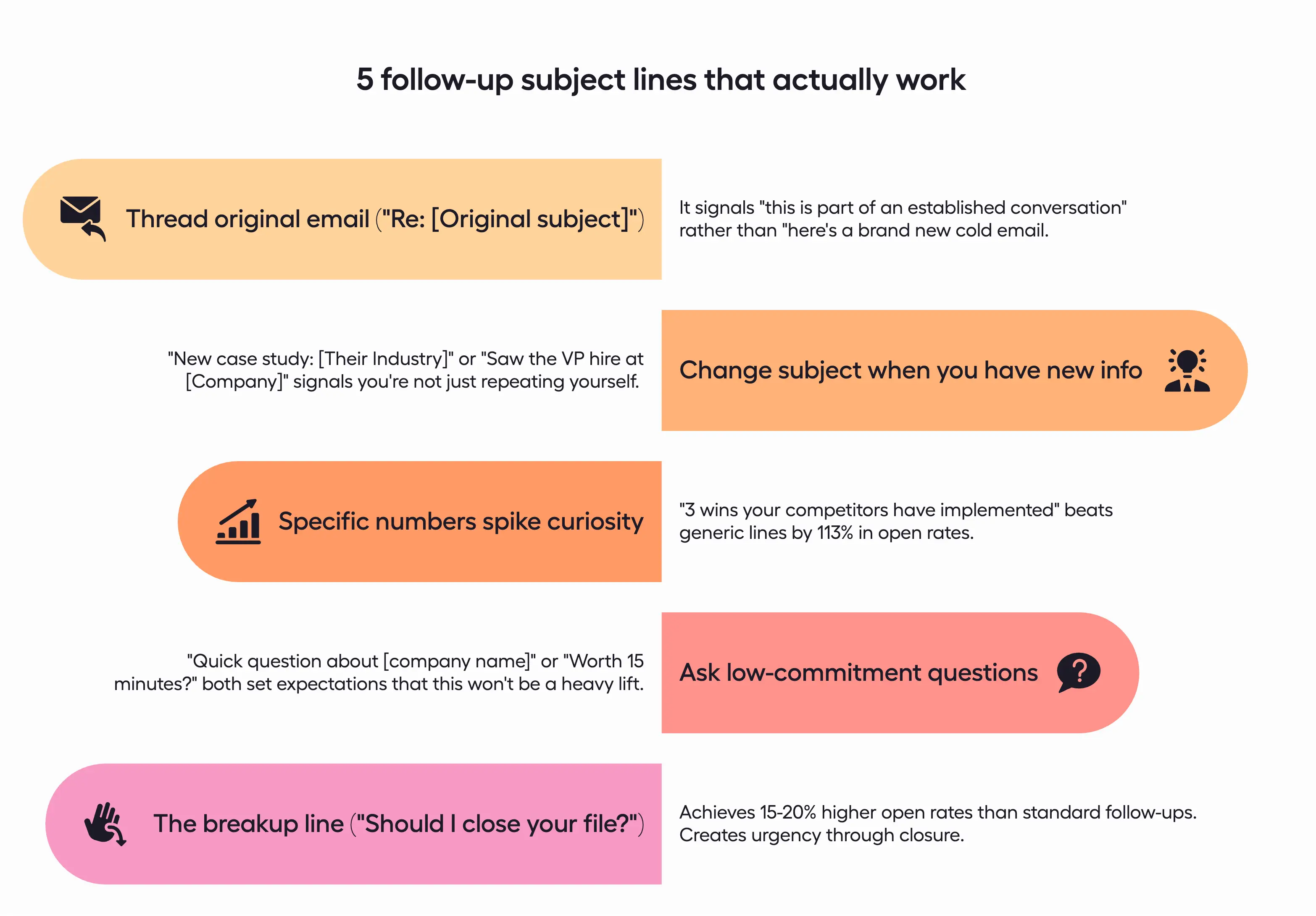
Critical insight: Your follow-up subject should be distinctly different from your first email's subject. Seeing the same subject line twice makes prospects think you literally just resent the same email, which makes them less likely to open (they already decided it wasn't relevant the first time). 🎯
Should follow-up emails be short or detailed?
Short. Always short. ✅
Your follow-up email length should decrease as the sequence progresses, not increase.
Initial message: 100-150 words max.
Follow-ups: 50-125 words.
Here's why: prospects who needed comprehensive context would have responded to your first email. If they didn't engage with 150 words of explanation, why would 300 words suddenly work?
They don't need more information to understand your basic premise. They need something new: a different angle, additional context about why now matters, or a lower-commitment ask.
Research comparing email performance across different word counts found that emails between 50-125 words typically result in response rates above 50%.
There is a lower bound though. Emails with fewer than 25 words perform similarly to very long emails (500–2000 words), averaging below 45% response rates. Extremely short emails may seem dismissive, unclear, or insufficient.
So the sweet spot: 60 to 100 words. 👌
Long enough to convey value clearly but short enough to feel respectful of the recipient's time.
How to send B2B follow-up emails (without sounding pushy)
Let's address the fear that stops most people from following up at all: sounding pushy, annoying, or desperate.
The language patterns you use directly determine whether you come across as professional outreach or unwanted pestering. Here's the difference:
- Use neutral, fact-based language focused on outcomes and next steps.
“I wanted to ensure you didn’t miss our previous conversation about reducing your software spend” feels helpful.
“Checking if you saw my last email” feels guilt-driven.
- Skip unnecessary apologies.
While courtesy matters, repeatedly apologizing for following up signals uncertainty about whether the follow-up was justified. In B2B, following up on potential business relationships is expected professional behavior.
The initial cold outreach carries more social friction than subsequent touches with someone who already knows about you.
- Frame follow-ups as new value or new context:
"I wanted to share something specific to your situation" beats "Did you get my email?" every single time. This reframes the follow-up as an initiative (you have something new to share) rather than a reaction to their inaction (you're checking up on them).
- Specificity beats vagueness as a respect signal.
A vague follow-up like "Would love to connect sometime" reads as low-commitment to the point of seeming insincere. A specific ask like "Would it make sense to spend 15 minutes next Tuesday or Thursday exploring this?" reads as professional and outcome-focused.
How many follow-up emails should you send after no response?
The optimal range: 4-7 total emails including your initial contact.
This balances capturing the maximum number of willing prospects against increasing risk of spam filters and recipient fatigue.
The performance breakdown:
- First email: Highest reply rate, captures 58% of total responses (your biggest shot)
- Second email: Generates 25-35% of remaining replies (meaningful contribution, worth the effort)
- Third email: Shows a 66% decrease in reply rate compared to the second email (steep drop-off, but still worthwhile)
- Fourth email and beyond: Increasingly small returns, but can catch prospects who needed more touches or experienced triggering events
For most B2B campaigns, a four-email sequence (initial plus three follow-ups) captures the majority of willing prospects and that’s the backbone of a good cold email strategy. A six-email sequence pushes to the upper limit before negative effects outweigh benefits.
Three signals tell you to stop:
- Zero engagement after 3-5 emails (no opens, no clicks, no replies): They're either not your target audience or your messaging isn't landing. Continuing wastes your time and hurts your sender reputation.
- Explicit opt-out or unsubscribe: This one should be obvious, but respect it immediately. Someone who explicitly opts out is fundamentally different from someone who's just not responding. The first has rejected you clearly, the second might just be busy or distracted.
- Engagement across other channels but not yours: If a prospect actively engages with your company's other content but ignores your specific outreach, that's a signal about targeting or messaging fit. They're interested in your company generally but not what you're specifically pitching (or how you're pitching it).

Sending four or more emails in a sequence more than triples unsubscribe and spam complaint rates. At some point, maintaining sender reputation (which affects your ability to reach everyone) becomes more important than squeezing out a few more responses from this sequence.
📚 If you're seeing zero engagement across multiple campaigns, the issue might not be your follow-ups, it could be your targeting. Our guide on building quality lead lists for cold email walks through how to find prospects who'll actually engage.
What to do if you still get no response after your follow-up email
Send the breakup email, then actually break up.
The strategic final email serves a specific purpose: giving prospects one last pressure-free opportunity to engage while signaling you're closing the file.
Breakup emails achieve 15-20% higher open rates than standard follow-ups because they create closure urgency.
Your final email should:
- Arrive at least 1-2 weeks after your previous touch (give them space and psychological distance to reconsider)
- Acknowledge the lack of response explicitly but respectfully (no guilt, no pressure)
- Clarify that you're closing the sequence (create closure urgency)
- Offer one final clear path to engagement (make saying yes easy if they want to)
Example framework:
"I don't want to keep filling your inbox, but I want to make sure you didn't miss [specific value statement]. If this isn't a priority right now, totally understand. Should I close your file, or would a brief conversation make sense?"
Don't interpret an unanswered breakup email as permanent closure. Circumstances change constantly in B2B.
A prospect who wasn't ready in January might be desperately seeking your solution in July when they're facing the exact problem you solve. Companies get acquired, budgets open up, leadership changes, priorities shift. Your "no" today is often "not right now."
That's why we recommend setting up CRM tasks to follow up at 2, 6, and 10 weeks after closing a sequence, so no timing window slips through the cracks. (something our RevOps team builds directly into your pipeline workflows.)
7 B2B follow-up email templates (that we actually use)
Alright, let's get to the practical stuff.
Hera are examples of actual follow-up emails we've tested across hundreds of campaigns, refined through millions of sends, and seen generate real meetings.
Template #1: The specific outcome follow-up email
Hi {First_Name},
I don't want to keep bumping this thread without adding value, but I thought this specific example might resonate given your industry.
We recently helped a similar company achieve the #1 ranking recommendation on ChatGPT for their category. We did this by restructuring their data so the AI platforms (LLMs) were forced to cite them as the authority rather than competitors.
I’d love to show you the "Before and After" data and how a similar strategy would impact {Company}'s visibility.
I’m free next Monday (Dec 8) at 11:00 AM or 1:00 PM CT. Alternatively, next Tuesday (Dec 9) at 9:45 AM or 2:00 PM CT.
Best,
✅ Why this works:
This one's smart because it acknowledges you're following up without being apologetic about it. The opener ("I don't want to keep bumping this") shows self-awareness, then immediately justifies why you're doing it anyway (you have something valuable to share).
The #1 ranking example is concrete enough to be credible but vague enough to create curiosity. And the specific time slots remove all the back-and-forth friction of scheduling.
Template #2: The quick win audit follow-up
Hi {First_Name},
Circling back with something helpful, the AI visibility audit is mainly about spotting where {Company} already shows up in AI platforms and which small fixes create the biggest lift. It’s usually a quick win for brands with strong content like yours.
If a live run-through helps, I’m free Nov 24 or 25 at 2 PM or 3 PM ET.
Best,
✅ Why this works:
Short, helpful, no pressure. That's the whole vibe here. You're explaining what you do in terms they actually care about (where they show up, quick fixes, big lift) instead of jargon.
The compliment about their content is subtle but effective. And "If a live run-through helps" is genius phrasing because it positions the call as something for their benefit, not yours.
Template #3: The full pitch follow-up
Hi {First_Name},
Happy to share more!
{Our_Company} acts as your ongoing automation and tech support team for agencies, we handle all your behind-the-scenes workflow setup, fixes, and reporting builds so your team can stay focused on clients. No hourly caps, no project limits, all covered under one flat monthly plan after your free 2-week hands-on trial.
We’ll start by automating one of your top bottlenecks (like client onboarding, campaign setup, or weekly reporting) to show results within days. Could you share what your top 1-2 current priorities are?
Would Nov 13 at 11:00 PM or 11:30 PM IST work best for a quick kickoff? If not, we can also do Nov 13 at 12:30 AM or 1:00 AM IST.
If non of those work feel free to book a time here: [link]
Once you confirm, I’ll send the calendar invite and we’ll get started.
Best,
✅ Why this works:
Some prospects genuinely missed your first email (remember, they're getting 121-375 emails daily). This gives them the complete picture without making them hunt through their inbox.
The question about their top priorities is clever because it gets them thinking about their problems instead of your pitch. Plus, offering three ways to schedule (two specific times plus a booking link) means they have zero excuse not to find a time that works.
Template #4: The hiring trigger re-engagement
Hi {First_Name}, wanted to check in.
Saw you are looking to hire a new sales director which is awesome.
Looks like one of their requirements is to build an outbound motion targeting enterprises and get you to 9M ARR.
Is it worth exploring how we can make sure your new hire is a success and they hit that goal?
At the very least happy to offer you a free GTM strategy/audit that you can share with them once they are hired.
Sharing my calendar if you have some time this or next week: [link]
✅ Why this works:
This is intent-based follow-up at its best. You're not randomly checking in, you're responding to something that actually changed in their business.
The framing around helping their new hire succeed (instead of selling to them) is brilliant positioning. Even if they're not ready to buy, that free GTM audit has real value they can hand to their new sales director. Low-pressure, high-value.
Template #5: The "how did your diy approach go?" follow-up
Hey {First_Name}, hope all is well.
Last time we spoke, you wanted to do cold email outreach internally, so wanted to check what results you have seen?
Would love to catch up on a call and see if we can help in any way.
Thank you,
✅ Why this works:
This respects their original decision (we're doing it ourselves) while opening the door for them to admit it's not going well. Most teams trying DIY cold email hit walls around deliverability or time investment within 30-60 days.
The beauty of this template is it doesn't list all the ways they probably failed. It just asks a simple question and lets them tell you what's not working. Way less confrontational, way more likely to get an honest response.
Template #6: The detailed reminder for complex services
Just checking in if now is a better time to reconnect about the RevOps help you needed.
As a reminder, here are some of the things we discussed
• HubSpot Optimization and Automation: Optimize your HubSpot CRM to improve outbound efforts, re-engage cold leads, and streamline operations. This includes building long-tail nurturing campaigns, automating follow-ups, and enriching contact data.
• Account-Based Marketing Infrastructure: Set up ABM fields and tagging in HubSpot, create ABM filtered views, and define strategies to capture "next step" and interest indicators.
• Data Enrichment and Reporting: Activate intent signals, configure workflows for job-post triggers, create alerts, and build foundational reporting dashboards in HubSpot.
• Process Definition and Training: Hypergen will audit current RevOps flows, define "reason lost" taxonomies, map follow-up logic, and train {Company}'s internal team on using HubSpot lists, views, and reporting.
I know specifically that the nurturing was taking a lot of your personal time.
Should we get started with that?
Thanks,
✅ Why this works:
Complex services need longer emails because prospects need to remember what you talked about (they've had 50 other conversations since yours). The bullet points make it scannable instead of overwhelming.
But the real power move is that last line before the CTA: "I know specifically that the nurturing was taking a lot of your personal time." That's their pain point in their words, which snaps them back to why they were interested in the first place.
Template #7: The personal touch reconnect
Hi {First_Name},
Hope you are having a great 2026 so far!
Was looking through LinkedIn, and I saw how much {Company} is growing. Wanted to check if you are having any common bottlenecks with the growth, like:
• Inconsistent forecasting and revenue predictability
• Underutilized CRM
• Poor SDR/AE nurturing sequences and templates
• Lack of reporting for ROI per channel, etc.
• We briefly talked about this when we last worked together, but now we have a full internal team that helps with RevOps.
Wondering if that would be interesting to you at all?
By the way, I'll be in London from Feb 26 to March 1st, so in any case, would love to catch up over coffee if you are free on those dates.
Thank you,
✅ Why this works:
The coffee invitation completely changes the dynamic. Even if they're not ready to buy RevOps services, grabbing coffee when you're in town feels reasonable and low-stakes.
The growth bottleneck list plants seeds about what you could solve, but the real hook is that personal connection. People do business with people they like, and coffee conversations build relationships that Zoom calls never will.
Geographic specificity (London, specific dates) makes it feel genuine instead of templated.
Can follow-up emails hurt your email deliverability?
Short answer: absolutely, if you're doing them wrong.
Email service providers don't care about your intentions. They care about how recipients respond to your emails.
When you repeatedly email someone who never opens your messages, you're training email algorithms that your messages aren't wanted. Modern deliverability isn't based on IP reputation anymore, it's based on engagement patterns and proper email authentication like SPF, DKIM, and DMARC.
Low engagement signals = spam folder for everyone.
Here's how to protect yourself:
Stop emailing unengaged prospects after your third attempt. Seriously. If someone hasn't opened any of your three emails, they're either not your target audience or your targeting is off.
Keep threading intact by using "Re:" in your subject lines (this maintains conversation context and improves deliverability). And monitor your metrics religiously (complaint rates, bounce rates, engagement rates) so you can maintain strong cold email deliverability.
Ready to fill your pipeline with qualified B2B leads?
You now know more about follow-up emails than 95% of B2B sales teams.
You could implement everything in this post yourself. Build the sequences, set up the infrastructure, monitor deliverability, track engagement, iterate on messaging. It's doable. It'll take 20-30 hours per week, plus another 40 hours upfront to get the technical foundation right.
Or you could you some help.
That's why we built the cold email infrastructure needed. Intent-based targeting, deliverability systems, systematic follow-up sequences that convert. So if you'd rather focus on closing deals than managing email campaigns, we’ll be happy to take it off your plate.
Frequently asked questions
Use automation for mechanics, personalization for content. Set up automated sequences triggered by engagement (like someone opening but not replying), then use dynamic content blocks that reference the recipient's industry, recent company news, or tech stack. You get the scale of automation with the effectiveness of personalization.
C-suite executives operate on a completely different timeline than everyone else. They batch-check email weekly, not daily. First follow-up should land at 7 days, second at 14 days, third at 30 days if needed. Maximum of 4 total emails for executives. Content needs to be even tighter (under 80 words), reference their specific business challenges, and include quantified outcomes from similar situations.
Yes, but it depends entirely on engagement. Someone who's opening your emails but not replying can handle 5-6 touches. Someone with zero engagement (no opens, no clicks) should get 3 attempts max before you move on.
Not even a little bit. In B2B, following up is expected professional behavior. The rudeness comes from how you follow up, not that you follow up. Avoid guilt language, add genuine new value with each message, respect their time with brevity, and space your emails appropriately.
Respect it immediately and treat it as valuable data. An explicit opt-out is different from silence. Remove them from your sequence right away. But know that if you're seeing rates above 0.5%, something's broken. Either your targeting is off (you're reaching the wrong people), your messaging isn't relevant, or your follow-up frequency is too aggressive.
Don’t miss these
Get your first lead this month
14 days to get started. 7 days to get your first lead on average.


