

Mastering founder-led sales: 7 steps to close more deals [2026]
TL;DR: Founder-led sales in 2026, the short version
- Founder-led sales is the process that builds your entire revenue engine. Stepping away too early often leads to stalled growth and weak pipelines.
- Founders generate unmatched credibility 🤝 Direct conversations build trust faster and shorten sales cycles compared to early sales hires.
- Sales becomes your best feedback loop 🔁 Every call reveals objections, buying signals, and real market needs.
- Start with a clear ICP 🎯 Define your ideal customer based on real closed deals, not assumptions.
- Focus on problem-first messaging 💡 The strongest pitches lead with the prospect’s pain, not your product features.
- Use multiple outreach channels 📬 Warm intros, LinkedIn, events, and cold email all play different roles in building pipeline.
- Discovery calls drive the deal 🧠 The goal is to uncover real pain and decision dynamics, not to pitch too early.
- Handle objections strategically ⚖️ Acknowledge, clarify, and respond with evidence to keep deals moving forward.
- Track the right metrics 📊 CAC, LTV:CAC ratio, sales cycle length, and conversion rates determine scalability.
There is a moment almost every B2B founder hits: the product works, early customers are happy, and the obvious next move feels like bringing in a sales hire to take it from there.
That move fails more often than anyone talks about.
Not because the hire is wrong, but because founder-led sales is not a phase to exit, it is the process that produces the market understanding, the repeatable messaging, and the validated proof points that make any future sales hire actually work.
A solid founder-led sales strategy is what separates startups that scale from startups that stall while wondering why their pipeline dried up.
This guide breaks down 7 steps for building one from scratch: covering everything from defining your ICP and crafting a pitch that lands, to generating B2B sales leads at scale without losing what made founder-led selling work in the first place. 👌
What is founder-led sales
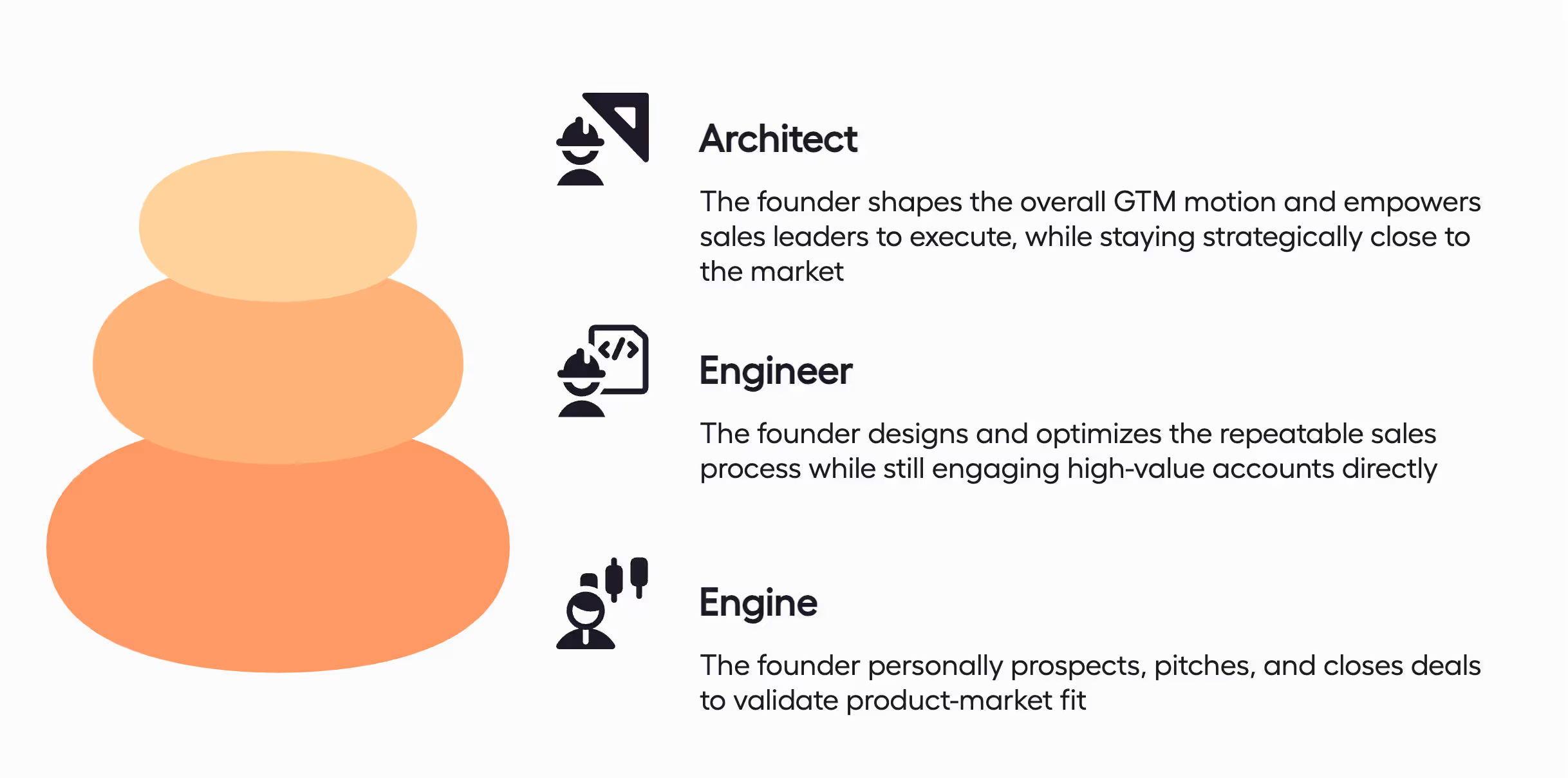
Founder-led sales is a go-to-market strategy in which the founder maintains direct ownership of the sales process, customer relationships, and revenue architecture throughout the company's growth trajectory, not just during the pre-revenue phase.
Rather than treating sales as a function to hand off as quickly as possible, founder-led sales positions the founder as the permanent architect of the revenue engine, with their specific role evolving as the company scales.
So, in practice, that involvement usually evolves through three phases:
How founder sales differs from hiring a sales team early
The core difference between founder-led sales and early delegation is that founders can simultaneously validate, build process, and iterate on messaging in real time, and a professional sales hire cannot.
When the founder leads sales, every conversation becomes usable data. Each call sharpens the ICP, clarifies the value proposition, and reveals what actually moves a deal forward. (And sometimes what kills a deal just as fast.) In other words, the sales process is being discovered in real time. 🧠
Professional sales hires work best when the process is already defined, the value proposition is battle-tested, and the methodology is documented.
Hire too early and the outcome is predictable: the new rep lacks institutional knowledge, grows frustrated with ambiguity, and consumes management time the founder urgently needs elsewhere.
Most B2B operators agree: close at least 10–15 deals and document your winning patterns before making the first dedicated sales hire. The playbook comes first, then the person to execute it.
Why is founder-led sales important for your startup?
Founder-led sales is important for your startup because the founder brings a combination of authentic credibility, deep product knowledge, and direct market access that no early-stage hire can replicate.
When a prospect speaks with the person who built the product and has real skin in the game, trust forms faster and sales cycles shorten, because the perceived risk of making a commitment drops significantly (buyers can feel when someone truly understands the problem 🤝).
Founder-led sales also acts as the company’s most important market intelligence system.
Every conversation reveals objections, hidden buying criteria, and unexpected use cases. Those signals often disappear once layers of reporting and internal summaries enter the picture.
When founders delegate sales before completing this discovery work, they risk building a sales organization that efficiently sells the wrong thing to the wrong people. That failure pattern is surprisingly common in B2B startups, and consistently expensive to reverse.
From a capital efficiency perspective, founder-led sales introduces no new fixed costs.
The foounder’s time is already committed to the company, which creates healthier early unit economics. And those economics are exactly what seed and Series A investors pay close attention to when evaluating early-stage startup.


What are the real benefits of founder-led sales
Founder-led sales produces five distinct, compounding advantages that extend well beyond simply generating early revenue: unmatched credibility, shorter sales cycles, a direct feedback loop, referral-generating relationships, and favorable unit economics that investors actively evaluate.
That combination is why many successful SaaS companies treat founder sales as a strategic advantage rather than a temporary phase.
- Unparalleled knowledge and credibility 🧠
No hired salesperson can replicate the depth of understanding a founder has about the product, the problem space, and the competitive tradeoffs.
When prospects ask detailed technical questions or raise implementation concerns, founders respond with real authority, because they designed the solution and made the tradeoffs themselves.
- Shorter sales cycles and substantially higher close rates ⚡
Prospects perceive less risk when speaking with the person who built the product.
Research shows that founder-led sales produce substantially higher close rates than sales cycles led by professional reps at equivalent stages, and founders move at decision-making speed that organizations with multiple approval layers simply cannot match.
- A direct, unfiltered feedback loop 🔁
When founders stay in direct contact with customers through sales conversations, feedback arrives without organizational hierarchy filtering out the nuance.
Companies that insulate founders from customers early often continue executing strategies the market has already rejected, because those signals never reach the people who can act on them.
- Authentic relationships that drive referrals 🤝
Customers who feel a personal connection to the founder become advocates rather than just accounts. These relationships reduce future customer acquisition costs through referral and word-of-mouth channels, which are consistently among the lowest-cost acquisition channels available.
- Favorable unit economics and investor confidence 📈
Founder time spent on sales does not represent an additional fixed cost the way a dedicated sales hire does. The result is favorable LTV:CAC ratios that seed and Series A investors evaluate closely.
7 steps to build a founder-led sales strategy that closes deals
Now that you know what founder-led sales can do for your pipeline, let's get into how to actually build it.
Step 1: How do you define your ideal customer profile for founder-led sales?
You define your ideal customer profile for founder-led sales by working backwards from your first 10-20 closed and lost deals, identifying the specific characteristics that distinguish customers who paid, stayed, and referred from those who churned or never converted.
Early-stage ICP assumptions are almost always partially wrong, and that is a predictable fact about early-stage companies rather than a failure of imagination.
Only direct customer conversations produce the empirical evidence needed to know who will actually buy, renew, and refer (and that clarity is what separates a high-quality lead list from a wasted outreach budget).
The components to define:
- Industry/vertical and company size
- Growth stage and revenue range
- Primary decision-maker role and who influences the buy
- Trigger events that precede a purchase (funding rounds, leadership changes, expansion, compliance deadlines)
- Disqualifiers that signal low-fit accounts
Importantly, the ICP is a living document. A critical pattern we see repeatedly: founders build ICPs that describe who they want to sell to, not who has demonstrated they will actually buy. The best ICPs are living documents, updated with every closed and every lost deal.
As your customer base grows, that ICP work also lays the foundation for smarter prospect segmentation: grouping contacts by industry, role, or buying stage so outreach stays relevant as volume scales.
What are the 5 buying signals that reveal a high-intent prospect?
- Consuming comparison content 📊: spending time on competitor comparison pages, downloading battle cards, or evaluating alternative solutions signals the internal debate is live.
- Asking about pricing and commercial terms 💰: internal validation is done; they are building the investment justification.
- Researching you across multiple channels 🔍: news coverage, review platforms, LinkedIn, and analyst reports simultaneously.
- Scheduling back-to-back meetings and inviting additional stakeholders 📅: one of the strongest conversion predictors in the research.
- Asking detailed implementation, integration, and roadmap questions 🛠️: they are in final evaluation stages before committing.
These signals indicate a prospect has moved from passive awareness into active consideration, and founders who recognize them can prioritize conversations most likely to convert rather than spreading their limited time evenly across the pipeline.
Step 2: How do you build a founder sales pitch that actually lands?
A founder sales pitch lands when it leads with the prospect's specific challenge rather than the company's features, follows a three-part structure of hook, credibility, and outcome articulation, and closes with a specific call to action that names the exact next step.
The most common mistake founders make? Leading with what they built.
The most effective pitches lead with what the prospect is dealing with. Your personal story, your funding, your feature list, those are supporting details, not opening moves 🎯.
The research-validated structure has three parts:
- The hook: A surprising fact, a bold statement, or a pointed question tied to the prospect's specific pain, not a generic industry claim. The hook must be relevant to their industry specifically. A hook that lands with a SaaS company rarely lands the same way with a professional services firm.
- Credibility: Why you, specifically, are positioned to solve this, grounded in your founder experience and the problem you observed, not in a product feature list.
- Outcome articulation: Translate your solution into customer transformation. "Reduces manual admin time by 10 hours per week" is infinitely more compelling than "includes workflow automation."
📚 The same logic applies to outreach. If you're wondering how to personalize at scale without it feeling templated, we cover the most effective approaches in our cold email personalization guide.
What are the best tips for effective founder-led sales pitches?
From our experience across hundreds of B2B campaigns, here are our best tips:
- Specificity and relevance 🎯: reference the prospect's recent announcements, industry trends, and competitive context, not a generic positioning statement.
- Brevity and single-outcome focus 📌: one primary benefit per pitch. Multiple messages create skepticism, not enthusiasm.
- Prospect-focused, not founder-focused 👥: funding, headcount, and milestones distract from the one thing prospects care about, which is whether this solves their problem.
- Authentic conviction 💬: speak from genuine belief in the solution, not from a rehearsed script.
- Clear, specific call to action 📅: name the exact next step with two offered time options, not "let's stay in touch."
Step 3: How does founder-led sales outreach actually work?
Founder outreach runs through a few distinct channels, and each one plays a different role depending on where you are in the process.
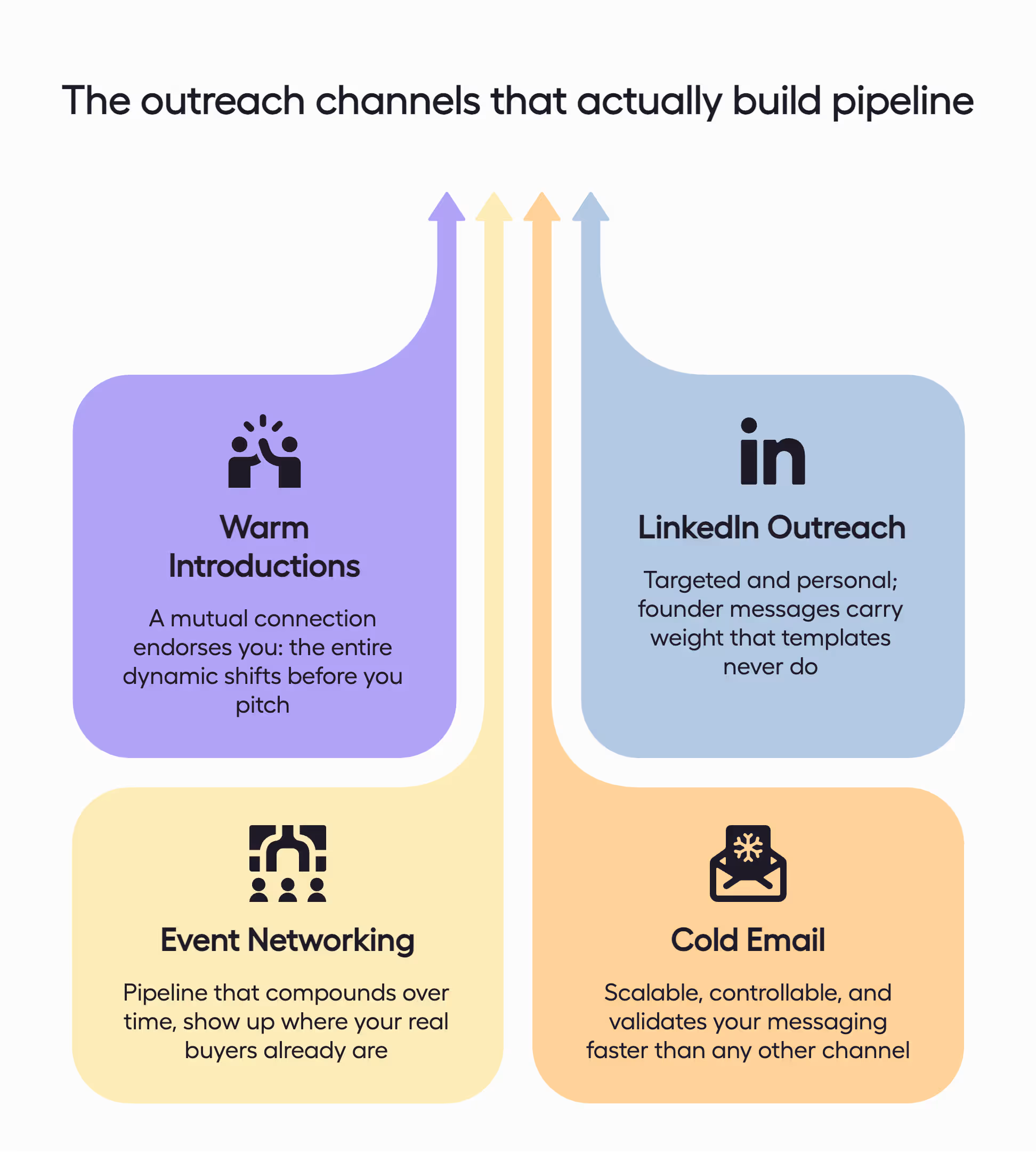
Warm introductions are the highest-converting channel you have access to right now. A mutual connection's endorsement changes the entire dynamic of a first conversation. Map your network deliberately before touching anything else.
LinkedIn outreach works well for targeted, relationship-first prospecting, particularly for founder-to-founder conversations where a personal message carries real weight.
Event-based networking builds pipeline that compounds over time, especially in industries where your buyers regularly gather in the same communities, conferences, or forums.
Cold outreach is where most founders eventually land, and for good reason. It is the most scalable channel, the most controllable, and the fastest way to validate messaging across a large segment of your ICP without needing a warm connection first. When built correctly, it generates qualified pipeline within days.

Cold email is also where the gap between "doing it" and "doing it well" is widest. Personalization at the right depth, targeting the right accounts at the right time, and sequencing follow-ups without tipping into spam territory, these are the variables that separate a 2% reply rate from a 10%+ one.
After writing hundreds of thousands cold emails, here are our best tips on what a high-converting cold email should include:
- Personalized opening line ✍️: references something specific about the prospect's company, a recent announcement, expansion, or industry context. This is the signal the email was not mass-generated.
- Credibility statement 🏆: one sentence of relevant experience with companies facing the same challenge. Brief, specific, and grounded in reality.
- Outcome claim 📈: a concrete result achieved for a similar company, framed as a specific, verified outcome. (For example: "reduced 12-15 hours of manual reconciliation to 2-3 hours per week.") Never fabricated.
- CTA with two time options 📅: a specific 20-minute call request with two offered slots, not "let me know if you're interested."

The outcome claim in your cold email must be a real, verified client result. A fabricated number might get a reply, but it will unravel the moment the prospect asks a follow-up question, and it will cost you the deal and your reputation simultaneously.
If you're not sure what to send when there's no reply, we've put together 7 B2B follow-up email templates that keep the conversation going without feeling like a nudge
Step 4: How do you run a discovery call that does the closing work for you?
Most founders treat discovery calls as a warm-up. The research says otherwise: the discovery call is where deals are won or lost, not the demo.
The founder's goal is not to pitch but to surface true pain points, understand the decision-making process, and assess whether genuine fit exists.
The structure that consistently works begins with a rapport-building opening that repositions the conversation as collaborative exploration. The specific language matters more than most founders realize 👇:
"I'm really hoping to understand more about how your team is currently handling [challenge] and whether the approach I mentioned might be relevant. How does that sound?"
That single sentence reframes everything. After it, prospects share far more openly, and the rest of the call generates the information you actually need to close.
From there, use open-ended questions that cannot be answered with yes or no.
- "Walk me through how your team currently handles [process], what does that look like right now?" generates a detailed, revealing answer.
- "Do you struggle with [process]?" generates a yes and stops the conversation cold.
How do you identify the hidden buyers in a B2B deal?
Modern B2B decisions typically involve 6-10 stakeholders. Most of them are invisible until late in the sales cycle. We see this constantly in client campaigns. 👀
Hidden buyers typically come from procurement, finance, or legal, and are focused on risk, cost containment, and vendor safety, not product capabilities. Research shows hidden buyers are 70% more likely to reject vendors they do not recognize and 31% more likely to reject vendors they have not encountered before.
For early-stage founders, that's a real problem.
Surface them early with one direct question during the discovery call:
"Walk me through the full decision-making process. Who all needs to approve this before you can move forward? Are there procurement, compliance, or finance considerations I should be aware of?"
Once identified, engage them directly rather than waiting for them to arrive with objections at the finish line. Build brand credibility through third-party reviews, thought leadership, and analyst coverage, because those are the channels hidden buyers actually consume.
Step 5: How do you handle objections without losing the deal?
An objection is not a rejection. Even when it feels that way in the moment 😅.
The moment you treat objections as attacks to deflect, you lose the deal that was still winnable. The most effective founders view each objection as a signal about what the prospect needs to feel confident enough to commit.
For every objection, the process is the same: acknowledge, clarify, address with tailored evidence.
Here is how that looks across the most common types:
- 💰 Price: Redirect to ROI. "Help me understand, what level of time savings or efficiency improvement would make this worthwhile for your team?"
- ⏰ Timing: Explore the real constraint. Is there a genuine blocker, or is it hesitation framed as logistics?
- 🔄 "We already have a solution": Validate that, then probe for gaps. "That's helpful to know. What's the one thing your current approach doesn't do well?"
- 👥 "We need to involve other stakeholders": Embrace it and get them into the conversation early, before they become a last-minute veto.
After addressing any objection, ask this exact question before moving on: "Is there anything else holding you back from moving forward?" It sounds almost too simple, but it consistently surfaces remaining concerns before they quietly kill a deal you thought was closed.
Step 6: What metrics should you track to measure founder-led sales success?
The five metrics that measure founder-led sales success are Customer Acquisition Cost (CAC), CAC Payback Period, LTV:CAC Ratio, Sales Cycle Length, and funnel stage conversion rates.
Track these from day one, because they also determine whether your eventual sales hire will succeed.
Most founders in this phase track the wrong thing first, focusing on volume rather than the economics behind each closed deal. We've audited enough B2B funnels to know that high activity with poor unit economics is not a win (and it is more common than sales leaders want to admit).
Let’s walk through the metrics one by one:
- Customer Acquisition Cost (CAC) 📊
Total investment to acquire each customer, including your time at opportunity cost, tools, and marketing spend. Founder-led CAC is typically lower than a full sales team's CAC, and that gap is worth measuring deliberately.
- CAC Payback Period ⏱️
Months to recover acquisition cost through gross margin contribution.
Good: 12 months or less.
Best performers: 8-10 months.
Beyond 12 months signals either the wrong customer type or insufficient product value for the price being charged.
- LTV:CAC Ratio 📈
Minimum 3:1 for sustainable profitability; elite operators target 4:1 or higher. A 2.5:1 ratio is acceptable during product-market fit validation, but treat it as a temporary condition, not a baseline.
- Sales Cycle Length 📅
Days from first contact to close. Track this to identify bottlenecks in your process. As you iterate, this number should gradually decrease. Stagnation or an increase signals a stage that needs attention.
- Funnel Stage Conversion Rates 🔁
Track three ratios: outreach to meeting, meeting to proposal, proposal to close. Each gap tells you which stage is leaking and where to focus your improvement effort next.
Step 7: How do you scale founder-led sales without losing what made it work
You scale founder-led sales by evolving the founder's role rather than exiting it, hiring your first sales rep as an executor of a documented process rather than a manager, and maintaining your ICP, pitch, and objection-handling in formal documentation that can be taught and refined.
The most common scaling mistake is not a bad hire. It is the decision to step out of sales entirely and assume the results will follow. They rarely do, and the realization usually comes three months and one frustrated hire later. 😬
Five principles that consistently work across the companies we've built outbound engines for:
- 🏗️ Never fully exit sales, evolve the role. Stay involved in significant and strategic accounts. Many of the most successful SaaS founders continue closing meaningful deals at scale. The goal is a changing role, not an exit.
- 🎯 Your first sales hire is a player, not a manager. Hire someone who can execute your process before anyone manages anything. Bringing in a head of sales as your first hire is the single most consistent failure pattern we see in this phase.
- 🧭 Maintain alignment between your sales team and company mission. Salespeople will sometimes optimize for closing in ways that drift from your core positioning. Stay involved in major deals and strategy discussions to prevent that drift before it becomes a culture problem.
- 📋 Formalize your documentation. Your ICP, your pitch, your objection-handling approach, your sales process: all of it needs to move from your head into documents that can be taught, refined, and handed to someone who was not in the room when you figured it out.
- 🔀 Build toward a hybrid GTM. Founder-led and account-based for enterprise, product-led for mid-market expansion. Founder-led sales is the foundation, not the permanent ceiling.
If you're at the stage where you're considering bringing in external pipeline support, we've put together an honest look at the top lead generation companies to help you compare.
What are the real challenges of founder-led sales you need to know?
Founder-led sales has real limitations, and most founders only discover them mid-execution (usually at the worst possible moment).
The model works incredibly well early on, but it introduces a few operational constraints that become more visible as the company grows.
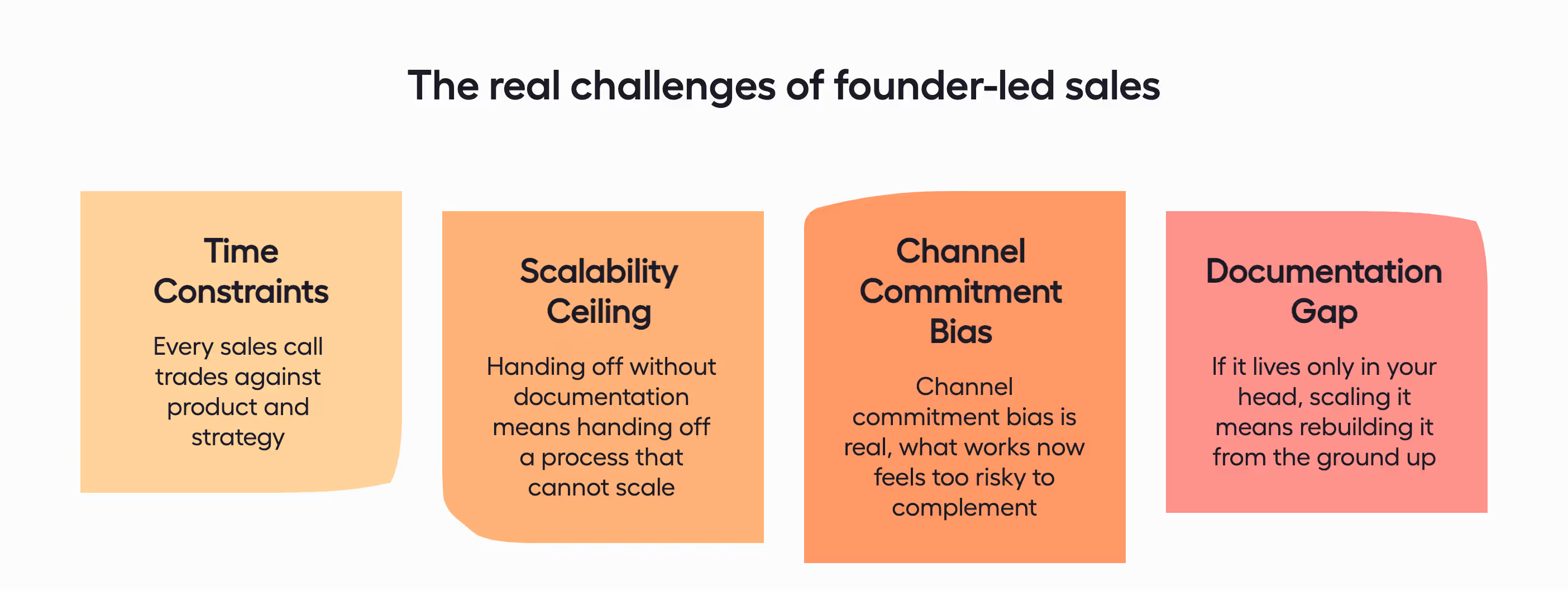
⏳ Challenge 1: Time constraints and capacity limits
Every hour in direct sales is an hour not in product, hiring, or strategy. That tradeoff gets harder as the business grows, not easier.
Mitigation: Block sales time deliberately and protect it like board prep.
📈 Challenge 2: The scalability ceiling
Handing off the sales motion without a documented process is a pattern we see fail consistently. The new hire lacks the credibility and customer intimacy you built, and prospects notice.
Mitigation: Hire into a working, documented process. Never hand off a blank slate.
🔒 Challenge 3: Over-attachment to founder-led sales
When founder-led sales works extremely well, founders sometimes hesitate to invest in additional channels like marketing, outbound programs, or product-led growth.
Success creates a form of channel commitment bias. What is already working feels too valuable to complement with anything new (which is understandable). But companies that scale successfully usually combine multiple growth motions.
Mitigation: Treat founder-led sales as the foundation, not the ceiling. And invest in lead generation strategies that compound alongside it.
📂 Challenge 4: The documentation and transition gap
If the entire sales process lives in your head, the company has a single point of failure. When scaling time arrives, that undocumented knowledge becomes an expensive bottleneck.
Mitigation: Document from customer one, not from the day you decide to hire.
Great founders sell. Smart founders use Hypergen.
At some point, every founder hits the same wall. The process is working, the pipeline is moving, and the next constraint is not strategy or messaging. It is time.
There are only so many hours in a week, and founder-led outreach at the volume the business actually needs to grow is not a sustainable solo operation. 😅
That is the specific problem we solve.
We take the ICP and messaging a founder has already validated through their own sales conversations and turn it into a cold outreach engine that runs without the founder carrying it alone: lead research, personalized campaign execution, and CRM integration, handled by a dedicated team.
You did the hard part. You figured out what works. Now let's scale it. 🚀
Frequently asked questions
Popular options include HubSpot, Salesforce, or Pipedrive for CRM; Warm or Instantly for cold email; LinkedIn Sales Navigator for prospecting; and Clearbit or Hunter for contact intelligence. Lean tooling stacks consistently outperform tool-heavy setups, as administrative overhead directly competes with selling time.
Pipedrive or HubSpot work best for early-stage teams because they require minimal configuration and no dedicated IT support. The single most important criterion is that the founder will actually use it consistently. Many successful teams start with spreadsheets before upgrading.
Train a sales team on founder-led sales by documenting the founder's ICP, proven pitch, objection-handling approaches, and closed-deal patterns into a repeatable playbook, then have the first hire shadow real calls before executing independently.
Founder-led sales delivers its strongest results in B2B enterprise software, infrastructure, and specialized services, where buyers value deep expertise and meaningful implementation timelines. It is less critical in high-volume, short-cycle, or low-friction categories where product-led or inbound approaches are more efficient.
Around $1M ARR or 50-100 personally closed customers is the consistent threshold from leading SaaS investors. Critically, stepping back from executing sales is not stepping back from sales involvement. The founder's role evolves from executor to strategy maker, never to absent.
Don’t miss these
Get your first lead this month
14 days to get started. 7 days to get your first lead on average.


