

21 top ways to generate high-quality B2B sales leads [2026]
TL;DR: How to generate high-quality B2B leads in 2026
- Lead quality beats lead volume: most teams waste time on prospects who were never going to buy.
- A “high-quality” lead = ICP fit + real intent + actual authority (miss one, and the deal stalls).
- Use intent signals (funding, hires, tech changes, competitor moves, announcements) to time outreach when buyers are in-market.
- Cold emails win when they’re personalized, short (50–125 words), and CTA-light (one clear ask).
- Fix deliverability first (SPF/DKIM/DMARC, warmup, domain rotation) or your best copy won’t even show up.
- Add lead scoring so sales talks to the most sales-ready accounts, not “random MQLs.”
- Pair fast outbound (days/weeks) with compounding inbound (SEO/content/LinkedIn) for steady pipeline.
- For bigger deals, run ABM across multiple stakeholders, because committees buy, not individuals.
- Speed matters: replying within minutes dramatically increases conversions and keeps momentum.
- When cold channels stall on senior buyers, invite them onto a podcast: a guestinvitation gets replies from people who filter everything else, and each episodedoubles as content.
Let's talk about something that keeps most B2B marketers up at night. Getting quality B2B sales leads is the #1 challenge for 61% of marketers right now. So if you're struggling with lead generation, you're definitely not alone in this.
Around 80% of leads never turn into customers. And that’s not a performance issue, it’s a qualification issue. Most companies are burning through budget and time chasing prospects who were never going to buy anyway.
After running 120+ outbound campaigns across 15+ countries, we’ve seen a clear pattern: qualified leads convert 3–4x better than bulk contact lists.
And the companies winning in 2026 aren't obsessing over lead volume. They're obsessing over lead quality.
In this guide, we’re breaking down 21 practical strategies for how to generate B2B leads who actually move through your pipeline, not just fill up your CRM and disappear.
Let’s get into it. 🎯
What's actually different about B2B lead generation in 2026
Let’s start with the obvious: B2B buying has changed, a lot.
Here’s what’s different, and why it matters:
- Buying committees are larger and more complex.
Most deals now involve 6 to 10 decision-makers, often spread across finance, IT, operations, and procurement. We see it constantly in client campaigns. That means your message has to resonate across departments (and no, a one-size-fits-all pitch won’t cut it).
- Buyers make most of their decisions before talking to sales.
About 70% of the journey happens independently. Prospects are comparing solutions, reading third-party reviews, and building shortlists before your SDR even sends a calendar link.
(If you’re not visible during this stage, you're already behind.)
- Intent signals and precision targeting replaced volume-based outreach.
We shifted from single-contact outreach to multi-stakeholder campaigns targeting finance, IT, and operations simultaneously because that's how deals actually get approved now.
- Deliverability is tougher, and it matters more than ever.
17% of cold emails never reach the inbox, blocked by spam filters or bouncing entirely. Open rates dropped from 36% to 27.7% between 2024 and 2025. That’s why we implement multi-domain strategies and stricter authentication to combat the 17% non-delivery rate.
- Speed and quality now beat volume.
70% of B2B teams lean on ABM. Responding within 5 minutes increases conversion by 21x. Not a typo. Twenty-one. That stat alone should change how you prioritize outreach.
What makes a B2B lead "high-quality" in 2026?
Now that we’ve covered how the game has changed, let’s break down what actually makes a lead worth your team’s time in 2026.
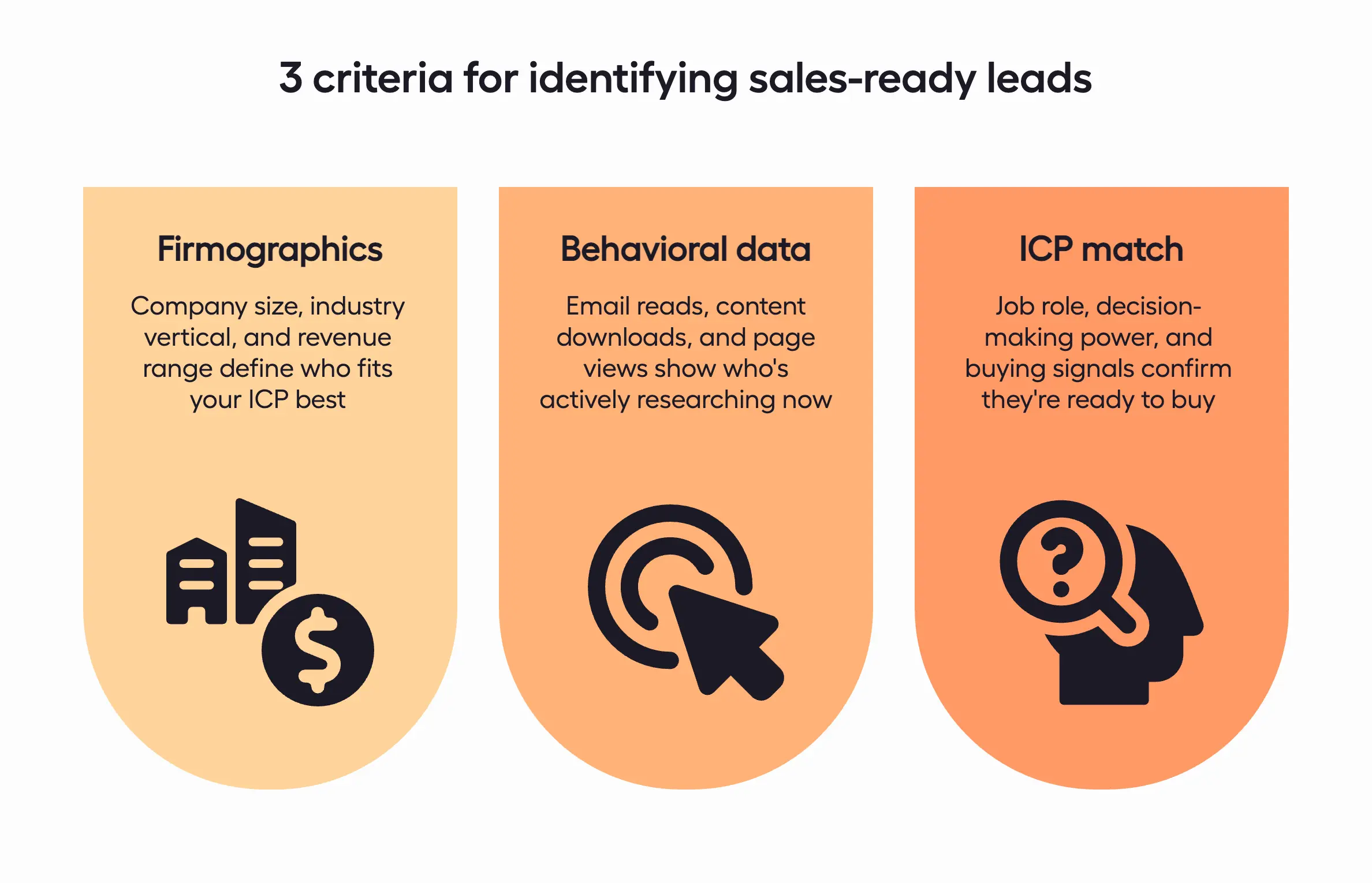
A high-quality B2B lead checks three boxes:
- Right company profile (ICP fit)
- Real buying intent
- Decision-making authority
Without all three, you're basically spinning your wheels on conversations that won't go anywhere.
1. Firmographic fit: does the company match your ICP?
This is your baseline filter.
✅ Industry
✅ Headcount
✅ Revenue range
✅ Tech stack compatibility
✅ Growth stage
If a lead misses the mark here, even strong engagement won’t save the deal.
2. Behavioral signals: is the prospect showing real interest?
You're not looking for random traffic. You’re looking for buying signals — and they’re measurable.
📈Look for patterns like:
- Repeat visits to high-intent pages (e.g. pricing, integrations)
- Time spent on site (not a quick bounce)
- Email engagement and reply depth
- Post-click behavior from cold outreach
- Social activity (like LinkedIn profile views)

In over 100 campaigns, we’ve found leads who visit pricing or ‘About’ pages within 48 hours of email outreach are 3x more likely to book a call. (Because they’re not just curious, they’re evaluating.)
3. Authority and qualification: can they actually buy?
BANT still matter (Budget, Authority, Need, Timeline), but with a modern lens.
A VP with zero purchase authority is a false positive. Don’t let senior titles fool your SDRs.
Also, know the difference:
- MQL: Engaged, but not ready
- SQL: Meets key criteria, ready for outreach
- Sales-ready: Actively comparing vendors now
How to generate more B2B leads? 20 strategies that work
You already know the game has shifted and you know what a quality lead looks like, now it's tiem for execution.
The 20 tactics below map to different stages of the buyer journey, from cold outreach to late-stage conversion. Some work better depending on your industry, sales motion, and resources. (No two ICPs buy the same way.)
Let’s get into it.
Strategy #1: Use buyer intent data to build better lead lists
Generic contact lists won’t cut it anymore. (You’ve probably seen this firsthand.) You need to build quality lead lists from the ground up.
Today’s high-converting lead gen starts with intent signals, not static data. Track behaviors that suggest active interest, such as:
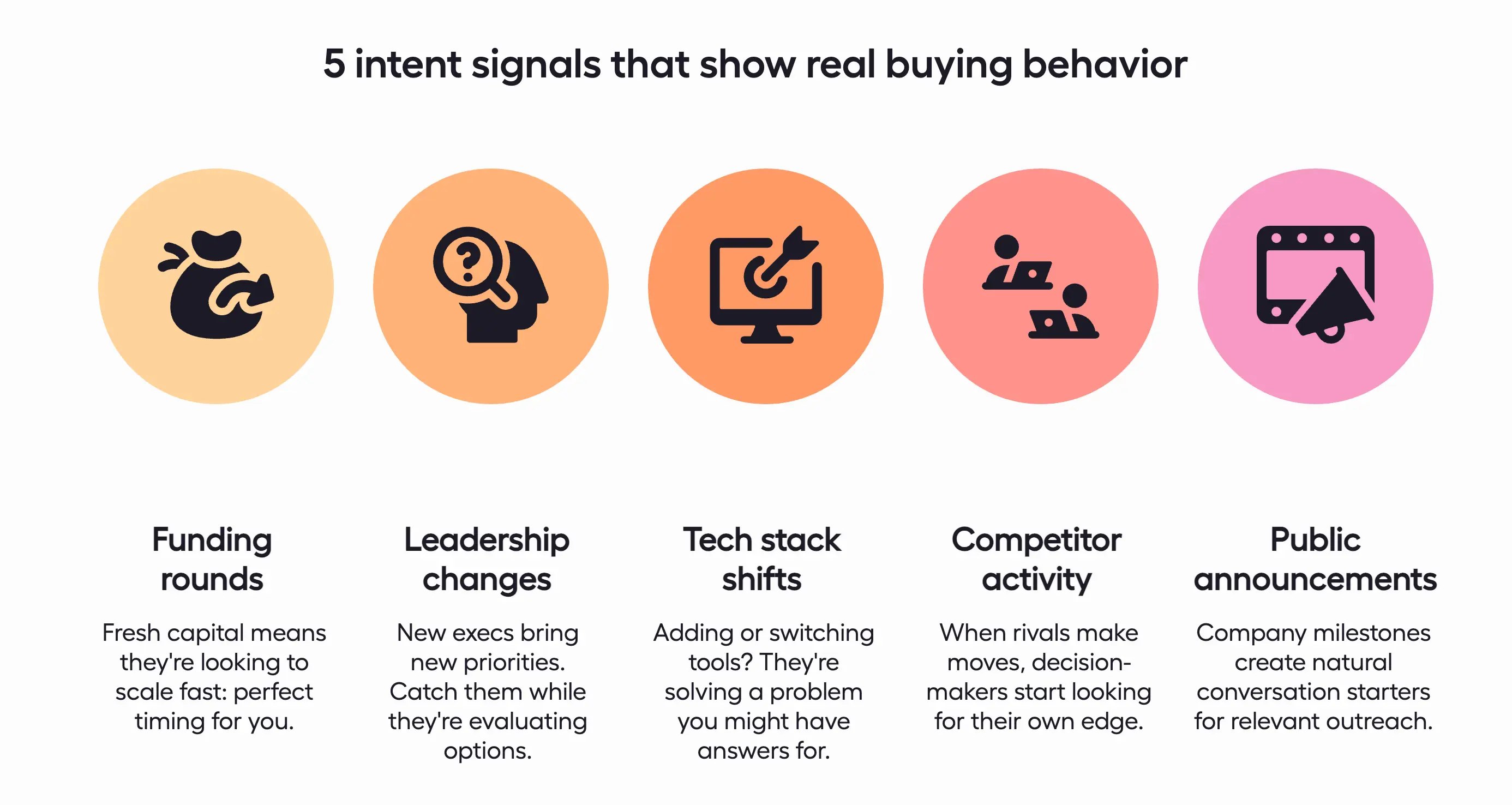
📊Marketers using intent data report 93% higher conversion rates than those using traditional lists.
Tools like Clay AI, 6sense, ZoomInfo, and Bombora let you monitor these signals at scale. We love using Clay for lead gen, as it allows us to analyze 100+ real-time buying triggers for clients, including Salesforce implementations, "Director of Sales" roles, and Series B funding events.
Why it works:
You're reaching out to companies already researching solutions, not cold-emailing accounts that haven’t shown a single sign of intent.

Set up automated alerts for intent signals in your target accounts. The faster you reach out after they show interest, the higher your chances of actually getting a response instead of radio silence.


Strategy #2: Fix your cold email deliverability before you send emails
Let’s start with the part no one wants to talk about, but absolutely has to. If your emails aren’t reaching inboxes, nothing else matters.
To build a system that works at scale, your infrastructure needs to be locked in from the start. Here’s what that looks like:
🔧Technical setup (non-negotiable):
- Authenticate every sending domain with SPF, DKIM, and DMARC
- Use dedicated domains for cold outreach (separate from your main business domain)
- Warm up each domain gradually (start with 5–10 emails/day, increase by 10–15% every few days)
- Rotate domains to spread volume and avoid getting flagged
📈 We typically manage 15 domains and 30 email accounts (a combination of G suite and Outlook) for every 7,500 contacts. This keeps inbox placement above 95%, even at scale.
And also, monitor these 4 metrics weekly:
- Bounce rate: stay under 2%
- Spam complaints: keep below 0.3%
- Domain reputation: track sender scores using tools like Google Postmaster
- Deliverability testing: run previews before every campaign
Still struggling with emails landing in spam? Here are 12 essential email deliverability practices that actually work.
Strategy #3: Send cold emails that people actually want to read
Once your emails are landing, the next challenge is getting responses.
Mass-blast emails don’t convert.
Personalized cold emails get 2-3x higher reply rates than templated blasts because they show you've actually done your homework on the recipient (not copy-pasted their name into a template).
🎯Real personalization goes beyond {FirstName}:
- Mention recent funding, hires, or press
- Reference pain points by vertical or persona
- Point to content they’ve published or engaged with
- Call out job postings or tech hires tied to your solution
- Highlight shared connections or events
Keep it tight: 50–125 words max. One call-to-action. Clear, specific, respectful of time.
Test messaging continuously (and we mean obsessively) using proven cold email strategies that drive replies. Small improvements in subject lines, opening sentences, and CTAs compound across hundreds of weekly emails.

A/B test one element at a time. Subject lines one week, opening sentences the next. Testing everything at once makes it impossible to know what actually made the difference in results.
📚If you're struggling to craft emails that actually get read, check out our complete guide on how to write cold emails that drive results.
Strategy #4: Use lead scoring to focus on your best prospects
Not every lead should go straight to sales (tough truth, but important). Lead scoring helps your team focus on the right opportunities by assigning point values to each lead based on firmographic fit and behavior.
📈Proper lead scoring boosts conversion rates by 20% and improves sales productivity by 20%. It helps reps focus on buyers who are actually ready, not random MQLs who clicked a blog once.
And AI-powered scoring takes this further. Campaigns using AI-enhanced models have shown 75% higher conversion rates than static point-based systems.
Review your scoring model quarterly. The signals you think matter may not match the ones that actually lead to deals.
Strategy #5: Turn your knowledge into lead-generating assets
Let’s shift from chasing leads to attracting them.
Gated long-form content works because it positions your team as a trusted expert and gives you qualified inbound leads. According to recent benchmarks, 61% of B2B marketers say gated content produces their highest-quality leads.
Why? People willing to share their contact info for in-depth resources are already invested.
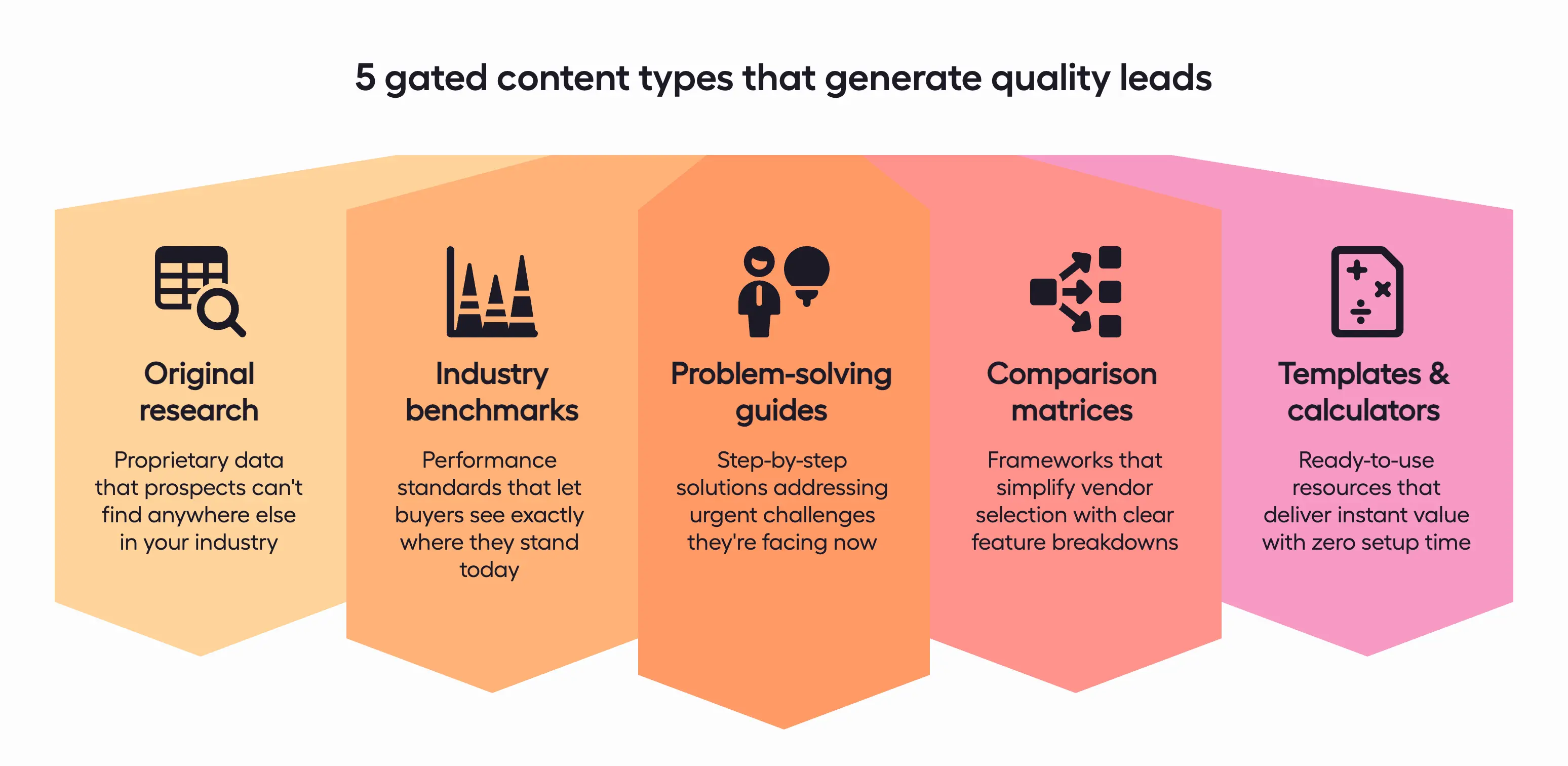
Require form fills for access (name, email, company, role) then use progressive profiling to gather more data over time (don’t ask everything upfront). Route ICP-fit leads to sales automatically for faster follow-up.
Create content that solves specific problems your prospects face right now, not generic thought leadership. "How to reduce churn in SaaS" beats "The future of customer success" every time. 📚
Strategy #6: Use LinkedIn to find and connect with decision-makers
LinkedIn works, when used correctly.
Sales Navigator lets you filter by title, company size, industry, seniority, and activity. This precision targeting for B2B lead generation beats random cold outreach every single time.
Here's the connection strategy that actually works:
- Send personalized connection requests mentioning why you're connecting (not "I'd love to add you to my network")
- Engage with their content genuinely before pitching anything
- Wait 3–5 days post-connection before reaching out
- Lead with value, not with a pitch
And don’t skip the warm-up.
Comment thoughtfully on prospects' posts. Share relevant insights that show you know what you're talking about.
Prospects who recognize your name from LinkedIn are far more receptive to email or phone follow-up. Multi-channel touchpoints build familiarity. And trust.
Strategy #7: Target exactly who you want with LinkedIn advertising
LinkedIn Ads are basically built for B2B lead generation. You can target by job title, seniority, company size, industry, and even specific companies (perfect for ABM campaigns).
🔍What makes LinkedIn Ads different:
- The quality metrics justify the investment: LinkedIn delivers 14-18% MQL-to-SQL conversion, double Google Ads' 7-12% rate
- The cost per click is higher (no sugar-coating that), but premium leads come with larger deal values averaging $85K-$125K
- Audience-level targeting for different stakeholders within the same company, addressing their unique priorities and pain points.
This means you can show ROI calculators to CFOs, demand gen content to marketing directors and case studies to sales leaders.
Because different stakeholders = different priorities.
Strategy #8: Write SEO optimized blogs that bring qualified leads to you
If your ideal buyer is researching on Google (they are, you can be sure), SEO is a long-term engine for qualified inbound leads.
🎯Create how-to guides, comparison posts, problem-solving articles, and buying guides targeting bottom-funnel keywords showing buyer intent.
Long-form blog posts (1,900–2,000+ words) tend to rank better and convert more traffic. Add embed CTAs, pop-ups, and downloadable upgrades to capture intent as it happens.
SEO-driven inbound leads often make ideal targets for our cold email campaigns because they're already researching solutions in your space.
And yes, SEO takes 3–6 months to show returns, which is why we recommend pairing it with faster cold outreach that delivers meetings in days (you need pipeline now while building long-term organic presence).
But the compound effect of SEO is powerful: content you publish today can generate leads for years with minimal ongoing investment
Strategy #9: Win enterprise deals with personalized ABM campaigns
ABM flips traditional B2B lead generation tactics completely upside down.
Instead of generating leads then qualifying them, you pre-select high-value target accounts and build campaigns specifically for those companies. Over 70% of B2B marketers now use ABM to improve ROI.
ABM execution looks like this:
- Identify 10-50 target accounts matching your ideal customer profile
- Research each account deeply (challenges, initiatives, stakeholders)
- Create personalized campaigns for each account tier
- Coordinate multi-channel outreach across email, LinkedIn, ads, and direct mail
- Involve sales and marketing together from day one
When you personalize at the account level rather than treating prospects as interchangeable contacts, decision-makers notice the difference and actually respond.
ABM takes more upfront effort per account, but the lift is worth it. Fewer accounts. Higher returns.
Strategy #10: Run webinars that fill your calendar with demos
If you’re not using webinars, you’re missing one of the most effective lead magnets in B2B.
53% of marketers say webinars deliver the highest quality TOFU leads, and for good reason.
Prospects self-select based on topic relevance and actually invest time learning from you (passive scrollers don't register for hour-long webinars).
Choose topics addressing specific pain points:
- Actionable training or how-to sessions
- Industry trends and commentary
- Educational product demos (not sales pitches disguised as education)
- Expert panels or fireside chats
- Deep dives into real customer success stories
Promote via email, LinkedIn, paid media, and partnerships. And collect registrations using qualifying questions: company size, role, or buying timeline.
🕒Then, and this matters, follow up within 24 hours. Send the recording, key takeaways, and a recommended next step. Leads are warmest right after the event.
Record every webinar and repurpose it into gated assets, short video clips, and blog content. A single webinar can fuel lead gen for months!
Strategy #11: Add live chat to engage prospects in real-time
Most buyers don’t want to wait for a response. Live chat and chatbots let you meet visitors in the moment they’re researching, without sending them to a form and hoping they follow up.
📊Here’s some interesting statistics worth noting:
- 23% increase in website conversion rates with chat
- 10–20% of chat interactions turn into leads
- Visitors who chat convert at 2x+ the rate of passive viewers
So use chatbots for FAQ automation and lead qualification, then route high-value prospects to live reps. This hybrid approach keeps your team lean without sacrificing engagement.
Strategy #12: Use referrals to generate pre-qualified prospects
Referrals convert 30% better and they work great because they come with built-in trust. They convert better, close faster, and often stick longer.
But most companies don’t ask for them consistently,or systematize the process.
So here is how to build a referral engine:
- Provide email templates and easy ask options
- Reward referrers meaningfully (discounts, gifts, exclusive access)
- Track and thank referrers promptly
- Close the loop by reporting back on referred leads
- Make it a regular conversation, not a one-time ask
📌Train your customer success team to ask for referrals during positive interactions: successful implementations, renewal calls, positive feedback. Happy customers want to help when you make it simple for them!
We’ve seen some of our best clients refer 3–5 companies after successful campaigns. These leads close faster and stick longer because someone they trust already vouched for us.
Strategy #13: Use Google Ads to intercept ready-to-buy searches
When a prospect Googles “[your solution] for [their problem]”, they’re actively evaluating, not passively scrolling.
That’s where Google Ads becomes essential. Paid search captures prospects with intent to buy, often near the end of their research cycle.
Benefits of paid search for B2B:
- Target bottom-of-funnel searches
- Appear above competitors on high-value keywords
- Track conversions from click to closed deal
- Test copy quickly and scale what converts
- Bid on competitor brand terms (strategically)
Always match landing pages to the ad intent. A “best email platform for SaaS” search shouldn’t land on your homepage, it should land on a page tailored to that exact topic.
Our experience shows paid search works best when paired with organic visibility. When buyers see you in both spots, your credibility increases.
Google’s Quality Score impacts cost-per-click and ranking. So improve ad relevance, keyword match, and landing page experience to drive results without wasting budget.
Strategy #14: Expand your reach with content syndication
Most B2B companies rely heavily on their owned channels, but content syndication lets you reach new audiences at scale without reinventing your content strategy.
Content syndication distributes your best content (whitepapers, articles, research) through third-party networks reaching audiences beyond your website traffic. You receive contact information of prospects who download content on external platforms you'd never reach organically.
Networks to consider: NetLine, TechTarget, Spiceworks, industry-specific publishers.
When done right, a whitepaper that gets 50 downloads per month on your site can get 10x the reach through syndication platforms.
⚠️Important: Follow up with syndicated leads within 24 hours. Personalize based on the content they downloaded, and offer a clear next step like demo, audit or conversation (not generic "thanks for downloading" emails).
Strategy #15: Partner with companies that share your ideal customer
Co-marketing = shared effort, shared reach, shared results.
Partnering with companies that serve your ICP (but don’t compete with you) expands your audience without the ad spend.
Smart co-marketing plays include:
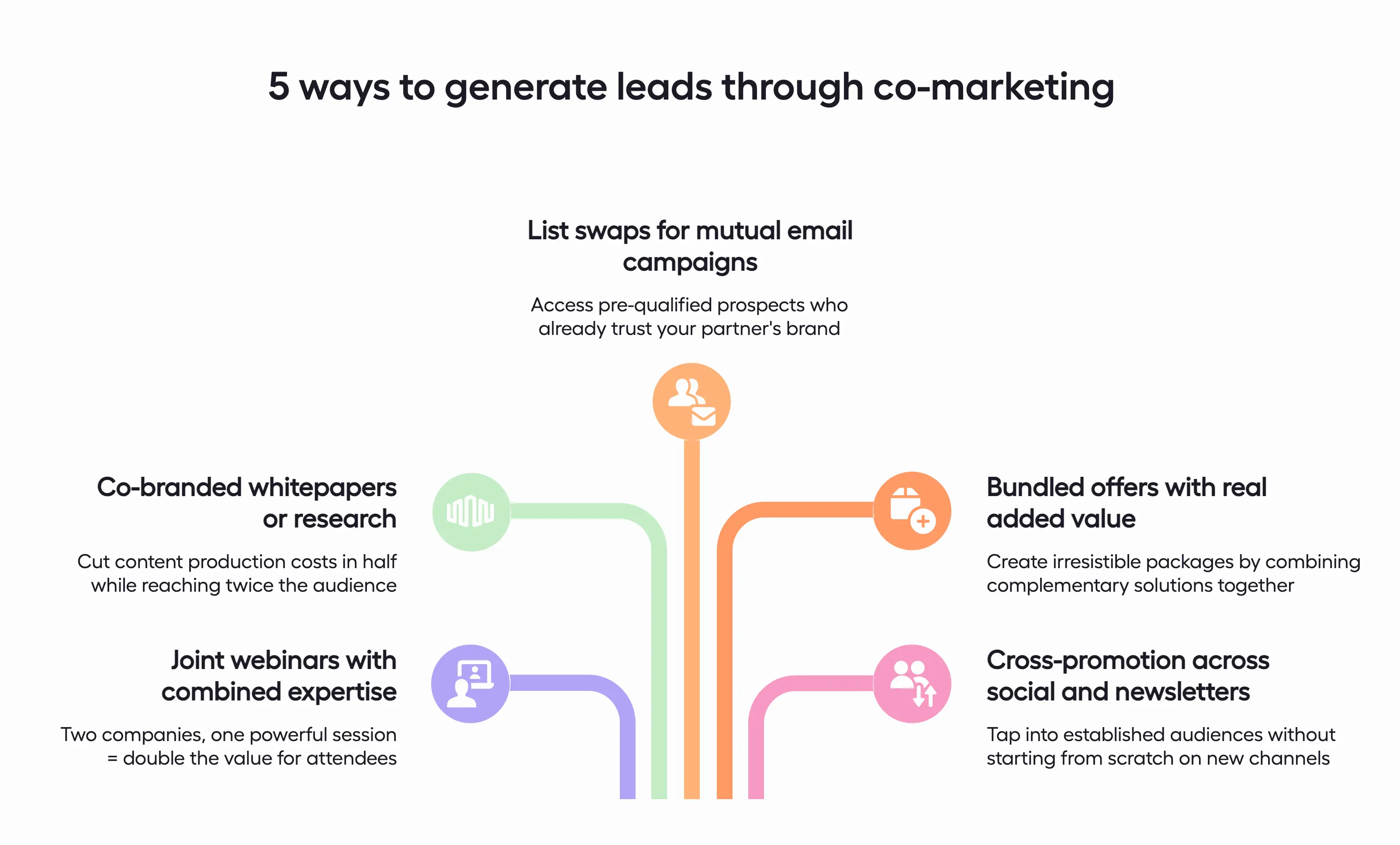
Both companies benefit: you get warm exposure to a trusted audience, and you cut content production and promotion costs in half. Just be clear on lead-sharing rules and follow-up workflows.
🤝In our work, partnerships with CRM platforms, RevOps consultants, and enablement tools have opened doors into sectors we probably wouldn’t have reached solo.
Strategy #16: Let automation handle the repetitive stuff
You can’t manually follow up with hundreds of leads. That’s why platforms like HubSpot, Marketo, ActiveCampaign, and Pardot run behind the scenes to ensure follow-up happens consistently across every lead stage.
They help with:
- Triggered email nurture sequences
- Real-time CRM syncing and scoring updates
- Instant alerts on high-intent behavior (pricing page views, webinar attendance)
- Dynamic content personalization based on persona or segment
Still remember, that the software won’t think for you. So start with a mapped-out buyer journey, then use automation to deliver the right message at the right time.
Strategy #17: Social selling works great when you're not constantly selling
B2B buyers scroll LinkedIn, read Twitter/X threads, and watch YouTube videos. That’s why social selling builds relationships before sales calls happen.
💡Social selling isn’t pitching. It’s credibility.
So post helpful content. Comment on prospects’ posts. Share insights based on your experience. Over time, your name becomes familiar. And trust builds naturally.
In our own strategy, we focus on individual team members posting real takeaways (not promotional fluff). Prospects DM us when they’re ready because they’ve been reading our content for weeks.
Strategy #18: Build comparison content for bottom-funnel searches
Prospects searching “[Your product] vs [Competitor]” are as close to conversion as it gets. This is where bottom-of-funnel intent lives.
Comparison pages and category guides help prospects evaluate clearly and confidently. And when written well, they build serious trust.
A strong comparison page includes:
- Honest feature-by-feature breakdowns (yes, acknowledge where competitors excel)
- Use case recommendations by company size or vertical
- Pricing transparency (if available)
- Clear implementation timelines
- Support level details and SLAs
These pages rank well in organic search and often convert higher than any TOFU blog post. Add strong CTAs like “Book a Consultation” or “Download Full Comparison” to move people forward.
⚠️Remember, that no one trusts exaggerated claims. Don’t bash competitors. Prospects see through biased comparisons immediately.
Be honest about trade-offs and let your genuine strengths speak for themselves.
Strategy #19: Follow visitors around the web with display ads
Most website visitors leave without converting (roughly 98% actually).
Retargeting brings them back and gives you a second shot (and often a third or fourth) without restarting from scratch.
Here are some of the best practices for B2B retargeting:
- Segment by page visited (pricing vs. blog = very different intent)
- Match ad creative to engagement level
- Offer real value (exclusive guide, free audit, limited trial)
- Test ad formats (video works well for mid-funnel)
- Set frequency caps to avoid ad fatigue
🎯Create separate retargeting campaigns for different page visits. Someone who viewed pricing needs different messaging than someone who read a blog post.
Personalization matters in ads too.
Strategy #20: Improve lead quality with multi-touch attribution
Let’s be real: most leads aren’t ready to buy the first time they hear from you. That doesn’t mean they’re a lost cause.
Multi-touch nurture sequences keep you top of mind while guiding prospects toward becoming sales-ready. And the best part? Automation handles the heavy lifting.
A strong nurture sequence should:
- Segment leads by role, industry, and behavior
- Send stage-specific content based on where they are in the buyer journey
- Mix formats: blog posts, case studies, calculators, webinars
- Increase product relevance as engagement grows
- Score leads by opens, clicks, and time on site to qualify in real time
And yes, email segmentation matters. CFOs want ROI. IT leaders want integration. Don't send everyone the same sequence.
Most marketers give up after 2-3 touches, but the majority of conversions happen between touches 5-7. Persistence wins, but only if you're providing value at each touch, often in different channels (email, LinkedIn, phone).
Strategy #21: Invite your target accounts onto a podcast
Cold email and LinkedIn reach the buyers who are willing to be reached. The senior people who have every request filtered need a different reason to say yes.
A guest invitation is that reason. You build a list of the accounts you want, invite the decision-makers on it to be guests on your show, and record a 30 to45 minute conversation about their work. Nobody gets pitched. You come out of it with a relationship, a natural reason to follow up, and an episode you can publish and cut into clips. 🎙️
Here is how it works in practice:
- Start with an approved target account list, not a broad audience. The guestlist is the prospect list.
- Send the invitation from the show, not from a sales rep. The ask is about the guest's expertise, which is why reply rates are far higher than for a cold pitch.
- Book a short call with each guest before the recording. That is where you learn what they are working on and whether there is a fit.
- Publish every episode and repurpose it. Guests share it with their own network, which is your target market.
If you do not want to run this in-house, ThePod.fm offers it as a done-for-you podcast lead generation service. One guest conversation feeds six lead generation techniques: the booking itself, lead capture on each episode page, LinkedIn engagement turned into a warm lead list, guests sharing into their own networks, episodes rewritten as search-ranking articles, and a dashboard that attributes every meeting to the technique that produced it. They have booked conversations for clients with decision-makers at Uber, Pinterest, GitLab and Zapier, and across client shows 18% of invitations get a reply and7.5% turn into a booked call.
The guest does not need to be a buyer today. A VP who joins your show in March is a warm contact when budget opens in September. Treat the episode as the start of the account relationship, not the end of the outreach.
Inbound or outbound: Which generates better leads?
Let's settle this debate.
Inbound marketing attracts prospects to you through SEO, content, and social media.
Outbound marketing means you reach out proactively via cold email, calling, and LinkedIn.
So here's the honest comparison:
We typically layer cold email lead gen on top of clients' inbound efforts. Outbound fills pipeline in days while inbound builds for months.
And this combination accelerates growth without sacrificing long-term organic presence.
What are the best B2B lead gen tactics? Our top recommendations
We need to be honest here. We specialize in cold email and intent-based outreach, so yes, we're biased toward what we do every day. But there's a reason we focus on these tactics.
So here are our favorite tactics:
1. Intent-based outbound prospecting.
We're putting this first because the data is undeniable: 93% higher conversion with intent signals compared to generic targeting. When you reach prospects already researching solutions in your space, conversations happen faster. Our campaigns generate first meetings within 7-8 days because we're not interrupting people, we're timing outreach to their active research phase.
2. Personalized cold email.
Yes, this is what we do. But here's why it works: buyers are overwhelmed with generic spam. Personalized outreach that references actual company signals (hiring announcements, funding news, tech stack changes) cuts through the noise. The 93% higher conversion from intent signals we mentioned? That's from real campaign data.
3. Multi-channel inbound foundation (content, SEO, LinkedIn).
Even though we specialize in outbound, we'd be lying if we said inbound doesn't matter. 89% of B2B marketers use LinkedIn, and SEO-driven content builds long-term authority. So the combination works better than either alone.
4. ABM for high-value targets.
97% report higher ROI than other tactics, with 28% shorter sales cycles. When you're targeting enterprise deals or finite markets, personalized account-based campaigns targeting multiple stakeholders simultaneously outperform everything else.
How to optimize your B2B lead gen for maximum ROI
As we've covered, generating leads is one thing. But getting maximum return is another.
So here's your optimization framework:
- Track quality metrics, not volume. Focus on MQL-to-SQL conversion, cost per SQL, and marketing-originated revenue. Vanity metrics look good in reports but don't pay bills.
- Implement multi-touch attribution. Identify which channels and tactics produce leads that convert. Typically 2.5 touches happen before conversion, so single-touch attribution misses the full picture.
- Optimize lead scoring. Filter leads before sending to sales. Raise qualification bars as volume grows to prevent overwhelming your team with junk.
- Speed wins every time. Respond within 5 minutes for 21x higher qualification likelihood compared to slower follow-up. We've observed the 5-minute response window impact firsthand. Clients responding to inbound inquiries within 5 minutes convert leads at a much higher rates.
- A/B test everything. We run continuous tests across our campaigns, testing subject lines, personalization depth, sending times, and call-to-action variations. Small improvements compound over thousands of touches.
To sum up
Twenty strategies is a lot to digest (we know). But you don’t need to implement them all, and definitely not all at once.
Pick the 3-5 lead generation strategies that make sense for your business and actually execute them well.
Focus on what actually matches your buyer behavior. If your prospects research online before talking to anyone, invest in SEO and content. If you're selling to a tight market of 50 target accounts, go all-in on ABM. If you need pipeline yesterday, cold email and paid ads deliver fastest.
And if you’re stuck on cold outreach, deliverability, or intent-based targeting, that’s our sweet spot. We help teams build pipelines that convert, fast. Most of our clients book qualified meetings in their first 7 days, not 7 weeks (because the technical setup and targeting are dialed in correctly).
Because your next leads are out there. You need the right system to reach them. 🎯
Frequently asked questions
Launch targeted paid ads on Google and LinkedIn for immediate visibility. Send personalized cold email to curated lists showing intent signals. Activate referral campaigns from happy customers. These tactics produce meetings within days or weeks.
Refine your targeting to focus on ICP firmographics like industry, company size, and role. Use intent data to prioritize prospects actively researching and implement lead scoring to filter before sales gets them. Create also in-depth content that serious buyers consume, helping them self-qualify.
Personalization matters more than volume. Reference something specific about their company instead of sending the same template to everyone. Connect on LinkedIn and engage with their content first before asking for anything. Spread your follow-up across weeks using different channels. When someone responds, get back to them as quickly as possible.
Combine multiple approaches instead of putting all your eggs in one basket. Intent data shows you who's actively researching solutions right now. LinkedIn Sales Navigator helps you filter by specific criteria. SEO content attracts people already searching for what you offer. Your existing customers can introduce you to similar companies they know.
Do your homework before reaching out so you're not wasting their time with irrelevant pitches. Talk about their problems first, your solution second. Be persistent without being annoying (spread touches over weeks, not days). And pay attention to what's working and adjust your approach.
Don’t miss these
Get your first lead this month
14 days to get started. 7 days to get your first lead on average.


