

Lead Routing Explained: 9 Best Practices, Strategies & Expert Hacks
TL;DR: Lead routing explained (the quick version)
- Lead routing is the system that decides who handles a qualified lead and how fast. When it’s slow or misaligned, revenue leaks quietly.
- Speed-to-lead changes everything ⏱️ Responding within 1 minute can boost conversions by 391%, yet the median B2B response time is 42 hours.
- Lead routing ≠ lead scoring 📊 Scoring decides if a lead is qualified. Routing decides who owns it.
- Modern routing runs on 5 layers 🧩 Enrichment → Lead-to-account matching → Scoring → Routing logic → Availability checks.
- Common strategies include round-robin, territory-based, account-based, skills-based, capacity-based, AI-driven, and intent-based routing.
- Intent-driven routing converts 3x higher 🔥 High-buying signals should trigger immediate assignment.
- Accuracy matters as much as speed 🎯 Keep reassignment rates below 3% and match rates above 85%.
- Automate everything 🤖 Manual assignment kills speed and introduces bias.
You built a solid outbound motion. Leads are coming in. And yet, somehow, deals are slipping. The culprit is rarely the rep, the product, or the pitch.
Most of the time, it comes down to lead routing, specifically, doing it wrong.
We've audited enough B2B funnels to know this is far more common than sales leaders want to admit.
Lead routing is the system that decides who gets each lead, when, and why. Get those decisions right, and your pipeline moves. Get them wrong, and speed-to-lead quietly bleeds revenue.
So in this guide, we cover the eight most common routing strategies, nine best practices we've tested across real B2B sales teams, and the mistakes we see kill conversions even when everything else is working.
What is Lead Routing? (and why 99% of sales teams get it wrong)
Lead routing is the systematic assignment of newly qualified leads to the sales representative or team best positioned to close the deal. It translates your go-to-market strategy into automated decision logic, accounting for territory ownership, rep availability, skills alignment, deal size, account tier, and product interest.
So why do most teams still get it wrong? Speed decay.
Research shows that responding to a lead within 1 minute can boost conversions by 391%. The median B2B response time sits at 42 hours, which means most sales orgs are losing deals before a rep ever picks up the phone.

When we run RevOps audits for clients, the gap between "we respond fast" and actual first-touch timestamps is almost always wider than the team expects. Tracking real speed-to-lead is the first step toward fixing broken routing.
One distinction worth clarifying before moving on (and yes, this trips up a lot of teams):
- Lead routing determines who handles a qualified lead.
- Lead scoring determines whether the lead is qualified at all.
- Lead distribution refers to the broader process of getting leads into rep hands.
Think of it this way: your lead generation strategy produces the raw pipeline. Lead scoring filters it. Lead routing is the last mile, the decision layer that determines whether a qualified lead reaches someone who can close it today or sits in a queue until the buying window passes.
How does a lead routing system work?
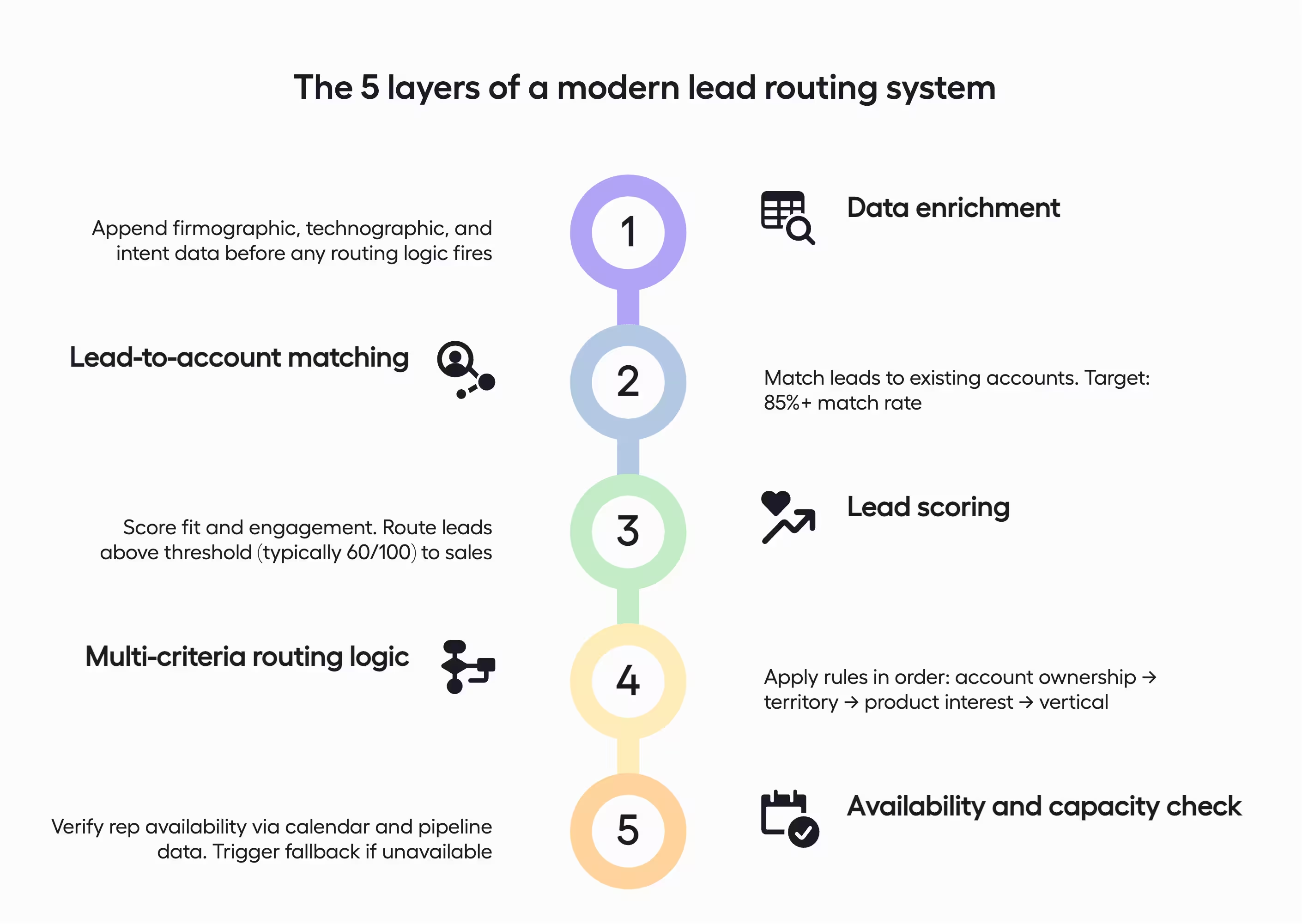
A modern lead routing system operates through five layers of logic, each building on the last.
Here is how it typically flows inside your CRM.
- Data enrichment
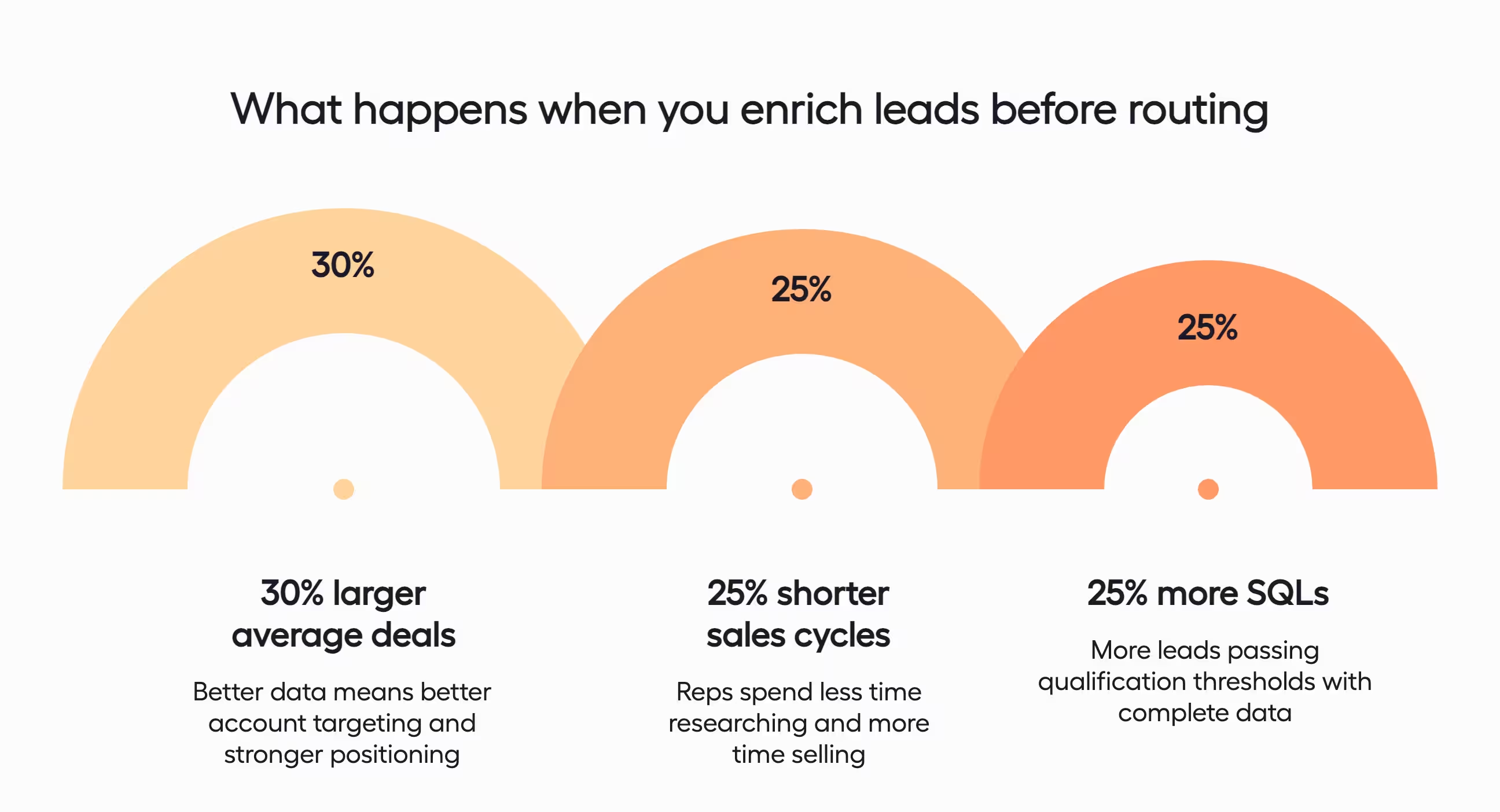
When a new lead enters your system, enrichment tools append firmographic details, technographic signals, account hierarchy data, and intent indicators.
Without enrichment, routing decisions rely on partial information. With enrichment, routing logic reflects company size, industry, tech stack, funding stage, and buying signals.
For leads generated through outbound like cold email lead gen, much of this enrichment already happens before the lead enters the pipeline. Well-structured outbound campaigns pre-enrich prospects during list building, appending firmographics, technographics, and intent signals before the first message ever sends.
That means when a cold email recipient replies with interest, the routing system receives a record that is already enriched to a level most inbound form fills never reach.
- Lead to account matching
Next, the system checks whether the lead belongs to an existing account or represents a net new opportunity.
High performing RevOps teams aim for match rates of 85% or higher before allowing a lead to proceed. This step protects account ownership and prevents duplicate outreach.
- Lead scoring
Once enrichment and matching are complete, scoring logic determines sales readiness.
Leads below the threshold remain in nurture sequences. Leads above the threshold move forward into routing.
This prevents sales reps from chasing contacts who are not ready to buy.
- Automated lead routing logic
Now the actual lead routing rules apply.
Most systems work through multi-criteria rules in a specific order: account ownership first, then territory, then product interest or vertical.
- Real time availability and capacity
Finally, the system checks rep availability and capacity using calendar data and pipeline load.
If the primary rep is unavailable, fallback logic assigns the lead to the next best rep. This protects response time and prevents leads from sitting idle.
We’ve seen that teams who skip the enrichment and account-matching layers end up routing leads based on incomplete data. That one shortcut quietly inflates reassignment rates and kills rep trust in the system.
So build the foundation layers first, then add routing complexity on top.
What are the most common lead routing strategies for B2B?
B2B sales teams use a spectrum of lead routing strategies, and the truth is, most mature organisations layer several together. There is no universal “best” model.
The right architecture depends on your sales motion, segmentation complexity, and RevOps maturity. 🗺️
When we audit routing systems, the problem is rarely a missing strategy. It is misapplied logic or poor layering. A strategy that works brilliantly in one context can quietly fail in another.
Here are the eight most common lead routing strategies we see across B2B sales teams, along with when each one makes sense, and where it falls short.
Round-robin lead routing
Round-robin lead routing distributes leads sequentially across a pool of reps, giving each person an equal share over time.
It works well when reps have similar skills and territories are not a factor.
Automated round-robin reduces response time by 67% compared to manual assignment. Advanced versions add weighted rotations or geographic sub-groups, which makes the system more realistic as you grow.
(If every rep truly sells the same way, round-robin is clean. The moment that changes, friction appears.)


Territory-based lead routing
Territory-based lead routing assigns leads using geographic regions, industry verticals, company size, or defined segments.
This pairs naturally with compensation structures where reps own defined regions.
In Salesforce, it means configuring Territory Management, defining boundaries, and building assignment rules. The main risk is uneven lead flow, so periodic rebalancing matters.
Account-based lead routing
Account-based lead routing protects existing relationships. If a new lead matches an account with a named owner, the system routes directly to that owner.
This approach needs strong lead-to-account matching using domain matching, legal entity mapping, and fuzzy matching logic. When confidence is low, best-practice teams flag records for manual review.
One thing we consistently see when helping clients clean up CRM data is that poor account matching is the silent killer of account-based routing. If your match rate sits below 85%, leads drift to the wrong reps, account owners lose visibility, and the strategy weakens quietly over time.
Skills-based lead routing
Skills-based lead routing matches prospect requirements to rep capabilities.
Not every rep handles enterprise deals. Not every rep speaks the same languages. Not every rep knows each product line equally well.
When you define skill categories, rate each rep’s proficiency, and build matching logic, you get higher first-call success rates and shorter sales cycles.
Capacity-based and workload routing
Capacity-based routing factors in current pipeline load before assigning a lead.
Simple versions count open opportunities; advanced setups pull CRM pipeline data, calendar info, and activity tracking. The goal is preventing overload on one side and underutilization on the other.
Pairing this with territory or skills-based routing often produces the strongest results.
Queue and priority-based routing
Queue-based routing sends leads into a shared pool. Distribution then follows priority order.
This is common in high-velocity inbound environments where speed matters more than long-term account ownership.
The upside is flexibility; the downside is reduced accountability. Without clear SLAs, leads sit longer than anyone wants to admit.
Queue routing can create what economists call the “tragedy of the commons.” Shared ownership lowers personal responsibility. The fix is strict SLA timers and automated escalation if a lead goes unclaimed within your target window, often five minutes for high-intent inbound. ⏱️
AI and propensity-based lead routing
AI and propensity-based lead routing uses machine learning models to predict which rep is most likely to close a specific lead. These models analyze historical win-loss data to spot patterns humans miss, reporting 75% higher conversion rates compared to traditional methods.
But the limitations are real: model opacity, potential bias from historical data, and the need for ongoing human oversight all come with the territory (teams feel this quickly after rollout).
Intent-driven and behavioral lead routing
Intent-driven and behavioral lead routing prioritizes leads showing active buying signals, routing high-intent prospects to available reps immediately. High-intent signals include for example pricing page visits, ROI calculator downloads, and recent funding events.
Intent-driven leads convert 3x higher than traditional leads, and the first vendor to engage an in-market buyer wins 70% of the time.
Lead routing best practices: 9 expert-backed strategies
The most effective lead routing best practices address specific failure modes: miscalibrated scoring, incomplete data, manual bottlenecks, and missing fallback logic.
So knowing the lead routing strategies is one thing. Putting them into practice without creating a tangled mess of rules, exceptions, and frustrated reps who "never get good leads" is another thing entirely. 😅
So here are nine lead routing best practices we have observed. And each one addresses a real failure mode we have seen derail otherwise solid routing systems.
Best practice #1 - Define your ICPs and lead scoring model first
Your routing logic is only as good as the scoring model feeding it. Organizations using AI-powered lead scoring achieve 83% accuracy in predicting conversion and report 75% higher conversion rates than manual approaches.
So start here:
- Define your ideal customer profiles
- Build a scoring model reflecting firmographic fit and behavioral engagement
- Set a threshold, often 60 out of 100
- Route only leads above that threshold
Everything else stays in nurture.
This is the part most teams get backwards. They ask how to generate B2B leads before defining who those leads should be. Without a clear ICP and a scoring model calibrated to it, you end up generating volume that routing logic cannot meaningfully sort.
When we review client funnels, we often find a scoring model that was set up once and never recalibrated. ICPs evolve. Markets shift. What qualified as a strong lead twelve months ago may not match your current motion. Revisit scoring criteria quarterly, not annually.
Best practice #2 - Enrich lead data before routing decisions
Routing decisions are only as accurate as the data behind them. And raw form fills give you name, email, maybe company name. That's not enough for intelligent routing.
Before triggering assignment logic, append:
- Firmographic data: Company size, revenue, industry, location, employee count
- Technographic data: Current tech stack, recent software purchases, technology needs
- Contact details: Job title, seniority level, department, decision-making authority
- Account hierarchy: Parent company, subsidiaries, division structure
- Intent signals: Recent research activity, content consumption, buying stage indicators
❗If enrichment accuracy drops below 95%, review vendor configuration or switch providers.
Best practice #3 - Automate lead assignment completely
Every manual touchpoint adds delay and introduces errors. Someone needs to review the lead, decide which rep should get it, manually assign it, then notify the rep. That process takes hours or days.
Build workflows that assign leads instantly based on your criteria, because automation also ensures consistent rule application.
Manual assignment introduces bias ("This looks like a good one, let me give it to my best rep"). Automated routing follows the rules every single time, creating audit trails showing why each lead went where it did.
If a human needs to click "assign," you're already too slow for competitive markets.
Best practice #4 - Match leads to rep expertise, not just availability
The fastest available rep isn't always the right rep. Layer skills-based criteria into routing logic:
- Industry expertise: Healthcare buyer → healthcare specialist
- Product knowledge: Complex enterprise infrastructure → senior technical rep
- Language capabilities: German inquiry → German-speaking rep
- Deal size experience: $500K opportunity → enterprise closer, not junior SDR
Yes, this adds routing complexity. The payoff? Companies implementing intent-based routing achieve much higher conversion rates because they're matching buying signals to rep capabilities.
A junior SDR can't effectively sell to a CTO evaluating enterprise security solutions. Routing them that lead wastes the opportunity and the rep's time.
Best practice #5 - Build fallback rules and catch-all queues
Your primary routing logic will encounter edge cases: rep on vacation, territory unmapped, account owner left the company, lead submitted at 2am Saturday.
Build fallback paths so no lead gets orphaned:
- Catch-all queues for unroutable leads requiring manual review
- Temporary owner assignment where a manager holds the lead until proper routing
- Time-based escalation where unassigned leads escalate to sales leadership after X hours
- Backup owners for each territory covering vacation and out-of-office periods
If more than 3% of your leads are reassigned post-routing, your logic needs refinement. High reassignment rates indicate your rules don't cover common scenarios. Fallbacks prevent leads from disappearing into CRM limbo, but excessive fallback usage signals fundamental routing problems.
Best practice #6 - How can you improve lead assignment speed?
Speed-to-lead determines whether you're first responder or playing catch-up. So benchmark your performance:
- Median response time: 50% of leads get contacted within X minutes
- P95 response time: 95% of leads get contacted within X minutes
High-performing teams achieve first contact within 5 minutes. And as we’ve said earlier, average teams languish at 42 hours.
Where does that speed come from?
✅ Zero manual steps: Instant automated assignment
✅ Push notifications: Instant Slack/SMS alerts to assigned reps
✅ CRM-calendar integration: Routing considers rep availability and meeting schedules
✅ Mobile enablement: Reps can respond from anywhere, not just desktop
But speed only matters if it converts into a conversation. The fastest routing systems connect assignment directly to B2B appointment setting workflows, so the moment a lead is routed, they receive a personalized booking link or a rep reaches out within seconds.
Reducing the gap between "lead assigned" and "meeting scheduled" is where speed-to-lead translates into actual pipeline.
Best practice #7 - Balance workload and monitor distribution fairness
Round-robin achieves mathematical equality but ignores operational reality. We recommend to monitor workload distribution weekly:
- Active opportunities per rep: Lead count by stage (qualified, meeting scheduled, proposal sent)
- Pipeline value per rep: Total dollar value each rep is managing
- Time since last assignment: Catch reps who haven't received leads recently due to capacity limits
If Rep A has 60 active deals and Rep B has 15, temporarily pause assignments to Rep A. Adjust routing weights dynamically: Rep A gets 20% of new leads, Rep B gets 80% until balance restores.
So workload balancing is sales funnel optimization at the rep level. And when leads concentrate with a few reps, the middle of your funnel chokes: response times stretch, follow-ups slip, and conversion rates drop for everyone, not only the overloaded reps.
The "rich get richer" pattern is one of the least discussed problems in lead routing. When top performers consistently get more leads (which makes sense on paper), newer reps never get the volume they need to develop.
The best teams we work with intentionally protect a percentage of lead flow for developing reps, treating it as an investment in future capacity rather than a short-term conversion sacrifice.
Best practice #8 - Define clear routing rules and document everything
Routing rules that live in one person's head are a single point of failure. Your routing logic should be completely transparent and documented:
📋 Rule documentation example:
- "Enterprise accounts (>1000 employees) → Enterprise team"
- "Mid-market (100-999 employees) → Commercial team"
- "SMB (<100 employees) → Inside sales"
- "Named accounts → Account owner (overrides territory)"
- "Unmapped territories → Sales manager catch-all queue"
Document every rule, exception, and override in a shared knowledge base your RevOps, sales, and marketing teams can reference. Include the reasoning behind each rule, not only what it does.
Because undocumented routing logic becomes a black box nobody wants to touch when someone changes roles.
Best Practice #9 - Review and optimize routing rules regularly
Routing is not a set-it-and-forget-it system. Review quarterly:
✅ Distribution fairness: Are leads balanced across the team or concentrated with a few reps?
✅ Match rate accuracy: Staying above 85% lead-to-account matching?
✅ Reassignment rate: Still below 3% or climbing due to outdated rules?
✅ Coverage rate: What percentage route successfully on first pass without fallback?
Simply said, treat routing as a living system that evolves with your go-to-market strategy.
Why is your lead routing inefficient? Common mistakes killing conversions
Unfortunately, even with following best practices, teams still make predictable mistakes.
After auditing lead flows across dozens of B2B organizations, the same seven mistakes keep showing up:
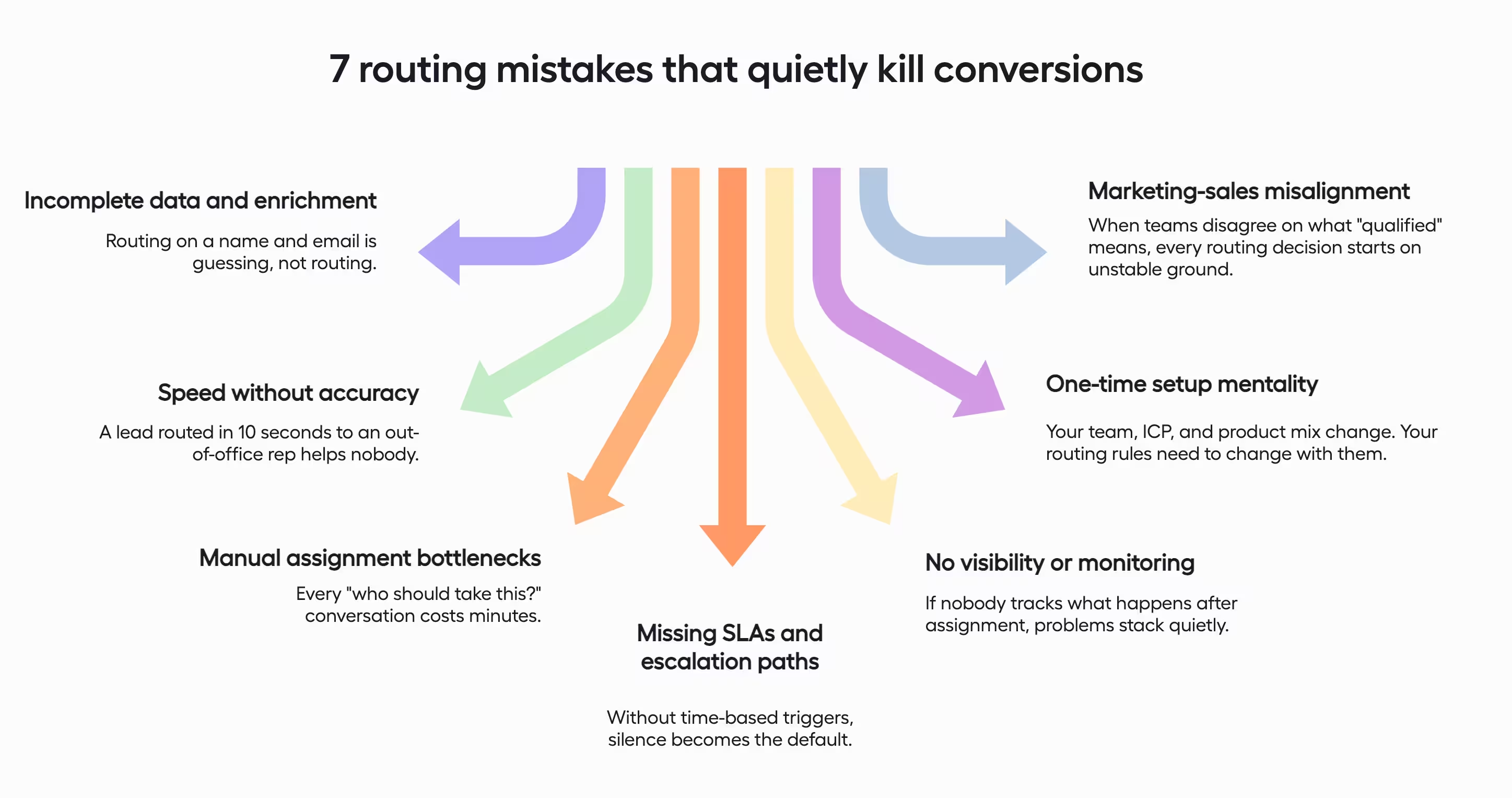
- Incomplete data and enrichment
Routing based on raw form fills means your logic is deciding with a name, an email, and maybe a company field. That is not enough to route accurately. When inputs are thin, misrouting becomes inevitable.

Leads from cold outreach campaigns that were built on enriched lead list for cold email (with verified firmographics, job titles, and intent signals baked in from the start) typically route correctly on first pass. Leads from organic inbound forms, where the visitor gave you a Gmail address and a first name, misroute at far higher rates.
So the problem may not be your routing logic; it may be that one channel feeds your system garbage while another feeds it gold.
- Over-optimizing for speed while neglecting accuracy
A lead captured at 11:59 PM on Friday gets routed within ten seconds to a rep who is out of office until Monday. Speed looks impressive in reports. Effectiveness disappears in practice.
- Manual assignment bottlenecks
Spreadsheets, forwarded emails, and “who should take this?” conversations create delays that compound with every new lead. One manual review might cost minutes; a hundred cost hours.
- Missing or misaligned SLAs and escalation paths
Without clear time-based triggers, leads sit in queues without automated follow-up or reassignment. Silence becomes the default state.
- Lack of visibility and monitoring
If nobody tracks what happens after assignment, problems stack quietly. Reassignments increase. Response times stretch. And no one notices until pipeline slows.
- Treating routing as a one-time setup
Your team evolves. Your ICP shifts. Your product mix changes. Routing rules must evolve with those realities (even small changes compound over time).
- Marketing and sales misalignment on lead qualification
When marketing and sales disagree on what qualifies as a “good lead,” every routing decision starts on unstable ground. The friction shows up downstream.
In funnel audits, mistake #7 is almost always present and rarely acknowledged. We begin by getting marketing and sales leadership in the same room to define MQL, SQL, and the exact criteria that trigger handoff. Without shared definitions, improving lead routing treats symptoms rather than root causes. 🤝
How do you measure lead routing success?
You cannot improve what you do not measure. So a strong lead routing framework tracks four categories of metrics, each telling part of the story.
1. Speed metrics
These show how fast a lead moves from capture to a real human touch.
- Speed-to-lead: Median and P95 time from lead capture to first human contact. High-performing teams operate under 5 minutes. If your median sits above 30 minutes, there is almost certainly a manual bottleneck or a notification gap in your workflow.
Key takeaway: Track both median and P95, since one hides what the other reveals. ✅
2. Accuracy metrics
These show whether your logic routes correctly.
- Reassignment rate: Percent of leads reassigned from their initial owner. Keep this below 3%. Above that, routing logic needs work.
- Match rate: Percent of leads matched to existing accounts. Target 85% or higher.
If reassignment creeps up, something in your enrichment or routing hierarchy needs attention.
3. Quality metrics
These show whether the system performs consistently, not only on good days.
- SLA attainment: Percentage of leads contacted within your defined SLA window. High-performing teams hit 80% or higher.
- Routing coverage: Percentage of leads successfully routed versus stuck in error states. Aim for 99%+.
Coverage gaps often reveal hidden configuration issues inside your CRM.
4. Outcome metrics
These connect routing behavior to revenue impact.
- Conversion rate by routing segment: Which routing paths generate the most meetings, opportunities, and closed deals?
- Win rate by routing segment: Do leads routed to certain reps or territories close at higher rates?
- Pipeline velocity: Measure pipeline velocity metrics that indicate whether routing is improving the overall speed at which opportunities move through the sales pipeline. Weekly tracking correlates with 34% annual revenue growth, compared to 11% for teams tracking it only ad-hoc.
If you want to strengthen your system, start by auditing speed-to-lead, reassignment rate, and match rate this week. Those three metrics alone usually reveal where your routing needs attention.
To sum up
Lead routing rarely gets the credit it deserves. It lives quietly beneath your pipeline, invisible when it works, devastating when it doesn't. And more often than not, the deals you think you lost on price or timing… you actually lost at assignment.
The good news is that it’s one of the most fixable problems in B2B sales. You don’t need massive re-platform or new headcount. You need smarter rules, cleaner data, and a process that keeps up with how your team actually operates.
We've spent years helping B2B sales teams stop bleeding revenue in places they couldn't see. So if any of this felt familiar while reading, let's talk, we're pretty good at finding the leaks.
Frequently asked questions
Lead scoring determines whether a lead is ready for sales by assigning point values based on fit and engagement. Lead routing determines who handles that qualified lead. Scoring is the filter; routing is the assignment logic that fires after the filter passes.
Look for real-time automated assignment, multi-criteria routing logic with configurable hierarchies, strong lead-to-account matching, built-in SLA timers with automated escalation, and detailed audit logs. Native CRM features such as HubSpot Workflows, Salesforce Assignment Rules, or Zoho Automation may be sufficient. These native tools integrate directly with your CRM, require no additional vendor relationships, and handle straightforward routing logic effectively
Set target ranges where each rep receives 45-55% of the average weekly lead volume and automatically rebalance when distribution drifts. Layer in weighted assignments: high-converting reps receive 1.2x average volume, while reps below target conversion rates get 0.8x. Monitor weekly and address imbalances before they erode morale.
Top platforms include Salesforce (built-in assignment rules and flows), HubSpot (workflows and sequences), LeanData (sophisticated multi-criteria routing), Chili Piper (speed-to-lead focus with calendar booking), and Outreach (sales engagement with routing). Choice depends on your CRM ecosystem, team size, and routing complexity needs.
The fastest wins come from automating assignment rules inside your CRM. Platforms like HubSpot let you route leads instantly based on territory, deal size, or rep capacity. Pair that with data enrichment tools and your routing logic gets sharper over time.
Don’t miss these






Get your first lead this month
14 days to get started. 7 days to get your first lead on average.


