


Lead vs Prospect: The Difference That Decides What You Pay For
TL;DR: Prospect vs. lead explained
- A prospect fits your targeting criteria. A lead also fits the ICP, has the problem, and shows intent to evaluate a solution. 🎯
- A reply does not automatically make someone a lead. In one example, 7,500 prospects generated 150 replies, but only 40 qualified leads. 📩
- The type of reply matters. Prospects asking specific questions about pricing, timeline, or fit converted to meetings at 60-70% vs. 15-20% for vague-interest replies. 🔍
- More replies can still mean worse performance. In one campaign, reply rate fell from 4.2% to 2.3% after a copy rewrite, while lead rate increased from 0.6% to 1.9%. 📈
- The distinction changes what you pay for. Prospect volume and reply counts can make an outbound offer look attractive, but qualified leads and cost per booked meeting tell you much more about what that activity produced. 💰
A campaign can contact 7,500 prospects, generate 150 replies, and still produce only 40 leads.
Those numbers are not contradictory. They measure three different stages of the outbound prospecting funnel. The problem starts when they are reported as if they mean the same thing.
We see this most often when companies compare outbound providers. One agency talks about prospects contacted, another reports replies, and another promises leads. On paper, the offers can look comparable. In practice, the definition behind each number can completely change what you're paying for.
In this article, we'll draw a clear line between a prospect and a lead, show how we identify that transition in real campaigns, and explain which metrics matter when you're comparing outbound performance and cost.
What is the difference between a prospect and a lead?
А prospect is someone who matches your targeting criteria.
A lead is a prospect who also shows that they have the problem and are evaluating whether your solution could be a fit.
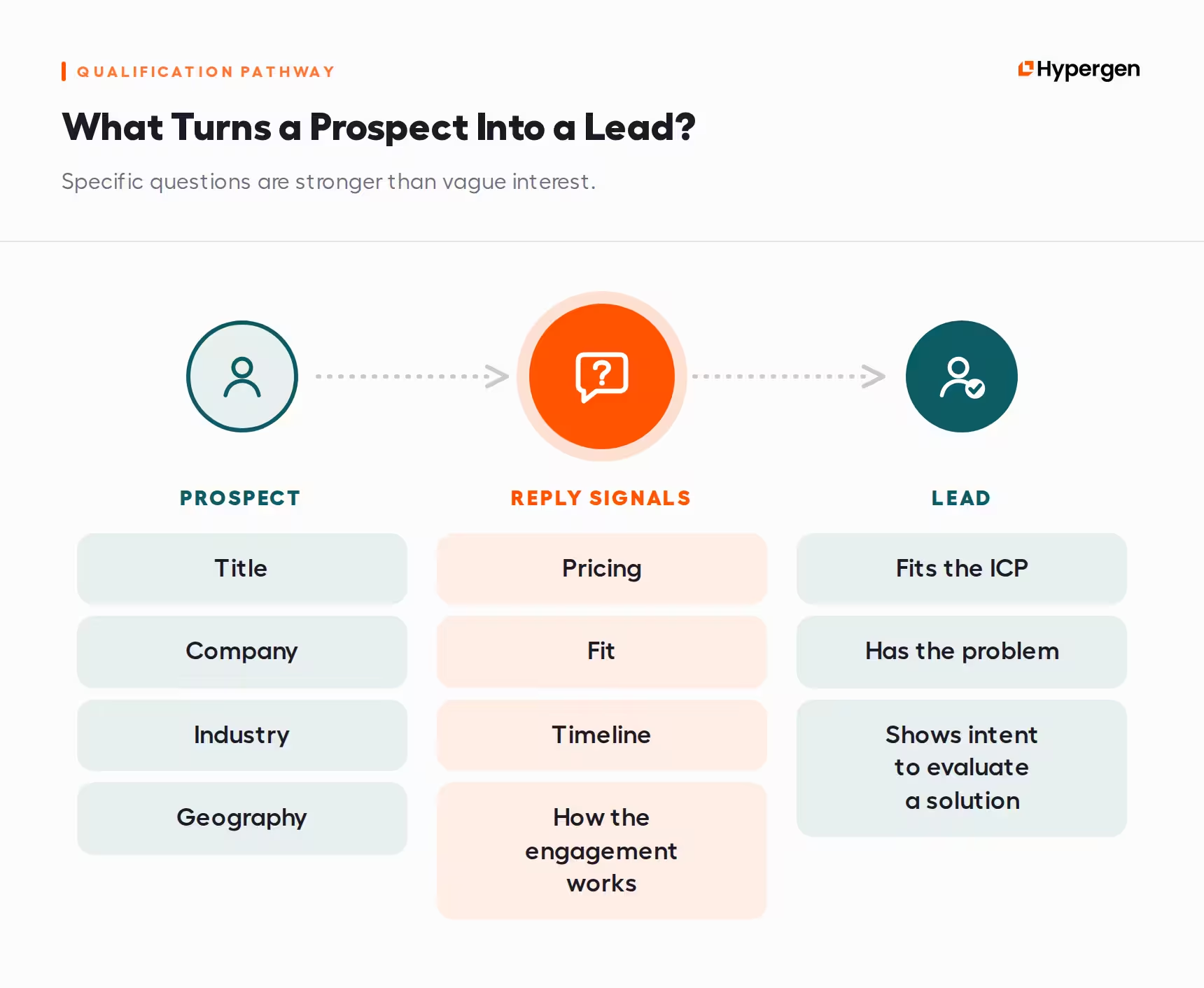
That distinction sounds simple, but there is an important stage between the two: the reply.
Someone responding to an email tells us that the outreach generated a reaction. It does not tell us that the person is qualified or has buying intent.
This is why we keep reply rate and lead rate separate in our reporting. A wrong-person referral, an out-of-office response, a vendor pitching back, or vague curiosity can all count as replies. None automatically qualifies as a lead.
That distinction becomes much more useful once we look at what happens inside the reply itself, because some responses reveal significantly more buying intent than others.
What turns a prospect into a lead?
Matching your ICP gets someone onto the prospect list. What moves them into the lead category is evidence of intent.
In our campaigns, that evidence often appears in the way someone replies. A positive response is useful, but a prospect asking a specific question about pricing, fit, timeline, or how the engagement works gives us a much stronger signal that they are evaluating a solution.
What the question can tell us
The type of question gives us additional context about what the prospect is already evaluating:
- Pricing questions suggest they've moved from “Do I need this?” toward “Can I afford this?”
- Fit questions show they're comparing the solution with their specific company, use case, or constraints.
- Timeline questions suggest they're thinking about implementation rather than simply exploring the category.
- Process questions show they want to understand how the engagement would work before deciding whether to move forward.

A vague “send me more information” can still develop into a lead, but it gives us much less evidence about buying stage. A specific question tells us what the prospect needs to evaluate next and gives the sales team a clearer conversation to progress.
Specific questions are stronger than vague interest
Across our campaigns, replies with specific questions convert to meetings at 60-70%, compared with 15-20% for positive-interest replies with no question.
They also tend to reach a meeting within 1-3 touches, while vague-interest replies can take 5-7 touches and convert much less often.
Two M&A advisory firms both had 8-12 employees, targeted the lower-middle market, matched the same ICP, received the same proof block, and replied within 48 hours.
Prospect A replied: “Interesting timing - we’ve been talking about outsourcing this. What does the ramp look like? How long until we’re seeing consistent meetings?”
They booked a meeting the same day, signed a six-month contract within two weeks, and launched 17 days after the initial reply.
Prospect B replied: “Thanks for reaching out. Can you send over some case studies or more detail on your process?”
They requested a one-pager, pricing, and references, then went quiet. They later said they were building internally, and the conversation never progressed to a meeting.

Both replies were positive. But Prospect A was already evaluating which provider to use, while Prospect B was still deciding whether to pursue the solution at all. That difference in buying stage made the replies very different lead signals.
Timing matters when the prospect gives you a reason
“Not now” can also contain useful intent, but the context matters.
When a prospect gives us a specific trigger, such as “We just hired an SDR, ask me again in six months if it doesn’t work out,” those conversations convert at 20-25% when re-engaged.
Generic responses such as “Not the right time, maybe later” convert at under 5%.
The difference changes the follow-up:
- Specific trigger: We have a reason and a defined point to restart the conversation.
- Generic “later”: There is no event, condition, or timeline to build the follow-up around.
In one SaaS campaign, a Series A company asked us to reconnect in Q3 when it expected to hire for GTM. We followed up at that point and booked a meeting within two replies. A PE prospect simply said it was “not a priority.” We re-engaged 90 days later and received no response.
We track specific timing qualifiers separately because they give us something operational to act on. Instead of putting every “not now” response into the same generic follow-up process, we can reconnect when the condition the prospect gave us changes.
Even reply timing can add context
One less obvious signal we've seen is when the reply arrives.
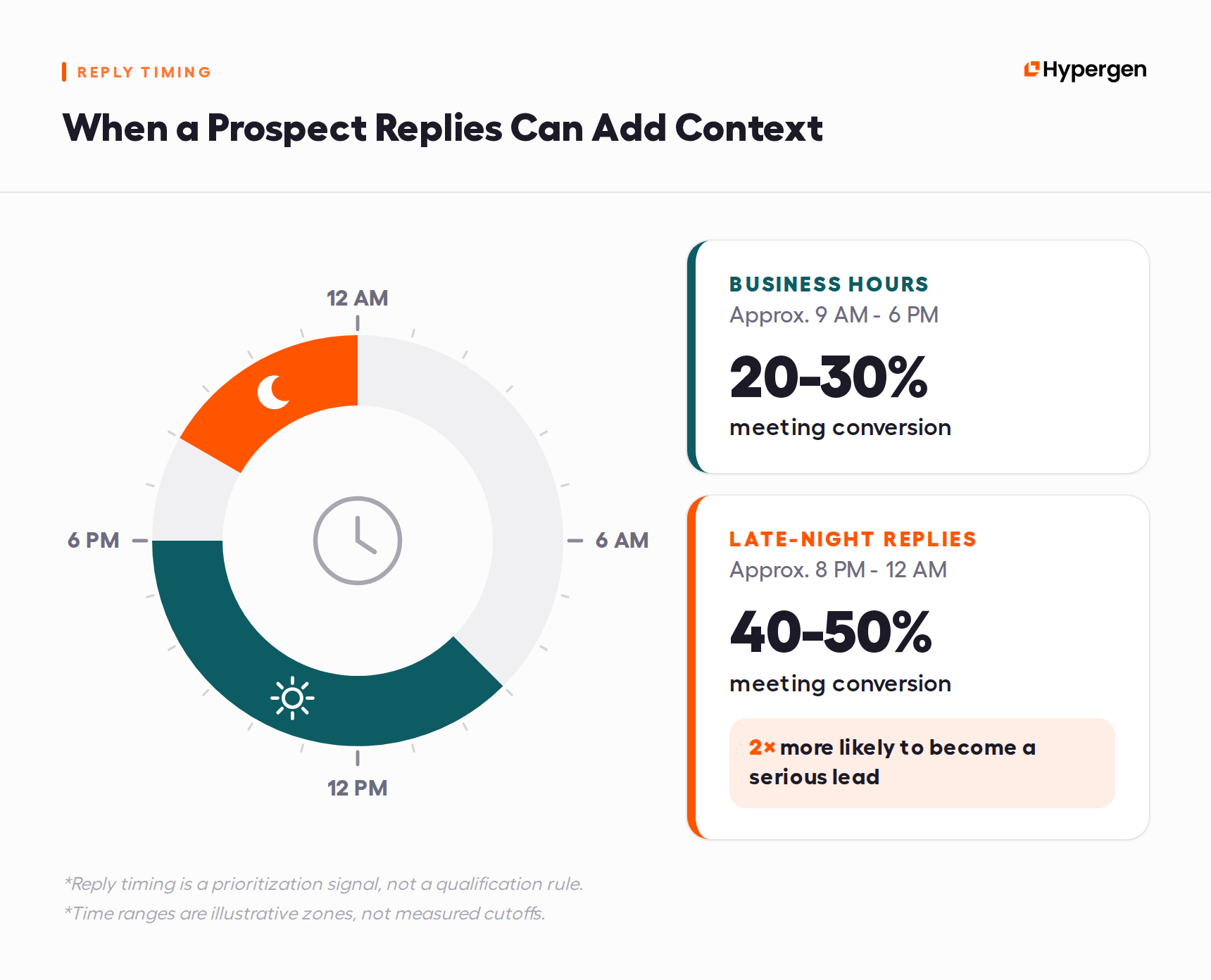
Across two years of our campaign data, prospects who responded outside business hours were 2x more likely to become serious leads. Late-night replies converted to meetings at 40-50%, compared with 20-30% for replies during business hours.
We don't use this as a qualification rule. But when a founder replies at 11 p.m. and asks about pricing or timeline, we treat the timing as an additional prioritization signal.
In our experience, these replies often come from people who are dealing with the problem themselves rather than evaluating it from a distance.
Why is reply rate not the same as lead quality?
A high reply rate tells you that people are responding. It does not tell you whether those conversations will produce high-quality leads with real sales potential.
We saw this in a campaign for a RevOps consultancy targeting VP Sales roles at mid-market SaaS companies. The original messaging led with a broad promise:
“We help sales teams close faster and hit quota more consistently.”
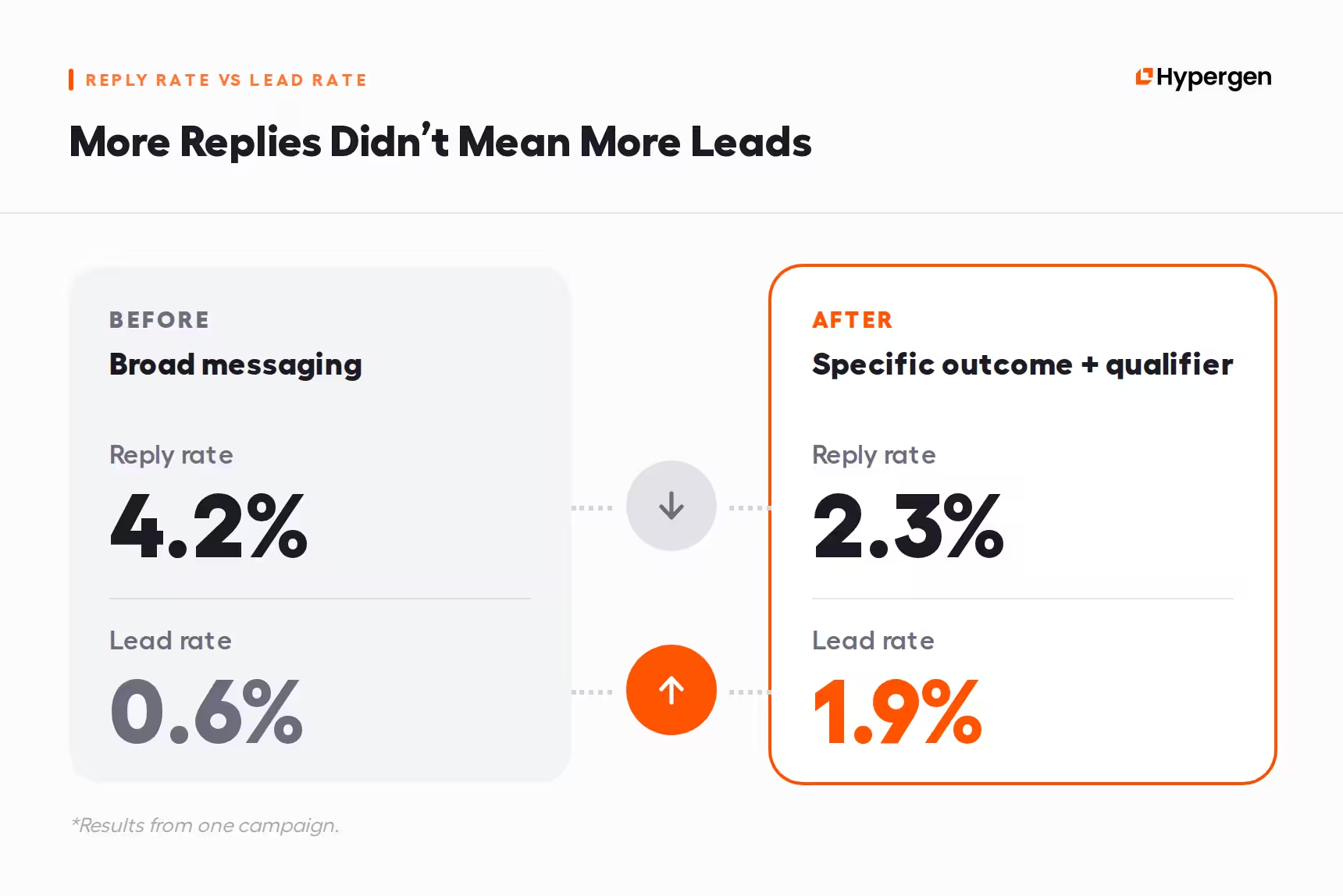
During the first two weeks, the campaign generated a 4.2% reply rate but only a 0.6% lead rate.
What the replies told us
The gap between those two metrics became much more useful once we classified the responses:
- Sales reps were replying instead of VP-level buyers.
The broad promise sounded relevant to individual contributors, who interpreted it as sales coaching or training.
- Adjacent vendors were entering the funnel.
The language was broad enough to sound relevant to other companies selling sales services.
- Some prospects showed curiosity without intent.
They asked for more information but stopped responding once they saw the pricing and scope.
- Qualified leads asked different questions.
They wanted to know about team size, engagement length, or integrations with Salesforce and Outreach.
We rewrote the message to encourage self-selection.
Instead of trying to preserve the higher reply rate, we made the message more specific:
“Most sales teams cut their deal cycle from 60+ days to under 45 when they fix their handoff process between SDR and AE. If you're running a 15+ rep SaaS sales team and losing deals in the handoff, worth a look?”
The new version introduced both a specific outcome and a clear qualifier. After the rewrite:
- Reply rate: decreased from 4.2% to 2.3%
- Lead rate: increased from 0.6% to 1.9%
- Meeting conversion: 3x higher among the remaining replies
- Deal conversion: 5x higher among the remaining replies
The lower reply rate wasn't a problem in this campaign. The message was filtering out more of the people we didn't want replies from in the first place.
Each qualifier was doing a different job
The rewritten message didn't become more specific in only one way. Each element helped a different type of prospect decide whether the offer was relevant:
- “60+ days to under 45” narrowed the problem. A VP already operating with a much shorter sales cycle could recognize that the message wasn't aimed at their situation.
- “Handoff process between SDR and AE” named where the problem occurs. Companies without that sales structure had another reason to self-select out.
- “15+ rep SaaS sales team” narrowed the company and team profile rather than leaving “sales teams” open to almost anyone.

Every additional qualifier can reduce the number of people who see themselves in the message. In this campaign, that was useful because the message filtered out more irrelevant responses before they reached the sales team.
How we read the gap between reply rate and lead rate
When those two metrics move in different directions, we don't treat them as the same problem:
- High reply rate + low lead rate: Check for curiosity, adjacent personas, broad positioning, or weak qualification.
- Replies from the wrong seniority: Check whether the message sounds relevant to a wider audience than the targeting intended.
- Vague positive replies that stall: Check whether the message creates interest without giving the prospect enough reason to evaluate the offer seriously.
- Lower reply rate + higher lead rate: Don't automatically try to recover the lost replies. First check whether the remaining conversations are progressing further into the funnel.
A reply-rate drop isn't automatically a campaign problem. In this case, it was the result of stronger self-selection. We would rather remove irrelevant conversations before they reach the sales team than preserve a higher top-line metric that creates more follow-up work without producing more qualified opportunities.
What does the prospect-to-lead funnel look like in practice?
The difference between prospects, replies, and leads becomes clearer when you follow the numbers through the full outbound funnel.
Using one of our campaign examples:
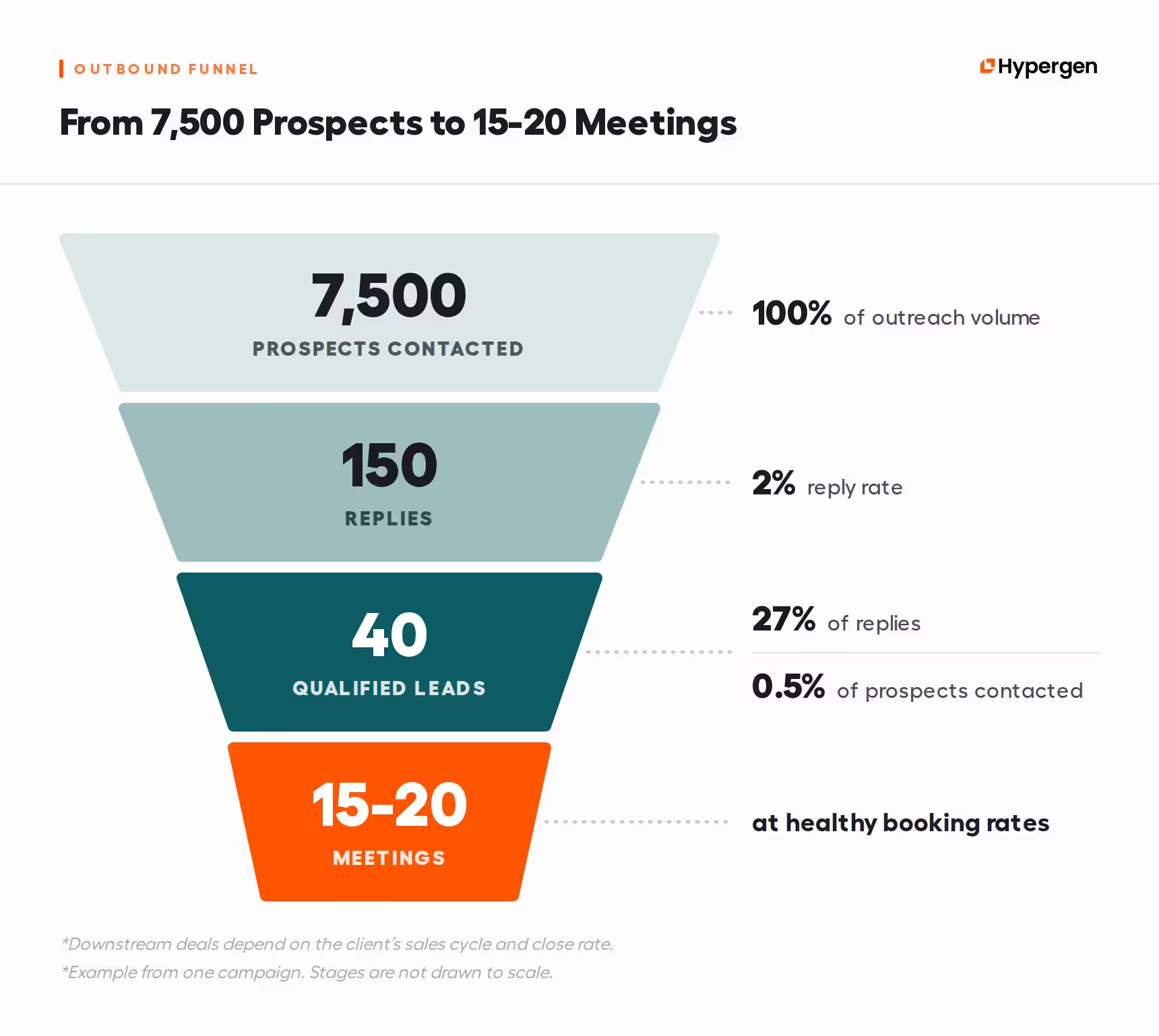
- 7,500 prospects contacted
- 150 replies, a 2% reply rate
- 40 qualified leads, representing 27% of replies and 0.5% of all prospects contacted
- 15-20 meetings at healthy lead-to-meeting booking rates
From there, the number of closed deals depends on the client's sales cycle and close rate.
In the example from our data, around 2 out of 20 meetings could become deals, although sales cycles can range from one month to a year, depending on the industry.
Not every non-lead reply is a dead end
The 110 replies that didn't qualify as leads still tell us something about the campaign:
- Wrong-person replies can show that the targeting or seniority needs adjusting.
- Out-of-office replies create a specific opportunity to retry once the prospect returns.
- Rejections with context can reveal whether the issue is timing, relevance, or the offer itself.
- Curiosity without intent can show that the messaging is generating interest without enough qualification.
We don't add these responses to the lead count, but we don't discard them either. They become inputs for follow-up decisions and campaign adjustments.
Why does the prospect vs lead distinction change what you pay for?
Outbound pricing becomes difficult to compare when providers use different definitions of what they deliver.
A campaign contacting 10,000 prospects can look more productive than one contacting 5,000. But prospect volume tells you how much outreach happened, not how many qualified sales conversations it created.
The same problem applies to replies. If every positive response is reported as a lead, the reported lead volume increases without necessarily creating more meetings for the sales team.
The difference becomes clearer when you calculate the economics further down the funnel:
Provider B costs $2,500 more per month and contacts half as many prospects. But it produces twice as many qualified leads and four times as many meetings. The resulting cost per meeting is $229 instead of $500.
Cost per contact can make the higher-volume provider look cheaper. Once you follow the numbers through qualified leads and booked meetings, the economics can look very different.
What should you ask a lead generation provider before comparing prices?
Two providers can use the word lead while promising very different things.
Before comparing retainers or cost per lead, make sure you're comparing the same output.
How do you define a lead?
A reply alone is not the same as qualified intent. A lead should also fit the ICP, have a relevant problem, and show signs that they're evaluating a solution.
What's your lead-to-meeting conversion rate?
This shows what happens after a lead is handed over.
35-50% of the leads we qualify convert to meetings, which is why we keep curiosity replies separate from the lead count.
Do you count timing qualifiers as leads?
We distinguish between a generic rejection and a response with a specific future trigger, because they behave very differently when re-engaged.
A prospect saying “not now” isn't automatically qualified.
What happens when the lead rate is low?
The answer should tell you how the provider diagnoses and adjusts a campaign.
In our RevOps example, we didn't try to recover the higher reply rate. We changed the messaging to improve self-selection, and lead rate increased from 0.6% to 1.9%.
What's included in the price, and what costs extra?
Compare the full delivery model, not just the headline retainer. Then look at what's included.
Infrastructure, deliverability monitoring, CRM integration, reply routing, copywriting, list QA, and campaign adjustments may all affect the final cost.
What are you paying for beyond prospect volume?
In our case, the monthly fee covers more than prospect volume or a target number of replies. It includes:
- Qualified leads
We separate genuine buying intent from curiosity, referrals, and other replies that don't meet our lead criteria.
- Outbound infrastructure
Sending domains, warmup, deliverability monitoring, HubSpot integration, and reply routing are part of the campaign setup and management.
- Campaign adjustments
We use early performance data to identify when targeting, messaging, or the offer needs to change rather than waiting until the end of the campaign.
- Human-written copy
Messaging is written by people rather than generated end-to-end with AI.
- List quality control
We use AI to assist with domain validation, title cross-checking, and list QA before prospects enter the campaign.
Outbound works better when the team responsible for generating leads also owns the conditions that affect lead quality. That is why we keep infrastructure, targeting, messaging, qualification, and campaign adjustments within the same delivery model.
Be careful what a volume guarantee incentivizes
A high or unlimited prospect volume combined with a guaranteed lead target can look attractive, but it's worth asking how the provider plans to reach that target.
The more prospects a provider needs to contact to hit a fixed lead KPI, the greater the risk that targeting expands beyond the original ICP. That makes the initial list and exclusion rules especially important.
Building a quality lead list for cold emailing also means defining which companies and contacts should be excluded before outreach begins.
Before launch, we recommend checking:
- Who appears on the initial prospect lists and whether they match the agreed ICP.
- Which companies are excluded, including existing customers and competitors.
- Whether prospect volume can expand when the provider is behind the agreed lead target.
- How lead quality is protected as outreach volume increases.
Don't evaluate a lead guarantee without looking at the prospect volume and targeting rules behind it. The KPI matters, but so does what the provider is allowed to do to reach it.
How should you measure outbound performance?
No single metric tells you whether an outbound campaign is working. Each stage answers a different question:
- How much outreach are we running?
- Is the campaign generating responses?
- Are those responses turning into qualified intent?
- Are qualified leads progressing into sales conversations?
- Are those conversations creating commercial value?
This is why we report reply rate and lead rate separately.
A campaign can generate plenty of responses while producing very few qualified leads, as we saw in the RevOps campaign where a 4.2% reply rate produced only a 0.6% lead rate.
Don't optimize a campaign around the metric that looks weakest in isolation. A low reply rate can point to messaging, while a healthy reply rate paired with a low lead rate can signal weak targeting, a broad offer, or curiosity without buying intent. The gap between the metrics is often more useful than any single number on its own.
Focus your outbound on the conversations that matter
Where you draw the line between a prospect and a lead changes the economics of an outbound campaign. It affects the lead rate you report, the problems you identify in the funnel, and the cost you assign to each qualified sales conversation.
A prospect can match every targeting criterion and still have no reason to buy. A reply can show engagement without showing intent. We start treating that prospect as a lead when the reply shows they have the problem and are considering a solution.
That gives us a much better way to judge outbound performance: track how many prospects show qualified intent, how many of those conversations progress to meetings, and what it costs to generate them.


Frequently asked questions
A prospect is someone who matches your targeting criteria, such as job title, company size, industry, or geography. A lead also fits the ICP but has shown evidence of a relevant problem and intent to evaluate a solution. A reply alone isn't enough to move someone from one category to the other.
A prospect becomes a lead once they show qualified intent. That usually appears through the reply itself, such as asking specific questions about pricing, timeline, fit, or how the engagement works.
An opportunity typically sits further down the funnel, once a qualified lead has progressed into an active sales process. At Hypergen, our outbound reporting focuses on prospects, replies, and qualified leads, while opportunity stages can vary depending on the client's sales process and CRM setup.
No. A prospect can match every targeting criterion without showing any buying intent. We qualify someone as a lead when they also have a relevant problem and show signs that they're evaluating a solution.
Different providers can use different definitions of a lead, which is why reported numbers aren't always directly comparable. Before comparing providers, ask what needs to happen before someone enters their lead count and how those leads convert into meetings.
Don’t miss these




Get your first lead this month
14 days to get started. 7 days to get your first lead on average.


