


We charge $6.5K/mo for lead generation - here's what good B2B lead gen actually costs
TL;DR: B2B lead generation costs 101
- B2B lead generation retainers typically run $2,500 to $15,000 a month.
- Per-lead pricing averages $200 to $500 per qualified lead.
- Per-meeting pricing runs $150 to $600 a call.
- Hypergen charges $6,500 a month, and it covers a full team, signal-based targeting, deliverability infrastructure, and CRM work.
- When you try to build that same setup in-house and you're looking at $9,000 to $15,000 a month once hiring, tools, and rookie mistakes are all added up.
- Most "cheap" alternatives fall apart on data quality or sender reputation long before price ever becomes the real issue.
Ask three lead generation agencies what their service costs and you'll get three different answers… and none of which explain why. 🤷
One quotes $500 a month.
Another wants $200 per meeting.
A third says "it depends" and books a demo call instead of just telling you.
Well, we charge $6,500 a month for B2B lead generation.
And instead of tucking that number behind a "let's hop on a call," we'd rather just show you where every dollar goes (because honestly, we'd want the same transparency if we were the ones buying).
So if you're a founder or budget holder trying to figure out what "good" lead generation should cost, this is the our most honest answer to all these questions you probably have.
How much does B2B lead generation typically cost per month?
B2B lead generation retainers range from $2,500 to $15,000 a month, depending on what's actually included and how big the program is. Basic outbound packages start around $2,500 and cover list building plus sending.
Full-service retainers with a dedicated team and real infrastructure usually start at $6,500. And Enterprise programs running multiple channels can climb past $10,000.
Here's the quick breakdown, tier by tier:
And on the topic of in-house SDR:
A fully loaded SDR runs $110,000 to $160,000 a year once you count tools, ramp time, and management (But we'll circle back to that comparison in a bit, It changes the whole "expensive" conversation).
What's the difference between retainer, per-lead, and per-meeting B2B lead generation pricing?
Retainer pricing means a fixed monthly fee no matter what gets delivered. Per-lead pricing charges $200 to $500 for every qualified lead. Per-meeting pricing charges $150 to $600 (sometimes $900+ for enterprise) every time a real meeting gets booked.
And most full-service agencies default to retainers for one blunt reason: pay-per-meeting only works if somebody's cutting corners somewhere.
We hear this objection on 40 to 50% of our M&A and investment banking calls: "I'd rather just pay per meeting, so I know I'm only paying for results."
And yes, it sounds reasonable. But here's the problem with it:
Let's put real numbers on it.
Say a pay-per-meeting vendor books meetings at a rough 1-in-40 close rate (fairly typical when volume is the whole game), at $200 a pop. Getting to 6 closed deals that way costs about $48,000.
Now picture a retainer team that actually qualifies prospects properly, pushing that close rate to 1-in-20. Which means that same $48,000 in meeting spend now closes 12 deals.
So that’s the same spend, but roughly half the cost per deal.
We've watched this play out with actual client, so here is an example:
One M&A advisory client's $6,500-a-month retainer led to 4 to 8 extra closed deals a year, worth roughly $400,000 to $1.2 million in revenue they wouldn't have otherwise landed.
Cost as % of that upside? <0.5% 🎯


Why do some B2B lead generation services cost $500/month while others cost $6,500?
A $500-a-month service is a software subscription. It's not managed lead generation, and honestly, it was never trying to be.
A $6,500-a-month retainer pays for a team's actual time plus the infrastructure behind it, roughly 30 to 40 hours of specialist work a month, plus $920 to $1,240 in per-client tool costs.
So that gap isn't just markup, but it’s just what the labor and systems genuinely cost.
At $500 to $1,500 a month, you're paying for a seat in a tool like Apollo, or a self-serve Clay setup.
You have no strategy, no team, and nobody watching deliverability. You do the work; the tool just gives you a place to do it.
So where does a $6,500 retainer actually go? Here's how we staff ours, roughly:
- Campaign manager (15 to 20 hours/month): weekly strategy calls, copy research, list QA, keeping the CRM clean, reporting, and just generally answering your Slack messages
- Copywriter (8 to 12 hours/month): writing the full sequence, spintax variations for deliverability, subject line testing, and revisions when something isn't landing
- GTM strategist, shared across accounts (3 to 5 hours/month): refining who you're targeting, hunting for new buying signals, quarterly check-ins
- RevOps and CRM support, shared (2 to 4 hours/month): HubSpot setup, lead routing, keeping the pipeline from turning into a junk drawer
That's 60 to 70% of the retainer in team time alone. The rest goes to per-client tooling:
Total: $920–$1,240/mo
Higher-volume clients (15,000+ sends a month) push that closer to $1,500.
But none of this shows up as a line item on any invoice, which is exactly why "why is this $500 and that's $6,500" is such a fair question in the first place.
The logical next question: does spending more actually get you better results?
Usually yes, but the mechanism matters more than the number. The extra spend buys qualification discipline. It's the difference between a team that stops a bad list before it burns your email domain reputation and a tool that sends whatever you upload.
If you want to see exactly how that plays out in real numbers, we've covered cold email agency ROI start to finish in a separate post.
What actually goes wrong with cheap B2B lead generation tools and agencies?
Across audits of 50+ clients who tried DIY tools or a cheaper vendor before coming to us, five failure patterns keep showing up: bad data (70% of cases), burnt sender domains (60%), generic copy (80%), zero infrastructure (50%), and a fuzzy ICP (40%).
Most of these snowball into something we call the death spiral, and it usually starts before anyone notices there's a problem. 👀
Let's walk through each one.
Bad data (the number one culprit)
Bad data is the most common failure we find, showing up in roughly 70% of audits.
Clients often arrive with Apollo "verified" lists that only hit 60 to 70% real deliverability, or ZoomInfo exports bouncing at 40 to 50%, and neither gets caught until the damage is already done.
One M&A advisory client came to us after sending 5,000 emails through a ZoomInfo export.
Eight replies.
And well… zero meetings.
When we dug in, we found a 42% bounce rate, 35% generic inboxes (info@, contact@... you get the idea), and 18% wrong-persona targeting. Out of 5,000 contacts they paid for, roughly 250 were usable.
That's 5% of what they thought they bought. 😬
Burnt deliverability (the mistake you genuinely can't undo)
Burnt cold email deliverability shows up in about 60% of audits, usually from sending cold outreach off a company's primary domain with no SPF, DKIM, or DMARC, and no warmup period at all.
So once that domain gets flagged, there's rarely a quick fix.
We later worked with a private equity firm that had sent 3,000 emails from their primary domain and ended up with a 0.2% reply rate and 12 spam complaints.
And that domain was done. Not "needs a small fix" done, but "needs 6 to 12 months of silence or a full rebrand" done.
Generic copy (the one that's easiest to spot)
Generic copy shows up in four out of five audits we run, usually AI-written openers with zero personalization and zero proof behind the claims being made.
It reads exactly like it could've been sent to any company in any industry, because well, to be honest it was.
Here's a real before-and-after from an M&A advisory client's original sequence (names swapped out, everything else untouched):
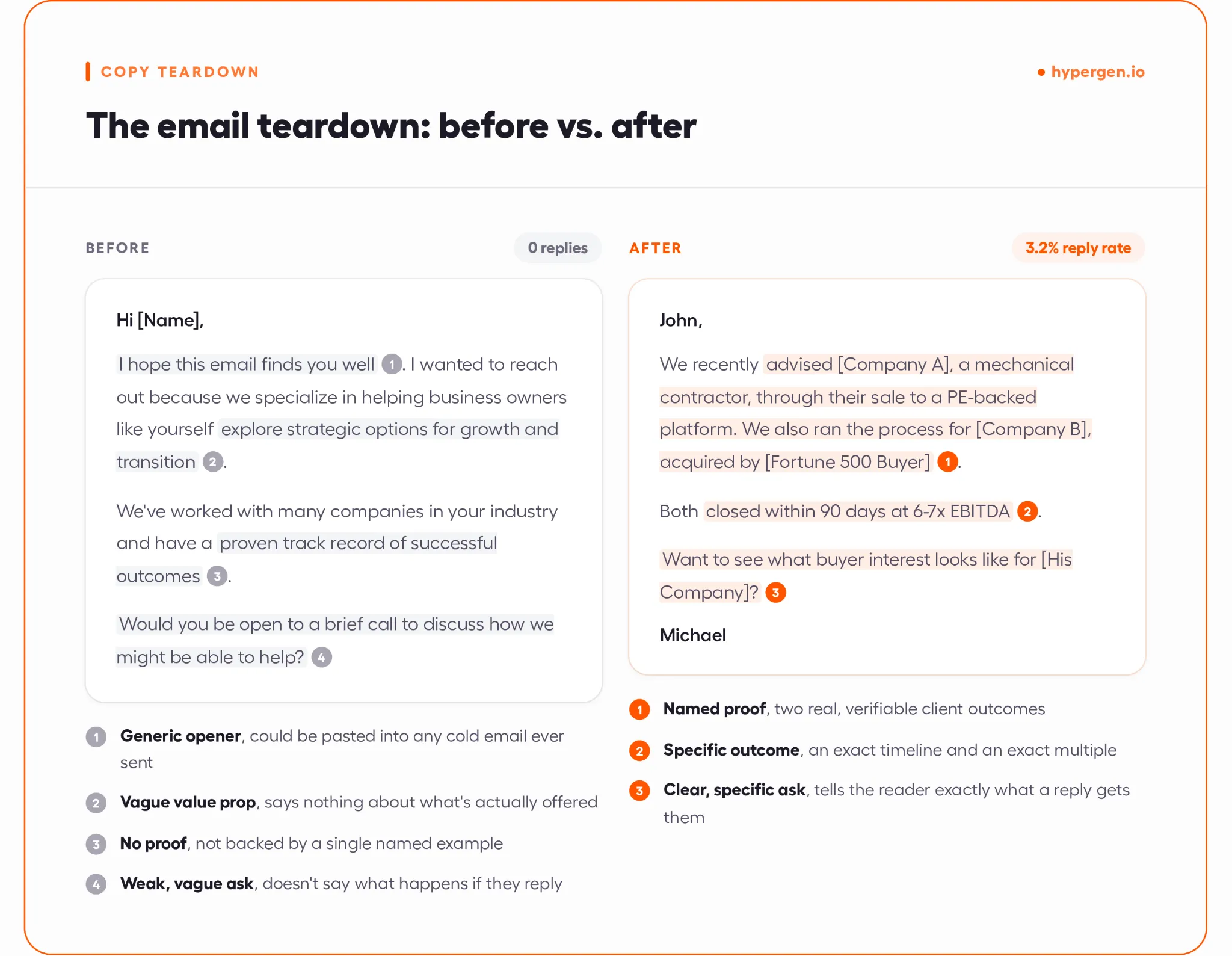
Before (0 replies):
"Hi [Name],
I hope this email finds you well. I wanted to reach out because we specialize in helping business owners like yourself explore strategic options for growth and transition.
We've worked with many companies in your industry and have a proven track record of successful outcomes.
Would you be open to a brief call to discuss how we might be able to help?"
After (3.2% reply rate):
"John,
We recently advised [Company A], a mechanical contractor, through their sale to a PE-backed platform. We also ran the process for [Company B], acquired by [Fortune 500 Buyer].
Both closed within 90 days at 6-7x EBITDA.
Want to see what buyer interest looks like for [His Company]?
Michael"
And no, the difference here isn't tone or "voice." It's named proof against a specific claim, instead of a sentence that could've been sent to literally any industry on the planet.
No infrastructure (so replies go straight into a black hole)
Missing infrastructure shows up in 50% of audits, meaning nobody was actually monitoring what happened after the send button got pressed.
An investment bank ran a self-serve sending platform for four months and told us, "we got some replies but nothing closed."
It actually turned out 17 positive replies had been sitting unread in the sending inbox for over 30 days.
There was no CRM handoff, no one monitoring the inbox, and obviously, no way to know the campaign had actually worked.
Wrong ICP (targeting that only looks like targeting)
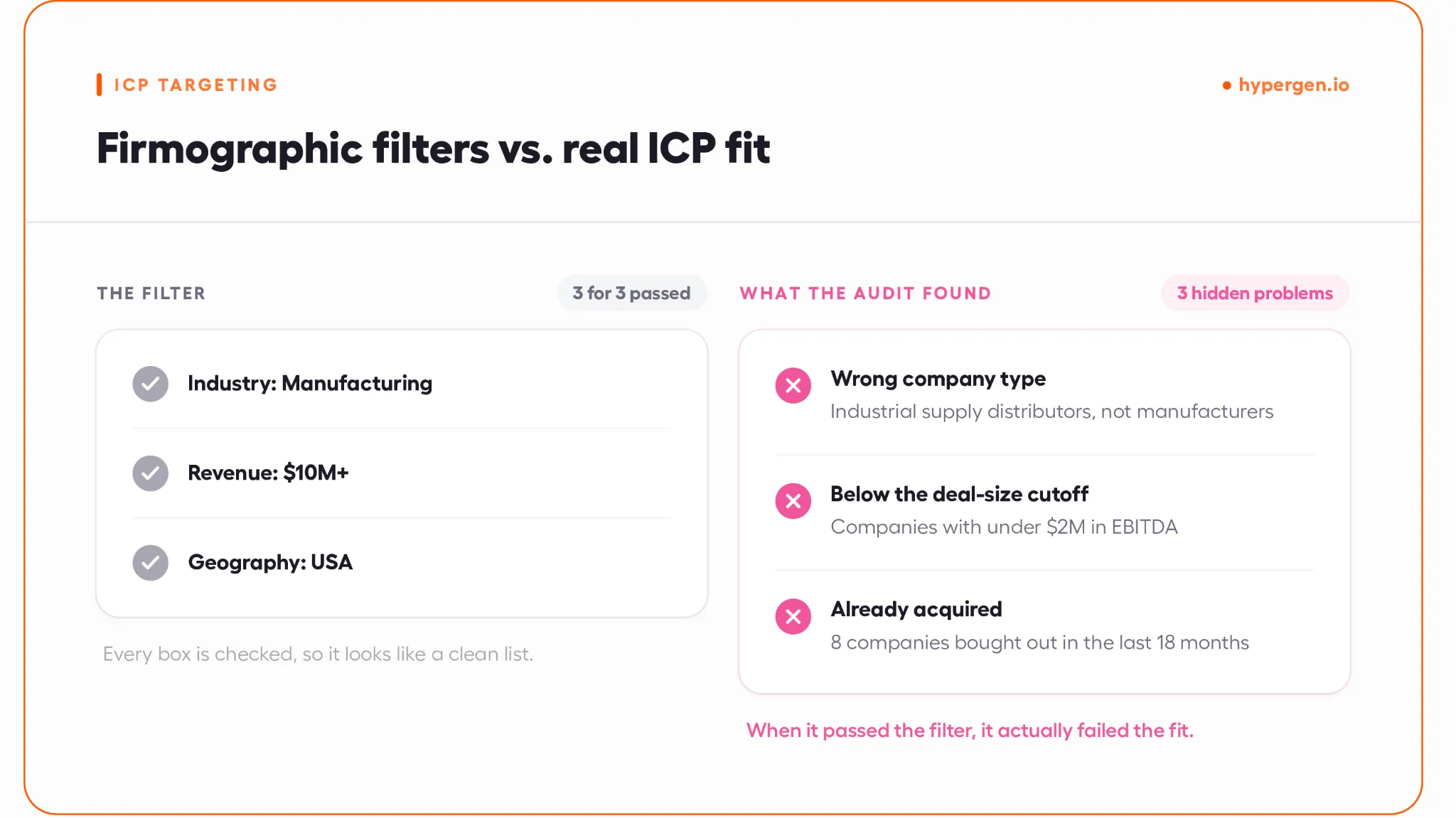
A fuzzy or wrong ICP shows up in 40% of audits, usually because firmographic filters got mistaken for real targeting.
An example from our audit we have is a firm going after "manufacturing, $10M+ revenue", that had a list packed with distributors (not manufacturers), companies below their own deal-size cutoff, and a handful of companies that had already been acquired eighteen months earlier.
Firmographic filters are very easy to apply.
But real ICP fit is one of the outbound lead generation tactics that actually takes market knowledge and a signal check, not just a filtered spreadsheet.

- Buy cheap data (Apollo, scraped LinkedIn)
- Send from main domain with no warmup
- Very high bounce rate (30-50%) → domain flagged
- Emails land in spam → zero opens
- Send more emails to "make up volume" → more spam flags
- Domain fully burnt in 2-4 weeks
- Give up, blame "cold email doesn't work"
Here's what we do differently on every single campaign:
- Validate every email address before it gets sent
- Never touch the company's primary domain for outbound
- Warm up gradually, roughly 50 emails a day scaling to 200 over four weeks
- Watch deliverability daily and pause automatically if bounces top 5% or spam complaints hit 0.3%
- Rotate sending across multiple domains and inboxes, so one bad signal doesn't sink the whole thing
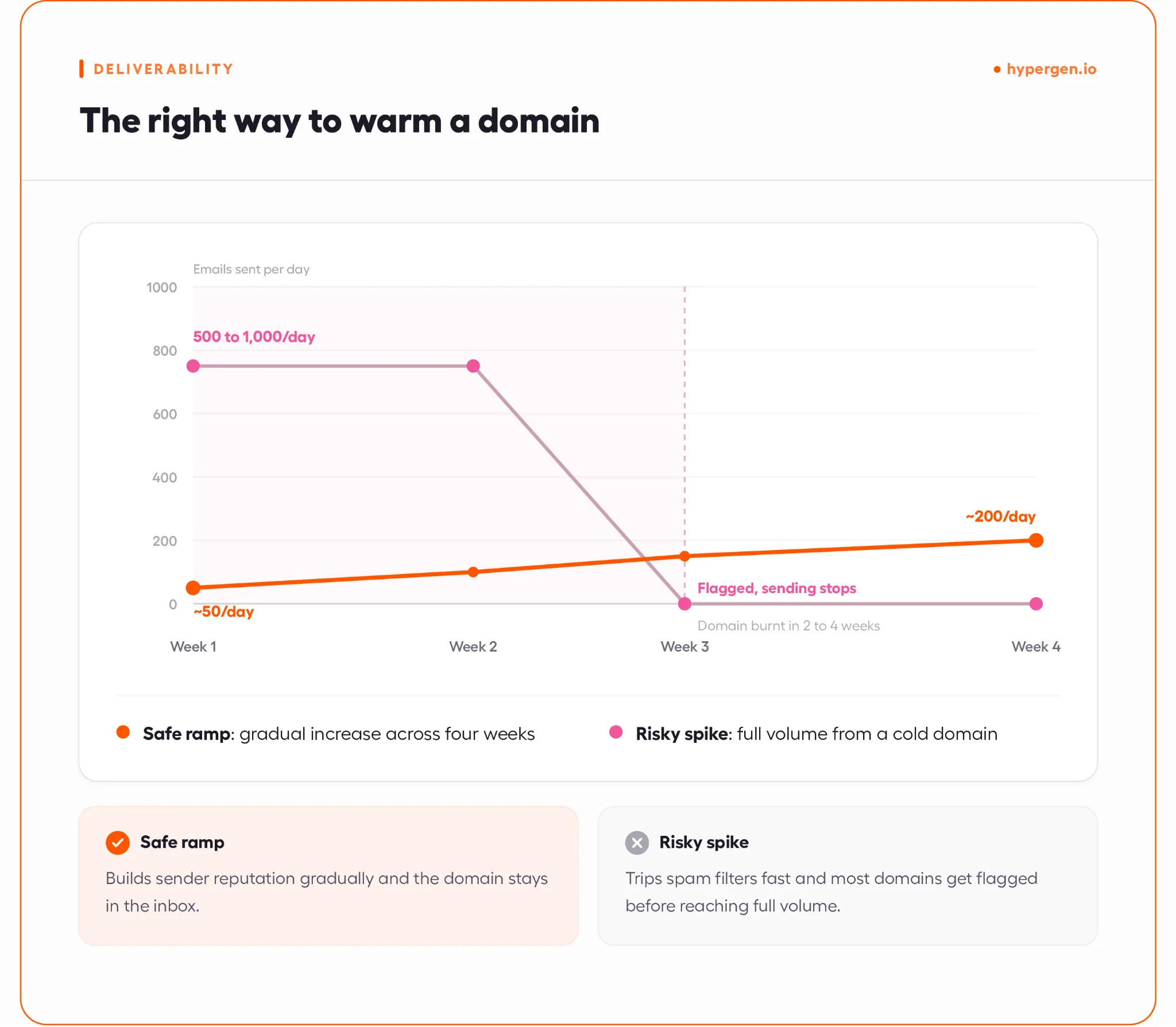
For cold email deliverability specifically, this is the part that a lot of cheaper providers skip entirely, and it's worth asking any vendor exactly how they handle it before you sign anything, not after your domain is already flagged.
👉 We break down exactly what to check for before that happens in a separate post on how to evaluate a cold email agency.
Is it cheaper to build an in-house SDR team or outsource B2B lead generation?
Outsourcing lead generation is almost always cheaper once every cost gets counted, not just salary.
A fully loaded in-house SDR in the US runs $110,000 to $160,000 a year after benefits, tools, management, and ramp time.
Our retainer delivers 15 to 25 qualified meetings a month, plus copywriting, deliverability, and CRM work, for $78,000 a year.
But what actually most founders get wrong is that you're not actually comparing us to other agencies.
You're comparing us to hiring one or two SDRs, at $80,000 to $120,000 a year each, once you add tools and training, for 10 to 15 meetings a month. We're the SDR, the copywriter, the list builder, and the deliverability engineer, all bundled into one line item
And that matters even more in specialized categories like M&A lead generation, where the copywriter and the strategist both need to understand deal structures, not just write good subject lines..
We've written out the full salary-vs-retainer math, line by line, in our outsource SDR vs hire in-house guide, if you want to see every number side by side.
What should a $6,500/month B2B lead generation retainer actually include?
At $6,500 a month, a retainer should cover a full team (campaign manager, copywriter, GTM strategist, RevOps support), signal-based targeting, real deliverability infrastructure, and CRM work.
Trying to replicate that in-house realistically costs $9,000 to $15,000 a month.
Here is the breakdown:
What it actually costs to replicate this yourself
Building the same program in-house runs $9,000 to $15,000 a month once you count hiring, tools, and the mistakes that come with learning deliverability the hard way.
Let's actually price it out:
- Hiring.
A campaign manager or SDR runs $6,500 to $8,500 a month fully loaded (taxes, benefits, the works), and needs 60 to 90 days before they're actually productive.
A copywriter, fractional or contract, runs $750 to $1,500 a month (or $4,000 to $6,000 for a junior full-timer).
A deliverability and RevOps specialist, fractional, runs $500 to $1,000 a month.
Total: $7,750 to $11,000 a month, before a single email is even sent.
- Tools.
A self-serve stack (data, sending platform, CRM, warmup tools, domains) runs $865 to $2,480 a month depending on volume.
- The part almost nobody budgets for.
A 3 to 6 month learning curve on deliverability and list quality usually burns $20,000 to $50,000 in wasted spend. Early mistakes, a burnt domain here, a bad ICP there, tend to tack on another $10,000 to $30,000.
So spread out, that's roughly $500 to $1,500 a month in what we'd call the mistake tax. 😬
Realistic DIY total: $9,000 to $15,000 a month.
And that's before anyone counts the founder or exec hours spent managing any of it, which, let's be honest, is never actually "free" either.
What you're actually paying for
Although it might look like it at first, you're not paying $6,500 for a batch of emails.
You're buying:
- A team that's sent over 10 million cold emails and already knows what breaks.
- Deliverability infrastructure that took years to build.
- Copywriting expertise pulled from real client campaigns
- A CRM setup your sales team will actually use.
When you run the DIY math honestly, you’ll see that you're saving somewhere between $2,500 and $8,500 a month, while skipping every mistake we've already made and learned from.
Our B2B lead generation services are built exactly around this idea: one retainer, one team, and no separate invoices for the parts that make a campaign actually work.
At the end of the day, most of the confusion around lead generation pricing isn't really about the number, but about not knowing what that number is supposed to buy.
And once you see the actual breakdown, team time, tools, infrastructure, the mistakes that get skipped… $6,500 stops looking arbitrary and starts looking like a number that actually adds up.
Because the cheapest option and the best option are almost never the same one.
But hopefully now you've got the real numbers to figure out which one actually makes sense for you.
Frequently asked questions
Cost per qualified B2B lead ranges widely by industry, from roughly $420 to $3,080 with legal, software, and financial services sitting at the higher end due to longer sales cycles and bigger deal sizes. Cold email specifically tends to run cheaper than paid channels, averaging $150 to $300 per lead. But the number that matters more than the benchmark is cost per closed deal, since a $300 lead that converts beats a $50 lead that never does.
It depends heavily on the provider, and it's one of the most common gaps we find when auditing a client's previous setup. Agencies charging $2,500 to $3,000 a month often bill deliverability infrastructure (domains, warmup, SPF/DKIM/DMARC monitoring) separately. Full-service retainers at $6,500 and above should include infrastructure as part of the core program, not as an add-on charged after you're already locked in.
Retainer pricing tends to win for sustained outbound because the incentive lines up with quality, not just volume. Per-lead and per-meeting models sound safer because you only pay for output, but they push an agency toward hitting a number rather than qualifying the right prospects. The exception is pay-per-meeting for very high-value, low-volume target accounts, where shifting risk to the agency can make sense if "qualified" is defined tightly in the contract.
Most full-service agencies do, through a retainer model that stays fixed regardless of exact output that month. Some agencies instead charge per lead ($200 to $500) or per booked meeting ($150 to $600), which varies month to month based on results. Retainers are more common among agencies running multi-channel programs with dedicated teams, since a fixed fee is what funds consistent staffing and infrastructure.
Enterprise campaigns cost more because targeting senior decision-makers takes more research, more personalized touches, and a stricter definition of "qualified." Retainers for enterprise programs typically start at $10,000 to $15,000 a month for multi-channel outreach, and pay-per-meeting pricing for enterprise targets regularly exceeds $900 per booked call. So you should budget for the complexity of the sale, not just the size of the target list.
Don’t miss these
.avif)

Get your first lead this month
14 days to get started. 7 days to get your first lead on average.


