

7 LinkedIn Connection Request Approaches We Use for B2B Outreach - Here's What Gets Accepted
TL;DR: LinkedIn connection request messages for B2B outreach explained
- The list matters more than the wording. In our M&A campaigns, the same connection request message achieved acceptance rates ranging from 6% to 26% across different prospect lists. 🎯
- A note isn't always necessary. We typically send connection requests without a note and save the pitch for the first DM after acceptance. ✉️
- Personalization doesn't guarantee acceptance. Our tests show that targeting, LinkedIn activity, and sender profiles can make a bigger difference than changes in copy. 🔍
- Acceptance rate isn't the whole story. A request can get accepted without generating interested leads. We look at both when evaluating performance. 📊
We've tested LinkedIn connection request messages across B2B campaigns for M&A advisors, SEO/GEO agencies, and other service providers.
One finding stands out: who receives your request can matter more than what the message says. That's why targeting is a central part of our LinkedIn outreach strategy.
Of course, the acceptance rate is only part of the picture. A connection request can get accepted without leading to a meaningful sales conversation. That's why we also track how many interested leads those connections generate.

Our usual approach is to send LinkedIn connection requests without a note, as this has generally performed better in our testing.
The 7 examples below show how we've approached connection requests across different campaigns, including the messages we tested, the audiences we targeted, and what happened after acceptance.
What makes a LinkedIn connection request message worth accepting?
We've seen the same connection request message perform very differently depending on who receives it. This suggests that prospect selection deserves at least as much attention as the wording itself.
Our testing points to three factors worth examining:
- Audience relevance
Does the prospect match the ICP, and is there a clear reason to connect? A relevant message sent to the wrong audience is unlikely to produce useful conversations.
- LinkedIn activity
In our M&A campaigns, filtering for recent activity was associated with stronger acceptance results, even when the message stayed the same.
- Sender profile
In one IT advisory campaign, two sender profiles recorded different acceptance rates, despite operating within the same broader outreach effort.
These factors also need to be evaluated against the outcome that matters to the business. A high acceptance rate can look promising, but the number of high-quality leads tells us more about whether the outreach is reaching the right people.
The seven examples below show how these considerations played out across different messages, audiences, and campaigns.
01. The proof-led request for SEO/GEO agencies
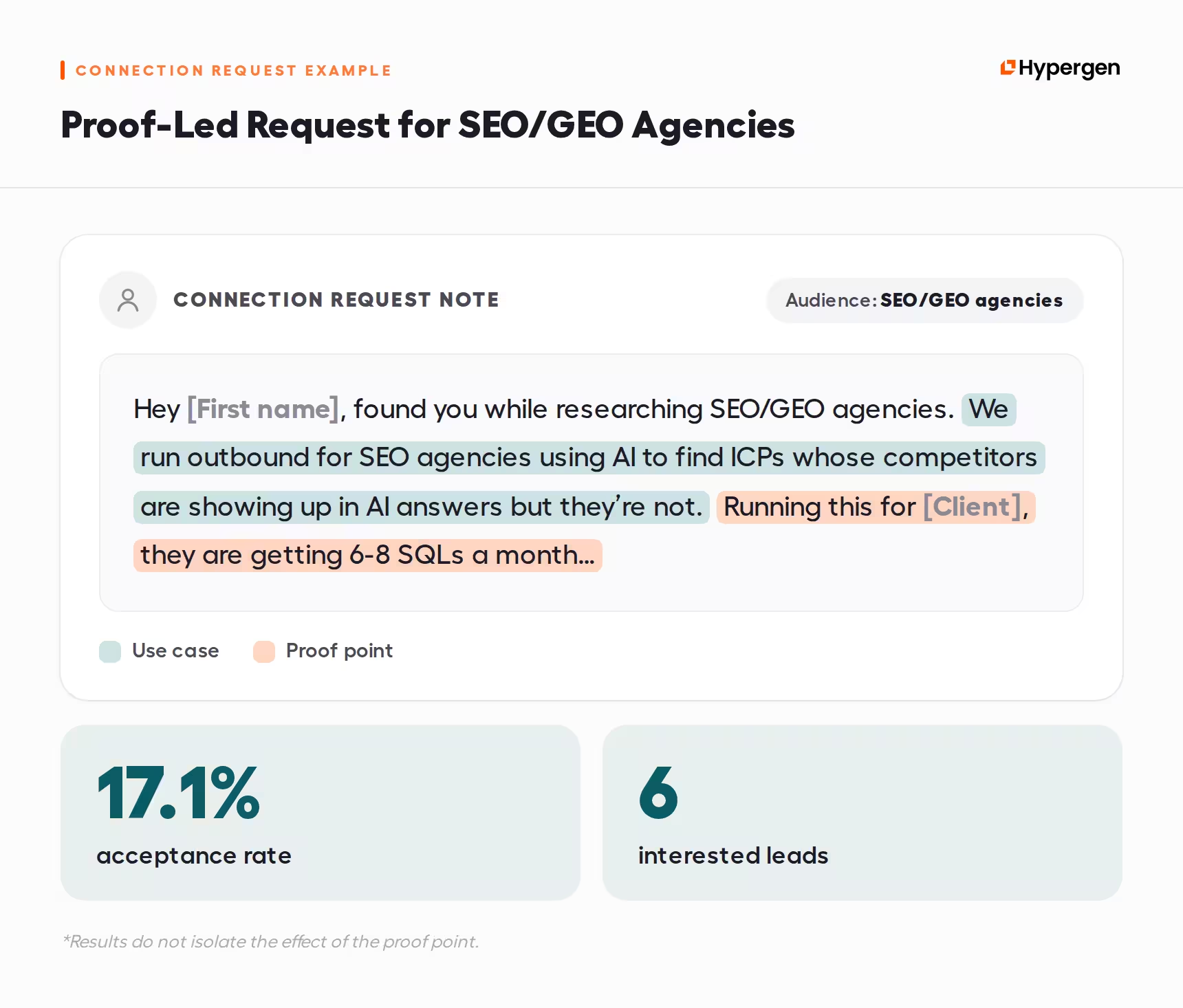
We targeted SEO/GEO agencies with a connection request that introduced our AI-powered outbound approach and referenced results from an existing client, Digital Authority Partners.
What did we learn?
The message opened with “Hey, found you while researching SEO/GEO agencies” and explained how we use AI to find prospects whose competitors appear in AI answers while they don't. It also referenced Digital Authority Partners, reporting 6-8 SQLs per month.
The campaign achieved a 17.1% acceptance rate and generated 6 interested leads.
This shows that a detailed, proof-led request can generate interest, although we can't attribute the results to the proof point alone without a controlled comparison.

Proof-led requests are worth testing when you have a relevant client result. Just make sure you measure both acceptance rates and interested leads.
02. The case-study-led request that underperformed
For another SEO/GEO agency campaign, we tested a more direct approach.
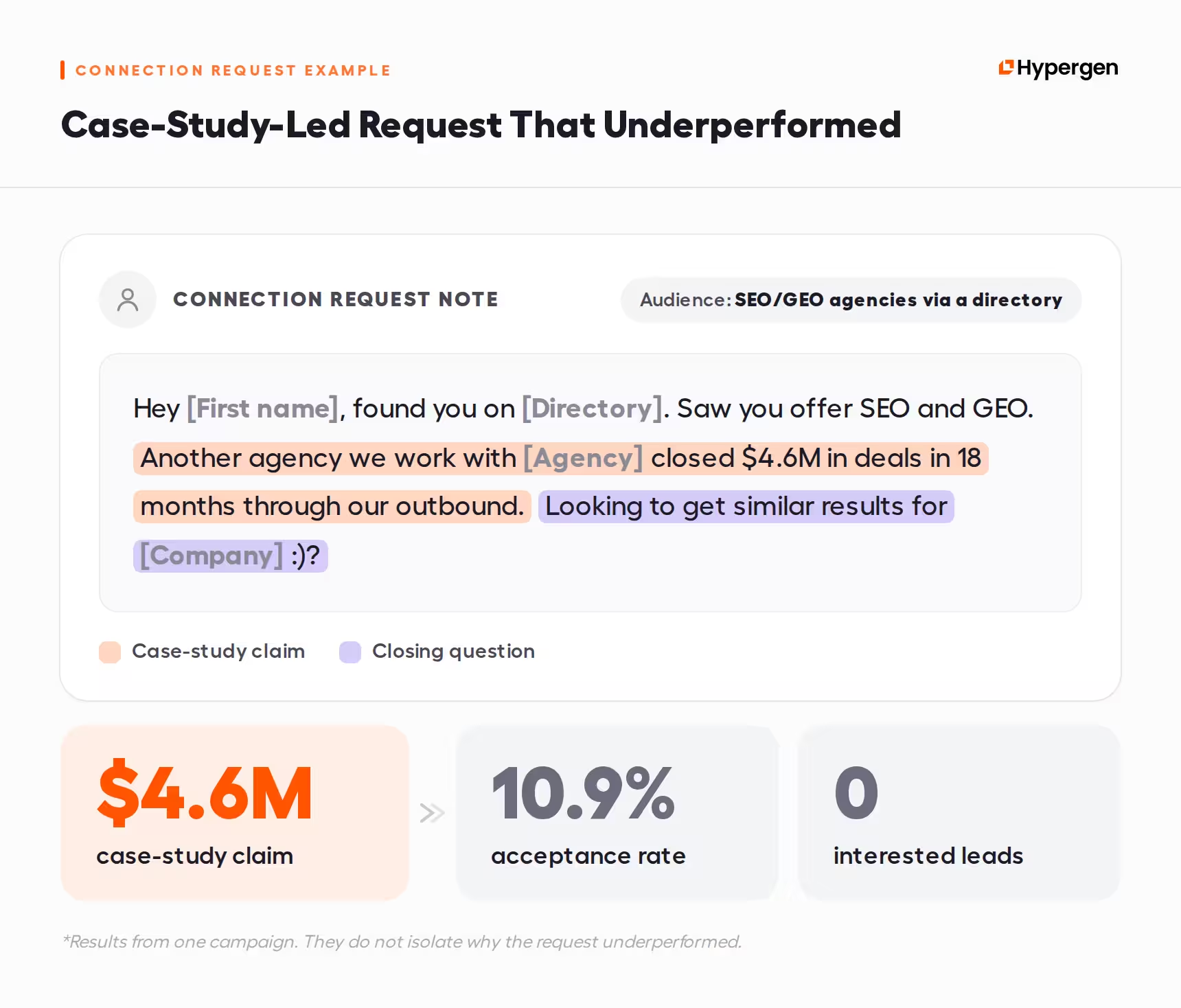
The connection request referenced a client's revenue results and ended with a question about achieving similar outcomes for the prospect's company.
Why didn't the strong case study translate into better results?
The request opened with a Designrush reference, then moved straight to a sales pitch backed by Dingus & Zazzy's $4.6M in closed deals over 18 months.
The result was just 10.9% acceptance and zero interested leads, making it the weakest agency message variant in our examples.
Looking back, we felt the combination of the Designrush reference and the large revenue claim may have made the request sound like a mass message.
A strong case study can be tempting to lead with, but it may be too much for a first interaction. Keep your connection request simple and relevant. Save the proof points and sales pitch for after the prospect accepts.
03. The company-specific opening line
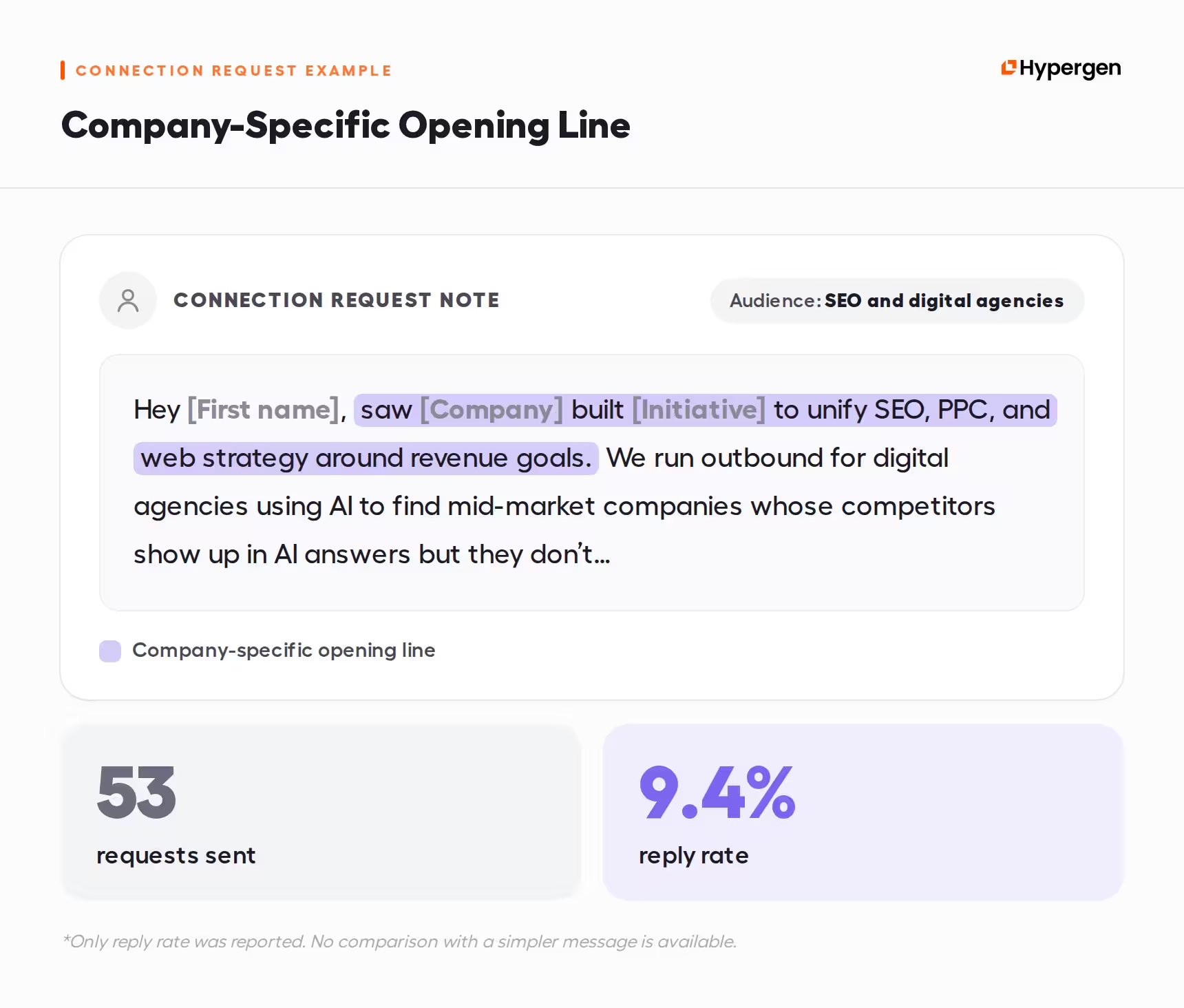
For this campaign, we tested a more personalized approach with SEO and digital agencies. Each connection request included a custom opening line referencing something specific about the prospect's company.
For example, one message mentioned HigherVisibility's Targeted Growth System before introducing our AI-powered outbound approach.
Did company-specific personalization generate more replies?
The campaign recorded a 9.4% reply rate across 53 requests. Each personalized opening required additional company research, but we don't have a comparison showing whether it outperformed a simpler message.
That leaves an important question for future testing:
Does the extra research generate enough additional interested leads to justify the time invested?
When personalizing your requests, look for details that give the prospect a genuine reason to connect, not just something specific you can mention about their company.
04. The warm connection after a positive email reply
We've also used LinkedIn to reconnect with prospects who responded positively to cold emails but then went quiet. In this campaign, the same sender followed up with a LinkedIn connection request.
Of the 21 connection requests sent, 6 were accepted, giving us a 28.6% acceptance rate. After acceptance, the sender followed up with a LinkedIn DM referencing their earlier email conversation.
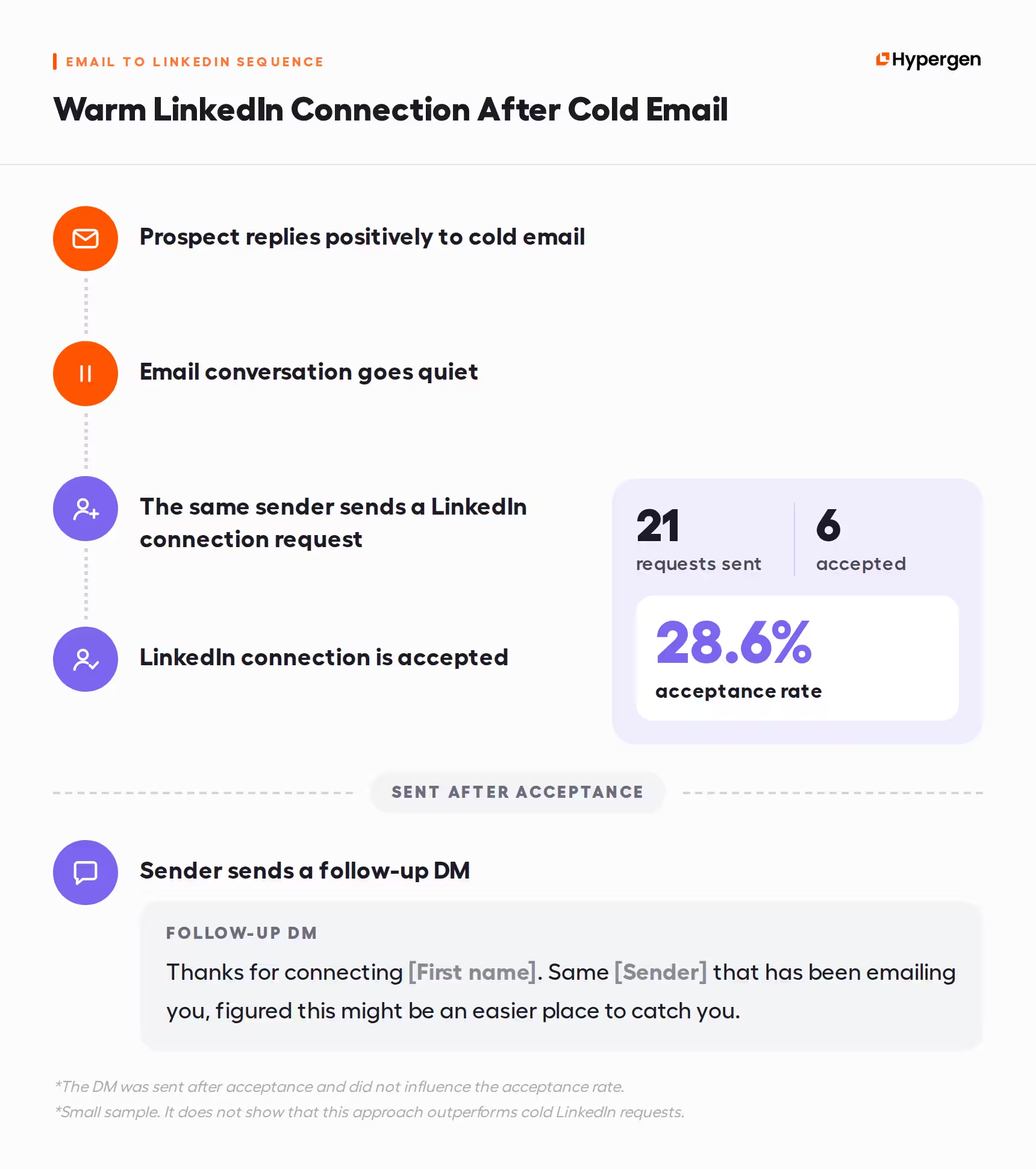
Can an existing email conversation improve LinkedIn acceptance?
The approach differed from the previous examples because recipients had already expressed interest through email. We weren't introducing ourselves to an entirely unfamiliar audience.
The small sample doesn't establish whether this approach consistently outperforms cold LinkedIn requests. It does, however, give us a useful example of how LinkedIn can serve as a second touchpoint when an email conversation stalls.
When a prospect has already shown interest, a LinkedIn connection request can reopen the door. Once they accept, you can follow up with a DM that references your earlier email conversation.
Same message, different lists (3 M&A connection request tests)
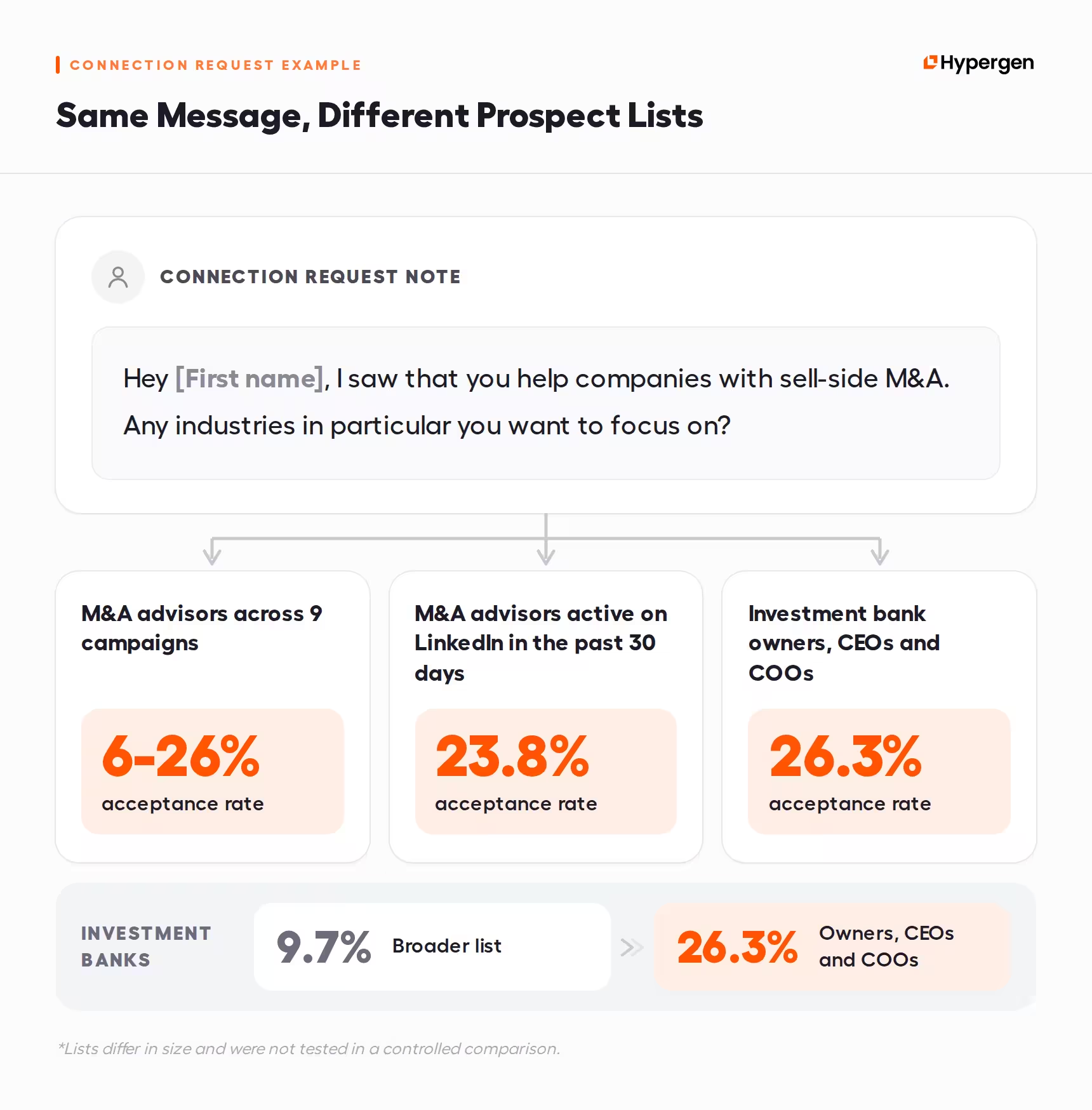
One of the clearest patterns in our M&A outreach campaigns came from using the same connection request message across different prospect lists.
The message was simple. We acknowledged the prospect's work in sell-side M&A and asked which industries they wanted to focus on.
05. The industry question for M&A advisors
We used this industry-focused question approximately 1,800 times across 9 campaigns, with acceptance rates ranging from 6% to 26% across different M&A advisor lists.
Around 4% replied directly to the connection note. We saved the sales pitch for the first DM after acceptance, which asked whether prospects wanted to connect with business owners looking to sell and recorded a 20.7% reply rate.
The wide acceptance range prompted us to look more closely at targeting rather than rewrite the message. The next 2 tests show what happened when we used the same copy with more specific prospect lists.
06. The same message sent to active LinkedIn users
For another list, we filtered M&A advisors based on whether they had posted on LinkedIn in the previous 30 days.
That campaign produced a 23.8% acceptance rate and 27 interested leads from 568 requests.
The wording hadn't changed. The audience selection had, suggesting that recent LinkedIn activity may be a useful targeting signal.
07. The same message sent to decision-makers
We also tested the message with investment banks, narrowing the list to owners, CEOs and COOs.
This list achieved a 26.3% acceptance rate and 7 interested leads from 76 requests. A broader investment bank list using the same message recorded 9.7% acceptance.
The smaller decision-maker list performed better on acceptance, although these results don't establish that seniority alone caused the difference.
What did the 3 tests tell us about targeting?
The results point to 2 audience characteristics worth investigating: recent LinkedIn activity and decision-making responsibility. Both appeared in lists with relatively high acceptance rates, although neither was isolated in a controlled test.
Neither comparison isolates a single cause. But together, they show why prospect selection deserves closer attention before changing the message.

Before rewriting an underperforming connection request, check who you're sending it to. Review ICP fit, LinkedIn activity, and job titles. Change one variable at a time so you can better understand what's affecting acceptance.
What did our connection request tests teach us?
Beyond the 7 examples, we've seen similar patterns in other client campaigns.
For an Arizona business brokerage, broad CEO/owner lists achieved 5-7% acceptance, while LinkedIn-active founders of companies with over $1M in revenue achieved 22-25%. The more targeted list also generated 23 of the campaign's 24 interested leads.
Both groups received blank connection requests, so message wording wasn't a factor in this comparison.
Small wording changes may matter less than expected
In an IT advisory campaign, we tested casual and professional messaging styles.
The acceptance rates were almost identical: 17.9% for casual wording vs. 18.1% for professional wording.
In this campaign, changing the tone showed little advantage. That doesn't mean wording never matters, but it's worth checking other factors before rewriting your messages.
Sender profiles and markets deserve attention, too
In the IT advisory campaign, we also observed differences based on prospect geography and the sender profile used.
These results suggest geography is worth examining when evaluating campaign performance, although other differences between the audiences may have contributed.
We also compared acceptance rates across 2 LinkedIn sender profiles used in the same IT advisory campaign.
This suggests the sending profile deserves attention alongside the message and prospect list.
Acceptance doesn't guarantee pipeline
In the same IT advisory campaign, we sent approximately 1,600 requests but generated only 6 interested leads. That result is a useful reminder to evaluate what happens after acceptance, not only how many people connect.
Understanding the role of LinkedIn vs cold email outreach also helps put these results in context, since acceptance rates measure only one stage of the LinkedIn funnel.
Track acceptance rates to understand how well your requests are being received. Then look at replies and interested leads to see whether those connections are turning into useful sales conversations.
How should you choose a LinkedIn connection request message?
The best starting point is what you know about the prospect and why you're reaching out.
Use these questions to choose an approach:
Ask yourself whether the note adds anything useful to the connection request. If not, consider sending a blank request and saving your introduction for the first DM after acceptance.
There's something more important than your connection request message
We've probably said this a hundred times by now, but our campaign results keep bringing us back to the same point: stop trying to perfect every connection request and take a harder look at who's receiving it.
We've seen the same message perform very differently across prospect lists. And in many of our campaigns, we skip the note entirely, saving the conversation for the first DM after acceptance.
A better prospect list gives every connection request a stronger starting point. And understanding how to generate B2B sales leads starts with knowing which prospects are worth reaching in the first place.


Frequently asked questions
A relevant message, the right audience, and a credible LinkedIn profile can all affect acceptance rates. We've seen the same message produce very different acceptance rates across prospect lists. That's why we look at targeting, messaging, and sender profiles together when reviewing campaign performance.
We generally recommend saving the pitch for after acceptance. A connection request works better as a brief introduction than a full explanation of your services.
There's no fixed ideal length. Include one relevant reason to connect, such as an industry question or a useful observation about the prospect's company. If you're trying to fit your introduction, services, case study, and meeting request into one note, consider moving some of that information to the first DM.
Personalization can help when it gives the prospect a clear reason to connect. But simply mentioning their company name, a recent post, or something from their website doesn't guarantee better results. The important part is how you use that information. A relevant observation or question can be more useful than a generic compliment with the prospect's name added.
Look for signals that help you understand the prospect's role, priorities, or current activity. These could include recent LinkedIn posts, a new company initiative, or a specific service they offer. Choose signals that connect naturally to your reason for reaching out. If a detail doesn't help explain why you're contacting that person, it probably doesn't need to be in the message.
Don’t miss these


Get your first lead this month
14 days to get started. 7 days to get your first lead on average.


