

5 LinkedIn Outreach Sequences We've Tested - Here's Which One Books the Most Meetings
TL;DR: LinkedIn Outreach Sequences Explained
- A strong LinkedIn outreach sequence gives every touchpoint a clear job. The sequences we tested use different approaches, from combining LinkedIn with email to using content signals, profile visits, or client proof. 🎯
- Proof is the strongest measured copy lever we found. In an email A/B test, replacing generic positioning proof with a named client, a specific number, and a clear outcome moved reply rate from ~0.8% to 3.2%. 📈
- Our LinkedIn benchmarks show the full funnel, not just reply rate. Around 600 invites can produce 15-20% acceptance, 25-30% replies among accepted connections, 4-10 hot leads, and 1-4 meetings booked. 📊
- The right sequence depends on the audience and setup. Invitation treatment, for example, can perform differently across audiences, so we treat some elements as tests rather than universal rules. 🧪
Most LinkedIn outreach sequences are built around the same basic idea: send a connection request, follow up a few days later, then keep nudging until the prospect responds.
That approach misses the part that matters most. Each touchpoint should have a reason to exist. A connection request can create recognition. A follow-up can introduce a new angle. A wrong-person ask can turn a silent prospect into a referral. The sequence should move the conversation forward instead of repeating the same pitch.
We’ve tested different LinkedIn outreach sequences across B2B outbound prospecting campaigns, including omnichannel outreach, content and event signals, profile visits, and proof-led messaging.
The results have shown us that some sequence elements matter far more than others.
Which LinkedIn outreach sequences have we actually tested?
The right approach depends on what you are trying to create before the pitch: recognition, relevance, a second channel, or immediate proof.
The difference between these approaches is not simply the number or timing of touchpoints. Each sequence creates a different reason for the prospect to engage, whether that comes from familiarity, a relevant signal, another channel, or specific proof.
The important difference is what each sequence asks the prospect to do next. Some build familiarity first. Others create relevance through a signal. Proof-First moves quickly to a specific value proposition backed by evidence.
Now let’s look at how each sequence works, what it is designed to achieve, and what our data tells us about it.
Sequence 01: Omnichannel Sync
The Omnichannel Sync sequence uses email and LinkedIn as two parts of the same outreach motion. Instead of repeating the same pitch on both channels, each touchpoint gives the prospect a different reason to engage.
The sequence starts with a Day 1 cold email, followed by a Day 2 LinkedIn profile visit and connection request. On Day 5, the LinkedIn message references the email topic from a different angle, so the second channel adds context rather than simply repeating the first message.
A Day 9 wrong-person ask then changes the CTA for prospects who have not responded, before a Day 14 break-up note closes the sequence.
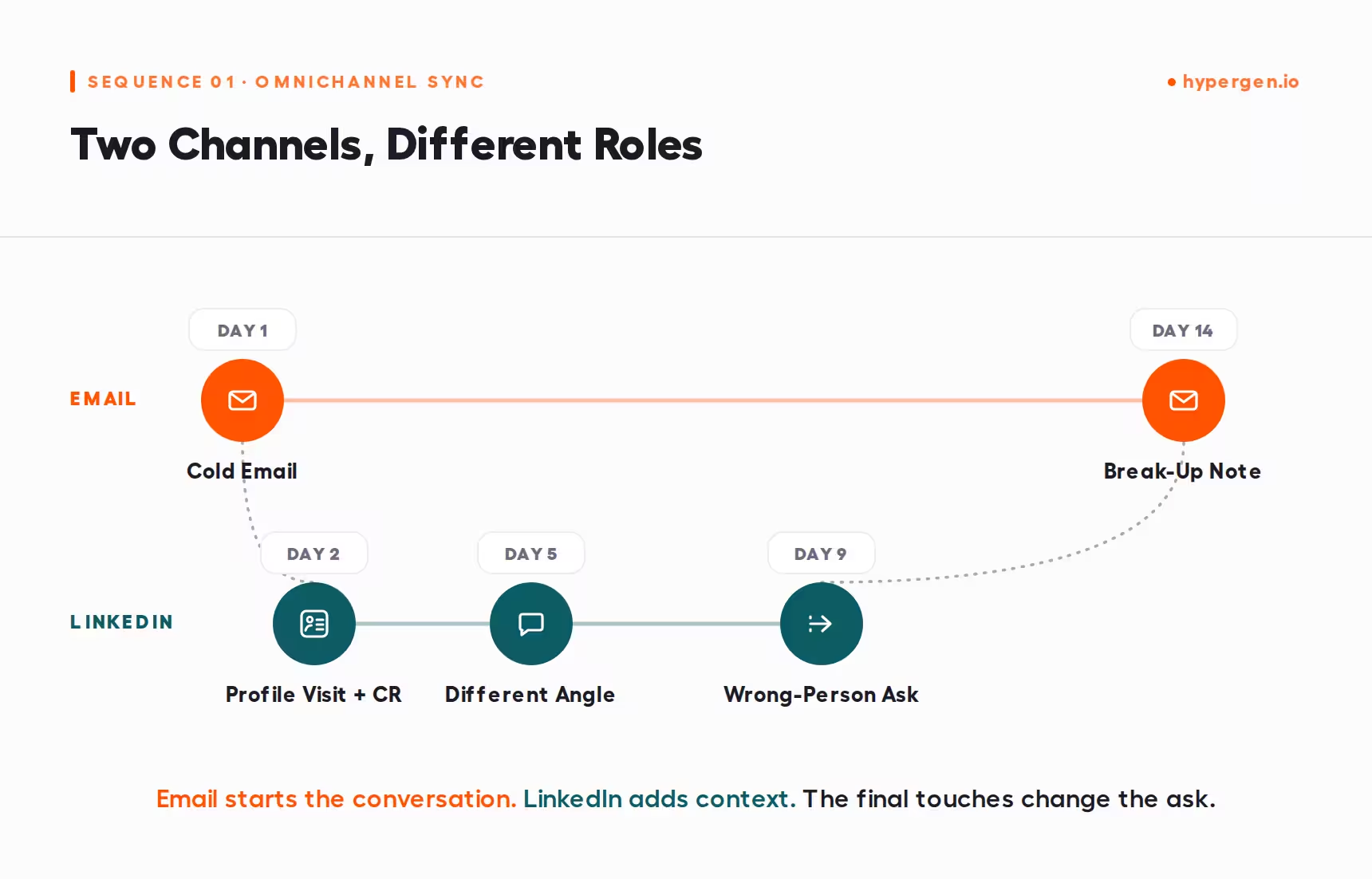
The wrong-person ask is particularly useful here because it gives a silent prospect an easy way to respond without committing to a meeting. If they are not the right person, they can point you in the right direction.
The final break-up note then gives the prospect one last opportunity to engage without extending the sequence indefinitely.

When combining email and LinkedIn, don’t use LinkedIn as a second inbox for the same pitch. Give each channel a distinct role so every new touchpoint adds something to the conversation.
Sequence 02: Content/Event Scraping
It starts with something the prospect has already done publicly: attending an event, commenting on content, or engaging with a relevant topic.
Instead of opening with a generic connection request, the sequence uses that signal as the reason for reaching out. On Day 1, the connection request and short note reference the relevant event, content, or comment. A Day 4 follow-up builds on the same context, before a Day 8 soft offer moves the conversation toward something useful, such as a teardown or relevant observation.
The goal is to move from signal to relevance to offer without turning personalization into a long research exercise, which is also a useful principle when deciding how to generate B2B sales leads from intent signals.
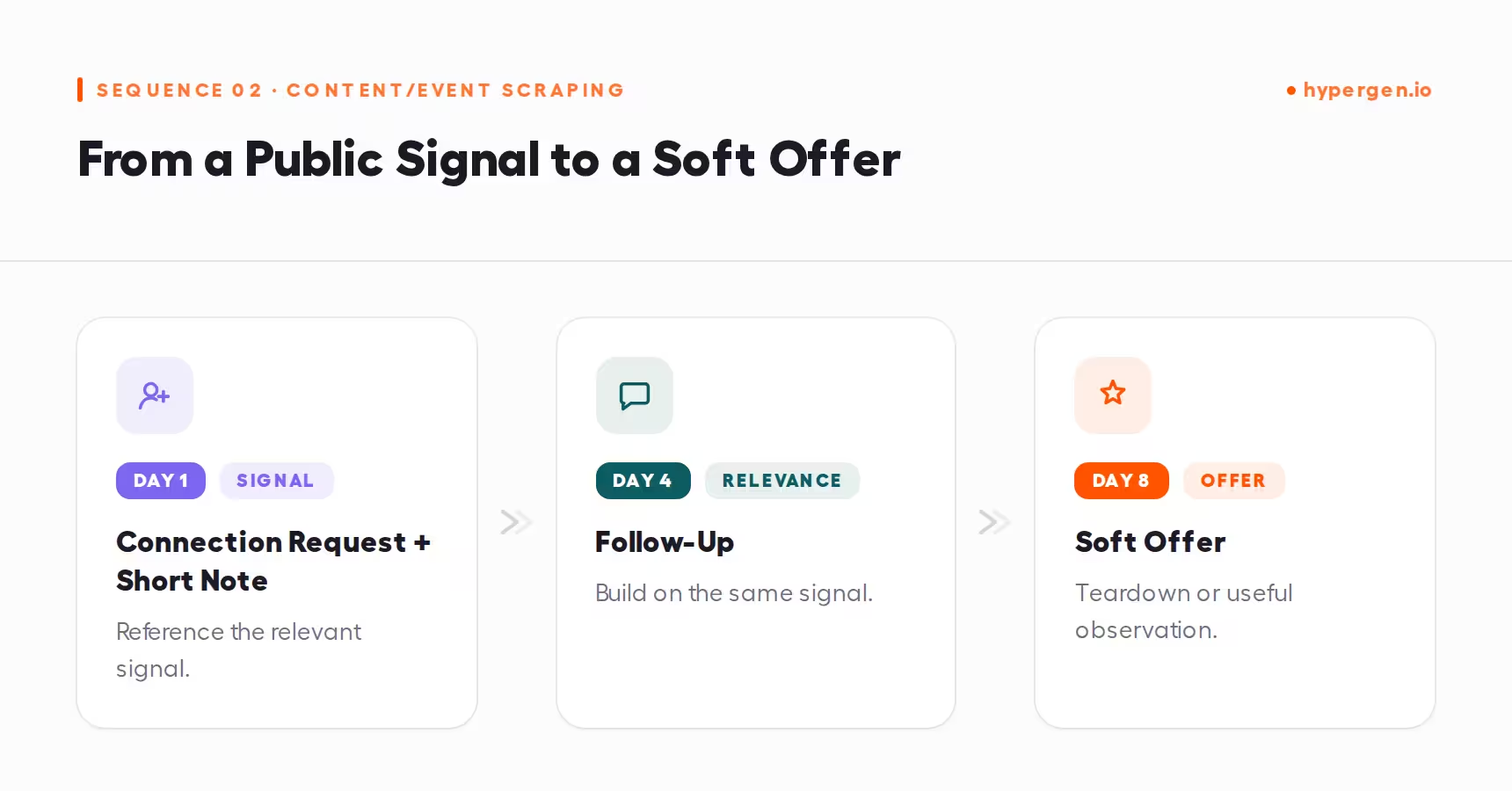
The important part is what happens between the first signal and the offer:
- Don't ask for a meeting immediately. Give the prospect a reason to engage first.
- Make the reason for reaching out clear. Use the event, content, or comment as the context.
- Give them something to respond to. Build from relevance toward a useful offer.

A relevant signal works best when it changes the reason for the outreach. Simply mentioning an event or post in the first sentence is not enough if the rest of the message could have been sent to anyone.
Sequence 03: Ghost Visitor
The Ghost Visitor sequence builds familiarity before asking for the connection.
Instead of sending the connection request immediately, the sequence starts with a Day 1 profile visit, followed by a Day 2 relevant comment. A blank connection request comes on Day 3, after those initial touchpoints, with the first direct message on Day 5 once the request is accepted.
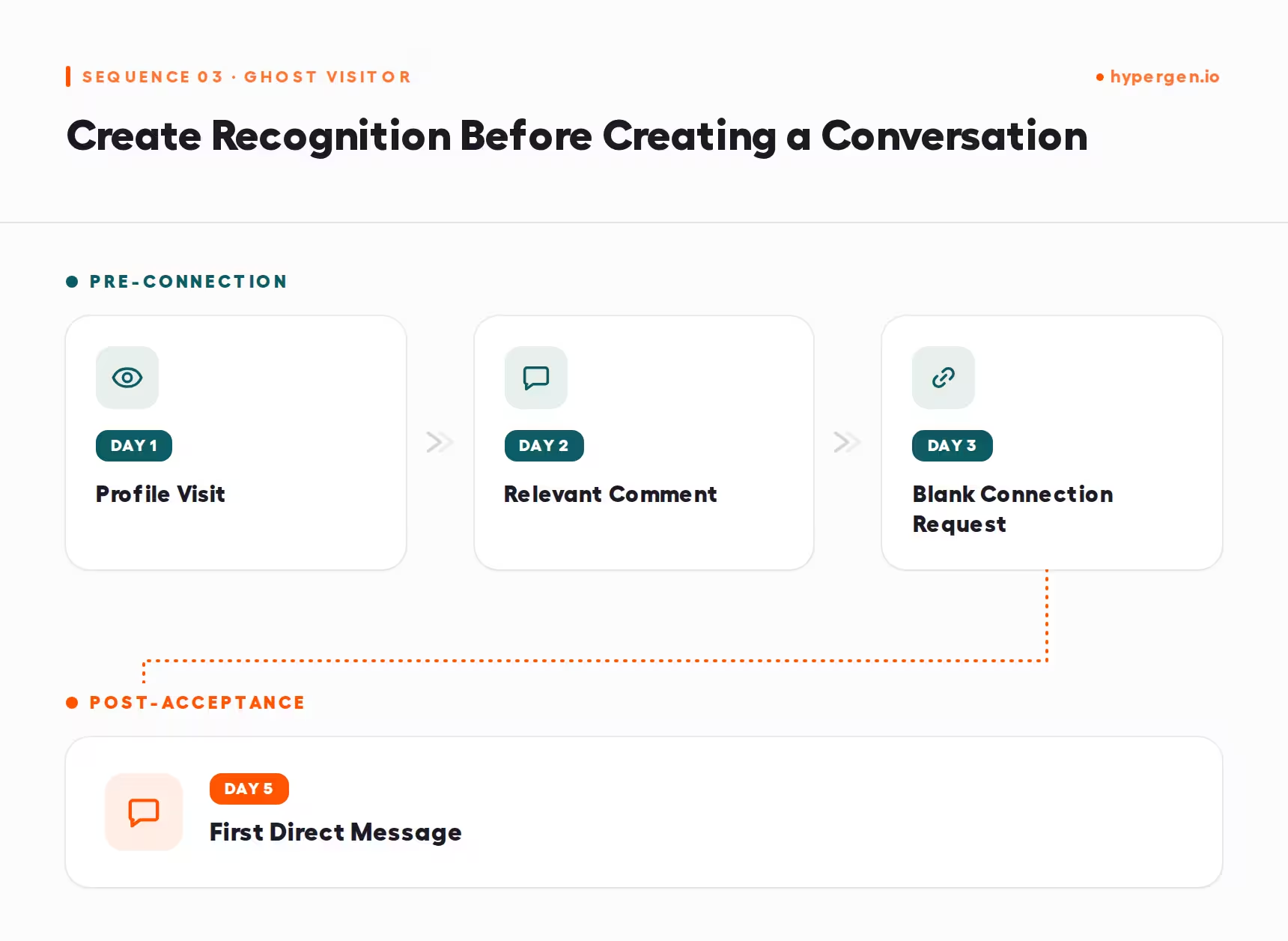
A prospect who has already seen your name through a profile visit or relevant comment may be more familiar with the sender when the connection request arrives. But this is something we treat as a test, not a universal rule.
We don’t have a clean quantitative benchmark showing that Ghost Visitor consistently increases acceptance rates. The potential upside is recognition, but the effect can vary by account and audience.
That makes this sequence particularly useful as a test when familiarity may influence how prospects respond to a connection request. It should not be treated as a guaranteed acceptance-rate tactic.
Sequence 04: The Micro-Opinion Sequence
For C-level and enterprise prospects, we use a different approach: start with their expertise rather than our pitch.
Instead of introducing an offer immediately after the connection, the Micro-Opinion sequence opens a conversation around an industry question.
The commercial transition comes later, once the prospect has already engaged with the topic.
Here’s the cadence we use:
- Day 1: Blank Connection Request
No note or pitch attached. - Day 4: Expert Ask
Ask for the prospect’s perspective on a relevant industry trend, framed around a simple choice or question. - Day 8: Value Exchange
Follow up with insights gathered from other industry leaders and offer а short summary of the findings. - Day 12: Transition to Pitch
Connect their earlier response to a relevant business challenge and introduce a low-friction meeting ask.
Another variation we use
Not every prospect needs the opinion-led opening.
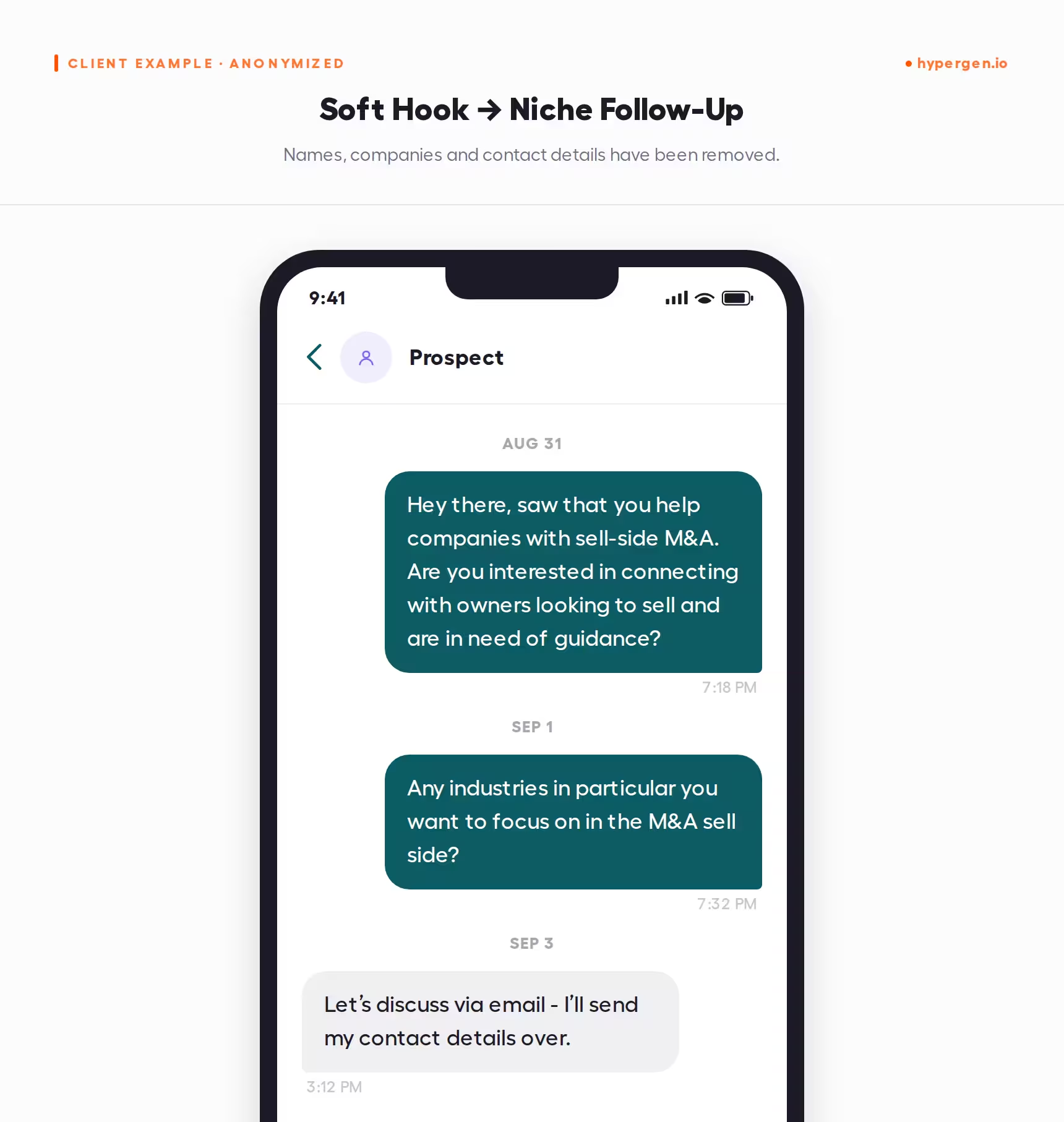
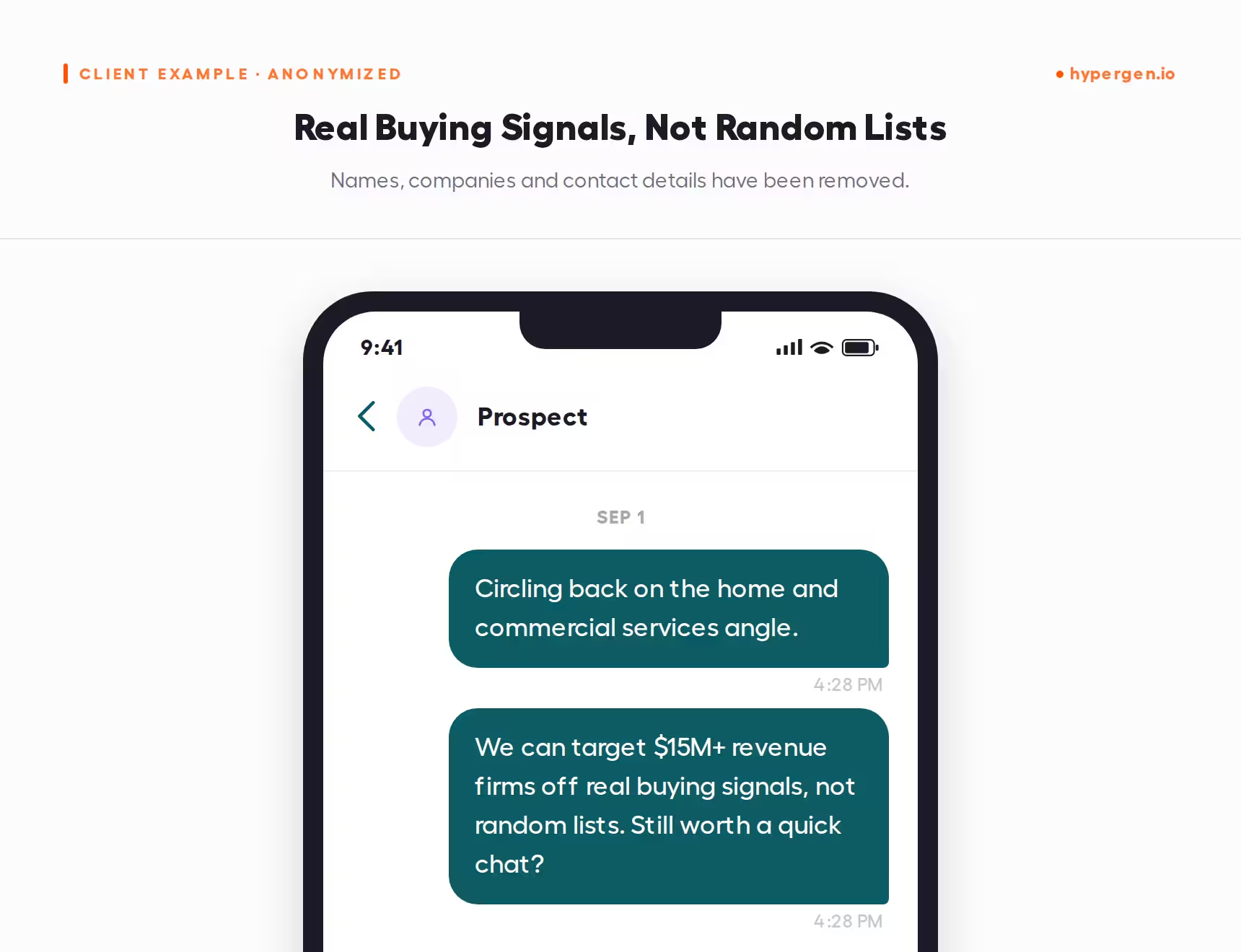
When there is already a clearer commercial angle, we use a more direct variation that still avoids leading with a hard pitch. The connection request stays blank, but the first message introduces a pure-value/soft hook related to what the prospect does.
The cadence looks like this:
- Day 1: Blank Connection Request
- Day 2: Pure Value / Soft Hook - introduce what we do while offering relevant contacts in the prospect’s target market without turning the message into a hard pitch.
- Day 3: Niche Follow-Up - ask whether the prospect is currently focused on a specific niche.
- Day 7: Case Study - follow up with relevant proof tied to that conversation.
Both variations use different opening mechanisms, but follow the same principle: the pitch does not have to do all the work in the first message.
Whether the opening is an industry opinion or a soft value proposition, the goal is to create a reason to continue the conversation before introducing stronger proof or a meeting ask.
Sequence 05: Proof-First
This is the documented Hypergen SOP and the one we use when we want the outreach to move quickly from connection to a specific value proposition.
The sequence starts with a Day 0 connection request, followed by the first message on Day 1. That message stays under 50 words and follows a simple HOOK + PITCH + PROOF + CTA structure. A short Day 3 bump keeps the conversation moving, followed by a Day 7 wrong-person ask. On Day 10, InMail gives us another way to reach prospects who never accepted the connection request.
Its defining feature is the proof line. The message does not rely on a broad claim about what you can do. It uses a named client, a specific number, and a clear outcome to make the proposition easier to evaluate.
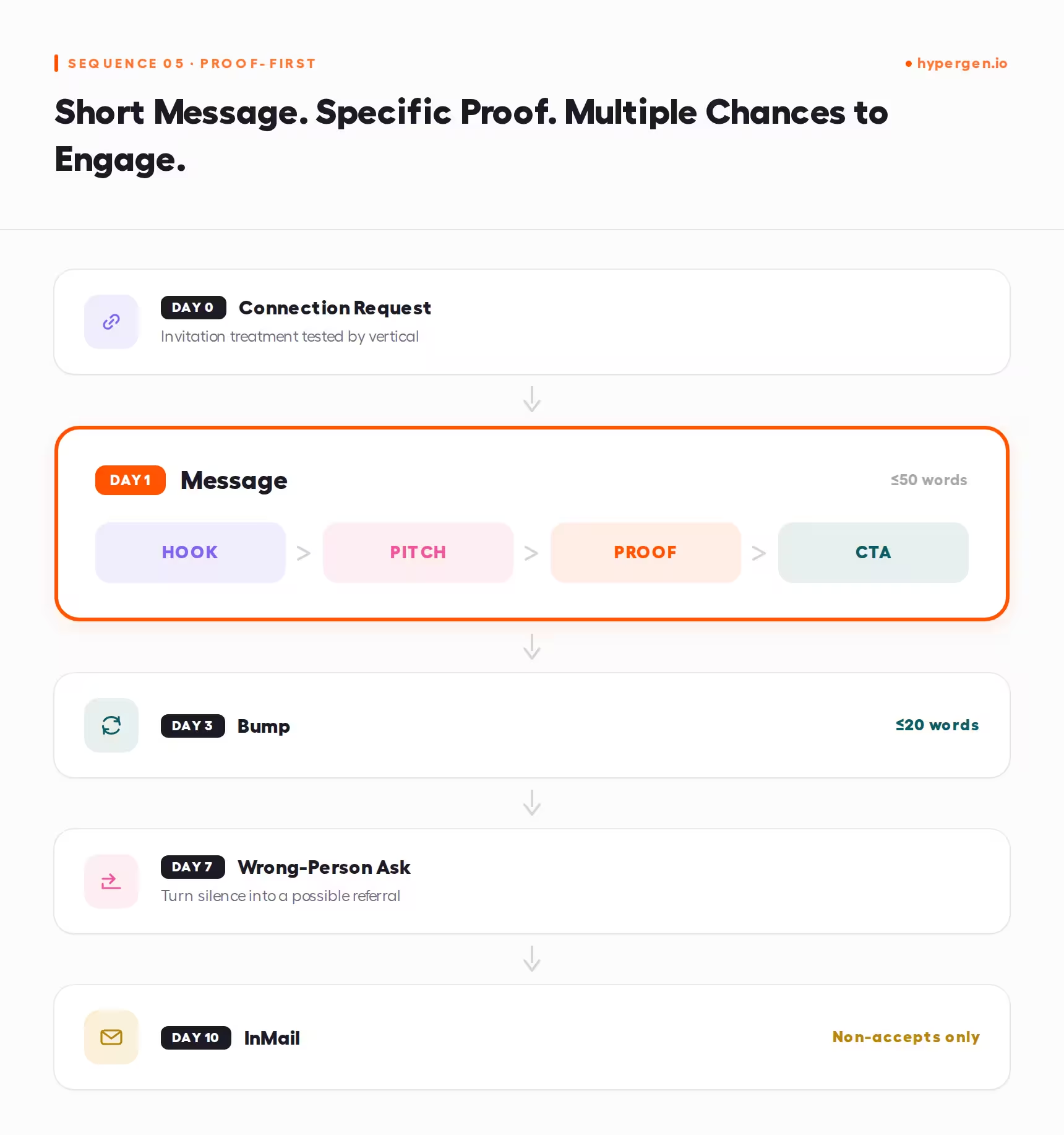

The proof line is the strongest copy lever we’ve measured. In a clean email A/B test using the same structure, replacing generic positioning proof with a named client, a specific number, and a clear outcome moved reply rate from ~0.8% to 3.2%.
What does the proof line look like?
The formula is simple:
- Named client - show who has already used the service.
- Specific number - give the prospect something measurable.
- Clear outcome - explain what changed or what the client achieved.
All three matter. A claim like "We've helped many clients get more meetings" gives the prospect very little to evaluate.
A line such as "[Client Agency] is getting 6-8 SQLs a month at a 35-40% close rate" gives them something much more specific to assess.
The same principle carries into the LinkedIn message itself:
- Keep the message under 50 words to make the value proposition easy to scan.
- Avoid links in the message because LinkedIn can throttle messages that include them.
- Let the proof line carry the credibility instead of adding more explanation.
Which LinkedIn outreach sequence would we choose?
Of the five approaches, Proof-First is the one we'd choose. It combines a short, focused message with specific proof and a follow-up structure designed to keep the conversation moving.
The proof line is the strongest measured copy lever
This is why proof sits at the center of the sequence. Instead of asking the prospect to trust a broad positioning claim, Proof-First gives them a named client, a specific number, and a clear outcome they can evaluate immediately.
The same proof mechanic carries into LinkedIn
The LinkedIn message uses the same principle: a named client, a specific number, and a clear outcome give the prospect something tangible to evaluate instead of relying on broad positioning claims.
The message stays short and focused
The Proof-First message is capped at 50 words, gets to the value proposition quickly, and lets the proof line support the claim instead of adding more explanation.
The winner isn’t the sequence with the most follow-ups. It’s the one where every touchpoint has a clear role and the core message gives the prospect something specific to evaluate.
The wider LinkedIn funnel also gives us a useful benchmark for what a mature setup can produce. Across three sender accounts, around 600 invites per month can lead to a 15-20% acceptance rate, with 25-30% of accepted connections replying, generating around 4-10 hot leads and 1-4 meetings booked.
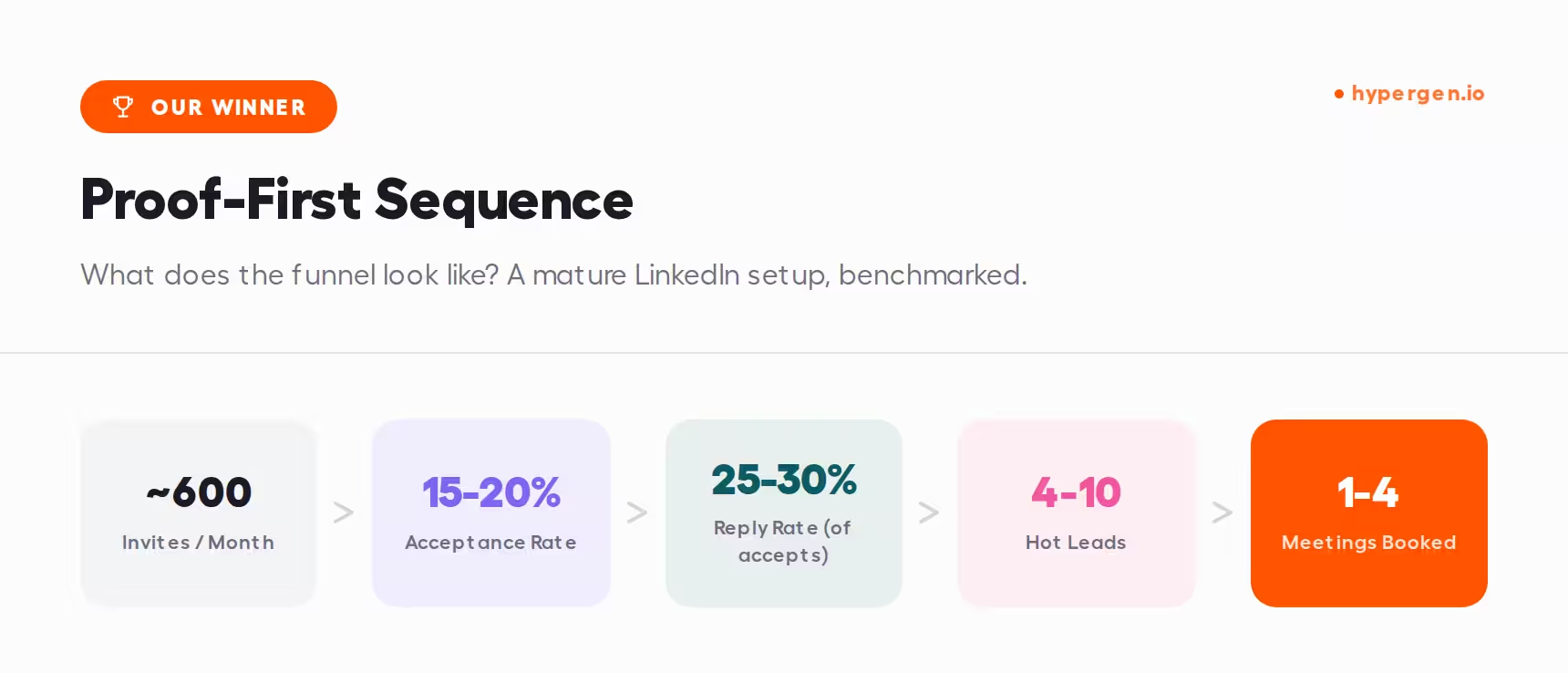
These figures describe the overall funnel, not a controlled comparison between the five sequences. We use them to show what a functioning LinkedIn outreach motion can look like, rather than claiming that Proof-First alone caused every result.
How many follow-ups should a LinkedIn outreach sequence include?
Our LinkedIn sequences typically use up to 3 follow-ups over about 10 days. The important part is not the number of touches, but what each one adds to the conversation.
The Proof-First sequence illustrates the approach:
- Day 3: Bump
A short follow-up that resurfaces the original message without adding another argument.
- Day 7: Wrong-person ask
A different CTA that gives the prospect an easy way to respond or point you to the right person.
- Day 10: InMail
A separate touch for prospects who never accepted the connection request.
The Day 3 bump is deliberately short. If the first message did not land, repeating the same pitch with more words is unlikely to change the outcome.
The Day 7 wrong-person ask changes the interaction instead of simply asking again for a response.
We don’t keep following up for too long. Our documented cadence stops at around Day 10 rather than stretching the sequence across several weeks. The goal is to give the prospect multiple ways to engage without turning every touch into another version of “just checking in”.
What should you measure when testing a LinkedIn outreach sequence?
Don't judge performance from reply rate alone. Look at the full funnel and make sure every metric is tied to the same stage of the process.
Why does the denominator matter?
LinkedIn reply rates can be misleading if you don't know what they are measured against.
For example, Hypergen typically sees 25-30% replies among accepted connections, but when the same performance is calculated against total invites, the reply rate is closer to 4-6%.
The number has not changed. The denominator has.
A sequence can have a strong reply rate among accepted connections while producing relatively little pipeline if acceptance is low. The opposite can also be true. Looking at the full funnel gives you a much more useful picture of whether the sequence is actually working.
When comparing two sequence variants, keep the denominator consistent and track the progression from invite to acceptance, reply, high-quality leads, and meetings. Otherwise, a change in one percentage can look more meaningful than it actually is.
What makes a LinkedIn outreach sequence work?
The strongest LinkedIn outreach sequences we've tested have one thing in common: every touchpoint has a clear role.
The sequence should create recognition, add relevance, introduce a specific value proposition, and give the prospect more than one way to respond. Just as importantly, you need to measure what happens at each stage of the funnel rather than optimizing for reply rate alone.
Our choice is Proof-First because it combines a focused cadence with specific client proof and a clear path from connection to conversation.
If you're building or testing your own LinkedIn outreach sequence, start with the structure, define what each touchpoint is supposed to achieve, and measure the full funnel. That's how you find out what actually works for your audience.
Want to see what this looks like in practice? Talk to us about building and testing a LinkedIn outreach sequence for your B2B team.
Frequently asked questions
A LinkedIn outreach sequence is a planned series of connection requests, messages, and follow-ups designed to move a prospect from first contact toward a conversation or meeting. Each touchpoint should have a clear role, rather than repeating the same pitch.
There is no universal number, but our documented Proof-First sequence uses a connection request, a Day 1 message, a Day 3 bump, a Day 7 wrong-person ask, and an InMail around Day 10 for prospects who never accepted the connection.
Our Proof-First cadence spaces the main follow-ups across several days: Day 1 for the first message, Day 3 for the bump, Day 7 for the wrong-person ask, and Day 10 for InMail to non-accepts. The exact timing can vary by sequence and audience, but each follow-up should add a new reason to engage.
We don't treat full automation as a requirement for a successful LinkedIn sequence. The important part is controlling the cadence, keeping messages relevant, and staying within LinkedIn's activity limits. Attempts to bypass those limits with unauthorized automation can lead to account restrictions or suspension.
Hypergen typically sees 25-30% replies among accepted connections. Measured against total invites sent, that is closer to 4-6%. The denominator matters, so always check what the reported reply rate is calculated against.
Don’t miss these

Get your first lead this month
14 days to get started. 7 days to get your first lead on average.


