


Outsourced Appointment Setting: What Actually Happens in Month 1
TL;DR: Outsourced appointment setting in Month 1
- Month 1 starts with discovery, not outreach. We review real closed deals, buying triggers, proof, and qualification criteria before locking the ICP. 🔎
- Infrastructure starts in parallel. Sending accounts, warmup, LinkedIn profiles, CRM setup, and campaign work begin during the first week. ⚙️
- A campaign-ready list is smaller than the raw data. Hypergen may scrub 12,000 records to produce 5,000 validated contacts worth targeting. 🧹
- Outreach usually starts with a controlled ramp. With fast access and approvals, campaigns can launch around day 14-16, followed by a soft launch that protects deliverability while generating early data. 📈
- Month 1 is about learning as well as meetings. Reply quality, wrong-person responses, bounce rates, and early lead signals tell us what to keep, change, or stop before scaling. 🧭
Outsourcing appointment setting does not mean outreach starts the next morning.
Before the first campaign goes live, B2B appointment setting requires some groundwork. We need to understand who buys, why they buy, and which past results we can use as proof. At the same time, we build the prospect list and prepare the infrastructure needed to run outreach safely.
For one commercial insurance client, we launched on day 17 and generated the first qualified lead on day 20. By day 30, the campaign had six leads in the pipeline and two meetings booked. That is one real campaign, not a guarantee of what every client should expect.
So, what does the first month of outsourced appointment setting actually look like?
Here is the process from kickoff to launch, including the work happening behind the scenes, the signals we watch, and the points where we change course instead of waiting for a struggling campaign to fix itself.
What happens in the first 30 days of outsourced appointment setting?
The first month is not one long setup phase.
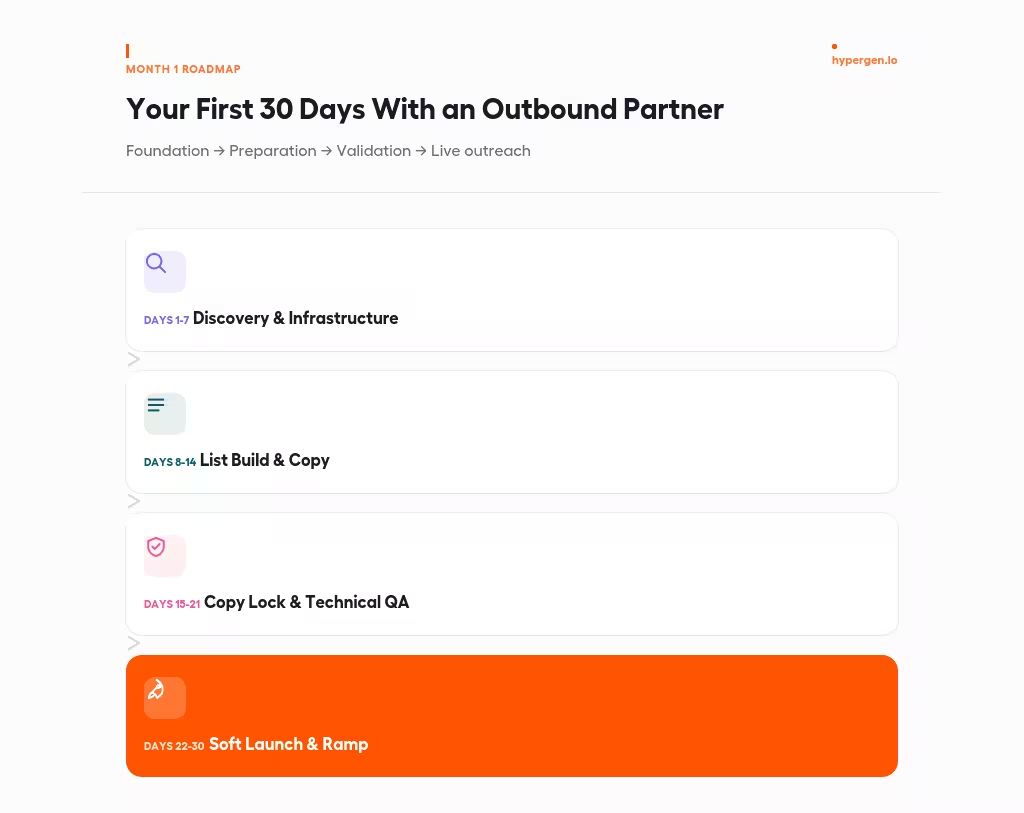
Different parts of the campaign move forward at the same time, from ICP research and infrastructure to list building, copy, technical QA, and finally outreach.
This timeline can move faster when access and approvals come in early.
When LinkedIn credentials, admin access, and copy approvals arrive on time, we can sometimes launch around day 14-16. When they arrive gradually over several weeks, the entire process moves with them.
What happens during Days 1-7?
The first week starts with discovery, but we are not trying to build an ICP from a few broad targeting preferences.
We look at real closed deals:
- which companies bought
- who signed
- how large the deals were
- how long they took to close
- what problem actually pushed the buyer to act
We also review lost pitches and the qualification criteria the sales team already uses.
Once we compare all of this with the client's initial assumptions, the picture often changes.
“Our ICP is mid-market companies, 50-500 employees, any industry.”
When we look at the last 10 closed deals, we often find a much narrower pattern: one vertical, a similar revenue band, and the same buyer title. In that case, we tighten the ICP around what has actually converted.
“We have great case studies and testimonials.”
Not every case study gives us usable proof. If it only says the product is “easy to use” or has “great support,” there is no measurable outcome to build into the message. We go back to the client and extract the results behind those stories.
“Our differentiator is Feature X.”
The last few closed deals can tell a different story. Feature X may never come up. The actual trigger might be speed, pricing structure, or a problem with the incumbent vendor. That is what we want the messaging to reflect.

Discovery is not about turning the client's existing assumptions into an outbound campaign. We compare those assumptions with the deals they have already won, then use that evidence to decide who to target, what to say, and which proof to test.
Infrastructure starts at the same time
Discovery does not put the technical work on hold. During the first week, we also:
- order separate Google Workspace sending accounts and start warmup
- provision HubSpot and PlusVibe
- connect 2-3 client LinkedIn profiles to HeyReach and set the outreach limits
The biggest delay at this stage is often access, not strategy. If LinkedIn credentials and Google Workspace admin access arrive on day 1, setup can move quickly. If they trickle in over two weeks, the launch timeline moves with them.
What happens during Days 8-14?
By the second week, the ICP is taking shape and the focus shifts to building the first campaign list.
The initial target is typically 2,000-5,000 validated contacts. Depending on the campaign, we use tools such as Prospeo, AI Ark, Apollo, or Clay for enrichment.
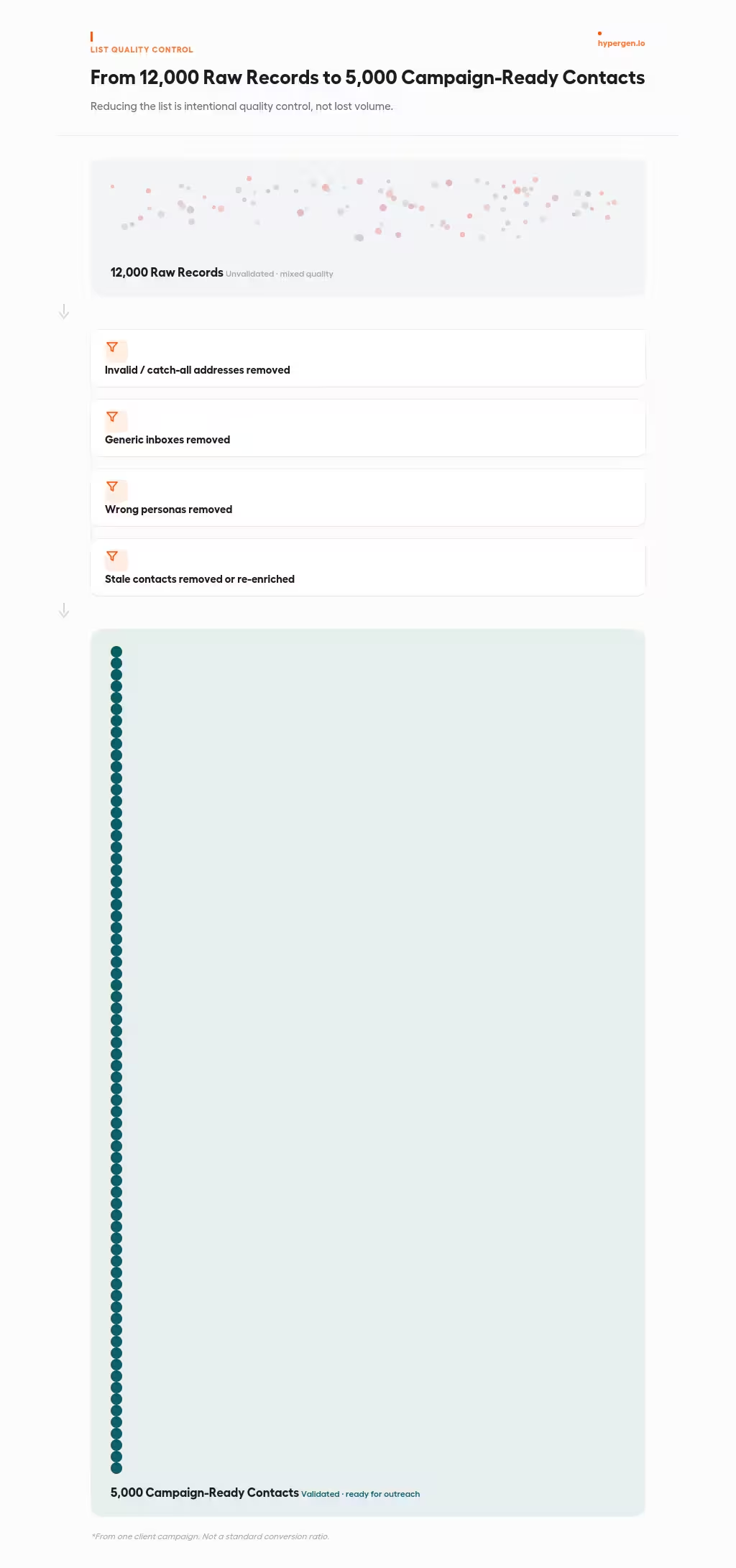
The number of contacts we start with and the number that make it into the campaign can be very different. A client might see 5,000 contacts uploaded in their weekly report. What they don't see is that we may have reviewed 12,000 records to get there.
Before a contact makes the final list, we remove:
- bounces waiting to happen - catch-all domains, role emails, obvious typos, and domains that do not resolve
- generic inboxes - addresses such as info@, contact@, and admin@
- wrong personas - titles or seniority levels that do not match the actual buyer
- stale contacts - people who have changed jobs but still appear in prospecting databases

A client came in with a supposedly clean list producing a 42% bounce rate. After validation, that dropped to 3%. For another finance client, 35% of the supposedly live contacts had already moved jobs and needed to be re-enriched before launch.
Copy starts before the list is finished
List building and messaging happen in parallel.
During this stage, we draft 2-3 messaging angles and pull proof from the client's real deal history. The first versions then go to the client for review before anything is locked for launch.
This is also when we overhaul the LinkedIn profiles used for outreach. Headlines, banners, About sections, and featured content are rewritten so the profile supports the conversation prospects will see in their inbox.
At this stage, we also expect client feedback. If wording needs to change, days 8-14 is the time to change it, before the copy is locked and the campaign moves into technical QA.
What happens during Days 15-21?
By the third week, the campaign should be moving from preparation into final QA.
Approved copy is uploaded to PlusVibe, while the LinkedIn sequences are built in HeyReach. At the same time, we run the technical checks and email deliverability best practices that need to be completed before outreach starts.
Before launch, we check:
- SPF, DKIM, and DMARC - each sending domain needs to be configured correctly
- warmup capacity - sending accounts should have capacity for 50+ emails per day before launch
- HubSpot setup - pipelines and lead labels need to be ready before replies start coming in
- reply routing - responses need to reach the right place and be tracked correctly
This is also where late changes can start pushing the launch date back. Two common delays are reopening copy after it has already been approved and discovering that the client does not have access to the DNS settings we need for the final checks.
We do not launch one "perfect" message
While the technical setup is being checked, we also prepare the copy for structured testing.
Instead of choosing one message and committing the entire list to it, we typically run 2-3 messaging/proof variants in parallel. Once a variant has enough volume to evaluate, we can reduce or stop the weaker versions and move more volume toward the stronger ones.
In our process, that decision is typically made after around 1,000 sends.
One private equity campaign shows what that looks like in practice:
After the first week, we stopped the generic positioning variant and kept the two proof-led versions running. By week 4, the named deal proof variant was receiving 80% of the campaign volume.
The goal is not to predict the winning message before launch. It is to build enough variation into the campaign to learn from actual prospect responses, then shift volume based on what the campaign data shows.
By the end of this stage, the infrastructure, sequences, and testing structure should all be ready for the soft launch.
What happens during Days 22-30?
By the final week, the campaign should be live or moving into live outreach, depending on how quickly access, approvals, and technical setup were completed. But we do not switch everything on at full volume from day 1.
For email, the soft launch typically starts with 200-500 sends on the first day. We monitor bounce rates, spam complaints, and early replies before increasing volume.
LinkedIn ramps more gradually. We usually start at 8-15 connection requests per day and work toward 25 per day over the following two weeks.
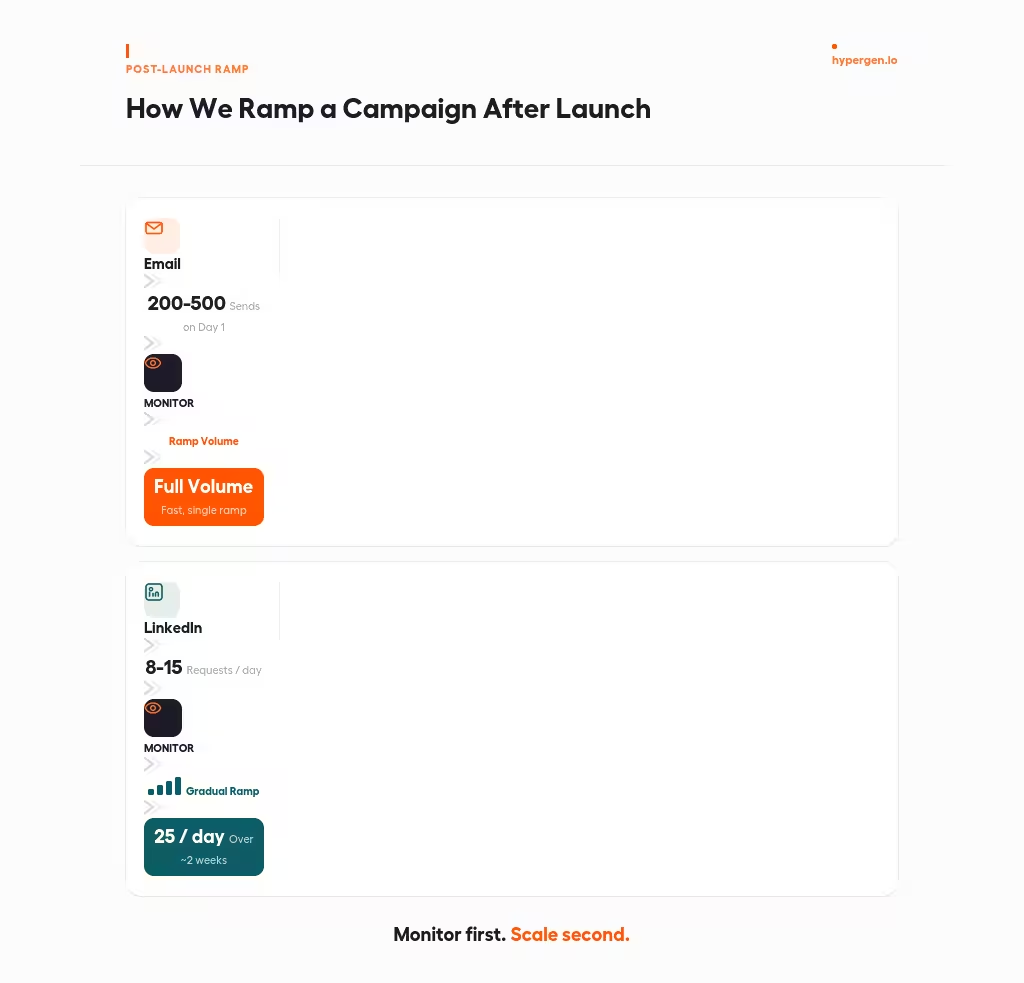
A side-by-side comparison of how email and LinkedIn volume ramp differently after a soft launch, with monitoring as the gate before scaling.
The first few days give us a chance to catch problems before they affect a larger part of the campaign. If the bounce rate moves above 5%, we pause and revalidate the list because that can point to broader email deliverability issues before we increase volume.
If spam complaints reach 0.3%, we pause that angle and review the messaging and sending setup before continuing.
We also pay attention to who is replying.
If responses by day 3 repeatedly tell us we have contacted the wrong person, that is an early sign that the ICP or targeting needs another look. We would rather adjust at this stage than continue sending through the rest of the list.
When do the first responses start coming in?
In our campaigns, the first leads can start appearing around days 24-28, although the two channels do not move at the same speed.
Email responses tend to arrive sooner. LinkedIn depends on prospects accepting the connection request before the conversation can progress, so the first LinkedIn meetings typically appear around weeks 5-6 rather than during the first 30 days.
That means the end of month 1 is not the point where we expect every channel to be producing meetings at the same pace. It is the point where the campaign is live, early responses are coming in, and we have enough real-world data to start evaluating what needs to stay, change, or scale.
When should you expect the first leads and meetings?
There is no fixed timeline for the first lead. The timing depends on how quickly the campaign gets through setup, approvals, and launch.
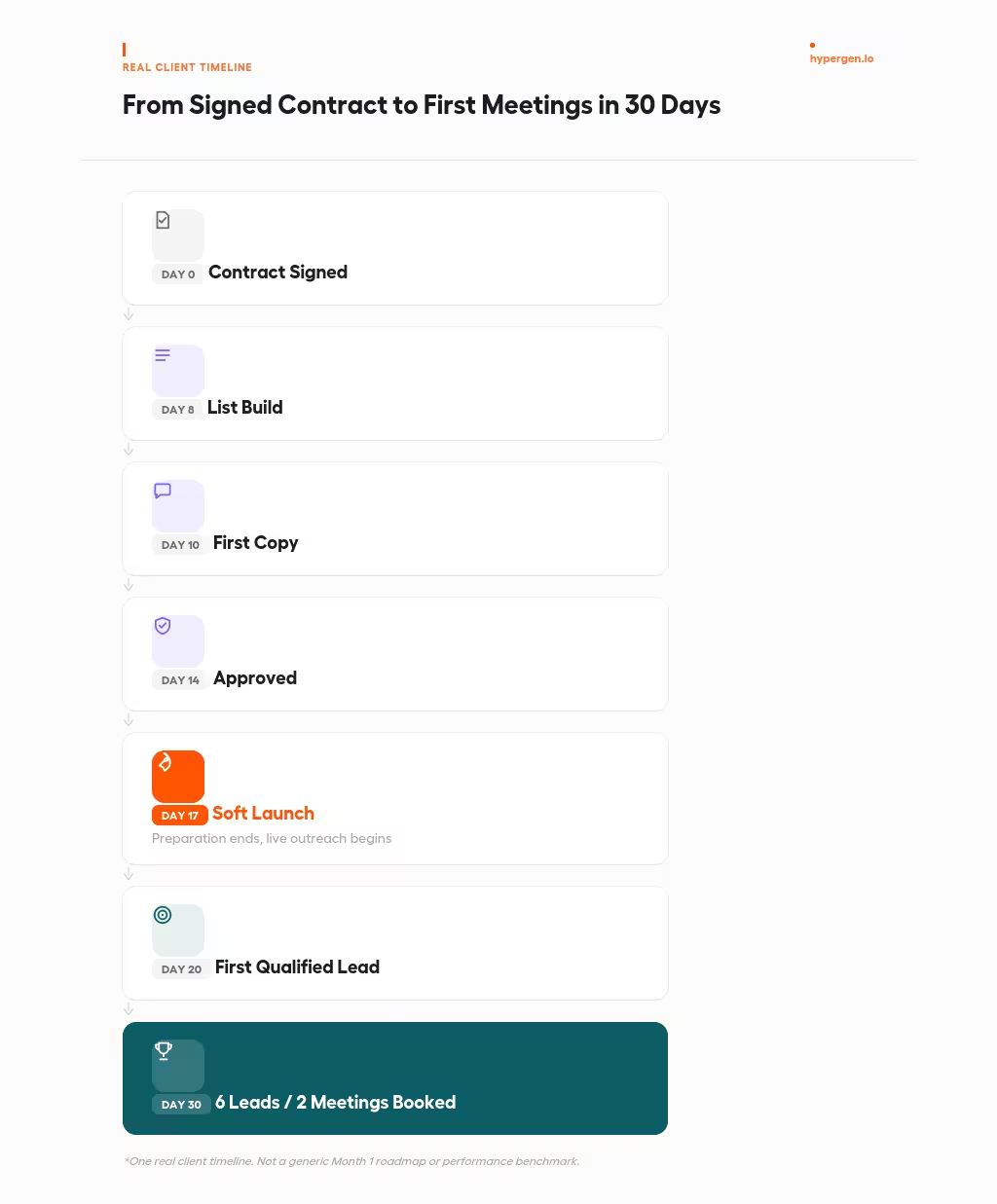
One commercial insurance campaign gives us a useful example of what a fast first month can look like. The contract closed on a Monday, LinkedIn credentials arrived on Wednesday, and Google Workspace access followed on Friday. By day 8, we were building the list.
From there, the campaign moved quickly:
- Day 10: first copy draft
- Day 14: copy approved
- Day 17: soft launch
- Day 20: first qualified lead
- Day 30: 6 leads in the pipeline and 2 meetings booked
This is a real campaign timeline, not a benchmark for every outsourced appointment setting engagement. With fast credentials and approvals, we can sometimes launch around days 14-16, but the timing will vary from campaign to campaign.
How do you know the campaign is working before meetings start coming in?
Meetings are not the only signal we look at during the first few weeks of a campaign.
Before enough volume has accumulated to judge overall campaign performance, the type of replies can already tell us whether the targeting and messaging are moving in the right direction.
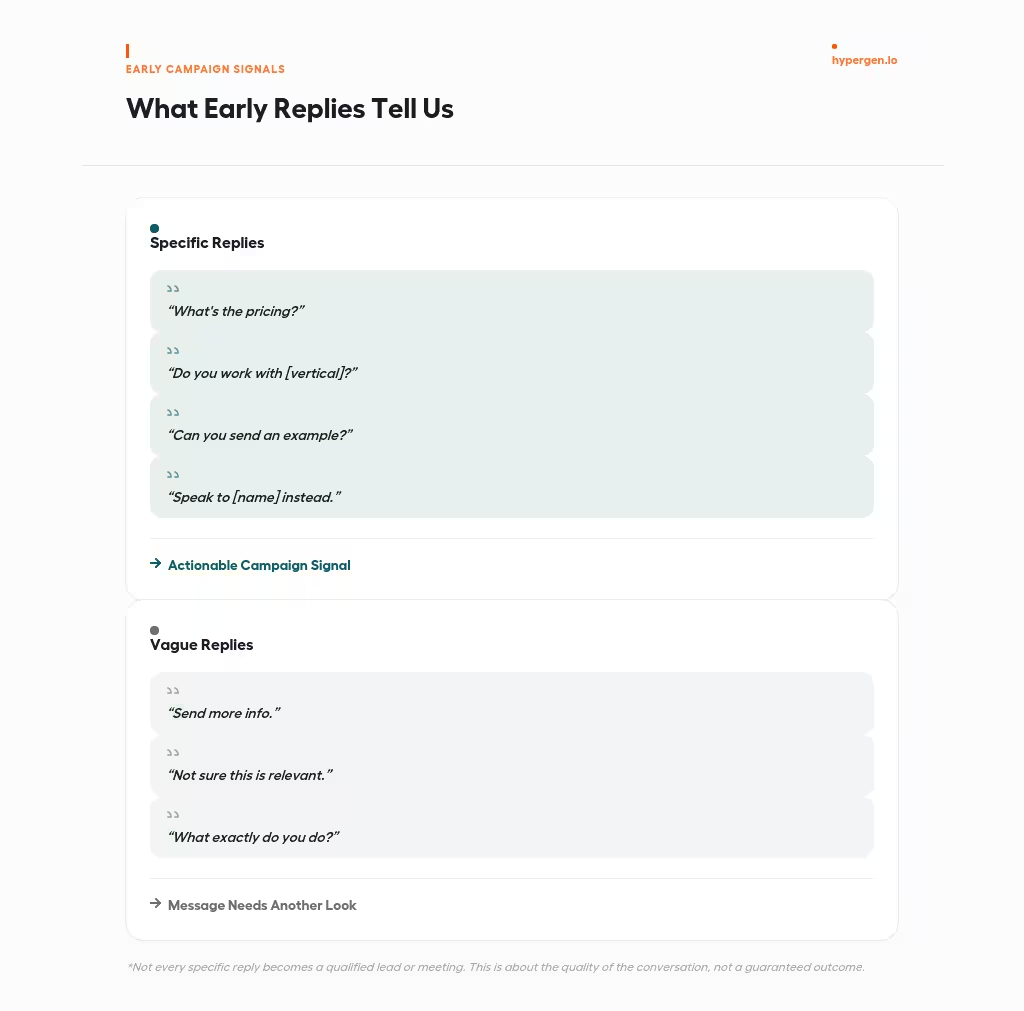
The most useful early responses are specific. Prospects ask about pricing, timing, relevant verticals, proof, or refer us to the person who actually owns the problem.
Here are some of the early signals we pay attention to:
A campaign generating specific questions gives us more to work with than one generating vague replies such as “send more information” or “I'm not sure this is relevant.” The first group tells us what prospects are evaluating. The second often tells us that the message has not yet given them a clear enough reason to engage.
That does not mean every specific reply will turn into one of your high-quality leads or a meeting. It means we are starting to see whether the offer, proof, and targeting are creating the kinds of conversations we can build on.
What are the biggest red flags in the first 30 days?
Early campaign data is only useful if you are prepared to act on it.
The key is identifying what is actually failing before changing the wrong part of the campaign.
Not every weak signal requires the same fix. A high bounce rate points us toward the list. Repeated wrong-person replies point toward targeting. Vague responses point toward the copy. If we treat all three as a messaging problem, we can easily change the part of the campaign that was not broken in the first place.
We also change what we evaluate as the campaign develops
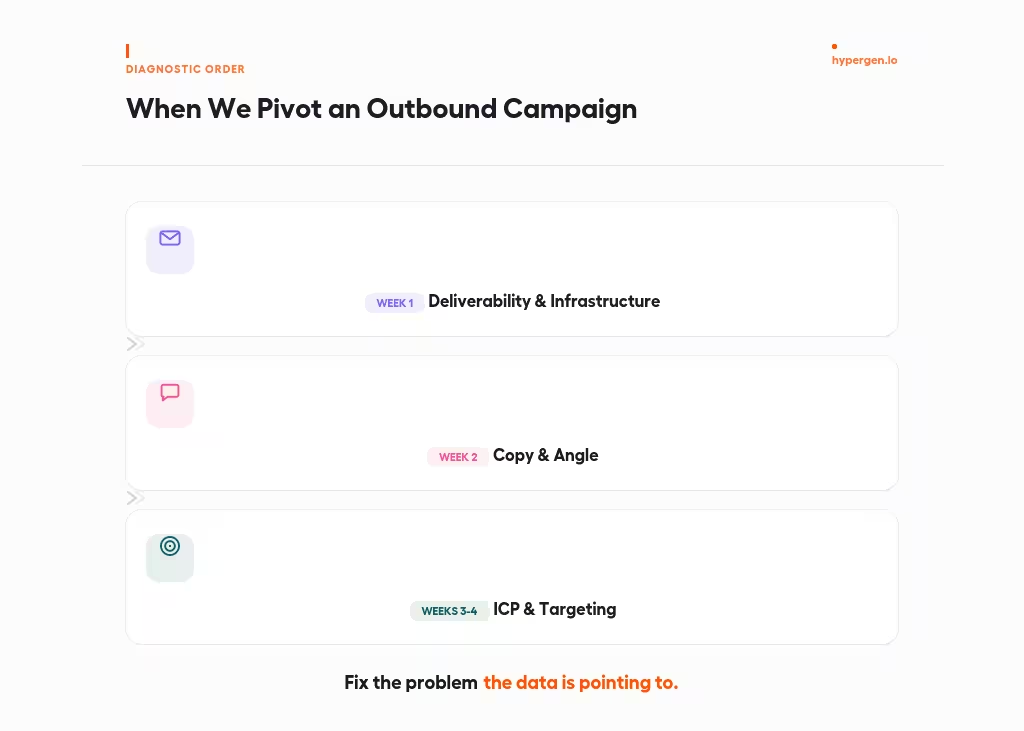
Our first-month pivot framework follows the amount and type of data available at each stage:
- Week 1: deliverability and infrastructure. Are messages reaching inboxes without abnormal bounce or spam signals?
- Week 2: copy and angle. Are prospects understanding the offer and giving us useful responses?
- Weeks 3-4: ICP and targeting. Once enough responses have accumulated, are we consistently reaching the people who actually own the problem?
We do not wait until month 2 when the campaign is already giving us enough evidence to change course.
We saw this with one SaaS campaign. In week 1, it had an 8% bounce rate, 22% wrong-person replies, a 0.9% reply rate, and zero timing qualifiers. We paused the campaign on day 8, revalidated the list, changed the targeting from VP Sales to Head of RevOps/VP Sales Ops, and replaced the generic proof with a specific client outcome.
After relaunching in week 3, the campaign reached a 2.6% reply rate, six timing qualifiers, and three meetings by week 5. Because we changed the list, targeting, and proof together, we would not attribute that improvement to any single change.
What the example shows is that we do not wait for one metric to confirm the problem when several early signals are already pointing in the wrong direction.
What if you don't have an outbound foundation yet?
Not every client comes into outsourced appointment setting with a defined ICP, polished case studies, and proof ready to use in a campaign.
One financial advisory firm came to us with no case studies, no named proof, and no documented deal history we could use in the messaging. The starting proposition was simply “M&A and succession planning.”
Instead of waiting for the client to build more sales collateral, we interviewed the founder about three recent clients. Three distinct problems emerged:
- an estate tax liability
- a partner buyout
- preparation for a business sale within 18 months
Those conversations gave us three messaging angles to test: estate planning, partner exits, and pre-sale preparation.
What happened next: The estate planning angle generated a 3.1% lead rate, compared with 0.9% for the other two. After 1,000 sends, we stopped the weaker angles and shifted more volume toward the stronger one.
You do not need a perfect outbound foundation before the work can start. If the proof is limited, we can extract what is available from real customer outcomes, test multiple angles, and use early campaign data to narrow the message.
Waiting for every case study, proof point, and positioning document to be perfect can push the launch back 60+ days.
Month 1 turns assumptions into campaign data
By the end of month 1, meetings matter. But they are not the only thing we expect to have learned.
The first 30 days should also give us a much clearer picture of the campaign:
- The ICP has met real prospects.
We can see whether we are reaching the right people or whether titles, seniority, or company targeting need another look.
- The messaging has been tested outside the strategy document.
Real replies show us which angles create useful conversations and which ones need to change.
- The campaign has a direction for month 2.
We know more about what to keep, what to adjust, and where it makes sense to increase volume.
By the end of month 1, we should have a live campaign, early pipeline, and real data to build on.
From there, the question is no longer what we think might work, but what the campaign has shown us is worth building on.
Frequently asked questions
The first qualified leads can start appearing before the end of month 1, but timing depends heavily on how quickly the campaign gets through setup, approvals, and launch. In our campaigns, the first leads can start appearing around days 24-28. LinkedIn usually takes longer, with the first meetings typically appearing around weeks 5-6.
We need enough information to understand who actually buys, why they buy, and what proof we can use. That includes examples of closed deals, buyer titles, deal sizes, sales cycles, qualification criteria, past wins and losses, and any case studies or measurable customer outcomes available. We also need access to the relevant LinkedIn profiles and Google Workspace admin settings so the technical setup can move forward.
The sending infrastructure is set up specifically for your outbound campaign, including separate domains and Google Workspace inboxes. We handle the technical setup and campaign configuration, while keeping the infrastructure separate from your primary company domain.
There is no fixed month 1 meeting number we would treat as a benchmark. In one commercial insurance campaign, we launched on day 17, generated the first qualified lead on day 20, and reached six leads in the pipeline and two meetings booked by day 30. That is one real campaign timeline, not a guarantee of what every engagement should produce.
Yes. A narrower ICP can actually give us clearer parameters for list building, messaging, and early campaign evaluation. The important part is validating the targeting against real deal history rather than relying only on broad assumptions about the market. In one healthcare campaign, reviewing the client's last eight closed deals showed that practice administrators, not doctors, were the actual buyers, so we changed the targeting accordingly.
Don’t miss these



Get your first lead this month
14 days to get started. 7 days to get your first lead on average.


