


Your SDR team is costing more than you think - here's the real math
TL;DR:
- One in-house SDR costs between $120K and $160K per year. Most leaders budget $65K, but the salary is just the first line item.
- SDR attrition runs at 45% annually. After a 3.2-month ramp, the average rep has roughly 15 productive months before the cycle restarts. ⚠️
- The real gap shows up at cost per meeting. An audit we ran found $20K+ per qualified meeting in-house vs. $250 outsourced. 📊
- The tool stack adds $600–$1,000 per rep per month. Sales Nav, ZoomInfo, Outreach, and data providers rarely appear in headcount approval docs.
- Outsourced SDR delivers first qualified meetings in 7–14 days. In-house, that takes 3–4 months of ramp. Hypergen fastest: 4 days.
- Outsourced SDR works for complex B2B cycles when messaging is role-specific. One M&A client signed their first deal in month two.
- Held qualified meetings is the only KPI connecting directly to pipeline. Benchmark: 12–25 per month by month three, at a 75–85% show rate. 🎯
Most sales leaders, when you ask what their SDR costs, give you a number confidently: something around $65K, maybe $75K.
But that's the salary. And that's usually where the math stops.
We audit outbound costs with almost every company that comes to us. The number they show up with is always just base salary.
We had one recently, 12-person SaaS business, convinced they were running an $80K function. But when we pulled the full picture together (salary, benefits, Sales Nav, ZoomInfo, Outreach, RevOps time, two replacement hires in 14 months), it landed at $187K.
And that’s for nine meetings all year.
That's over $20,000 per meeting. We were generating them for $250.
So today we're covering the real outsource SDR vs hire in house comparison. Not just salary vs retainer, but every cost layer most companies forget to price in. 👇
The real cost of hiring an in-house SDR (it's not just the salary)
Hiring one in-house SDR costs between $120K and $160K per year fully loaded, not the $65K–$75K most sales leaders budget. The gap comes from employer taxes, benefits, 15–20% recruiting fees, tool stack, manager time, and three-to-four months of near-zero ramp output.
So the number on the offer letter covers less than half of what you're actually paying.
Here's what the full breakdown looks like:
Most hiring managers budget for the first row and call it a day.
The tool stack alone, which in the SaaS company's case included LinkedIn Sales Navigator, ZoomInfo, and Outreach, adds $600–$1,000 per rep per month before even emails are sent. (And that's not unusual, that's a fairly standard outbound stack.)

The total cost to ramp a new sales rep is estimated at roughly three times their base salary once you include recruiting, onboarding, training, and lost productivity. For a $55K base SDR, you're looking at around $165K before they're fully productive.
That said, the salary and tool costs are at least visible. What tends to break companies is the thing they don't see coming.
The ramp-attrition trap
This is the most expensive in-house SDR mistake we see… and it almost never shows up in anyone's budget.
A client of ours hired two SDRs, ramped them for four months, then had to let one go for underperformance. Six weeks of rehiring later, the second rep quit two months after that, heading to an AE role somewhere else (classic).
Twelve months in, they'd generated fewer than 15 qualified meetings and burned close to $280K across salaries, recruiting cycles, and tool seats.
That’s a full year. Zero real pipeline.
And unfortunately that's not bad luck, but the structural reality of the in-house SDR model.
According to data from 939 B2B companies, SDR annual turnover runs at 45% (the highest of any sales role). Average tenure is about 1.5 years. With 3.2 months of ramp eating into that, you're realistically getting around 15 months of productive output before the cycle resets.
The ramp-attrition trap compounds silently. With 45% annual attrition across a 5-person SDR team, you're running 2–3 full ramp cycles per year as a structural baseline.
So you're not just hiring a rep. You're hiring a ramp, a likely replacement hire, and all the management overhead that comes with it.
Which brings us to the actual comparison. 👇
Outsource SDR vs hire in house: the ROI comparison
Outsourcing an SDR function typically costs $3K–$8K/month, versus $9.8K–$14.2K/month fully loaded for one in-house rep. But the real gap shows up in cost-per-meeting.
Here's the side-by-side on the factors that actually matter:
The fastest first qualified meeting we've ever delivered at Hypergen was day 4 after launch: a cybersecurity client targeting mid-market CISOs, tight ICP, sharp offer, clean infrastructure from day one.
Dingus and Zazzy is another example of how much offer quality matters here. They are one-stop-shop creative marketing company that came in with a proposition that was genuinely hard to say no to: first project completely free, no long-term contract, strictly month-to-month.
Over 18 months, their sales team closed 215 deals from our opportunities, totaling $4.5M in expected revenue and a 15X ROI, scaling from a standing start to 400+ outbound opportunities per month.

Offer quality is often the difference between a campaign that pops in week one and one that grinds for three months. If your SDR, in-house or outsourced, can't get a "that sounds interesting" response in a few sentences, the problem usually isn't the outbound channel.
And if you want to know what separates agencies that consistently deliver from those that don't, our guide on cold email agency ROI breaks down exactly where the gap lives.
What are the hidden infrastructure costs of building in-house cold outreach?
The hidden infrastructure costs of in-house cold outreach include secondary domain setup, SPF/DKIM/DMARC configuration, inbox warm-up, sending platform licensing, deliverability monitoring, and ongoing blacklist management.
Most companies skip this layer entirely because it's invisible, until their primary domain gets flagged.
But when that happens, it's not just one bad campaign… the damage affects every email your company sends.
Here's what cold email infrastructure actually involves:
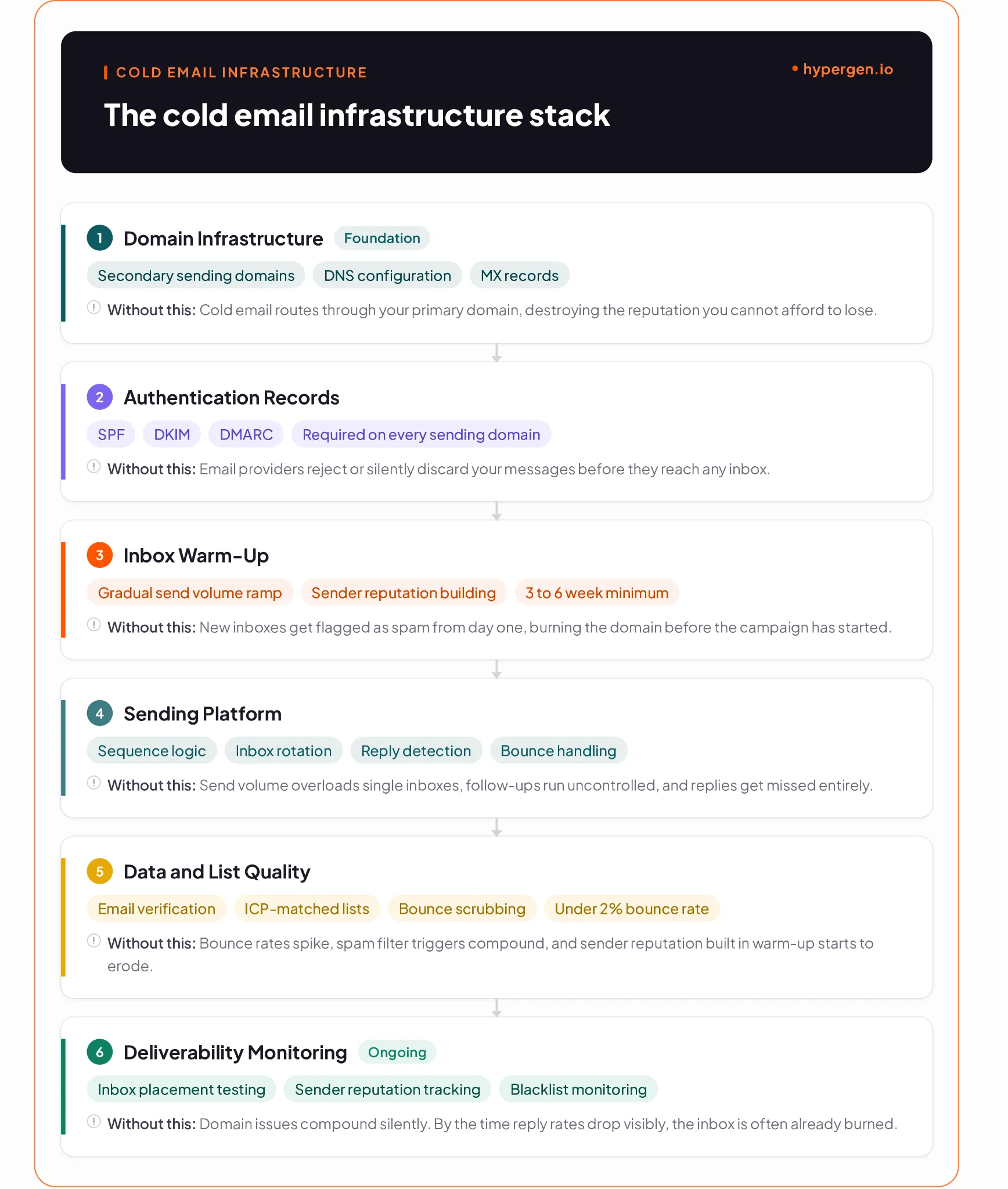
We've had companies come to us after burning their primary domain on a DIY cold email setup. The repair was significantly expensive, and some of the reputation damage took months to recover. (Not fun… and most importantly, completely avoidable.)
In our work, for every Hypergen client, cold email infrastructure is built from scratch during onboarding: dedicated secondary domains, full DNS authentication, a proper warm-up period, and ongoing monitoring as a managed function.
Treating infrastructure as a one-time setup rather than an ongoing function. Most companies configure it once and forget it, then six months later, reply rates tank and no one can explain why. So if you're managing cold email deliverability in-house, know that it needs a dedicated owner.
How does outsourcing SDRs affect your sales team's workflow?
Outsourcing your SDR function means your internal team's only job is taking qualified meetings and running the sales process. Prospecting, sequencing, inbox management, reply handling, and in some cases meeting scheduling all come off their plate entirely.
Your AEs stop spending 15–20% of their week on pipeline sourcing, and your sales manager stops coaching someone who's two months into their ramp.
Here's exactly what the first 30 days look like when a company onboards with us:
- Days 1–20 - intake and infrastructure.
CRM access, a full review of what they've tried messaging-wise and who they've been targeting, domain purchase, sending infrastructure setup.
The client's team puts in roughly 3–4 hours total: one kickoff, one CRM automation session, and a sign-off on the first copy batch.
- Day 21 - launch.
We go live at controlled volume, typically 500–800 sends per day. Reply rates are monitored daily and the first copy iterations run within this window. The client gets weekly reports, but handles zero execution.
- Day 30 - handoff.
By this point, the client's internal team has one job: picking up the qualified leads we're sending through, booking them (unless they're using our booking service, in which case they'd only need to join the call prepared to sell), and running the sales conversation from there.
Everything else (prospecting, sequencing, inbox management, and in some cases reply handling and meeting scheduling) is fully off their plate.
Our take: Outsourcing the SDR function doesn't just reduce cost. It removes a function that needs constant optimization (copy, targeting, sequencing, deliverability) from a team that already has a full plate.
Working with a RevOps agency on the pipeline hygiene side also tends to improve results because there's now a dedicated external source producing clean, attributed pipeline data instead of scattered SDR activity that never quite gets logged properly.
Outsourcing the SDR function doesn't just reduce cost. It removes a function that needs constant optimization (copy, targeting, sequencing, deliverability) from a team that already has a full plate.
Working with a RevOps agency on the pipeline hygiene side also tends to improve results because there's now a dedicated external source producing clean, attributed pipeline data instead of scattered SDR activity that never quite gets logged properly.


Do outsourced SDR agencies work for complex B2B sales cycles?
Yes, outsourced SDR agencies work very well for complex B2B sales cycles when the approach shifts from volume-based outreach to deep personalization, with messaging anchored to role-specific goals rather than product features, and qualification built around genuine fit signals rather than budget alone.
The model is fundamentally different from a transactional sale: discovery-first, outcome-anchored, and built around what's actually relevant to the specific person you're reaching.
For those longer, higher-stakes deals, the whole approach shifts: personalization becomes the lever, not volume.
And we're not talking about swapping in a first name and a company, we mean building the message around where the recipient's actual quarterly priorities and yours overlap.
Every cold email for long sales cycles we write follows the same four-part structure:
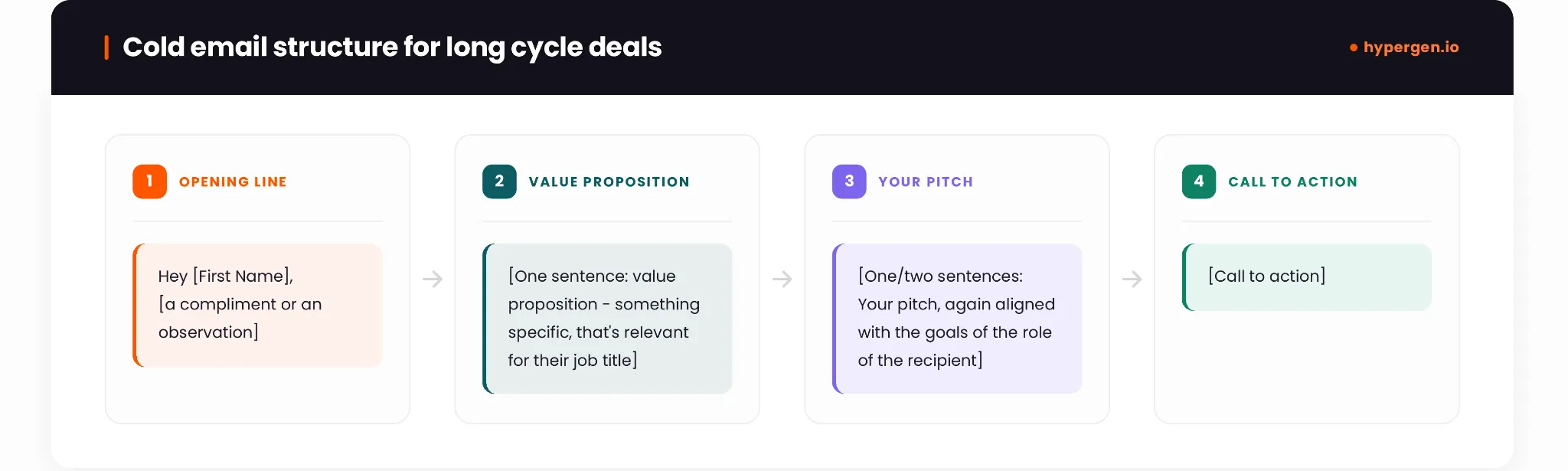
- An observation specific to their role: not their company, their role. Something that signals you actually know what their job involves. (For example, for a Director of Enterprise Sales at Groupon, that's opening with the fact that you know they handle enterprise sales, not just that they work there.)
- A value proposition tied directly to their goals: one sentence and no product features. What outcome does this person's role live or die by? That's your hook.
- A proof point from a comparable situation: a client, a result, a company they'd recognize. Specific enough to be credible, but short enough to land in a skim.
- A single, low-friction call to action: one ask. Not "let's jump on a call to discuss synergies." Instead: would this be worth a conversation?
No product pitch and no features list. But a specific reason this person should respond. The whole email fits in four sentences, and each one earns the next.
The most common objection here is "our product is too complex for outsourced SDRs to represent well." In almost every case, the real issue isn't product complexity, it's that the messaging hasn't been distilled into something a relevant prospect recognizes in three seconds.
Complex products have specific buyers with specific problems. So start with that connection, not the spec sheet.
The four-part structure above is the execution layer. But what feeds it (what determines whether it generates results rather than just activity) is almost always the same two things, regardless of cycle complexity:
Deliverability and a good offer.
When a company has a sharp picture of who they're going after and can explain what they actually do for that person in a couple of sentences, our campaigns run well, pretty much every time.
When they come in fuzzy on both fronts ("we work with any B2B company over $5M" or "we help businesses unlock growth"), even best-in-class infrastructure doesn't save it.
Sometimes we're helping clients try an audience they've genuinely never touched before, or a new angle on their offer. In those cases, we say it upfront, early numbers will be lower, and that's expected.
It's new territory for their outbound, and frankly for their own sales team's messaging too. We recalibrate the strategy and the benchmarks together rather than pretend the first month is representative.
Sutton Capital Partners is one of our favorite examples. Sutton Capital is a tech-focused investment bank working in M&A, a vertical where long sales cycles are just the default reality.
In the first couple of months of their campaign, they generated 50+ leads. And in month two, they signed their first client.
As Peter Cowen, their Managing Partner, put it:
"The biggest surprise we had was that at the start of the second month, we actually signed a client. And it's a good client, and we're deeply engaged with them now. We were surprised how quickly it was, but it was the right client at the right time, and it was literally one call who were able to be signed."
Most in-house SDR setups underdeliver at the execution layer, not the talent layer. We recommend checking out our take on outbound prospecting, it's a good read on why.
What KPIs should you expect from an outsourced SDR team?
The core KPIs for an outsourced SDR team are held qualified meetings, opportunities created, and pipeline value sourced per month. Activity metrics (like emails sent, calls made, reply rates) are diagnostic signals, not success metrics.
A healthy outbound SDR program books 12–15 qualified meetings per rep equivalent per month, with a 75–85% show rate and 25–40% meeting-to-opportunity conversion.
Our standard benchmark at Hypergen is 20–25 qualified leads per month by month three, depending on tier and ICP difficulty.
Here's how the full benchmark picture breaks down:
The conversation we have at the start with every client is pretty straightforward: what we take ownership of is sends, active sequences, cadence, and hitting the lead targets we've agreed on based on their ICP and offer.
What we don't put our name on is close rates, deal values, or pipeline figures: those are determined by how the client runs the sales conversation once the meeting is booked, not by us.
When we're not hitting benchmarks by month three, we don't keep running the same strategy. By that point we've already been through a round of copy rewrites and target adjustments.
If we're still short, we step back and look at the whole strategy. Sometimes that means widening the ICP if the original definition was too narrow to give us enough to work with. Sometimes it means re-approaching the offer angle entirely.
Here is a read you’ll definitely find interesting: How to evaluate a cold email agency.
So, should you outsource SDR or hire in house?
To be completely honest here, the question was never really "hire or outsource." It was always: what is this function actually costing us, and is it working?
Most companies running in-house outbound have never done that audit properly. And once you do, the $65K salary line starts to look like a very optimistic number.
The math on outsourcing isn't that it's cheap, but that it's legible. You know what you're paying, what you're getting, and when the model isn't working. And that kind of clarity matters more than most leaders realize when they're in a budget review.
We've done this math with more than 120 B2B companies. Most sales leaders who go through it come out surprised, usually not pleasantly.
So if you want to know yours, we're happy to help.
Frequently asked questions
Outsourcing wins when you need pipeline in weeks, not quarters, or when your budget can't sustain a fully loaded in-house rep ($120K–$160K/year). It also makes sense when testing a new vertical without permanent headcount commitment. Most companies see positive ROI before month three.
The main risks are brand voice misalignment, misqualified meetings from weak ICP documentation, and deliverability damage from agencies running bulk untargeted outreach. All are preventable: require CRM-direct logging, shared qualification criteria, and deliverability reporting before you sign anything.
Look for dedicated sending infrastructure separate from your primary domain, CRM-direct activity logging, signal-based targeting, and transparent deliverability metrics. Verify tool costs are bundled into the retainer. Also ask for their average time to first meeting, anything over four weeks is a red flag.
A properly set-up outsourced SDR team delivers first qualified meetings within 2–4 weeks. Full ramp takes 60–90 days. That compares to 3.2 months average for an in-house SDR to reach first full productivity, with zero pipeline generated during that window.
Yes, any credible outsourced SDR agency logs activity directly into your CRM as standard. Every email, reply, meeting, and qualification note should write into HubSpot or Salesforce automatically. Without direct CRM logging, you lose attribution, forecasting accuracy, and AE handoff quality.
Don’t miss these

Get your first lead this month
14 days to get started. 7 days to get your first lead on average.


