


B2B Lead Generation Services: What You Should Get for Your Retainer (Deliverables Checklist)
TL;DR: What Should Your B2B Lead Generation Retainer Cover?
- Your retainer should cover the full outbound process, from prospect research to ongoing optimization. 📋
- You should own your infrastructure and data, including domains, CRM records, and prospect lists. 🔑
- Reporting should show real lead quality, not just sends and reply counts. 📊
- Campaigns need continuous management, including copy testing, list refreshes, and deliverability checks. 🔄
- The retainer isn't always the total cost. Watch for tools, enrichment, setup fees, and overages. 💰
Two B2B lead generation agencies can offer the same monthly retainer, promise the same services, and deliver very different levels of work.
One might include everything from prospect research to ongoing optimization. Another might charge extra for the same work while offering little visibility into what gets done.
We've seen how much work goes into keeping outbound campaigns running after launch. Prospect lists need refreshing, messaging needs testing, deliverability needs monitoring, and interested replies need to reach sales teams before opportunities go cold.
So what should you expect to receive for your money?
This guide includes a practical deliverables checklist to help you evaluate proposals for B2B lead generation services, identify what’s missing, and understand exactly what you’re paying for.
What should your B2B lead generation retainer include?
A B2B lead generation retainer can cover strategy, prospect research, campaign execution, lead management, and reporting. But the exact scope varies by provider, and some services may be billed separately.
The checklist below helps you identify what should be included in an agency's proposal.

Every deliverable in the proposal should have a defined owner, a delivery frequency, and a way for you to verify that the work has been completed.
What should you receive before the first campaign launches?
If you're evaluating outsourced appointment setting, the first red flag can appear before a single email is sent.
If your agency can't show you the approved targeting, verified prospect data, sending infrastructure, and CRM setup, you're being asked to trust a campaign you can't properly evaluate.
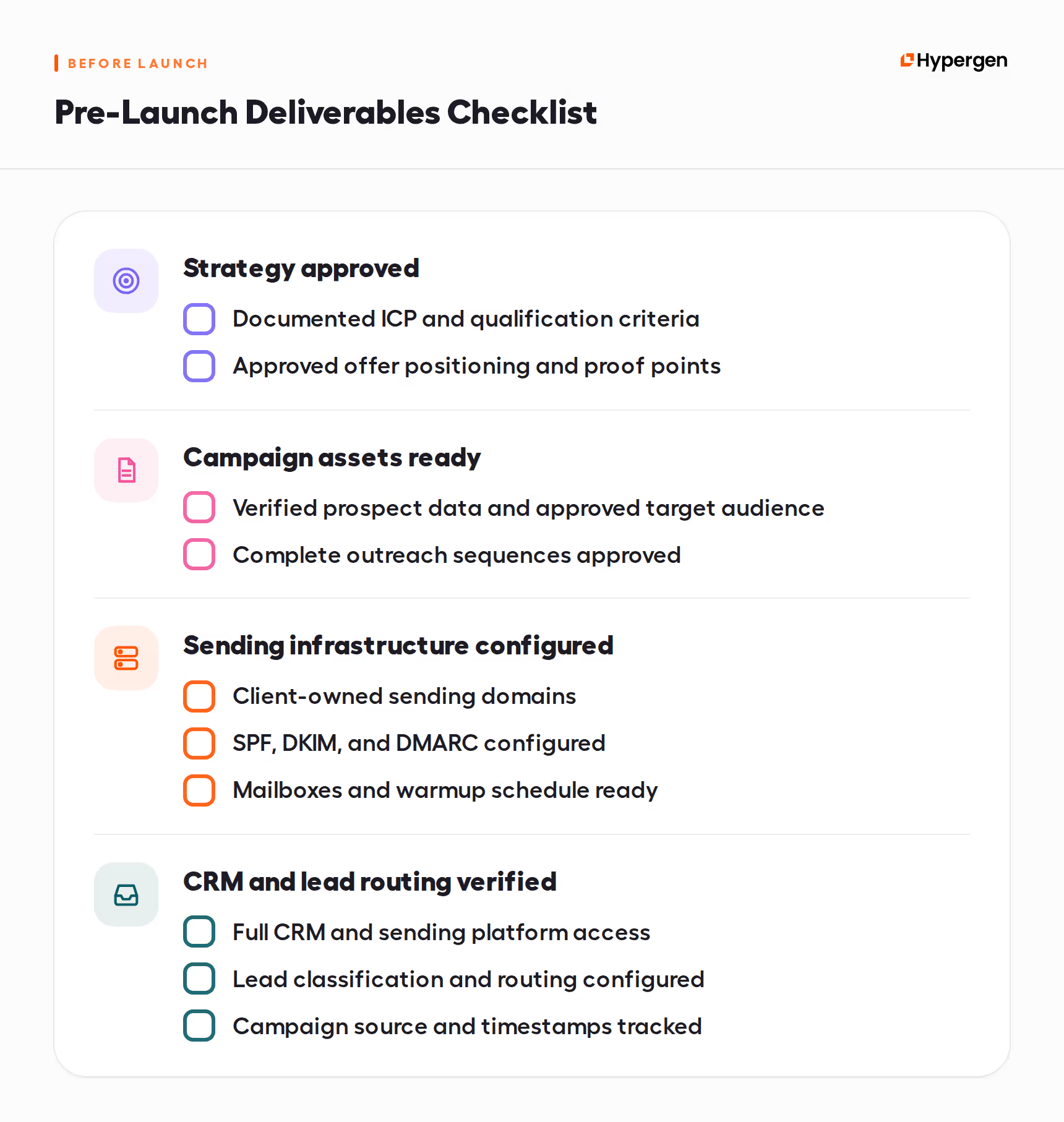
A documented ICP and outreach strategy
Your agency should provide a written intake document covering:
- Ideal customer profile (ICP): target industries, company sizes, job titles, and exclusions
- Qualification criteria: what makes a prospect a relevant potential customer
- Offer positioning: the outcomes and value propositions used in outreach
- Approved proof points: client names, case studies, deals, and performance figures the agency can reference
This gives your team a chance to identify targeting gaps and approve the strategic direction before campaign setup moves forward.
A verified prospect list and approved messaging
Your agency should build a quality lead list for cold emailing, with contacts filtered against your ICP, verified email addresses, and checks for outdated information, incorrect job titles, and irrelevant companies.
You should also receive the complete email sequences for approval, including the messaging angles and customer proof used in each.

Check whether the contacts match your intended buyers and whether every claim in the copy is supported by evidence your company has authorized the agency to use.
Sending infrastructure you control
Your agency should configure the sending infrastructure before the first campaign launches:
- Dedicated sending domains registered under your ownership
- SPF, DKIM, and DMARC authentication
- Mailbox setup and a documented warmup schedule
- Access to the sending platform
If the domains are registered under the agency's accounts, you may lose access to infrastructure you've already paid for when the engagement ends.
Full access to your CRM and sending platform
You should have full access to both platforms, with every reply classified, qualified leads routed to the right person, and campaign sources, labels, and timestamps recorded in your CRM.
Ask your agency to demonstrate this workflow using a test lead to verify that routing and tracking work as intended.
What should your agency deliver every month?
Once campaigns are live, a significant part of your retainer goes toward work you may never see in a standard performance report.
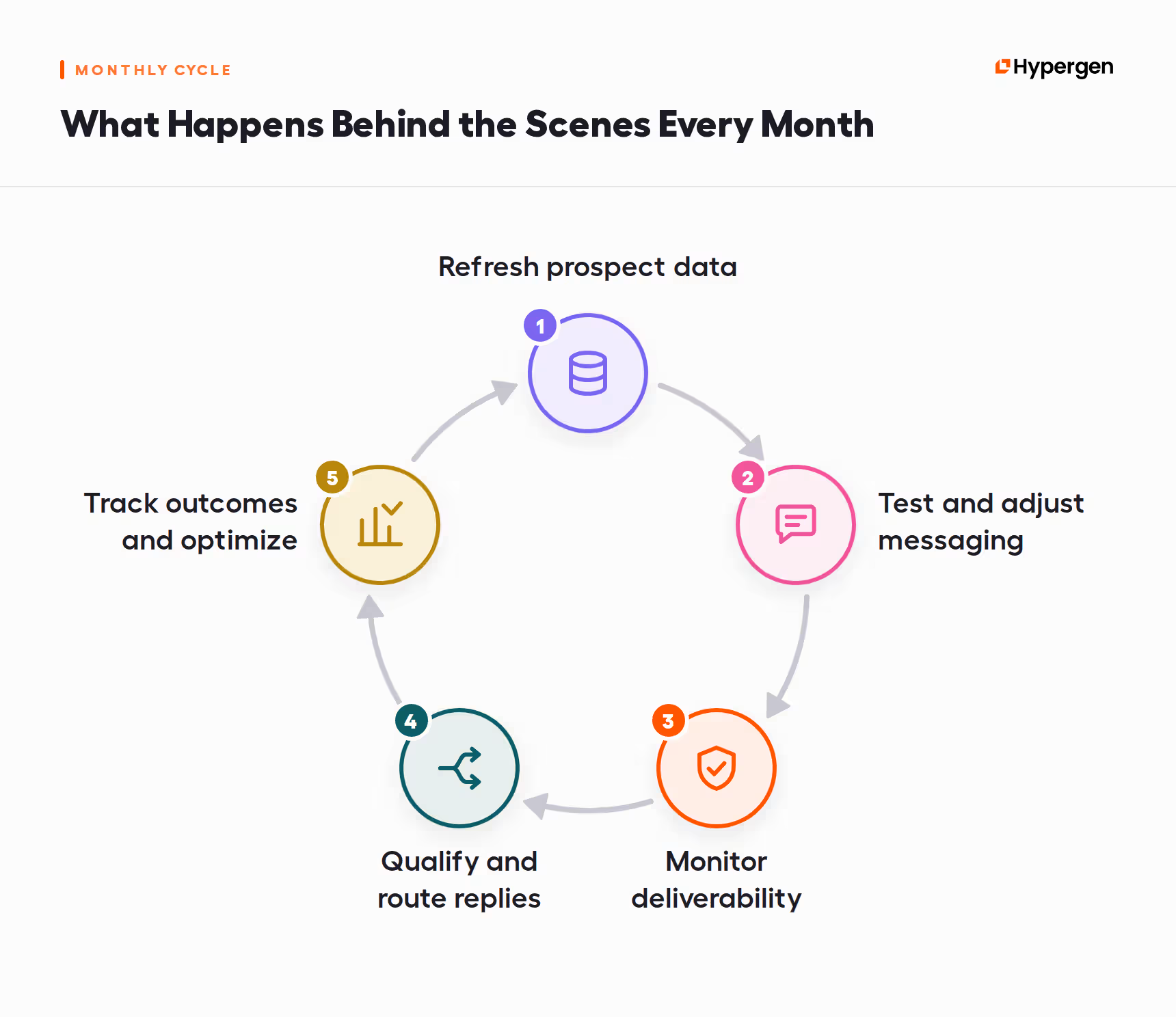
Keeping prospect lists up to date
Prospect lists lose relevance as contacts change roles, companies get contacted, and new targeting patterns emerge.
Each month, the agency should:
- Replace contacted, bounced, or outdated records and check for companies approached in the previous 6-12 months
- Recheck email addresses, job tenure (including contacts in a role for under 90 days), and ICP fit before adding prospects to campaigns.
- Use wrong-person replies and lead distribution across company sizes or job titles to adjust audience filters
For example, if 18% of replies indicate that the contact isn't responsible for the problem you're solving, that's a reason to revisit the job titles being targeted.
Testing and improving outreach messages
The messaging that launches in month 1 shouldn't necessarily be the messaging running in month 3.
Your agency should test different messaging angles, compare their performance, and revise copy based on the quality of responses.

A campaign starts with different messaging angles built around the client's offer and approved proof points. What happens next depends on how prospects respond.
First, we look for a signal.
After 1,000 sends, we evaluate which messaging angles are generating qualified interest and which are underperforming.
Then, we decide what deserves another test.
We revisit weaker angles and build new variations around the messages attracting qualified prospects. For example, if one angle generates a 3.1% lead rate while 2 others generate 0.9% each, we'd prioritize new variations of the stronger angle. This testing cycle runs every 2-3 weeks.
Finally, we keep the proof current.
As new client results become available and are approved for use, we update the messaging so campaigns aren't relying on outdated examples.
Keeping campaigns running and emails out of spam
Monitoring also means catching the small technical problems that can interrupt a campaign or prevent leads from reaching sales.
A campaign can run into trouble without anything changing in its messaging. CRM workflows can break when fields are renamed, API limits can interrupt syncing, and DNS changes can affect email authentication.
Managing replies and identifying qualified leads
Every reply needs to be classified and handled appropriately. Some require immediate sales follow-up, while others help improve prospect data or future targeting.
Straightforward replies can be classified with AI assistance, while ambiguous responses may require human judgment.
When a prospect shows clear interest, we aim to pass their details and reply to the client's sales team within 1 hour.
CRM hygiene and meeting tracking
A positive reply doesn't always lead to a meeting. Some prospects stop responding, others book a call but never attend.
Your agency should track these outcomes in your CRM and connect each lead to the campaign that generated it.
For example, a campaign generating 20 leads but only 4 meetings has a 20% lead-to-meeting conversion rate. Another generating 12 leads and 8 meetings reaches 66.7%. The second campaign produces fewer leads but more sales conversations, which is why meeting conversion matters alongside lead volume.
From our playbook:
Here's what happens when a lead doesn't follow the expected path:
- When a prospect misses a meeting, we record the no-show in the CRM and follow up to reschedule.
- When a lead stops responding after 2 follow-ups, we move them into a long-term nurture sequence rather than leaving them in the same pipeline stage.
- When a meeting gets booked, we track its status and campaign source in the CRM so the client can see which outreach generated it.
We check these systems weekly, alongside domain renewals and mailbox capacity, to catch issues before they disrupt outreach or lead routing.
What do agencies really mean by list building, campaign management, and reporting?
"List building" could mean anything from exporting contacts from a database to researching, verifying, and regularly updating a prospect list.
The same ambiguity applies to campaign management, reporting, and other services commonly included in outbound prospecting proposals.
The important distinction is whether the agency can show you the work behind each service.
A proposal that promises campaign management, for example, should make it possible to see which messages were tested, what changed, and why.
Ask the agency for a sample monthly report, copy testing records, and proof of CRM lead routing. For prospect lists, ask what percentage of sourced contacts passes verification and what bounce rate the agency typically sees.
Retainer, pay-per-lead or pay-per-meeting: which pricing model should you choose?
A monthly retainer isn’t the only option. Some agencies charge per lead or per booked meeting
instead.
Each model shifts the risk differently, so the deliverables checklist above matters more
under some models than others.
Monthly retainer
You pay for the work, whether or not it produces meetings in a given month.
In return, you get the most control over targeting, copy and infrastructure, which is why
ownership and visibility should be written into the contract.
Pay-per-lead
You pay only for leads, but the agency often defines what counts as one.
Agree on the qualification criteria in writing, or you may end up paying for replies that never become sales conversations.
Pay-per-meeting
This is the closest to paying for an outcome, but the price per meeting is usually higher, and the model can reward volume over fit. Ask how no-shows and unqualified meetings are handled.
Whichever model you choose, ask which benchmarks the agency will be measured against over the first 3 to 6 months, such as the time to the first qualified lead and the lead-to-meeting rate, and what happens if those benchmarks aren’t met.
What costs might be missing from your lead generation retainer?
A $3,000 monthly retainer doesn't necessarily mean your total monthly cost will be $3,000.
Some agencies charge separately for the tools, data, and infrastructure needed to run your campaigns.
Here's how they could add up for a company paying a $3,000 retainer.
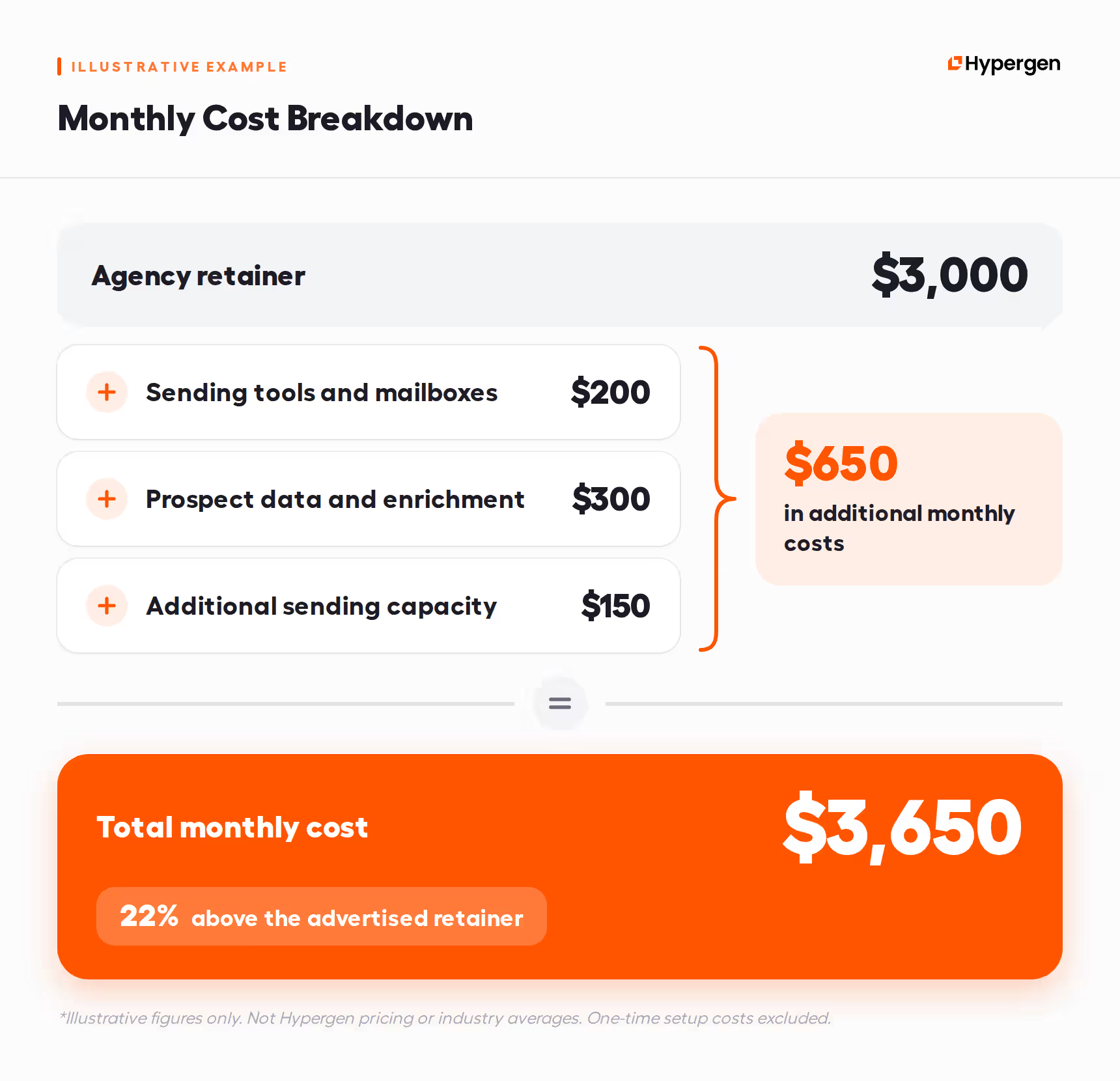
In this example, the additional costs increase the monthly spend by $650 to $3,650, or approximately 22% above the advertised retainer.
What does a slower launch cost you?
The monthly fee is only part of the cost. A lower retainer may lose its advantage if campaign setup takes longer or underperforming messaging goes unchanged for weeks.
Before comparing prices, ask each agency:
How long does it typically take to launch the first campaign?
What's your typical time from signing the contract to generating the first qualified lead?
How soon do you review and adjust campaigns that aren't producing qualified interest?
These answers help you compare the time you're paying for before meaningful opportunities start reaching your sales team.
Request a breakdown of included services, third-party subscriptions, one-time setup fees, volume limits, and charges for work outside the agreed scope.
How can you tell whether your lead generation agency is doing the work?
A monthly report can show impressive numbers without revealing much about the work behind them.
To evaluate your agency, you need to be able to check where those numbers come from and what happens to the leads they generate.
Can you trace a positive reply all the way to a meeting?
Choose a qualified lead from your monthly report and check the original prospect reply. Does it show genuine interest, or was it simply a question, referral, or polite rejection?
Then check the corresponding CRM record. You should be able to see when the lead was passed to sales, which campaign it came from, and whether a meeting was booked or attended.
Can you see which outreach messages perform best?
You should be able to see which messages were tested, how many prospects received each version, and what happened afterward.
Look for a record of changes with dates and reasons. For example, if an email sequence was replaced, you should be able to see what prompted that decision.
Can you verify who was contacted?
Ask to inspect a sample of the prospect list, including job titles, companies, and contact details.
Compare those records with your agreed ICP. This can reveal whether the agency is reaching the right people or simply increasing outreach volume.
Ask your agency to walk you through one real campaign adjustment from the past month. You should be able to see what prompted the change, what was adjusted, and how the results were measured afterward.
Are your emails reaching prospects' inboxes?
Ask to see the latest inbox placement results, bounce rates, and any sending issues identified during the month.
If your campaign develops email deliverability issues, your agency should be able to show what it did to address them, such as reducing sending volume or checking the sending setup.
If you can't see the work, what are you paying for?
A polished monthly report is nice. But it won't tell you whether your prospect lists are getting better, your messaging is improving, or your leads are making it to the right salesperson.
And if you decide to part ways with your agency, you shouldn't have to start from scratch.
The domains, prospect lists, campaign copy, CRM records, and performance history built during the engagement should remain accessible to your team. So should the lessons behind them: which audiences responded, which messages worked, and where potential meetings were lost.
Before you commit to another monthly retainer, ask yourself 3 questions:
Can I see the work? Can I verify the results? And can I keep what I've paid for?
Those answers give you a much better starting point for understanding what your outbound investment is delivering and where there's room to improve.
And if these answers aren't clear, neither is the value of your retainer.


Frequently asked questions
A B2B lead generation retainer typically covers prospect research, contact list building, outreach messaging, campaign execution, lead qualification, and reporting. Depending on the agency, it may also include sending infrastructure, deliverability monitoring, CRM integration, and meeting booking. The important detail is which of these services are included in your monthly retainer and which are billed separately.
The timeline depends on campaign setup, audience size, offer, and how quickly the agency can test and refine its messaging. Ask providers to distinguish between the first campaign launch, the first positive reply, the first qualified lead, and the first booked meeting. These are different milestones, and a single promised timeline can hide that distinction. Request their typical time from contract signing to the first qualified lead, along with an explanation of what happens if early results fall short.
Sending domains, mailboxes, outreach platforms, and other tools may be included in the retainer or charged separately. What matters is that the proposal clearly states who pays for them and who owns the accounts. Your company should retain control of its sending domains and access to its campaign data. If an agency provides tools through its own accounts, clarify what you can export or transfer when the engagement ends.
Don’t miss these



Get your first lead this month
14 days to get started. 7 days to get your first lead on average.


