


Hiring a Lead Generation Agency? 12 Questions to Ask Before You Sign a Retainer
TL;DR: What should you know before hiring a lead generation agency?
- A polished sales pitch won't tell you how an agency handles underperforming campaigns. Ask what happens when the first approach fails. 🔍
- Get clear on what your own team needs to provide, from customer proof to timely approvals and sales follow-up. 🤝
- Agree on what counts as a qualified lead, how results will be measured, and who owns each step after a prospect replies. 📊
- Ask to see how the agency sources data, protects deliverability, and adapts messaging to your ICP. ⚙️
- Request evidence from comparable campaigns and make sure the agency's promises translate into responsibilities you can verify. 📋
A promise of qualified leads sounds great. But who decides what qualifies? What happens when a campaign underperforms? And who follows up when a prospect replies on Friday afternoon?
From managing B2B outbound campaigns, we've seen how easily small gaps in targeting, approvals, and lead handoffs can become expensive problems. Many of those gaps can be identified before the first email goes out, provided you know what to ask.
These 12 questions will help you look beyond the pitch, understand how an agency operates, and decide whether its approach fits your business before committing to a retainer.
Before you hire a lead generation agency (the readiness checklist)
Even a capable agency will struggle if your ideal customer profile is unclear, your sales team can't follow up, or nobody is available to approve campaign messaging.
Based on Hypergen's experience managing B2B outbound campaigns, these are 5 things worth checking before you sign a retainer.
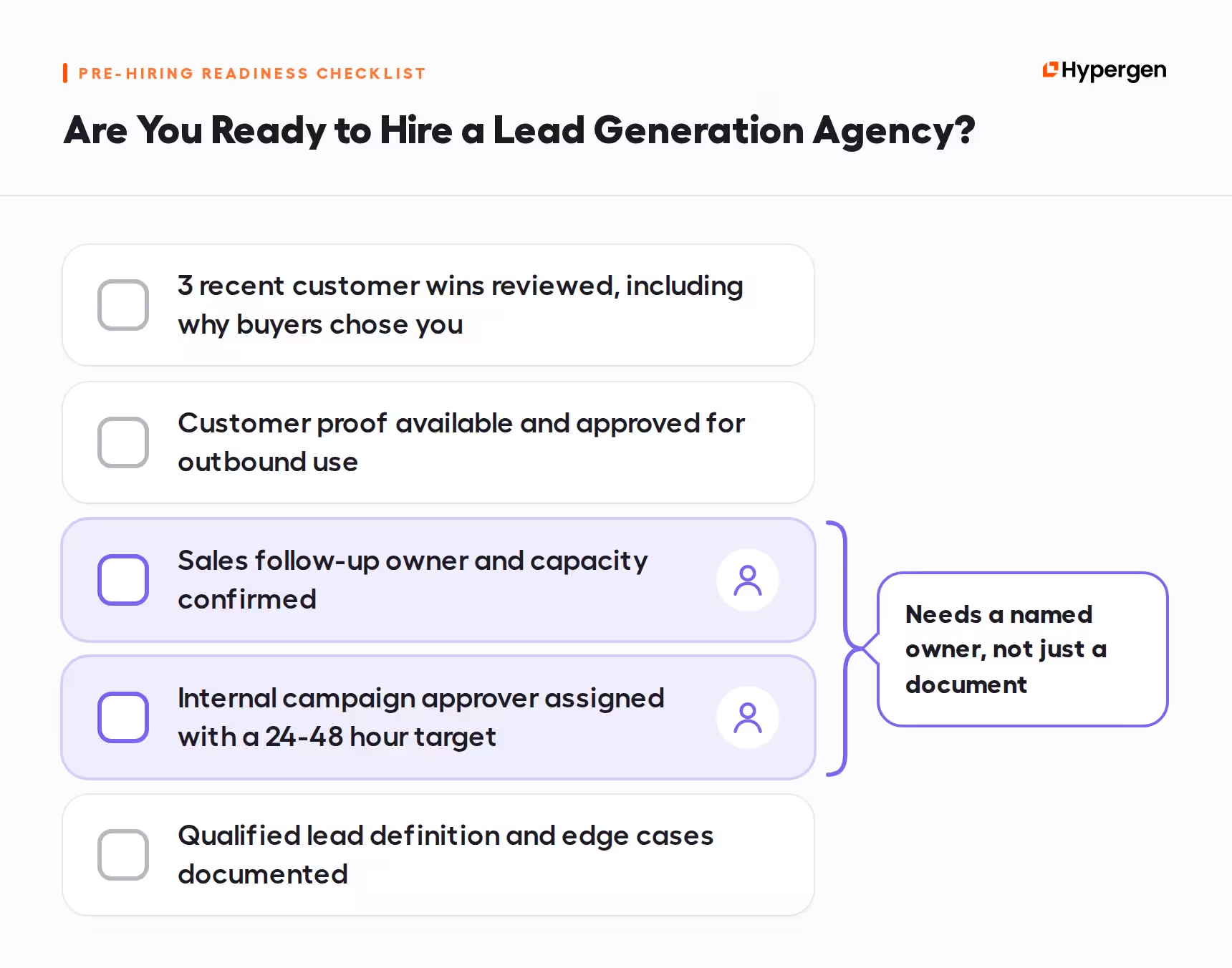
Recent customer wins
Review 3 deals you've closed in the past 12 months. Document who bought, what problem they needed to solve, and why they chose your company.
This gives the agency real customer evidence to work with instead of relying entirely on assumptions about your ICP.
Approved customer proof
Gather case studies, testimonials, customer results, or specific examples of problems you've solved. Confirm which details can be used in outbound messaging.
Sales follow-up capacity
Identify who will respond to interested prospects and whether your sales team can handle the expected lead volume.
As a practical benchmark, consider 15-25 new leads per month with follow-up within 4 hours.

If your sales team is already stretched thin, agree on a realistic handoff process before outreach begins.
An internal campaign owner
Assign someone who understands your customers and can review targeting, messaging, and campaign materials. Aim for approvals within 24 to 48 hours.
A documented qualified lead definition
Agree internally on what makes a response worth passing to sales. Include edge cases, such as prospects asking for pricing or expressing interest in a future quarter.

If you're missing an item, bring it up during the agency evaluation. The important part is to establish who will provide it and when, so the campaign has what it needs to launch.
12 questions to ask a lead generation agency before signing a retainer
Use these questions to get specific answers about expectations, campaign execution, reporting, and responsibilities.
What results should we realistically expect in the first 30, 60 and 90 days?
Ask the agency to walk you through its first 3 months, including what it expects to accomplish at each stage and what needs to happen before results become predictable.
With outsourced appointment setting, the first 30 days may focus on setting up sending infrastructure, refining your ICP, preparing prospect lists, and developing campaign messaging.
By day 60, the agency should be reviewing initial prospect responses, identifying which messages generate replies, and beginning to assess conversation quality.
By day 90, you should have a clearer understanding of which messages generate qualified conversations and what adjustments to targeting, messaging, or campaign setup are needed.
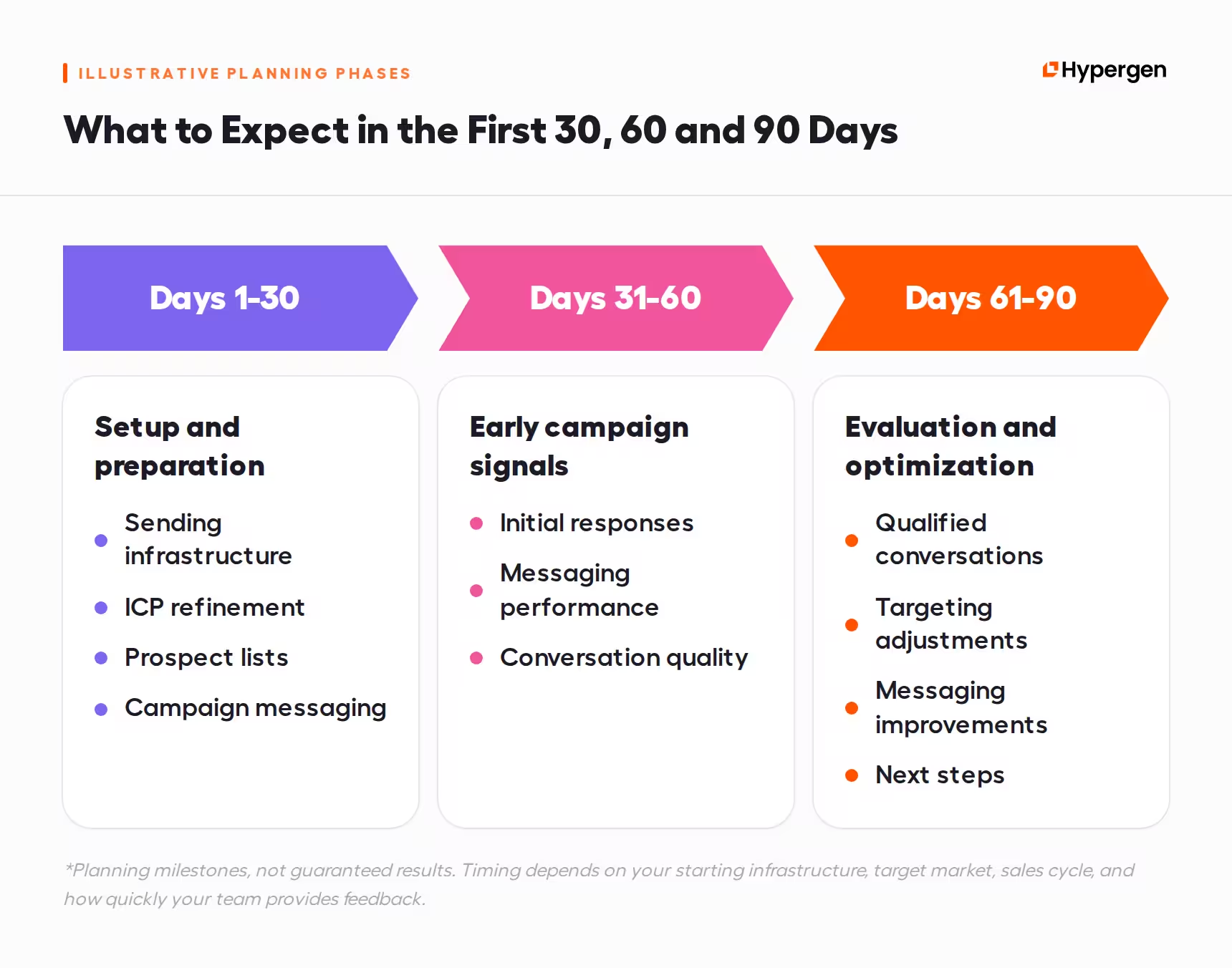
These are planning milestones, not guaranteed results. The timeline will depend on your starting infrastructure, target market, sales cycle, and how quickly your team provides feedback.
Be especially careful when an agency promises a specific number of meetings before reviewing your offer, audience, or existing outbound performance.
A realistic timeline with clear deliverables, assumptions, and an explanation of how the agency will evaluate early campaign performance.
What do you need from our team for the campaigns to work well?
If an agency says it can handle everything without much involvement from your team, ask what that looks like in practice.
Even with fully managed outbound, the agency will need access to your customer knowledge, timely decisions, and feedback from sales.
Before signing, clarify how you'll work together:
- Who will share details about your ICP, recent customer wins, common objections, and why buyers choose you?
- Who will review targeting, messaging, and customer proof? How quickly does the agency need feedback?
- Who will handle interested prospects, and what response times should both teams commit to?
- How will your sales team report whether conversations are relevant, meetings are productive, and leads match your qualification criteria?
- How frequently will you review campaign performance and agree on changes?
Outbound leads may need a different sales approach than prospects who request a demo themselves. Someone asking about pricing, for example, may still be evaluating whether a conversation makes sense, so the first response should address their question rather than immediately push for a full demo.
These responsibilities should be documented during onboarding, along with the people accountable for them.
Otherwise, a campaign can lose momentum while both teams assume the other is handling the next step.
How do you define a qualified lead, and how is that different from a prospect or a reply?
One agency might count every positive reply. Another might only count prospects who meet your ICP criteria and express a relevant business need.
Understanding the prospect vs lead distinction matters because each stage represents a different level of engagement.
The tricky part is agreeing on the borderline cases.
For example, imagine a prospect who matches your ICP and replies: "This looks interesting, but we're not reviewing vendors until next quarter."
Should the agency count that as a qualified lead, place the contact into a nurture sequence, or leave the conversation with your sales team?
There isn't one universal answer.
What matters is agreeing on the criteria before the campaign launches, including how ambiguous replies will be classified, who makes the final decision, and how those decisions appear in reporting.
Where do you get your prospect data, and how do you verify it?
A prospect list can look impressive on paper. But if the information is outdated or the contacts don't match your ICP, that impressive list won't do much for your campaign.
Ask the agency to explain how it builds a quality lead list for cold emailing, which data providers it uses, and what happens before a contact is approved for outreach.
Pay particular attention to these 4 areas:
- Does the agency rely on a single database or combine multiple sources to identify relevant companies and decision-makers?
- How does it confirm that prospects meet your targeting criteria beyond basic filters such as industry, company size, and job title?
- How does it check email addresses, identify outdated records, and remove contacts that shouldn't be contacted?
- How often are lists reviewed and updated, particularly when campaigns run over several months?
A contact who changed jobs 6 months ago shouldn't keep appearing in your outreach simply because nobody updated the spreadsheet.
Before signing, clarify who owns prospect sourcing, verification, and ongoing list maintenance, including whether data enrichment tools carry additional costs.
Do you use buying signals or intent data to decide when a prospect should be contacted?
Imagine you're selling sales enablement software to B2B companies. Your agency notices that one of your target accounts is hiring 10 new sales representatives.
That's a potential buying signal, but what should happen next?
- Signal: a target company is hiring 10 new sales representatives.
- Possible interpretation: a growing sales team may create new challenges around onboarding, training, and getting new hires productive.
- Agency decision: check whether the company matches your ICP, identify the people responsible for sales onboarding, and prioritize the account if the signal is relevant to your offer.
- Outreach approach: reference the team's expansion and introduce a relevant onboarding challenge, rather than sending a generic software pitch.
The agency has now used the signal to make 3 decisions: which account to prioritize, whom to contact, and how to frame the message.
But there's an important limitation. Hiring activity doesn't prove the company has a budget, an active project, or an interest in buying your solution. The signal suggests a possible need that the agency can explore through outreach.

A useful signal should lead to a specific campaign decision, not just another field in the prospect database.
Do you write campaigns specifically for our ICP, or do you use existing templates?
There's nothing inherently wrong with using a proven campaign structure. An agency doesn't need to reinvent the wheel every time it writes a cold email. The important question is how much of the messaging is adapted to your buyers.
For example, imagine 2 companies selling the same cybersecurity solution. One targets IT managers at mid-sized businesses, while the other targets CISOs at enterprise organizations.
Both might use a similar email structure, but their messaging should reflect different priorities:
Note: This is an illustrative example. Actual messaging should be informed by customer research and validated assumptions.
Ask the agency to show you how it would adapt the same campaign for 2 different buyer groups within your target market. Pay attention to whether it can explain the reasoning behind each message, including the customer insights, pain points, and supporting evidence it would use.
What do you do when email deliverability starts to decline?
Suppose an agency increases campaign volume and notices rising bounce rates alongside fewer replies. A sensible response would be to investigate list quality, mailbox performance, and recent sending changes before increasing volume further.
Lower reply rates alone don't prove email deliverability issues. The agency should investigate other possible causes, including targeting and messaging, rather than treating every performance decline as an inbox placement problem.
What do you do when a campaign isn't generating enough qualified leads?
Imagine a campaign that generates plenty of replies but very few qualified leads.
That could indicate a mismatch between the targeting, messaging, and the prospects' actual needs. Sending more emails to the same audience is unlikely to solve the underlying problem.
This is why the agency’s approach should distinguish between different problems:
These are possible explanations, not automatic diagnoses.
The agency should use campaign data and sales feedback to determine which changes are justified and whether those changes are helping generate high-quality leads.
Which metrics will you use to measure whether our campaigns are actually working?
Ask the agency to distinguish between campaign activity, lead quality, and sales outcomes.
For example, a campaign might have a high reply rate but generate very few qualified leads.
Another might receive fewer replies but produce more conversations that your sales team considers relevant.
Looking at reply rates alone would give you a misleading picture of which campaign is performing better.
How will leads and conversations be passed to our sales team and connected to our CRM?
Ask the agency to walk you through what happens from the moment a prospect shows interest to the point where your sales team takes over.
The handoff process should answer 5 practical questions:
- Who handles the first reply?
Does the agency respond to interested prospects, or does your sales team take over immediately?
- Who books the meeting?
Clarify whether the agency manages scheduling or passes the conversation to a sales representative.
- How quickly does sales follow up?
Agree on response-time expectations for interested prospects and who monitors missed handoffs.
For example, an agency might commit to routing interested leads within 1 hour, while the assigned sales rep commits to responding within 4 hours.
- How does the conversation enter your CRM?
Confirm which contact details, campaign sources, conversation history, and qualification notes are transferred, and whether the agency or your RevOps team owns integration troubleshooting.
- Who handles leads that aren't ready to book?
Decide who qualifies ambiguous responses, schedules future follow-ups, and coordinates re-engagement to avoid duplicate outreach.
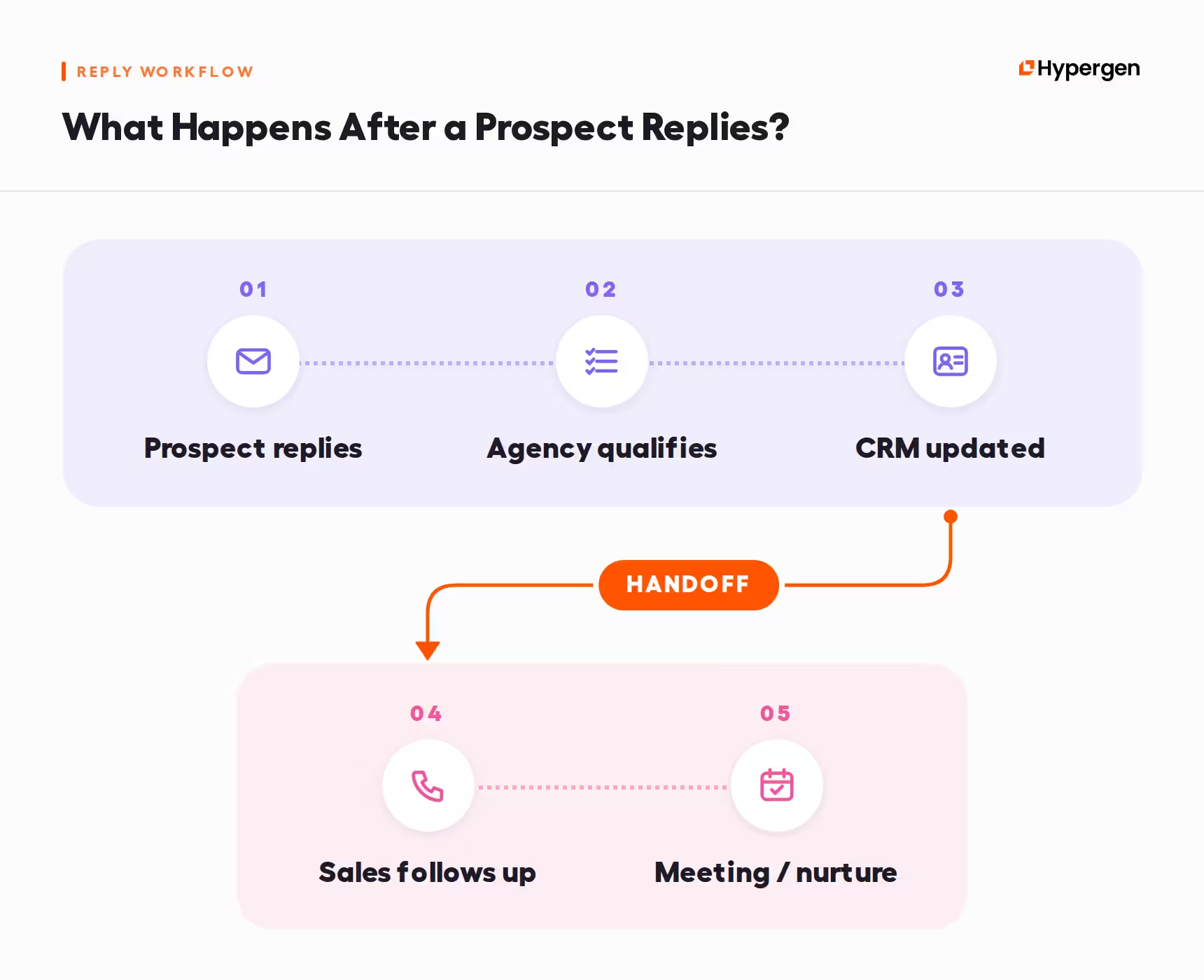
Before launch, agree on which CRM fields will be updated, who maintains the records, and how sales outcomes will be shared with the agency.
The handoff also determines how much of the campaign's commercial impact you can measure. Opportunities created and deals won require CRM data or feedback from your sales team.
If the agency only sees replies and booked meetings, it cannot reliably report what happens further down the sales pipeline.
How do you use AI in your lead generation process, and which parts still require human input?
The agency should be able to explain where AI is used, what gets reviewed by a person, and who is responsible when something goes wrong. Ask how the AI is used across 3 key areas:
- How do you review AI-assisted messaging for accuracy, relevance, and personalization?
- How do you use AI to classify prospect replies, and when does a person step in?
- How do you evaluate AI-generated recommendations against campaign data and sales feedback?
For example, an AI tool might identify a company expansion and suggest referencing it in a cold email. Before using that information, the agency should confirm that the expansion is real, relevant to your offer, and appropriate to mention.
Can you show us results from companies with a similar ICP, industry or sales cycle?
A case study with impressive numbers is a good starting point. But those numbers become more useful when you understand how closely the campaign resembles your own situation.
An agency might show you a campaign that generated 40 booked meetings in 3 months. That's useful information, but the number alone doesn't tell you whether the same approach would work for your business.
For example, a campaign targeting small business owners with a relatively simple purchasing process may have little in common with one targeting enterprise buying committees.
Ask what made the example successful and which parts of the approach the agency would change for your business. A relevant case study should help you understand the agency's decision-making, not just its best-performing numbers.
Know what you're signing before you commit
The most revealing part of an agency evaluation might be what happens when you start asking difficult questions. Can the team explain its decisions? Is it comfortable discussing underperforming campaigns? Can it show you how the process works beyond the sales presentation?
Before signing, make sure the answers you've received are reflected in the agreement. That includes what the retainer covers, how qualified leads are defined, who owns prospect data and campaign assets, and how responsibilities are divided between the agency and your sales team.
The right agency should welcome this level of scrutiny.
After all, if you're trusting someone to represent your business in conversations with potential customers, you deserve to know exactly how they'll do it.


Frequently asked questions
Start by checking whether the agency has experience with companies that share your ICP, industry, or sales cycle. Ask how it builds prospect lists, develops messaging, qualifies leads, and measures results. Compare its proposed approach with your sales capacity, budget, and internal resources. Before signing, make sure deliverables, responsibilities, and reporting expectations are clearly documented.
Watch for guaranteed meeting numbers without an assessment of your market, vague explanations of where prospect data comes from, and an unwillingness to explain how campaigns are managed when performance declines. Other warning signs include unclear lead qualification criteria, limited visibility into reporting, and no defined process for handing conversations to your sales team.
Be cautious of unconditional guarantees. Meeting and lead volumes depend on factors such as your ICP, offer, market conditions, and qualification criteria. An agency should explain the assumptions behind its projections and what it will do if performance falls short. If a guarantee is included in the contract, clarify what counts toward it, how results are verified, and what happens if the target isn't reached.
Don’t miss these





Get your first lead this month
14 days to get started. 7 days to get your first lead on average.


