


6 signals that show a company is ready for M&A
TL;DR: How to find companies to acquire
- Companies rarely say they are ready to sell. The real signal is behavioral: ownership, founder tenure, and headcount, not financial statements. 👀
- Business age past 10 years is the most predictive standalone check. A decade of downturns changes how a founder hears a partner offer.
- Family or founder ownership is the strongest signal on its own. No board and no fund clock means timing is the family's call.
- Ownership structure cuts both ways. PE funds sourcing proprietary deals often exclude anything already institutionally owned, regardless of other signals firing.
- Headcount trajectory points opposite directions by thesis. Plateau signals a mature exit, growth signals a capital-raise or roll-up fit.
No business owner announces that they're ready to sell. There's no memo, no press release, no line on a website that says "considering an exit".
If it worked that way, sourcing would be a much simpler job.
What you get instead is a pattern of small, observable changes: a founder who's been running the same company for a decade without bringing on outside capital, a headcount chart that suddenly flattens, a company that quietly stops chasing every deal it used to chase.
None of it looks like "for sale." But once you know what to look for, it might as well be. 👀
And that's what this post covers.
We're walking through the six signals signals we track, why each one holds up in practice, and why PE firms and VC or corporate development teams can look at the exact same data (the same company, even) and land on very different conclusions about what to do with it.
What are the most reliable signals that a company is ready for M&A?
The honest answer, and it surprises some newer deal teams, is that the most reliable signals aren't in the financial statements at all. They're behavioral: how old the business is, who actually owns it, how long the founder has been in the seat, and whether it's already been through a transaction.
These show up in public data long before any formal sale process begins, which is exactly why they're worth tracking closely (long before, not just weeks before).

Consider what happens if you wait for the formal process instead. By the time a company shows up with a banker attached, every buyer in the space has the same teaser sitting in their inbox.
At that point it's effectively an auction. The price climbs, the terms tighten, and any edge that came from being early disappears, because now you're simply competing on price with everyone else who received the same email.
So instead of waiting, we help M&A advisory firms and PE teams build lists that get ahead of that moment. Not by guessing who's quietly shopping their business (nobody's guessing here), but by tracking the handful of signals that consistently appear on companies before an owner is even actively looking.
One tip from us:
One signal on its own is interesting and worth noting. But three or more stacked on the same company is worth a call today, not next week. We treat signal count as a rough urgency indicator rather than a fixed rule, but it's a genuinely useful way to triage a large list quickly.
The 6 signals we track for M&A readiness
Six signals show up consistently across the sell-side, buy-side, and capital-raise lists we've built across every stage of the M&A process (and we've built a lot of them by now).
And the important part is this: none of them mean much in isolation, it's the combination that tells you something real.
Here they are at a glance:
- Business age (10+ years)
- Family-owned or founder-owned status
- Founder or CEO tenure and succession age
- Ownership structure: independent vs. already acquired
- Headcount trajectory
- Recent funding history and expansion activity
Now let's get into why each one actually holds up. 👇
1. Business age (10+ years)
A company under a few years old rarely wants to talk about selling. It's still proving the model out.
But once a business crosses the 10-year mark (a somewhat arbitrary line, admittedly, but one that holds up in practice), it's usually settled into a stable operating rhythm, and that's exactly when a founder starts weighing what the next 10 years should look like.
This signal is easy to verify and one of the most consistently predictive we track. A founder who's navigated a decade of ups and downs (a recession or two, probably a pandemic) hears an offer to bring on a partner very differently than someone still in the early, scrappy years of the business.
2. Family-owned or founder-owned status
Of everything on this list, this is the one we've found to be the most reliable on its own.
We verify it two ways: checking the company's own website for language like "family owned" or "family operated," and cross-referencing the last names of executives listed on the leadership page (a small detail, but it works surprisingly often).
Family-owned businesses face a decision most institutionally-backed companies never have to consider, and that's succession. There's no board pushing for an exit and no fund running a 10-year clock.
The timing is entirely the family's call, which also means the right message at the right moment can open a conversation that's sat untouched for years (sometimes decades, honestly).
Founder or CEO tenure and succession age
Long-tenured founders, especially those approaching an age where the next chapter is a real question, are more likely to be genuinely considering an exit.
This overlaps with business age, but it's not the same signal. A company can be old with a founder who sold it internally three times over.
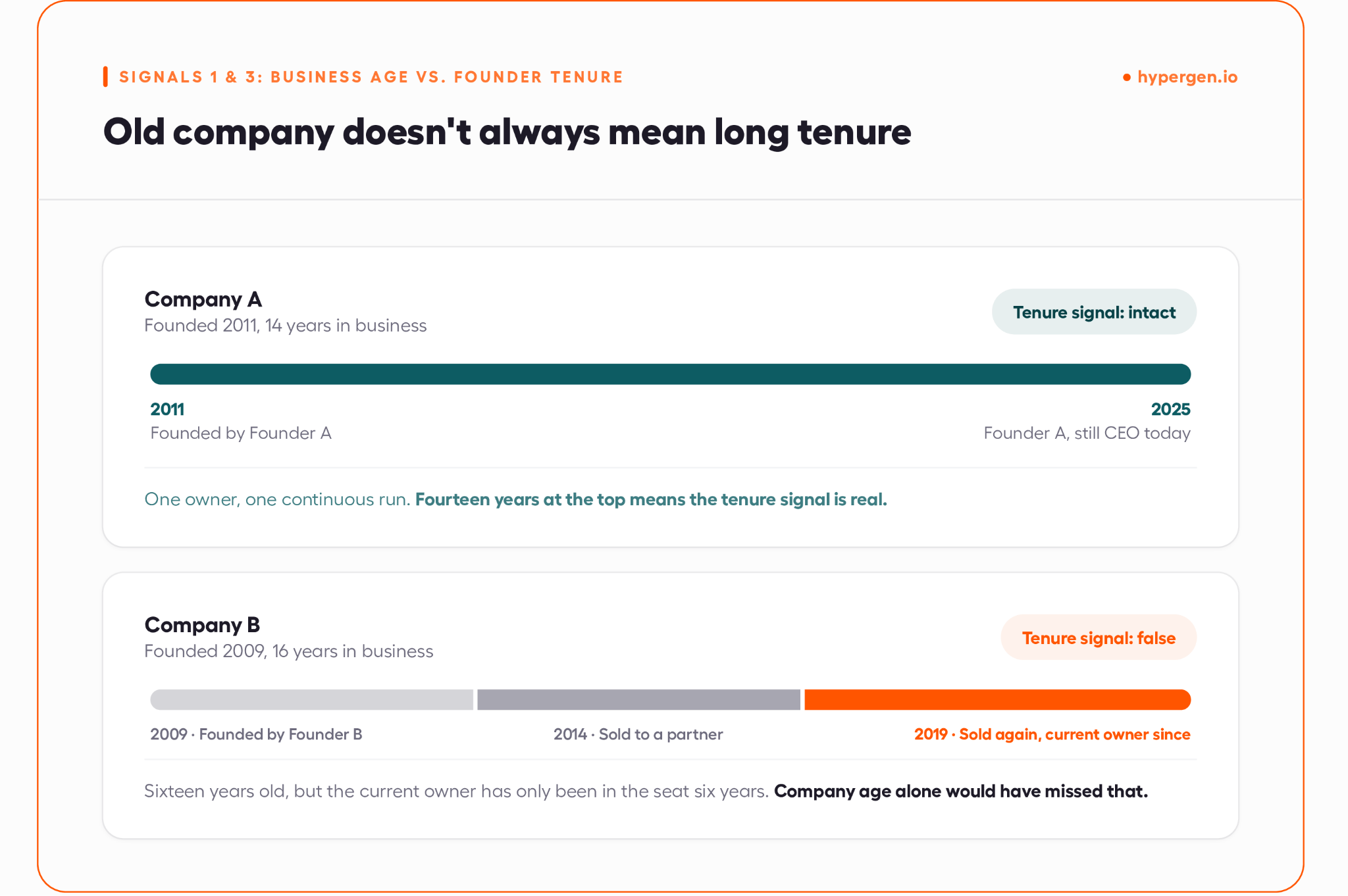
What we're actually watching for is the same person, at the top, for a decade or more.
4. Ownership structure: independent vs. already acquired
This is a simple check with an outsized impact: does the company describe itself as independent, or does it mention being owned by a parent company?
It sounds basic (almost too basic), but it's one of the fastest ways to avoid wasting outreach on a company that's already been through a transaction and isn't a fit for a new one.
The reverse of this signal matters just as much, and it's the part most generic sourcing tools miss entirely.
On a target list we built for a PE client sourcing proprietary buy-side deals, the fund was explicit about scrubbing out anything already PE-backed, since their entire pitch to their own investors was proprietary, un-intermediated deal flow.
A target could show every other exit-readiness signal on this list and still get excluded, purely because its ownership didn't fit that fund's thesis.
🚩 Worth Noting: The "who is NOT a fit" question matters as much as "who is a fit." If a "target list" doesn't ask who to exclude and not just who to include, it likely isn't built on real signals.
5. Headcount trajectory
This signal points in two different directions depending on the deal thesis, which is part of what makes it so useful (and occasionally confusing, if you're not tracking the thesis alongside it).
- A plateau or slow decline in headcount often points to a business that's matured and may be open to a partner or exit.
- Growth in headcount, especially a sudden increase, tends to point the other way, toward a company gearing up for a raise or actively expanding, which makes it a better fit for a roll-up or a capital-raise thesis.
We've built lists reflecting both patterns.
For a sell-side advisory client in the lower-middle market, headcount plateau was one of our core filters, alongside ownership tenure.
For a different client building toward a capital-raise thesis, recent hiring growth was actually one of our inclusion criteria (the exact opposite signal, used to the exact opposite end), since it flagged targets actively expanding and scaling up, which pointed toward a company gearing up for its next round rather than a quiet, mature exit.
6. Recent funding history and expansion activity
A company that raised capital and then went quiet, or one that's suddenly opening new locations, is signaling where it sits in its lifecycle.
For a capital-raise thesis specifically, we weight funding history and expansion news fairly heavily, since they're the clearest public proxy available for revenue momentum.
Now all that covers the six signals, but knowing them is only half the equation, though.
What actually separates a proprietary deal from a bidding war is who's using these signals, and why, and that's where PE and VC start to diverge quite a bit.


How do PE firms use these signals to source off-market deals?
PE firms lean on these signals to build a proprietary M&A pipeline before a formal sale process exists, so they can reach a founder before a banker does.
Once a deal is being marketed, the price climbs and the terms tighten, so the entire logic of signal-based sourcing comes down to one thing: getting there first.
The numbers help explain why this matters:
Global PE deal value reached roughly $2.2 trillion in 2025 (the second-highest year on record), and dry powder heading into 2026 remains substantial, according to Chronograph's 2026 report.
More capital chasing the same pool of quality assets means more competition for off-market deals, which is exactly why proprietary sourcing has stopped being a nice-to-have and become central to how funds win deals outside of a bidding process.
The exclusion filter mentioned earlier is where this really pays off.
A fund running buy-side origination usually isn't just asking whether a target matches its size and sector criteria. It's asking whether the company already has institutional ownership that would make it the wrong fit for what that fund is pitching its own LPs.
That single filter, applied properly, is often the difference between a genuinely proprietary target list and a database export that only looks proprietary.
We saw this firsthand with Winston Dunn, a firm that advises insurance agency owners on M&A transactions, and a client we've worked alongside for over 16 months 🤝.
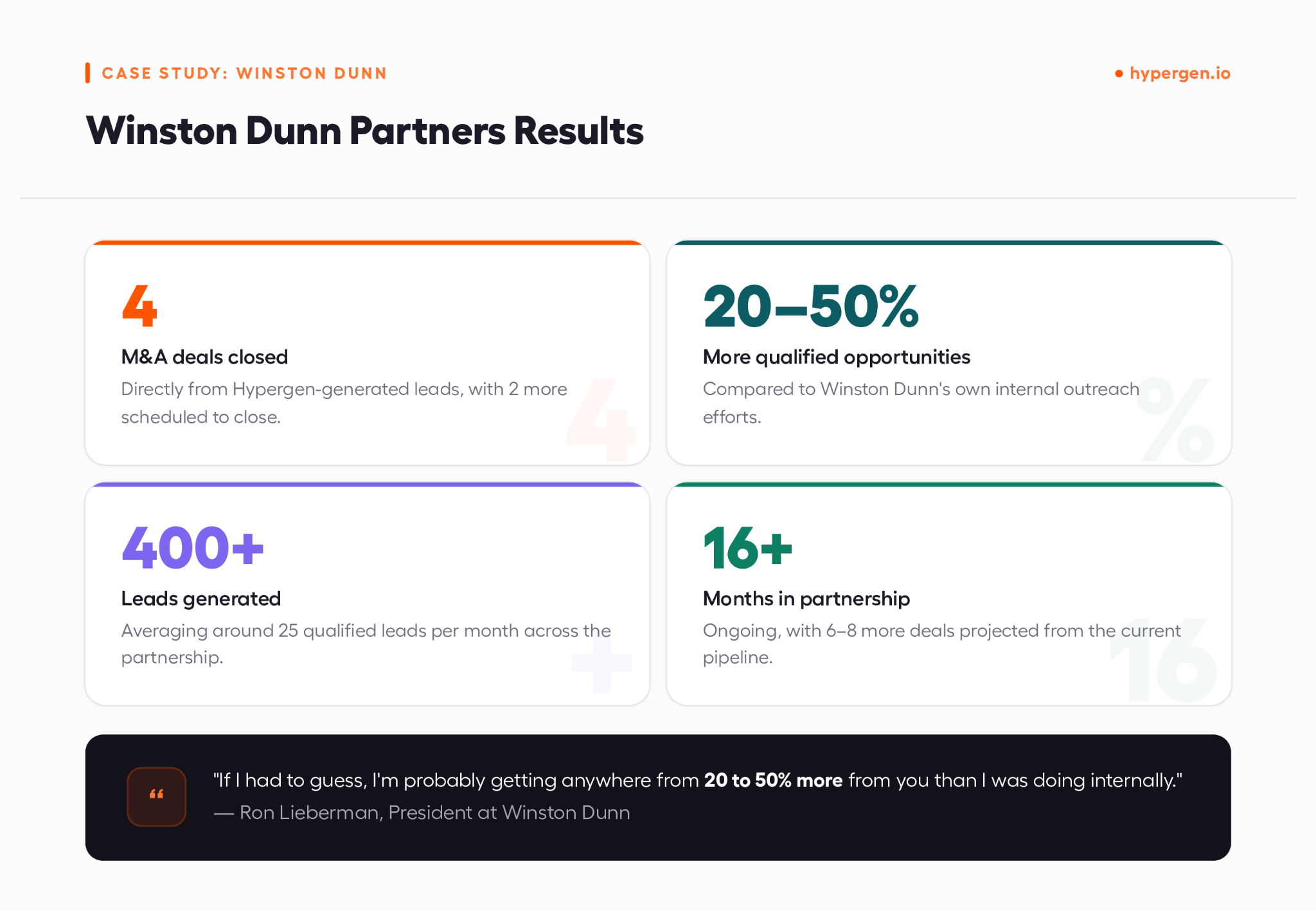
Signal-based outreach tailored to their exact target profile helped them close 4 deals and generate 20 to 50% more qualified opportunities than their substantial internal outreach efforts alone, largely because the names we reached weren't the same ones every other advisory firm in their space had already worked through.
For a deeper look at how proprietary deal flow gets built from the ground up, we cover that here: M&A Deal Sourcing Explained: Step-by-Step Deal Origination Guide.
How do VC firms track similar signals to find opportunities early?
VC and corporate development teams tend to catch these same signals earlier in a company's life, and often for a different reason than a PE fund would.
Rather than hunting an acquisition target directly, they're usually spotting an investment opportunity, one that may eventually become an acquisition (though not always, and not always on the timeline anyone expects).
For corporate venture arms in particular, that early investment often functions like a real option on a future deal.
In 2025, roughly 22% of global VC funding flowed through corporate venture arms, up from around 15% just three years earlier. CVC activity picking up in a sector is often a preview of consolidation 12 to 24 months out, since the strategics investing today are frequently the same companies acquiring tomorrow.
The signal weighting shifts here too, which is worth knowing when building a target list for this type of buyer:
- Funding gaps and product or technology capability tend to get more attention from VC and corporate development teams, since they're closer proxies for investment timing than for exit readiness
- Ownership structure and founder tenure carry more weight in a straightforward PE sell-side search
A company that raised 18 to 24 months ago and has gone quiet since could be profitable and weighing its options, or it could be heading toward a bridge round (two very different situations that look nearly identical from the outside).

It's worth being clear on how this connects back to signal #6: recent funding paired with active expansion is a growth signal, the company is scaling and likely a fit for a buy-side or capital-raise thesis.
A funding gap, on the other hand, is a timing signal. The same underlying data point (when a company last raised) tells you something different depending on whether the money kept moving afterward or the trail went cold.
Either scenario is worth a conversation for a fund watching that space closely. On the exit side, most VC-backed liquidity events end up being acquisitions rather than IPOs, which is exactly why tracking these signals matters just as much for corporate development teams as it does for a traditional PE buyer.
And also worth clarifying: A VC firm tracking M&A signals usually isn't planning to acquire the company outright. More often, it's using the same behavioral cues to decide when to invest, since that timing decision and a later acquisition decision tend to run on parallel tracks.
Now the natural next question, and the one clients ask us most, is how to find M&A leads month after month and track all of this at scale.
How do we track these signals at scale?
Manually checking these signals against a few hundred companies isn't a sourcing strategy, but a research bottleneck.
This is why we built our M&A vertical around Clay tables rather than a document someone updates manually every month. Here's roughly what that setup looks like on our end:
- Prospeo and AI Ark for pulling primary contact data
- Google Maps and reviews for surfacing smaller, less digitally visible businesses
- Direct website scraping, Clay data enrichment, using AI prompts to catch harder-to-find signals like family ownership
The trigger logic underneath is specific.
One prompt might check a company's website and flag whether it mentions being family owned.
Another runs a straightforward pass on whether the business fits a target industry.
A third asks for the company's actual niche in a couple of words, so a residential HVAC company and a commercial HVAC company end up in two separate campaigns with two separate messages (a distinction a basic industry filter would completely miss), even though both would technically fall under "HVAC."

Segment outreach by signal, not just by industry. A family-owned business and a PE-backed company in the exact same vertical need very different messaging, even when their firmographics look identical on paper.
What should you do after identifying a company showing M&A signals?
Once a target shows two or three signals stacked together, the next step is qualification, not an immediate pitch.
A signal firing and a company actually fitting your deal thesis are two different gates, and treating them as the same thing is how a well-targeted campaign turns noisy.
We run this in two stages.
- The first is hard disqualifiers, defined before a single company is scored: already institutionally owned when the goal was proprietary deal flow, a sub-vertical that's technically adjacent but wrong for the thesis, or an existing client conflict.
- The second is a pre-send quality check on the finished list itself, keeping duplicates under 1%, verifying title relevance sits above an 80% match to the actual ICP, and confirming every email before anything goes out.
M&A copy isn't standard B2B copy
The outreach itself has to match the moment as well.
The reader isn't being asked to evaluate a new tool. They're being invited into a conversation about arguably the most consequential decision of their professional life (which, fair enough, deserves a very different tone).
So in practice, applying the right outbound sales strategies here means:
- Writing in the founder's own voice rather than a generic company voice
- Offering an actual valuation instead of explaining what a multiple is to someone who already understands it well
- Avoiding burnout or legacy-guilt framing, which reads as manipulative rather than empathetic to someone who has spent decades building what's being discussed
We cover that more in-depth in how we source M&A deals via cold email, so we recommend checking it out.
We saw this play out with Sutton Capital Partners:
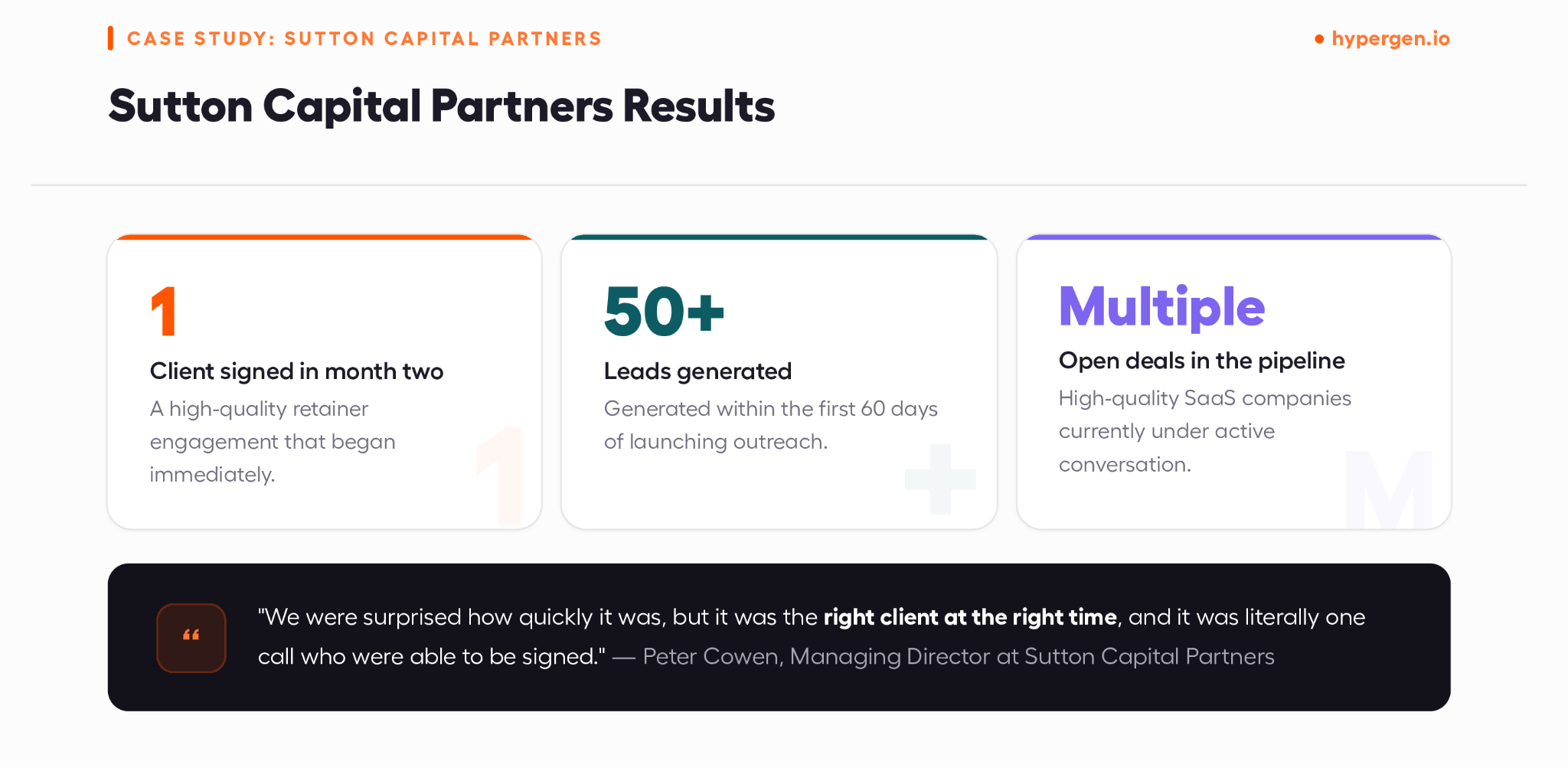
A technology-focused investment bank working with SaaS companies in the lower middle market, where signal-based outreach generated over 50 leads in the first 60 days and led to a signed client at the start of month two.
Also, the speed matters as much as the targeting: a founder replying to a cold message about their own business is usually doing so in a narrow, considered window, and a slow or generic follow-up (even a day or two late) can undo the credibility that first message worked to build.
The best acquisition targets never announce themselves
That's really the whole thesis of this post.
Company age, ownership status, founder tenure, independence, headcount trajectory, funding history, none of these show up in a press release.
It shows up in patterns that are easy to miss unless you're actually looking for them (which is exactly why so many good targets end up going to whoever happens to call first).
If you want to see what a target list looks like when it's built around your actual deal thesis, not a generic industry export with a filter on top, that's exactly what our B2B lead generation services help M&A advisory and PE clients build.
Frequently asked questions
Signal-based acquisition sourcing combines data enrichment tools like Clay, Crunchbase, and LinkedIn with monitoring that flags a company once it crosses a defined threshold, typically two or more signals firing at once. The result is a prioritized, continuously updating target list rather than a static export pulled once and reused for months.
It comes down to three layers working together: a target list segmented by mandate and signal type, automated monitoring that flags new threshold crossings as they occur, and a structured outreach cadence that begins before any formal process starts. Many PE and VC teams hand this entire layer to a specialist M&A lead generation partner so their internal team can stay focused on diligence rather than list-building.
Vetting happens in two passes: hard disqualifiers defined before a company is scored (already institutionally owned, wrong sub-vertical, existing client conflict), followed by a pre-send quality check on the finished list itself, covering duplicate rate, title relevance against the ICP, and email verification.
Growth-oriented targets show up primarily through headcount trajectory and funding activity moving in the same direction: hiring picking up, new locations opening, or a recent funding round paired with visible expansion. That combination points to a company gearing up rather than winding down, which makes it a better fit for a buy-side roll-up or a capital-raise thesis than for a straightforward sell-side search.
Look for specialist outbound and data enrichment firms (not generalist lead gen agencies), they handle M&A target identification best. This work requires building signal logic around a specific deal thesis rather than pulling from a standard demographic list. So look for a firm with active M&A or PE clients, clear exclusion logic (knowing who not to target matters as much as who to target), and ownership of the full process from signal tracking through outreach.
Don’t miss these





Get your first lead this month
14 days to get started. 7 days to get your first lead on average.


