


We find qualified M&A leads every month - here's the exact process we use
TL;DR: How to find M&A leads explained
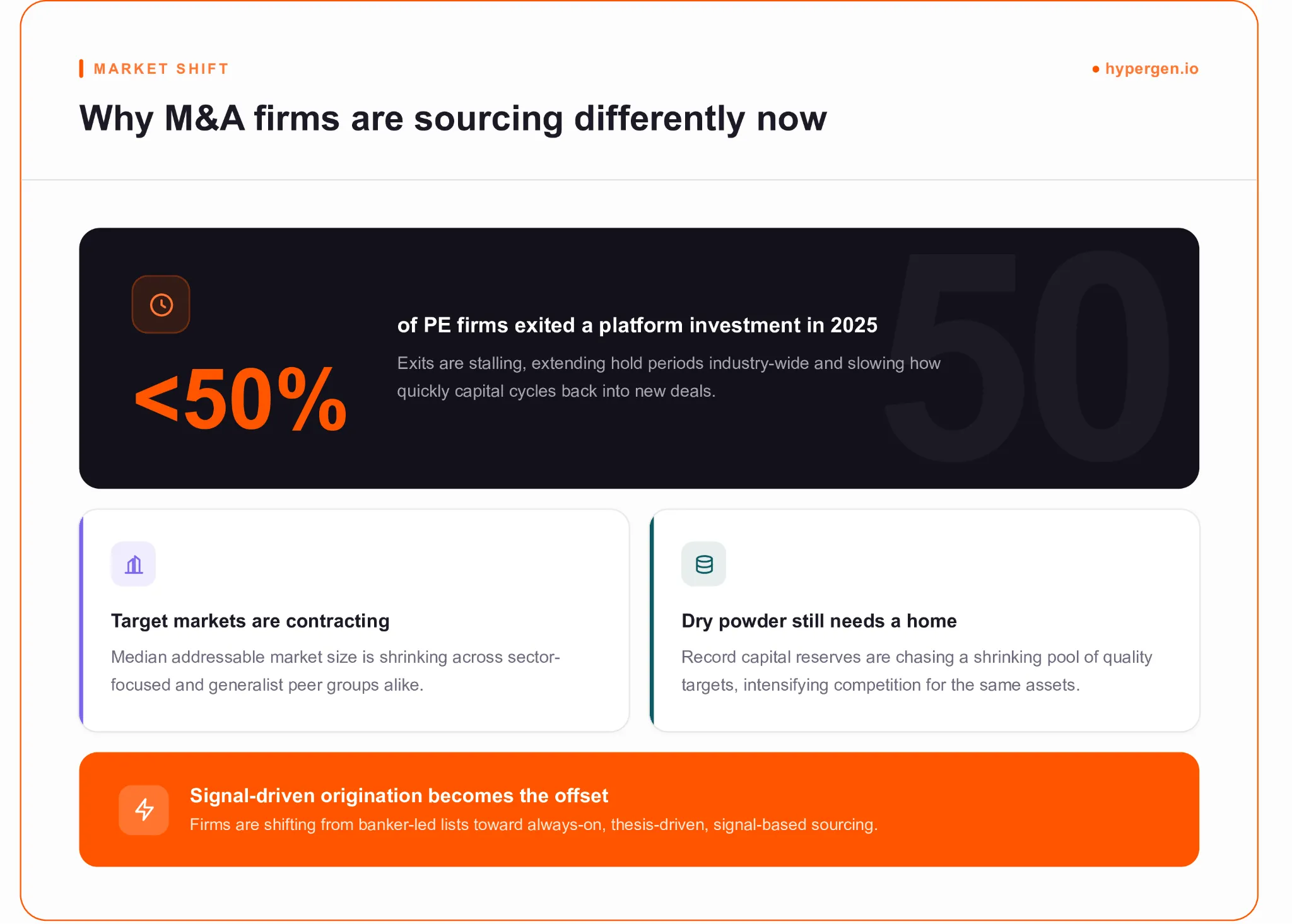
- Referrals move at someone else's pace, not yours. An HBR analysis of nearly 900 VCs found 70% of deals originate from a firm's existing network. 📊
- Signal-based outbound targets a deal thesis, not a demographic. Sell-side, buy-side roll-up, and capital raise mandates each prioritize different signals.
- Exclusions matter as much as inclusions. Scrubbing PE-backed firms or blacklisting known contacts catches noise a demographic filter would miss. 🚫
- Qualification runs in two gates, not one. Hard disqualifiers set at onboarding, then a quality check requires 100% verification before send.
- Skipping the quality gate has a real cost. One account watched meeting-to-proposal conversion fall from 40% to 10% before correction. 📉
- M&A copy opens a conversation, not a pitch. Offering the valuation without explaining the concept respects a reader who knows the mechanics.
- Warm replies have a closing window measured in minutes. The internal SLA target sits under one hour, aiming for 5 to 10 minutes. ⏱️
What happens to your pipeline the month nobody happens to refer you a deal?
For most advisory firms, the honest answer is: not much.
One client we work with put it well during onboarding, admitting that referral flow "surges now, but there's a potential downturn coming in the fall." It's a good problem to have in the good months, but a real one in the slow ones.
That's really the whole case when discussing how to find M&A leads without relying entirely on someone else picking up the phone.
It comes down to three things: build a signal profile around your actual deal thesis, filter hard before outreaching anyone, and move fast when a reply comes back so the moment doesn't pass you by.
We run this exact M&A process every month for our M&A advisory clients, so this post breaks down the how.
Where do qualified M&A leads actually come from?
Qualified M&A leads come mainly from two places: referrals and signal-based outbound.
Referrals are high quality, but they're cyclical and completely out of your control.
Signal-based outbound builds a target list around a specific deal thesis (sell-side readiness, a buy-side roll-up, a capital raise, whatever the mandate is) so your sourcing doesn't live and die by who happens to call this month.
We're not here to tell you referrals are dead. They're not, and honestly, they shouldn't be your only channel either.
An HBR analysis of nearly 900 VCs found that over 70% of deals originate from a firm's existing network, which sounds impressive until you realize what it actually means: 70% of your pipeline moves at the speed of somebody else's schedule, not yours.
And signal-based outbound doesn't try to replace that, but it runs alongside it, on a schedule you control. Instead of waiting for the phone, you're tracking the same kind of liquidity signals private equity teams already watch for (ownership tenure, succession gaps, headcount plateaus) and reaching out before the company ever talks to a banker.

The goal was never just "more leads." It's leads that actually match a thesis somebody already sat down and defined. Volume without a thesis is just noise with better formatting.
👉 A read you'll find interesting: The M&A pipeline explained: Your guide to deal flow in 2026
Okay, so what do these signals actually look like in practice? Let's get specific.
What signals indicate a company is open to acquisition?
Our most honest answer: it depends entirely on the deal thesis.
- A sell-side mandate cares about ownership tenure, succession age, and whether the company has any recent PE backing.
- A buy-side roll-up cares about fragmentation, EBITDA fit, and how close the target sits to an existing platform.
- A capital raise mandate cares about funding history and hiring signals.
This is where a lot of prospecting tools fall short. They hand you a filter for "companies over 10 years old" and call it targeting. But no, that's not a signal profile, but a demographic guess dressed up in a dashboard. 🙃

A regional lower-middle-market advisory client came to us with around 60 referral-driven engagements a year and wanted to scale toward 100. The signal set we built for their sell-side thesis included ownership tenure and succession age, PE-backed status excluded outright, headcount growth, expansion news, and a residential-versus-commercial split.
That last one wasn't decorative. Their prior manual list-building kept pulling staffing firms and consultancies into what was supposed to be a pure construction and trades list (the kind of noise signal-based filtering exists specifically to catch).
Midway through onboarding, the signal priority flexed in real time. A public buyer had raised roughly $750 million specifically to roll up lumberyards in the region, and the client wanted a piece of that deal window before it closed.
That's a textbook case of the signal profile flexing to a specific, dated mandate rather than a static ICP: the priority signal for that slice became "owns a lumberyard, EBITDA-fit, hasn't already sold" over the standard trades/HVAC signal stack, because the acquisition window was closing.
📌 Worth clarifying: sometimes the most valuable signal isn't an inclusion, it's an exclusion.
Take one PE buy-side origination fund we've worked with: their entire target universe was built around scrubbing out PE-backed firms entirely, because their pitch to LPs depends on proprietary, un-intermediated deal flow.
A company could fire every exit readiness signal in the book and still get disqualified, purely because the ownership structure didn't fit that fund's thesis.
Here's a quick cheat sheet for how signal priority tends to shift by mandate:
And look, we'll be upfront about this: it's not "we track 40 signals and pick 6 that sound good." It's closer to reverse-engineering signal-based prospecting around a client's actual buy box, including the things that should explicitly stay off the list.
That exclusion logic is usually the part prospects don't expect, and honestly, it's the clearest proof this isn't spray-and-pray with a fancier filter added on top.
👉 We recommend checking out: M&A deal sourcing explained: Step-by-step deal origination guide
Alright, signals fired. Now what?
A fired signal doesn't automatically mean a company belongs on your outreach list, and that's a really important distinction.
How do you qualify a company as an acquisition target?
A fired signal and a deal-thesis fit are two completely different gates, and mixing them up is exactly how a "targeted" campaign quietly turns into a noisy one.
Qualification runs in two stages: hard disqualifiers defined before a company ever gets scored, and then a mechanical quality gate applied to the finished list right before anything goes out.
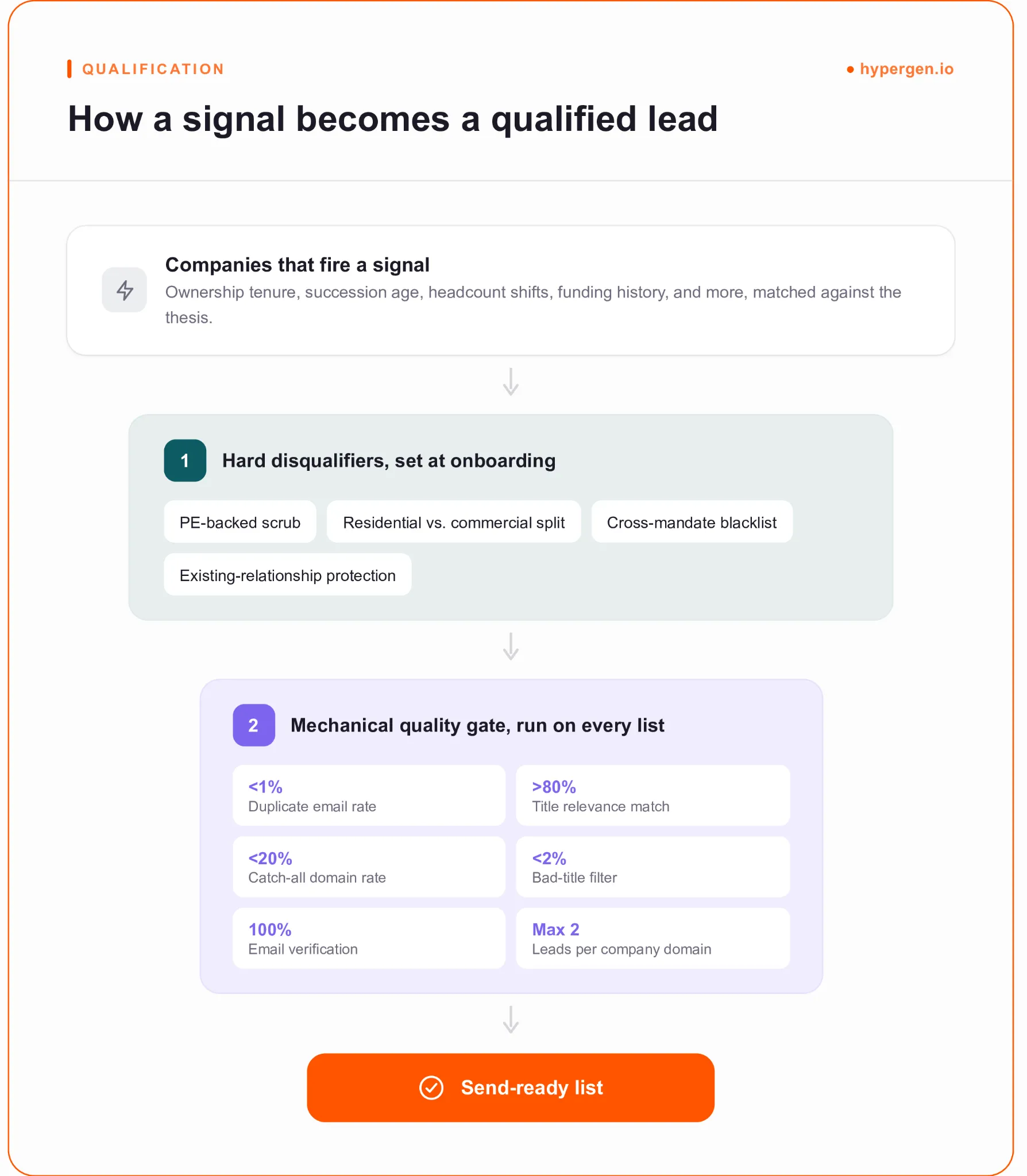
- Stage one happens at onboarding
Every intake conversation we run asks two questions: who IS a perfect customer, and who is NOT.
The second question is where the real filtering logic lives and it's the part a generic database tool just can't replicate, because it requires knowing why a specific client buys, not just what SIC code a company happens to sit under.
If your current targeting process only answers "who fits," you're missing half the filter. The exclusion list matters just as much as the inclusion criteria. Sometimes even more.
A few real exclusions we've built:
- The PE-backed scrub mentioned above, for the buy-side fund that wanted proprietary deal flow only
- A residential-versus-commercial split, to keep staffing and consultancy firms out of a construction search
- Cross-mandate blacklists, so the same investor never gets contacted twice across two separate mandates for the same client
- Protection for existing relationships, which one client put plainly on a reconnect call: "for blacklist and exclusions, we don't want to start pinging clients or people [they already know]."
- Stage two is a mechanical quality gate
And this one runs on every finished list before it ever touches an inbox:
- Duplicate email rate under 1%
- Title relevance above 80% match to the defined ICP
- Catch-all domain rate under 20%
- Bad-title filter (interns, coordinators, students) under 2%
- 100% email verification, no exceptions
- Max 2 leads per company domain, unless it's an explicit account-based play
Verification happens per company here too, not as some average across the whole list, because database industry codes are wrong more often than you'd think.
That means checking the real industry straight from the company's own website, confirming family or founder ownership through the founder's name and how long the company's been around, and scrubbing PE-backed firms one at a time instead of trusting a filter field to catch it for you.
The exclusion list existed, it just wasn't catching everything before send. Meeting-to-proposal conversion dropped from 40% down to 10% before the account was rescued by a full SDR-as-a-service pivot.
Because a signal firing on a company doesn't automatically make it a high-quality lead. That's exactly what stage two is for.
Standard onboarding runs three to four weeks: lists get sent for approval, blacklists get confirmed, copy gets reviewed, and then everything gets iterated on weekly.
Once the list is clean, it's time to actually put everythinginto motion. Here's what that looks like month over month.


How to build a monthly M&A lead generation process
The process runs in four stages: build the thesis-specific signal profile, run it through the disqualification and quality gates, launch outreach that's written for the weight of what's actually being asked, and route every warm reply into CRM within minutes of it landing.
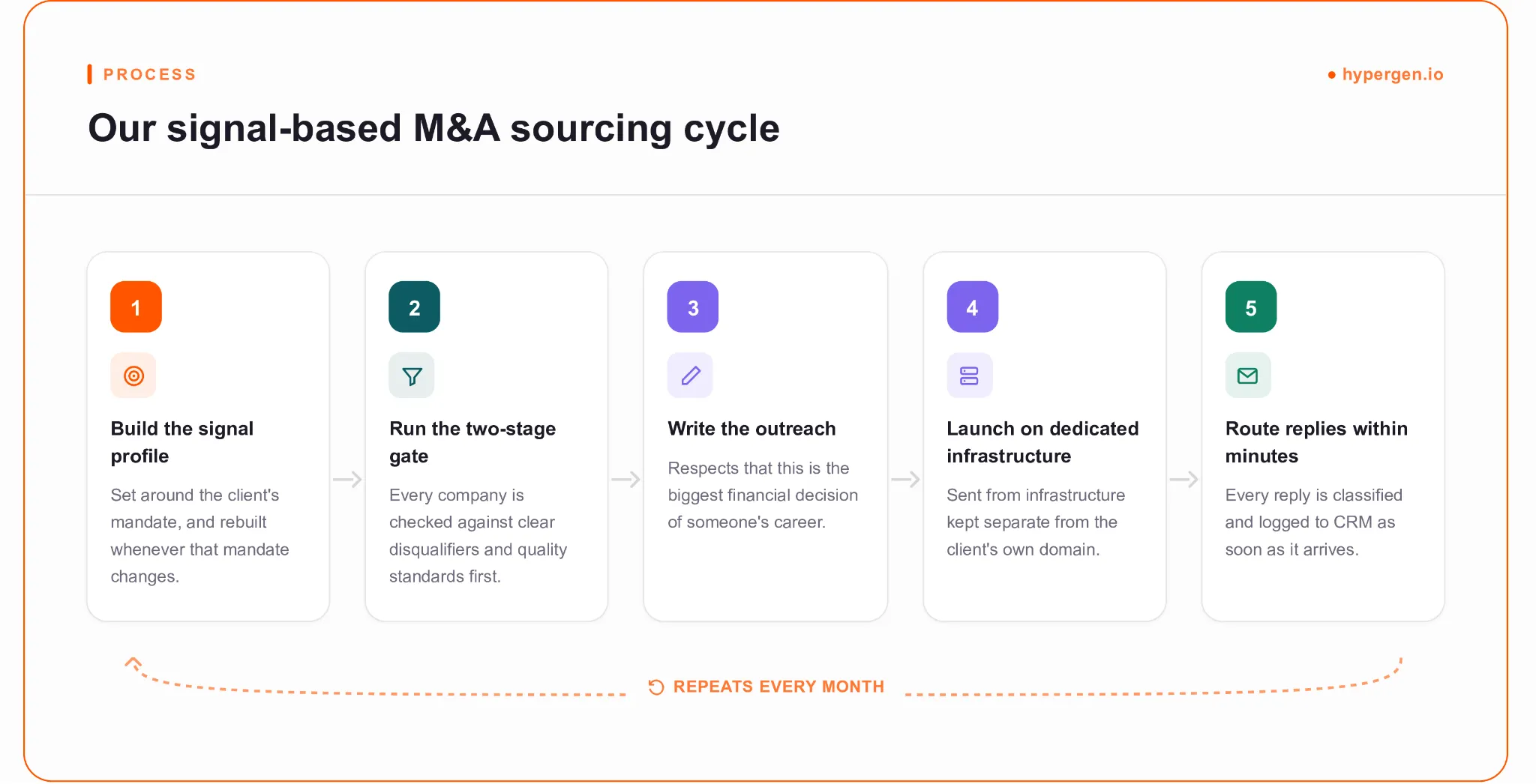
- Build the signal profile around the client's specific mandate. Redone whenever the mandate shifts. Never templated once and reused across every client.
- Run the two-stage qualification gate before any name enters an outreach list.
- Write outreach for someone being approached about their life's work, not someone comparing vendors.
- Launch on dedicated, compliant cold email infrastructure, kept completely separate from the advisor's brand domain.
- Route and log every warm reply within minutes of it being classified.
Response volume tends to build predictably once this is actually running: 5 to 10 replies in month one, 10 to 15 in month two, 15 to 20 or more by month three as the sequences mature.
First signed engagements usually land somewhere in months 3 through 6. This is M&A pipeline building, not a quick win, so anyone promising you overnight deals is selling you something else entirely.
Why M&A outreach copy is different
SaaS and agency copy sells a decision. M&A copy opens a conversation about the single most consequential financial event of someone's professional life, and it has to read that way without ever saying it outright.
The buyer here isn't evaluating a tool. They're being approached about their life's work. That’s why our internal tone target for this audience is a successful advisor at a dinner party.
Relaxed. Specific. Credible. Not selling.
That's a completely different register from the "peer who just switched software tools" voice that works perfectly fine for SaaS outreach.
Here are a few rules we hold ourselves to that most generic B2B templates completely miss:
- Don't over-explain.
"Offer the valuation, don't explain the concept" is a hard internal rule for us. A 60-year-old who spent 20 years building a $20M company already knows exactly what a multiple is. Explaining it just reads as condescending, not helpful.
- Match the case study to the world the reader actually lives in.
A manufacturing case study dropped into a staffing owner's inbox is a mistake we see often, and it's an easy one to make, since the deal itself might be genuinely impressive on paper. But it still backfires, because it signals a lack of understanding of the reader's actual world.
- Write like a person, not a company.
A first-person line like "I run a boutique M&A firm" consistently lands better than "We are a boutique M&A firm." The premise behind this kind of outreach is one principal reaching another, so that shift in voice is doing real work.
- Never lean on emotional manipulation.
Phrases like "you built this baby" or burnout and exit-fatigue framing are banned internally, and we call them out plainly as "too negative." A founder weighing a sale is already carrying a lot emotionally. Copy that leans into that reads as manipulative, not empathetic, and founders can smell it a mile away.
There's also a compliance layer that most B2B outreach never has to deal with. A lot of M&A and investment banking prospects are FINRA or SIPC-regulated buyers themselves, which means the outreach itself carries real recordkeeping exposure.
FINRA Rule 3110 requires member firms to supervise and retain business-related communications, emails included, and that obligation doesn't magically disappear just because the message came from an outbound campaign instead of an actual client conversation.
On one engagement with a broker-dealer-supervised client, their compliance team set explicit parameters around content, approvals, disclosures, and archiving before a single email went out, and they told us directly they'd handled FINRA-regulated engagements like this plenty of times before.
For a licensed advisor, that's not a footnote tucked at the bottom, but a part of the actual deliverable.
👉 We go deeper on this here: We source M&A deals via cold email - here's the full playbook we use for deal teams
How replies get routed into pipeline
Every reply gets classified into a category the moment it lands, then triggers an instant notification and a CRM record at the same time.
Replies get sorted into clear buckets:
- ASKING_FOR_CALL
- MORE_INFO
- REFERRAL
- POSTPONED
Аll count as positive, plus a separate "soft no" bucket to distinguish a polite decline from a genuine "maybe later." That distinction exists because clients wanted cleaner segmentation for retargeting later, not just a flat yes-or-no.
The notification fires the moment a reply is classified, landing in whichever channel the client actually checks (Slack, email, Teams). RevOps automation logs that same reply into CRM in parallel, not afterward.
HubSpot ends up being the source of truth for most clients; for Salesforce or another platform, we build the same logic through Zapier.
The actual internal SLA target, pulled straight from a real sales sync, reads: "Align on SLA for inbound response (<1 hour; aspire to 5–10 minutes) and tighten HubSpot dispositions and ICP filters."
That's the standard we hold our own SDR motion to internally, and it's the exact same standard we push to every client, because a founder who took 90 seconds to reply to a cold email is sitting in a decision window that closes fast.
Follow up a day later, and you're often re-selling interest that already peaked.
That window matters more in M&A than almost anywhere else in B2B. A founder replying "tell me more" about their own business is usually doing it in a quiet, considered moment, reviewing the message after hours, thinking about succession, quietly testing the market without telling anyone yet.
A slow or generic follow-up doesn't just lose momentum here, but it can read as exactly the kind of impersonal mass outreach the founder worried this was to begin with, undoing the credibility the original message worked to build.
So, all of that gets you a working process.
But there's still the question every skeptical advisor eventually asks: how does this actually compare to the referral network the firm already has?
Signal-based vs. referral-based M&A sourcing: what works better?
Neither one replaces the other, full stop.
The objection advisors raise almost never sounds like "cold email doesn't work." It's brand risk and a narrow-TAM quality concern, and what resolves it isn't a persuasive pitch. But scoping volume to the firm's real quality bar and proving no reputation damage shows up.
One boutique Food & Bev banking team is the clearest example we have of this: three managing directors, entirely referral- and event-driven, with no systematic outbound before working with us.
And two concerns came up on the very first call, and they're the same two concerns you'll hear from most skeptical firms:
- Volume mismatch. Their addressable market for large F&B transactions is genuinely narrow. They said outright that something like 7,500 contacts a month "doesn't map to their addressable market or quality." The fear wasn't abstract spam anxiety. It was running out of legitimate targets and burning the ones that actually mattered with a generic blast.
- Deliverability and domain risk. They'd watched other firms in the space wreck their email domain reputation running outbound through generic tools with zero infrastructure discipline. For a relationship-driven, regulated business, a damaged sender reputation isn't just a metrics headache. It shows up right in front of the exact referral network they depend on.
What actually changed their opinion wasn't a sales pitch, but scoping send volume and targeting precision down to their real addressable market ($30 to $50 million in enterprise value, a narrow F&B sub-vertical), paired with dedicated infrastructure and compliant archiving kept completely separate from their brand domain.
The regional advisory client from earlier in this post summed up the actual business case better than any pitch deck ever could: referral flow is inherently lumpy, and there's no lever anywhere to smooth it out.
And that's not an argument for ditching referrals, but the argument for having something else running in parallel.
Once a properly-scoped signal-based campaign starts landing qualified, on-thesis conversations without any brand blowback, the objection tends to just... resolve itself.
Turns out the thing advisors were actually protecting (their referral network's perception of them) was never really at risk to begin with.
The best lead is still a warm one. It's just not a reliable one.
Nobody's telling you to stop picking up when a referral calls. That's still your best lead, full stop, and that's not changing anytime soon.
What actually needs fixing is everything in between: the slow stretches where nothing's coming in, not because anyone did anything wrong, just because nobody happened to call that week.
That's the part signal-based outbound solves. It doesn't compete with your network or try to outdo it.
It just means something's quietly running in the background on your own schedule, so a slow month stops turning into an empty one, and your pipeline stops depending on someone else's timing.
Frequently asked questions
Most M&A deal teams source primarily through referrals from their professional network and relationships with bankers and brokers. A growing number are adding signal-based outbound as a supplemental channel, not a replacement, because referral flow is cyclical and gives firms no lever to smooth out slow periods. Signal-based outbound is typically scoped to add four to eight signed engagements a year on top of existing referral flow.
An end-to-end process includes building a signal profile around the specific deal thesis rather than a generic template, applying hard disqualifiers before any company is scored, running a mechanical quality gate on the finished list, launching outreach written for the emotional weight of the ask, and routing every warm reply into CRM within minutes of classification. Skipping the disqualification or quality-gate stages is the most common cause of a targeted list turning out noisy in practice.
RevOps makes sure a warm reply gets classified, logged in CRM, and routed to the advisor within minutes, not hours. The internal standard is under one hour, with five to ten minutes as the target, because a founder replying to a cold email about their business is often doing it in a narrow, private window of attention that closes fast. Without this infrastructure, replies get handled inconsistently and responses often arrive too late to matter.
M&A outreach needs dedicated sending domains separate from the advisor's brand domain, full authentication, and for FINRA or SIPC-regulated buyers, compliant archiving and pre-approval workflows for outreach content. This matters more in M&A than most B2B contexts because a damaged sender reputation is a brand problem in front of the exact referral network the firm depends on.
Yes. Every positive reply needs a CRM record created in parallel with the advisor notification, not after a human manually re-types it. When they're handled separately, replies sit untracked, response time slips past the window when a founder's interest is highest, and there's no attribution connecting which signals or targeting decisions are actually producing engagements.
Don’t miss these
.avif)




Get your first lead this month
14 days to get started. 7 days to get your first lead on average.


