

Our clients close 12-month deals with cold email – Here's the exact framework
TL;DR:
- Cold email does not close enterprise deals, it opens them. Its job is the first qualified meeting, but the sales motion handles everything after.
- Enterprise software deals average 9 to 18 months end-to-end. Running SMB-length sequences against that timeline is where most long-cycle campaigns fail.
- Every email in a long-cycle sequence needs a different angle and CTA. Repeating the same message after no reply is noise, not persistence.
- Day 1 emails cap at 75 words, plain text only. Anything formatted like marketing gets filtered before a decision-maker ever reads it.
- Signal-based targeting finds accounts inside their buying window. Leadership changes, tech stack shifts, and SDR hiring surges each flag an active vendor evaluation.
- ICP fit and buying readiness are not the same thing. Two matching accounts can differ by 12 months in their actual evaluation timeline.
- RevOps determines how much cold email pipeline actually reaches a close. In enterprise, hours of response delay can hand the deal to whoever moved faster.
The reason most cold email campaigns fail at enterprise accounts isn't the copy or the sequence. It's that the team running them expects the channel to behave like it would for a 45-day SMB deal, and enterprise buying doesn't work that way.
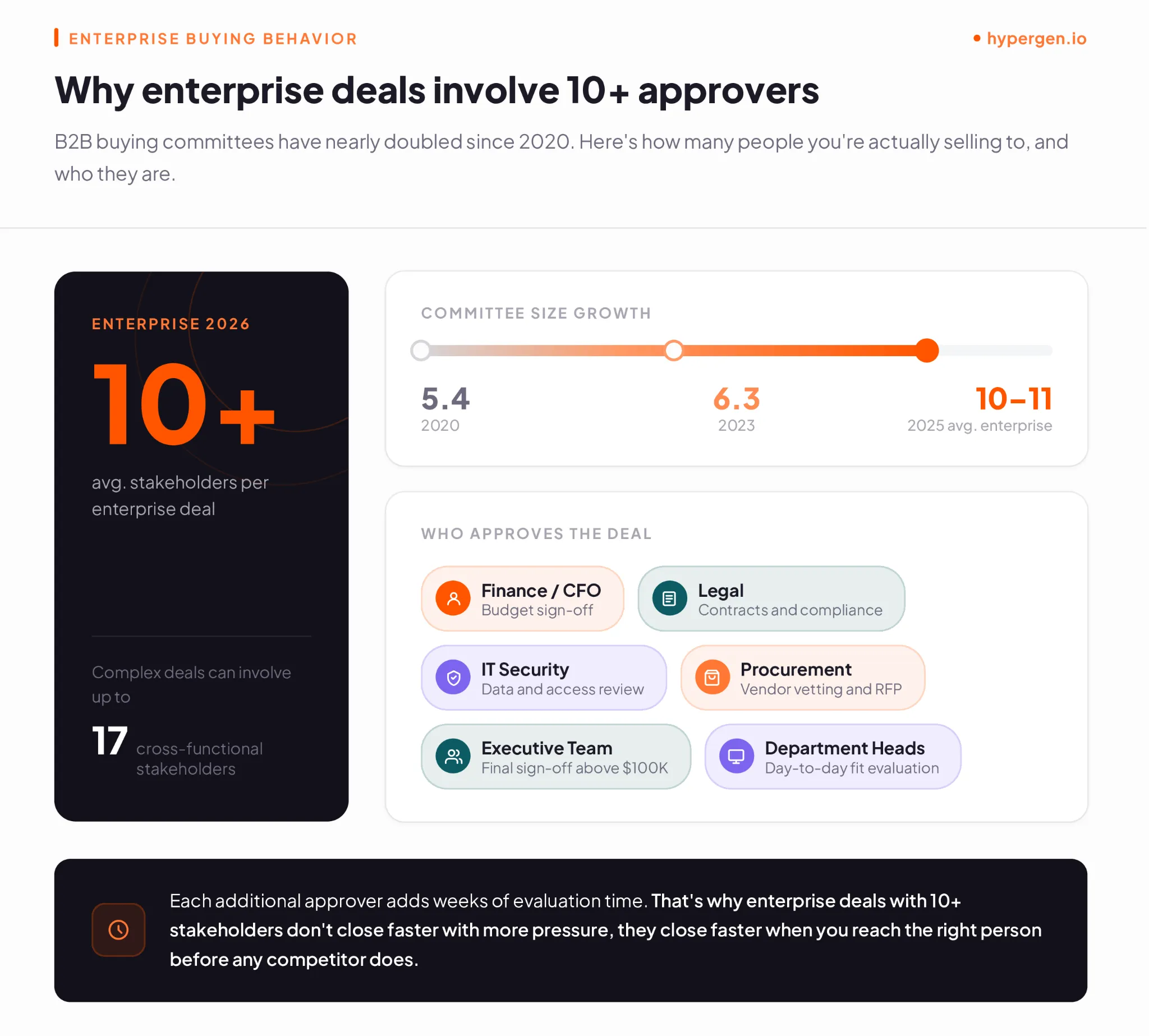
Enterprise software deals now average 9 to 18 months end-to-end, with buying committees that include legal, procurement, and a CFO who needs a full business case before anyone signs anything.
And cold email doesn't compress that timeline.
What it does is put you in front of the right stakeholders before anyone else does, and keep you there long enough for the timing to shift in your favor.
We've built that system for clients across industries, so here's the exact framework.
Does cold email work for long B2B sales cycles?
Yes when it's used to start the conversation, not close it. Cold email's job in a long sales cycle is to generate the first qualified meeting. Everything from there is a sales motion.
And the fatal mistake is treating enterprise like SMB.
If your time-to-close expectation is 45 days, you're not running an enterprise strategy. You're running SMB logic at enterprise accounts and wondering why the numbers don't add up.
The reality is different: According to Optifai enterprise deals above $100K regularly run 90 to 180+ days from first contact to signature. And enterprise software deals specifically now average 9 to 18 months end-to-end (Aexus, 2025).
Buying committees involve an average of 6.8 stakeholders (up from 5.4 in 2020).
So there's legal.
There's procurement.
There's a CFO somewhere who needs a business case.
So before your cold email can become a signed contract, it has to move through every one of these people.
And cold email doesn't solve that complexity. But it puts you in the room before anyone else does.
The clients who close these deals use B2B outbound lead generation as the entry point not the entire motion. They treat cold email as the top of a funnel that runs for months, feeds the CRM continuously, and tells them what's working everywhere else.

Take Blings.io for example. They came to us for US enterprise market entry with zero existing relationships in the market. We ran cold email as the core channel, and they closed three enterprise deals in six months with an 8X ROI.
Did cold email close those deals? No, their sales team did.
But cold email opened the door and made those conversations possible in the first place.
Bottom line: Cold email starts conversations at the top of a very long funnel.
So the channel works, but the expectation of what it should produce and when is usually what doesn't.
👉 Here’s a read you’ll definitely find interesting: 20 top ways to generate high-quality B2B sales leads
How we structure cold email sequences for 12-month enterprise sales cycles
For a 12-month enterprise sales cycle, we structure cold email sequences so every email carries a different CTA and a different angle. No repeat touchpoints, ever. This means each email advances the conversation one step forward. Day 1 caps at 75 words, plain text only, and every follow-up brings something genuinely new or the sequence ends there.
That's our non-negotiable foundation. Here's how it breaks down in practice:
- Day 1 email: Hard cap at 75 words. Plain text only: no links, no images, no HTML formatting. If you can't make the case in 75 words, you haven't found the right angle yet. (Anything that looks like marketing gets flagged as spam before a decision-maker ever sees it.)
- Every follow-up after no response: Different angle, different CTA, something genuinely new. Simple rule: if you can't bring a fresh piece of value to the next email, the sequence is already long enough.
- Copy framing: The people you're emailing aren't confused about their business. They've been running it longer than you've been contacting them. The email that wins doesn't explain their problem back to them, it jumps straight to what becomes possible when that problem is solved. So write to someone's ambition, not their anxiety. Enterprise buyers respond to opportunity, they don't respond to pressure.
- Tone: Your prospect built something. They lead something. They've earned the right not to be lectured about their own category by someone who's been in their inbox for three days. So skip the diagnosis, get to the part where you make their goals easier to reach.
That structure is what our cold email campaign management is built around.
For context, according to Saleshandy, enterprise sequences need 5 to 7 touches spread over 30 to 45 days per outreach window, not per campaign lifetime. And a 12-month campaign is multiple windows, each triggered by a new signal or a re-engagement event.
Now, here's where most agencies leave serious performance on the table: personalization.
Cold email personalization tied to a specific signal is what generates replies from people who delete everything else. Generic "I noticed you're hiring" lines are table stakes. "I saw you brought on a new CRO last month and you're expanding mid-market" is what actually lands.
Beyond good email segmentation, by deal stage and engagement level matters more than most agencies admit.
The message for a prospect who opened your first email twice but never replied is completely different from the one going to someone who's never engaged.
Treating them the same way is a volume play dressed as a strategy. (And yes, we've seen this cost companies months of pipeline momentum. It's a painful and very preventable mistake.)
The sequence structure handles what you say and when you say it. But there's a layer underneath all of that and that’s deliverability.
How we protect inbox placement for long sales cycles
We protect inbox placement across a long campaign by running entirely dedicated sending infrastructure: secondary domains, separate inboxes, warm-up protocols, SPF/DKIM/DMARC configuration, and continuous monitoring.
We never send from the client's main domain. Not once, not even to test.
And here's why this is non-negotiable: most cold email campaigns don't fail because of bad copy. They fail because the sender reputation degraded quietly while no one was watching.
A domain that starts at 98% inbox placement can collapse to 40% by month four if no one's actively managing it.
Our own benchmark is 98.2% inbox placement, maintained consistently across thousands of sends per day. Achieving that requires dedicated cold email infrastructure built specifically for outbound volume, not a shared setup riding on the company's main domain.
📚 For the complete setup guide, our cold email deliverability best practices covers the exact configuration we recommend before any campaign goes live.
With the sequence structure and infrastructure locked in, the next question is: who are you actually sending to?
And more importantly when?


How we target enterprise prospects to reach them inside their buying window
We find enterprise prospects inside their buying window by targeting on timing, not demographics. The signal stack we monitor: leadership changes, tech stack shifts, hiring patterns, and competitor mentions.
And here's the thing about ICP targeting alone:
Two companies can match your ideal profile exactly and have nothing in common in terms of readiness.
- One just brought in new leadership and is reshuffling vendor relationships.
- But the other has had the same team for four years and isn't evaluating anything.
And firmographics don't tell you which is which. But signals do.
The signal stack we use to time enterprise outreach
Each of these signals points to internal change, and internal change is when vendor evaluations happen. A company that's stable and predictable isn't evaluating anything.
But a company that just reshuffled leadership, expanded headcount, or switched tools is actively rethinking how it operates, which means they're open to conversations they wouldn't have entertained six months earlier.
Here’s the signal stack:
Building a quality lead list for cold emailing is what makes everything downstream much more efficient. Contract renewals, new budget cycles, post-funding hiring surges: if you know what to monitor, you can show up at exactly the right moment.
This is why we use Clay-powered signal prospecting to track these triggers across hundreds of data points simultaneously.
We segment all enterprise targets into three tiers:
- Full ABM: Top 50 accounts. Deep research, coordinated multi-touch, fully aligned with sales before a single email goes out.
- ABM-lite: The next tier. Personalized, signal-triggered, but less manual customization per account.
- Scaled cold outreach: Everyone else. Still signal-triggered, just not hand-crafted per contact.
So everything we've learned from running B2B lead generation at scale points to the same place: the targeting layer is where most campaigns win or lose before a single email is sent.
Always coordinate with your sales team before any campaign launches. One of the fastest ways to burn a warm prospect is to have three people from your company contact them about three different things in the same week.
Because enterprise buyers notice. And worse, they remember.
This framework assumes you already know who you're going after.
But if your ICP still relies on job titles and company size without a signal layer on top, our guide on 9 еffective outbound lead generation tactics covers how to build a target list that's actually worth running a 12-month sequence against.
And for teams running cold email alongside LinkedIn, cold calling, or ABM, the outbound sales strategy guide shows how the channels fit together.
With all that said, even the most precise targeting in the world means nothing if warm replies disappear into a broken pipeline.
Which brings us to the layer most agencies completely overlook: RevOps.
Why cold email without RevOps loses enterprise deals
Cold email without RevOps leaks pipeline because there's no system to catch warm replies when they come in. In a 12-month cycle, a positive reply that waits four hours for follow-up is a deal handed to whoever responded first.
And RevOps is the layer that routes every warm reply before the window closes. But a lot of cold email agencies stop at the reply.
And the reply is only the beginning.
What happens to warm enterprise replies without a routing system
Without a reply routing system, warm enterprise replies wait in inboxes until someone notices them, which is usually too late. The context that prompted the reply is no longer front of mind, and the window to capitalise on it is already closing.
To get this straight: speed of response isn't a courtesy in long-cycle enterprise deals, but a competitive advantage.
Think about what happens 4-5 hours after an enterprise buyer responds. They've moved on to their next meeting, their inbox has 40 more messages in it, and the moment that made them reply… is gone.
A good RevOps pipeline management is what creates that system. Specifically:
- Reply routing: Every positive reply goes into CRM immediately, not at end-of-day.
- Follow-up triggers: Workflows fire the moment a contact hits a re-engagement threshold.
- Signal cross-referencing: Old contacts who show new buying signals get flagged automatically, not manually discovered weeks later.
And that last one is where most teams leave serious pipeline on the table, so let’s explain what we mean:
A contact from eight months ago who just changed roles or expanded their team isn't a dead lead. They're a warm one with fresh context. So without RevOps in place to surface that automatically, those opportunities stay invisible indefinitely.
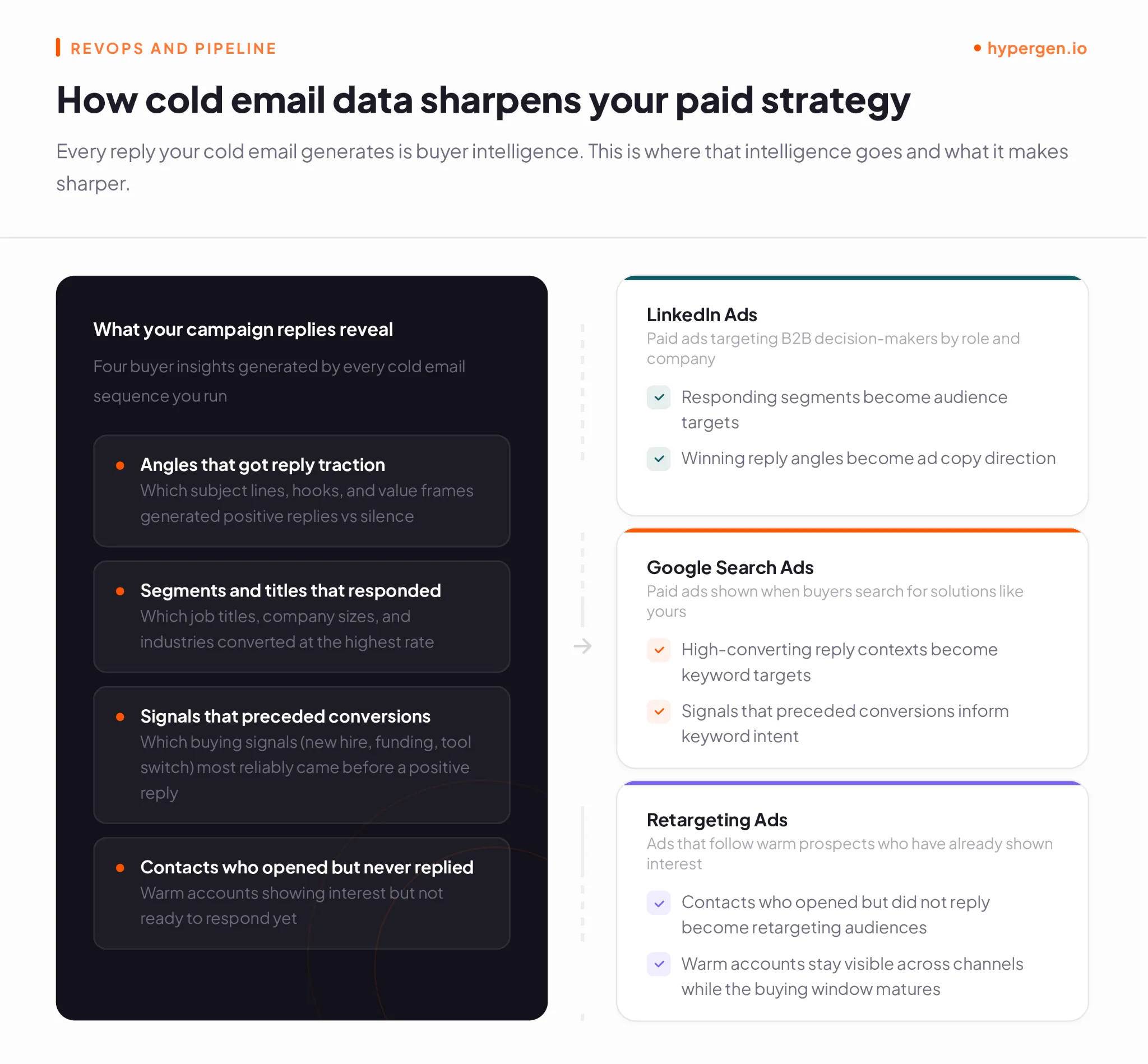
Every reply your cold email generates is a signal about what's resonating, with whom, and under what conditions. Which means that data doesn't belong in the cold email channel alone.
The angles getting traction, the segments responding, the signals that preceded conversions: that's the input for your paid LinkedIn and paid search strategy.
Bottom line: RevOps doesn't close deals, it makes sure warm replies don't die in a sending inbox before the sales team ever sees them.
But what happens after the routing (how the team tracks, manages, and re-engages that pipeline over 12 months) is a CRM problem, not a RevOps one.
How we use your CRM to keep long-cycle pipeline visible from first touch to close
A properly configured CRM keeps a long-cycle pipeline visible by connecting every cold email interaction directly to the deal record. So when a prospect opens, replies, or re-engages after a quiet stretch, the sales team sees it in real time, not weeks later when the moment has already passed.
Without that connection, a 12-month campaign is a lot of activity with no shared memory. With it, every touch, every signal, every re-engagement event is in one place, and the team can act on it in real time.
Here's what a properly connected CRM does that a disconnected one doesn't:
Why a clean CRM is non-negotiable before a long-cycle campaign
A CRM that hasn't been cleaned doesn't reflect what's actually moving in your pipeline. It reflects what was entered, which is a different thing entirely. And for a 12-month campaign, those are not the same thing.
And what is the most common problem we inherit? Yes… a messy CRM.
Duplicate contacts. Contradicting deal stages. Reps working around the system instead of in it. (We've seen some CRMs that were... let’s say it creative. And it's always fixable, but it's always slower to fix than to prevent.)
Before any long-cycle campaign launches, audit your CRM for deals that stalled in the last 6 to 12 months.
Cross-reference them against new buying signals on those same accounts.
Often the best re-engagement pipeline you have might already be sitting in your closed-lost folder.
If you quit at month two, someone else closes the deal
Every component in this framework, from the signal stack to the sequence structure to the RevOps layer, exists to solve the same underlying problem: keeping the right deal in motion long enough for the timing to work in your favor.
And what most teams miss is that enterprise buying decisions rarely accelerate. They shift.
A prospect who went quiet in month four often re-engages in month eight because something changed internally, a new executive, a budget cycle opening, a competing vendor that didn't deliver. The system we've described is built to catch that moment rather than miss it.
Because enterprise is a long game.
We've been playing it with our clients for years, and we can proudly say we're genuinely good at it. So if your enterprise pipeline needs a system that runs as long as the cycle does, we should probably talk.
Frequently asked questions
Continuously. Enterprise deals average 90 to 180+ days, and a prospect who goes quiet in month three can re-engage in month nine when a new budget cycle opens. Campaigns with fixed end dates miss the deals that needed more time.
Four signals indicate active evaluation: leadership changes (new VP of Sales or CRO), tech stack shifts, SDR hiring surges, and competitor mentions. A company showing three or more simultaneously is in-market right now, not just a strong ICP fit.
When a new signal fires: a leadership hire, a funding announcement, or a competitor review. A fresh signal gives you a specific, relevant reason to reach out. Without one, re-engagement reads as a follow-up for its own sake.
Yes. We ran cold email for Blings.io's US enterprise market entry and closed three deals in six months with an 8X ROI. The key was building sequences that stayed relevant across multiple buying stages, not just the initial outreach window.
Track cost-per-meeting as your primary KPI, not closed revenue. Use cohort analysis to follow each campaign's leads through to close. And connect cold email touches to CRM deal records so attribution holds across the full 12-month window.
Don’t miss these
.avif)

Get your first lead this month
14 days to get started. 7 days to get your first lead on average.


