

We Closed 3 SaaS Enterprise Deals in 6 Months - Here's the Exact Cold Email Playbook
TL;DR: Cold email for SaaS
- Signal-based targeting is not an upgrade to list-based outbound. It reaches the 5% of accounts actively in-market instead of blasting the other 95%. 🎯
- Signal-triggered sequences hit 4-8% reply rates. Static list outreach to the same ICP typically lands at 1-2%.
- Never send cold email from your primary domain. One deliverability flag affects every email your business sends, including billing and customer support.
- The infrastructure formula has a simple rule. Daily target divided by 40 equals minimum inbox count, plus a 20% rotation buffer. ⚙️
- 98.2% inbox placement comes from setup, not guesswork. SPF, DKIM, DMARC, 4-6 week warm-up, and a hard cap of 30-40 emails per inbox daily.
- The highest-performing SaaS cold emails run under 75 words. One role-specific observation, one comparable result, one question. Nothing more.
- Open rate is a vanity metric in 2026. Apple MPP inflates it. Track positive reply rate, meetings booked, and closed revenue instead.
Blings.io came to us with a clear goal: use cold email for SaaS enterprise entry into North America, a market where they had zero pipeline and multiple failed outbound providers behind them.
Their ICP made it harder still:
Marketing executives at enterprise companies receive more cold outreach than almost anyone in B2B, and breaking through wasn't just about better copy.
Over 6.5 months, we generated 180 leads, booked meetings with Fortune 500 and Fortune 1000 brands, and closed 3 enterprise deals with a projected 6-8X ROI.
And this is the exact playbook that got us there.
Why signal-based cold email outperforms list-based outreach for SaaS
Signal-based cold email for SaaS targets accounts at the exact moment something changes (a funding round, a key hire, a tech stack migration, a competitor review) instead of blasting a static demographic list.
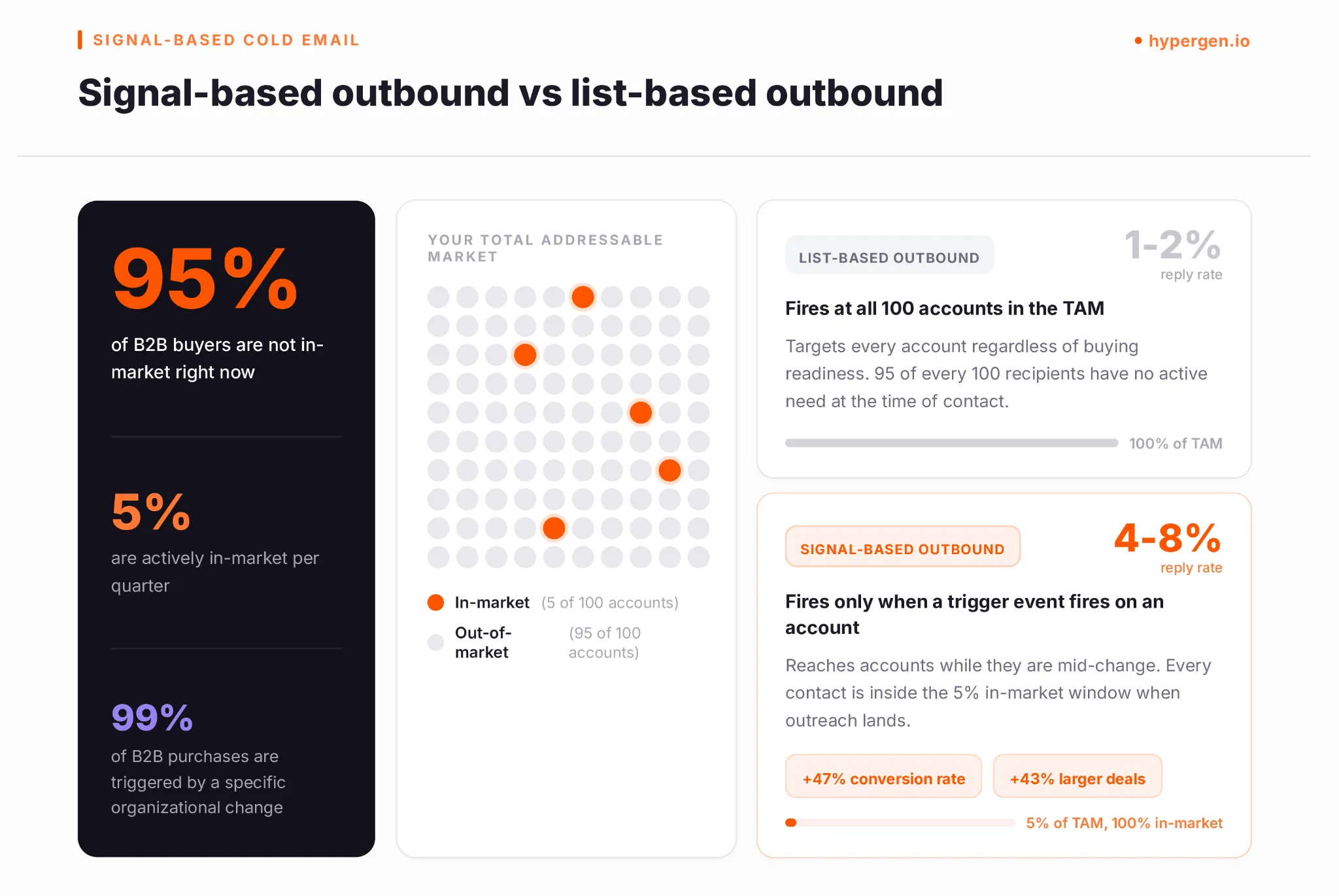
According to 2026 B2B SaaS benchmarks, signal-triggered sequences hit 4–8% reply rates vs 1–2% for cold lists. And for SaaS buyers who already receive 15+ outbound emails per week… timing is the only lever that earns real attention.
Here's the model we use:
Only about 5% of your total addressable market is actively in-market at any given moment (that's the Ehrenberg-Bass 95:5 rule, and it holds up). Traditional list-based outbound sprays messages at the other 95% and hopes to catch someone mid-cycle.
Signal-based outbound watches for behavioral triggers that tell you a specific prospect just crossed into that 5% window, then reaches out immediately while the context is still fresh.
Here's what that actually looks like across a market of 100 accounts:
For SaaS specifically, the highest-converting signals we track are:
- 💰 Funding events (Series A–C, within the last 4 weeks)
- 👤 C-suite or VP-level job changes
- 🔧 Tech stack migrations or competitor cancellations
- 📋 Competitor reviews on G2 or Capterra
- 📈 Hiring signals (3+ SDR or RevOps roles posted simultaneously)
We track all of these using Clay data enrichment, which monitors hundreds of data points across a client's target market in real time.
And the difference between this and a basic Apollo list pull isn't incremental, but categorical. Where signal-triggered outreach reaches prospects in the middle of a change, traditional list-based outbound reaches prospects because their name showed up in a database export.
So one of those approaches has a timing advantage built in.
And the other one simply doesn't.
Bottom line: A signal-triggered email with average copy will outperform a perfectly written cold template sent to a zero-intent prospect. So always fix targeting before you fix copy.
But of course, reaching the right person means nothing if your email never lands. And that's where infrastructure comes in.
The cold email infrastructure we use to hit 98.2% inbox placement for SaaS
Our SaaS cold email infrastructure runs across 12+ sending domains, completely separate from the client's main domain, with 3 inboxes per domain capped at 30–40 emails per inbox per day.
Every domain authenticates with SPF, DKIM, and DMARC, and warms for 4–6 weeks before any live sending starts. That stack is what produces our 98.2% inbox placement rate.
And that’s the reason Blings.io's campaigns landed where they needed to land from day one.
The first rule of cold email infrastructure: never, ever send from your primary domain.
Your brand domain carries your product emails, billing notifications, customer support communications, and investor updates. One deliverability flag from a cold outreach campaign and all of that goes to spam. (We've rebuilt infrastructure for clients who learned this lesson the expensive way. It's not fun to explain to your CEO why your billing emails are landing in junk.)
Here's what each authentication layer actually does:
All three need to be correctly configured before the first email goes out.
Our cold email deliverability setup handles this during onboarding, including full SPF, DKIM, and DMARC configuration across every sending domain.
Now that's the foundation. But the harder question is what happens when you need to 10x the volume without torching what you've built.
How do you scale cold email infrastructure without burning domains?
Scale by adding domains and inboxes in parallel, not by pushing more volume through the ones you already have.

The formula: daily email target ÷ 40 = minimum inbox count, plus a 20% rotation buffer.
At 1,000 emails per day you need 20+ inboxes across 10+ domains. At 500 per day, at least 13 inboxes across 6-7 domains.
Most SaaS teams hit a wall somewhere around 200 emails per day.
Everything works fine at low volume. Then someone decides to 5x the output, adds a few inboxes to existing domains without changing the underlying architecture, and watches reply rates drop 40% inside three weeks.
The multi-domain approach solves three real problems at once:
- Volume distribution. No single domain carries enough load to trigger bulk-sending detection.
- Risk isolation. If one domain drifts toward spam, it touches only a small fraction of total daily volume, not your entire operation.
- Recovery continuity. Teams managing 10+ sending domains can pause a flagged domain while everything else keeps running without missing a beat.
We maintain a bank of backup sending accounts that are always warmed and ready. When an inbox starts drifting toward spam (detectable through real-time placement monitoring), we rotate it out immediately, so there’s zero campaign downtime.
For the Blings.io campaign, this meant consistent deliverability across all six months without a single infrastructure reset.
Always have 2-3 new domains warming up in the background so you can rotate aging ones out on schedule rather than scrambling when something flags. Treat domain warm-up like a pipeline: it takes 4-6 weeks to get a domain ready, so plan ahead.
You can explore cold email infrastructure providers to find the right setup for your send volume.
Beyond rotation, factor domain age into your schedule too.
Regardless of whether a domain shows problems, retiring and replacing domains every 6–12 months keeps sender reputation fresh. Think of it as infrastructure hygiene rather than damage control.
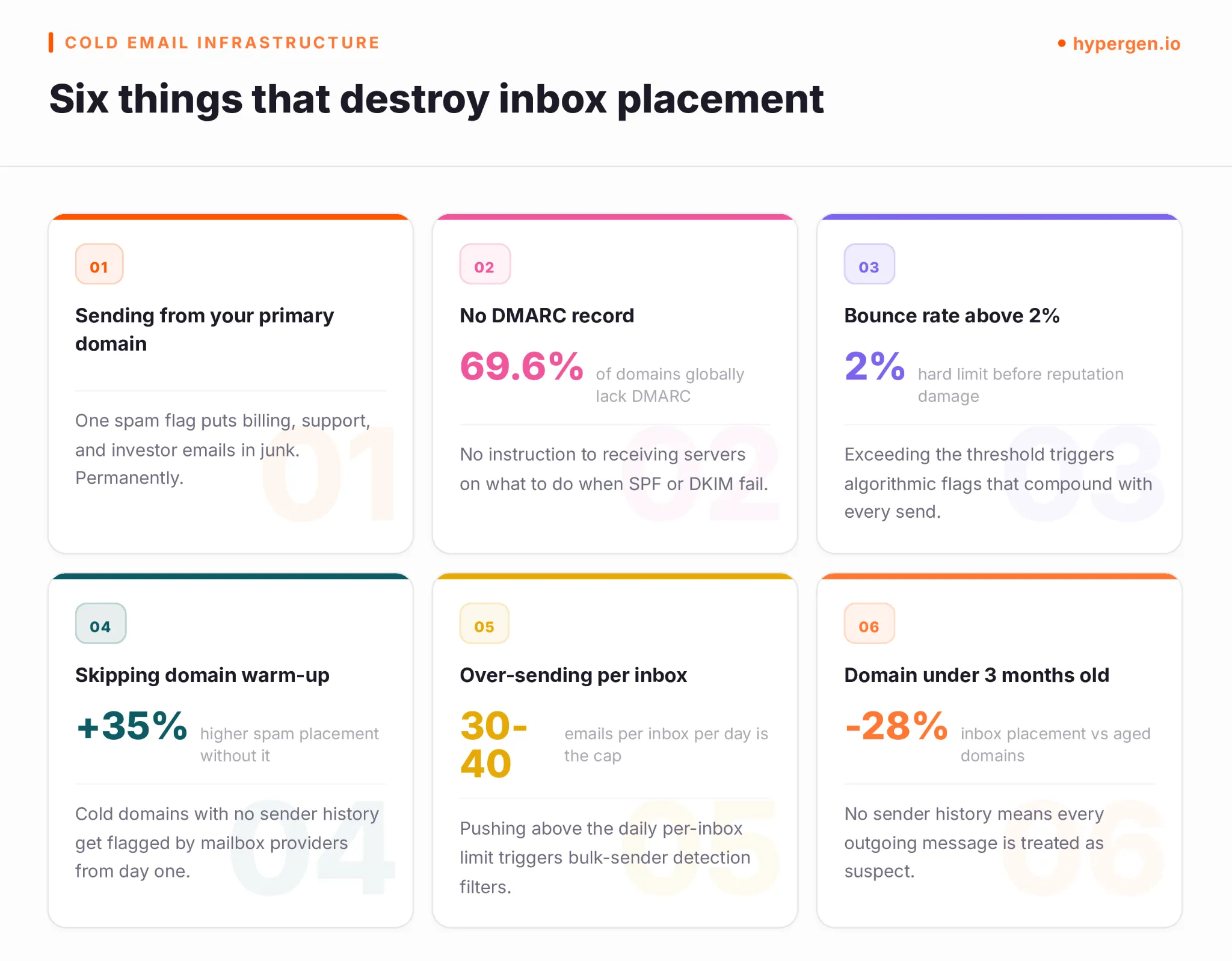
These are the six things we see killing inbox placement most consistently across the campaigns we audit:
We’ve covered the targeting and the infrastructure.
Now let's talk about the thing most people obsess over first and should actually think about third: the email itself.
The exact cold email we sent to book Groupon (and the playbook behind it)
Most SaaS cold email we send follows the same four-rule framework: under 75 words, 8th-grade reading level, value framed around the prospect's role (not product features), and a 3-touch cadence on day 1, day 3, and day 7.
The day-1 email opens with a role-specific observation, names a target account the prospect wants to win, references a comparable client result, and closes with one question.
Here's the exact email we used to book Groupon with:
Subject: Campaign suggestions
Was wondering if you were looking to get in touch with VPs of Marketing and Directors of Sales at companies like Caesars Entertainment and Celebrity Cruises?
We helped one of our clients book those exact companies with AI-personalised outbound campaigns.
Would you be interested in discussing how we could replicate this for Groupon?
Best, John @ Hypergen
As you can see it’s 72 words, an intern could read it in under 10 seconds. And that's the entire point.
Let's break down why each line works:
- "Saw you handle enterprise sales at Groupon": role-specific, not generic. Signals this email was written for this person, not broadcast to a list of 5,000.
- "Caesars Entertainment and Celebrity Cruises": specific names Joe would recognize and actually want as customers. Not "companies like yours." Real names.
- "We helped one of our clients book those exact companies": proof before the ask. Specific and verifiable, not a vague ROI claim.
- One closing question. Not a calendar link, not a demo request, not three CTAs fighting for attention. One low-friction question.
Beyond the structure, there are writing rules that govern every email in the sequence. Cold email personalization gets embedded in the observation line and the named target accounts. The structure stays consistent, but the signal-specific detail is what makes it feel 1:1.
So here is the full rulebook:
- No superlatives. "Best," "revolutionary," "leading": cut all of them. Let the proof do the talking.
- Frame around pride, growth, or freedom, not fear of falling behind. Enterprise founders built something, so always treat them accordingly.
- One exclamation mark maximum across the entire 4-email sequence. (One, across the whole sequence! Not per email.)
- Plain text subject lines. No links, no images, no emojis in the subject. Yes, boring infrastructure wins.
- Never open with "Hope this finds you well" or "I'm reaching out because." Enterprise buyers have seen every variation thousands of times. And these lines are the fastest way to get deleted before line two.
- Never imply the prospect hasn't thought about their options. They for sure have.
What cadence works for SaaS enterprise cold email?
A 3-touch cadence on day 1, day 3, and day 7 is what we use and recommend for most SaaS enterprise sequences.
- Day 1 makes the offer.
- Day 3 adds a different proof point or pivots the angle (a new target account, a different use case the same product solves).
- Day 7 is a short break-up: More touches on a tight, high-intent list increase spam risk faster than they increase reply rate.
For follow-up emails after no response, we recommend to keep them short. Seriously short.
One sentence that adds something new, plus a question. This means no guilt-tripping and no "I just wanted to circle back." (We've all received that email. Don't be that person.)
Once your copy is working and your sequences are running, the next piece of the puzzle is what happens when a reply comes in. And this is where most SaaS outbound campaigns quietly lose the deals they worked hard to earn.


How our RevOps system cuts SaaS reply-to-demo time from days to hours
Our RevOps system uses AI reply labeling in PlusVibe to classify every incoming reply, push positives directly into HubSpot with full contact context attached, and assign an SDR task within minutes.
The goal, of course, is a booked demo before the prospect's interest window closes.
For Blings.io, this cut the average time from reply to booked call from days to hours. That is part of the reason 3 enterprise deals closed in 6 months.
And here's something that’s not talked enough about:
When a positive reply comes in from a VP of Sales at a 500-person SaaS company, that person is interested right now, in that moment, with whatever triggered their response still fresh in their mind. So if you wait 24 hours to respond… you're now competing against 30 other things that landed in their inbox that afternoon.
Because intent cools fast. Faster than most teams realize.
Our RevOps system eliminates exactly that lag.
Here's how it works:
- AI reply labeling in PlusVibe classifies every incoming reply automatically: positive, negative, OOO, referral, or question
- Positive replies push directly into HubSpot with the contact record, company data, and campaign context already attached
- An SDR task gets assigned within minutes, not hours, not "whenever they check the shared inbox"
- SDRs send from pre-built templates with industry-specific case studies ready to go, so there's no research delay on their end
Beyond Blings.io, the same system helped drive 40+ deals in 3 months for RealScale. You can see exactly how that played out in the RealScale case study.
So the system works.
But how do you know if your campaign is working? That comes down to knowing which numbers actually matter and what to do when they're off.
What metrics should SaaS cold email campaigns actually hit?
As mentioned earlier, SaaS cold email campaigns should hit 4–8% reply rates and 1–3% meeting-booked rates when signal-triggered.
And the Blings.io campaign sat at the top of the signal-triggered range throughout all 6 months.
That's the baseline. But beyond the headline numbers, there are a few metrics most SaaS teams either ignore or track incorrectly:
- Positive reply rate (not total reply rate). Most platforms count "not interested" and "unsubscribe" as replies. Track positive replies separately. A 4% total reply rate might be a 1.5% positive reply rate. That's the number that connects to actual pipeline, so it's the number that matters.
- Meeting-booked rate per 1,000 emails sent. This tells you whether the full system is working: targeting, copy, andRevOps. Not just whether your subject lines are getting opens.
- Reply-to-booked-meeting conversion rate. If positive replies aren't converting to booked meetings, the leak is in SDR follow-up speed or the qualification process, not in the campaign itself.
And speaking of opens: open rate is largely a vanity metric in 2026. Apple MPP pre-loads tracking pixels and inflates the number significantly. We don't report on them for our clients and we'd suggest you stop optimizing for them too.
Positive reply rate, meetings booked, and closed revenue are what actually tell you if the campaign is working.
If you want to understand what separates a reply worth your SDR's time from one that isn't, our post on high-quality leads breaks that down based on 120+ campaigns. And for a full picture of how the targeting, infrastructure, and follow-up layers connect into one system, outbound lead generation tactics for 2026 covers all of it.
So those are the numbers to watch. Now, what do you do when they drop?
We've debugged enough underperforming campaigns to know that the problem is almost never where you think it is.
Here's where to look first:
- Infrastructure first.
If your bounce rate is above 2% or inbox placement is below 90%, nothing else you fix will matter. Deliverability is the foundation everything else is built on. According to Cleanlis the average cold email reply rate in 2026 is 3.1% across all senders.
So teams below that benchmark are almost always fighting an infrastructure problem, not a copy problem.
- List quality second.
Verified lists get 2x the reply rate of unverified lists. If you're sending to bad data, you're burning email domain reputation on every single send, and the damage compounds faster than you'd expect.
- Copy third.
Messaging fixes are fast once targeting and infrastructure are clean. If you're still below benchmark after fixing steps one and two, run the copy through the 75-word test and check for forbidden openers.
Nine times out of ten, one of those is the culprit.
- Cadence last.
Send timing tweaks (day 3 vs day 4, Tuesday morning vs Thursday afternoon) are the smallest lever in the system. Fix everything else first, then fine-tune timing.
One thing we do that most teams never think about: we feed campaign data back into paid channels.
The messaging angles that generate the highest positive reply rates in cold email (the specific pain points, the target accounts that resonate, the proof points that land) get passed directly to LinkedIn and paid search to sharpen ad copy.
Your outbound campaigns are basically a real-time research engine for what messaging actually works with your ICP.
Enterprise deals don't close themselves
The three deals Blings.io closed weren't won in the copy. They were won in the moment we reached the right marketing executive at a Fortune 500 company on the exact week something changed in their business.
And that's the principle behind signal-based outreach: you're not just writing better emails, you're manufacturing better timing.
If closing enterprise accounts is on your roadmap and the pipeline isn't moving, that's exactly the gap we close for SaaS companies.
We handle the targeting signals, the infrastructure, and the RevOps layer behind every reply, so your team shows up to conversations that are already worth having.
Your next enterprise deal is closer than you think. It just needs the right moment.
Frequently asked questions
Yes, but only when it's signal-triggered, backed by dedicated infrastructure, and targeted at decision-makers with real buying authority. Generic list-based outreach is background noise in 2026. For SaaS with ACV above $5K, cold email still beats paid ads on cost-per-meeting.
SaaS companies running signal-based cold email typically see 5–10X ROI within 12 months. Blings.io hit 8X in 6 months. At a $5,000/month retainer, one closed enterprise deal over $50K ACV covers the engagement for 10+ months.
Very few do both well. Hypergen runs RevOps as a paired service alongside outbound: HubSpot and Salesforce cleanup, AI reply routing, SDR task automation, and pipeline reporting.
Full-service cold email for SaaS typically costs $3,000–$8,000 per month plus a $1,500–$5,000 setup fee. Hypergen plans start at $5,000/month with a 6-month minimum, covering strategy, list building, copy, sending, follow-up, reporting, and a dedicated GTM specialist.
No agency can guarantee 100% inbox placement, but a credible one publishes its benchmark. Hypergen's current rate is 98.2% across 12+ sending domains. Walk away from any agency that won't share its placement rate or sends from your primary domain.
Don’t miss these

.avif)
Get your first lead this month
14 days to get started. 7 days to get your first lead on average.


