

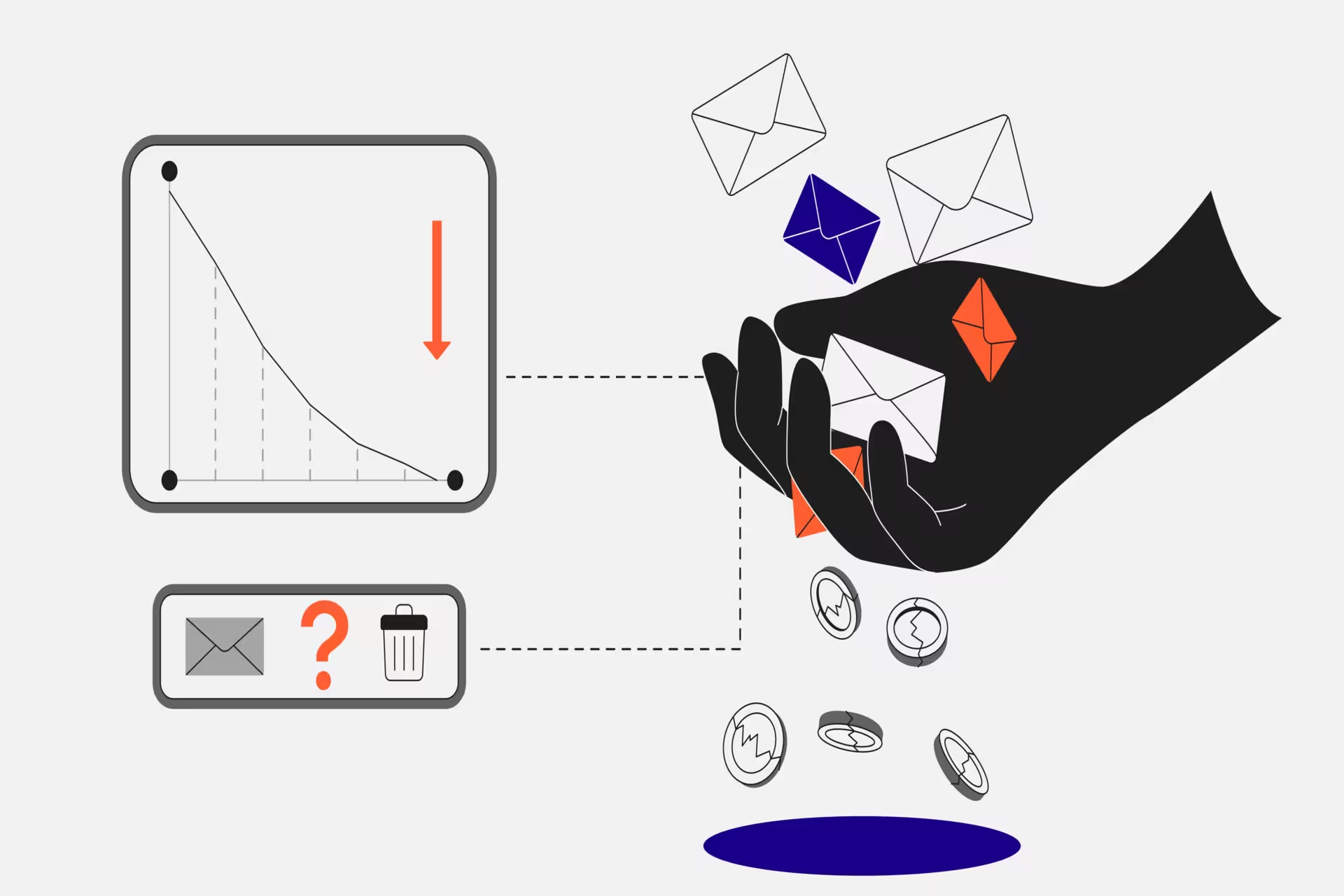
We ran 120+ cold email campaigns - Here's why most agencies fail to deliver ROI
TL;DR
- Cold email ROI is decided before emails go out. The real benchmark is your existing cost per lead across every active channel.
- Most agencies fail before they send a single email. No CPL benchmark at onboarding means no agreed definition of success when reports land. 🎯
- Total campaign cost is almost always undercounted. Mature programs achieve 3–8x ROI, but that math only holds when infrastructure costs are properly counted.
- Signal-based targeting outperforms demographic lists by 5x. Emails triggered by buying signals average 15–25% reply rates versus 3–5% for generic outreach. 📈
- Open rates are a deliverability signal, not a business result. Track cost per meeting, booking rate, and pipeline contribution instead.
- Every onboarding needs three shared targets with named owners. Lead volume, booking rate, and first-close milestone. Вithout named owners, pipeline slips between teams.
- Low booking rate and low close rate need different fixes. Meetings not converting is a capacity problem. Deals not closing is a sales strategy problem. ⚙️
We're going to say something that surprises most clients when they first hear it: cold email agency ROI is mostly decided before a single email goes out.
Not by the copy, not by the sequences, not by how well your sending domains are warmed up.
It's decided by whether the agency and client sat down at onboarding, looked at what the client was already paying per lead from every channel they're running, and agreed on a specific number to beat.
That conversation is the foundation, and after 120+ campaigns we can tell you it's almost always the one that separates the engagements that produce pipeline from the ones that produce reports. 👇
Why do most cold email agencies fail to deliver ROI?
Most cold email agencies fail to deliver ROI because they never define what ROI means for the client before the campaign starts, with no shared benchmark, no agreed cost per lead, no booking rate target, and no framework for measuring success when results start coming in.
Here's the pattern we see constantly: an agency onboards, builds infrastructure, and writes sequences.
Emails go out, reports go out, and the reply rates look reasonable. Then month two arrives and both sides quietly realize that all this activity hasn't actually connected to pipeline.
The agency points to their reply rate; the client points to an empty CRM. And nobody can agree on what went wrong, because nobody agreed upfront on what "right" looked like.
So the channel itself isn't broken. Cold email still generates real B2B pipeline when it's built around the right framework.
But the variable is always alignment: who owns what metric, what the targets are, and what baseline you're measuring performance against.
Before we launch any campaign, we always request everything the client already has:
- Cold call scripts
- Current ad copy
- LinkedIn sequences
- Historical conversion data
Not to copy it, but to understand what's already converting and, more importantly, what the client is currently paying per lead from every channel they're running.
That number, your existing cost per lead across cold calling, LinkedIn ads, Google, whatever you're running, becomes the benchmark we commit to beating.
What does cold email agency ROI actually measure?
Cold email agency ROI measures the revenue generated from a campaign against the total cost to run it.
The formula is straightforward: ROI = ((Revenue Generated - Total Campaign Cost) / Total Campaign Cost) x 100.
But the harder part is making sure "total campaign cost" is counted honestly, and most clients undercount it significantly, partly because most agencies don't rush to correct that misunderstanding.
Because your total campaign cost isn't just the monthly retainer. A properly run outbound system includes:
- 🏗️ Sending infrastructure: dedicated domains, inboxes, and cold email hosting and deliverability setup
- 🔐 Authentication: SPF, DKIM, and DMARC configuration (mandatory since Google and Yahoo's 2024 bulk sender requirements, with no shortcuts)
- 🔥 Domain warm-up: weeks of email domain warm-up before the first send, because skipping this step burns domains fast
- 📊 Reputation management: actively protecting your email sender reputation across every active sending domain
- 🚫 Blacklist monitoring: email blacklists can quietly kill a campaign mid-flight before you've noticed anything wrong
- 🔎 Campaign optimization: ongoing adjustments to sequences and targeting as campaigns mature and lists evolve
- 🛠️ Infrastructure provider costs: the choice of cold email infrastructure providers directly affects both your cost base and your deliverability ceiling
When all of that is properly counted, mature, optimized cold email programs typically achieve 3-8x ROI, with a 5:1 return considered solid performance and 10:1 considered outstanding.
So the single most important metric to track before any deal closes is cost per meeting (CPM), because it gives you a unit-level view of whether the campaign economics make sense before you're waiting on revenue to land.
But without a CPM target agreed at the start of an engagement, you'll spend months having an unwinnable argument about whether things are "working."


Why are some email prospecting services better than others?
The agencies that consistently deliver ROI target prospects based on active buying signals, not demographic lists.
For example leadership changes, funding rounds, tech stack migrations, patterns in competitor reviews: these signals are the difference between contacting someone who might be a fit someday versus someone who is actively evaluating solutions today. (Yes, it’s the same company on paper, but a completely different conversation to walk into!)

Research across thousands of B2B campaigns shows that emails referencing specific buying signals achieve reply rates of 15-25%, roughly a 5x lift over generic outreach.
At Hypergen, we use Clay data enrichment to monitor 100+ company signals, from funding rounds and leadership changes to tech stack shifts and competitor mentions, before a single sequence is built.
And yes, our Clay prospecting methodology means we're tracking accounts continuously rather than pulling a static list once and hoping it holds two months later.
For a SaaS client entering the US market, this approach produced meetings with multiple Fortune 500s, which isn't a result you get with a demographic list and a copy-pasted template.

Ask your agency what specific signal triggered a given prospect being added to your campaign. If they can point to one, they're doing intent-based prospecting. But if they can't… well, they're using a list, and that distinction matters more than most clients realize.
What metrics should a cold email agency report on?
Your cold email agency should report on cost per lead, cost per meeting, booking rate, and pipeline contribution, not open rates.
Because open rate is a deliverability signal, not a business result, and we even speak openly against tracking open rates.
So if your agency's monthly report leads with open rates and ends there, well, you don't have a performance report, but a vanity dashboard dressed up as accountability.
Here is the metric hierarchy that actually connects to revenue:
- Positive reply rate: are the replies warm, or just noise?
- Booking rate: what percentage of positive replies convert to held meetings? (This one matters especially if your team handles its own bookings)
- Cost per meeting: your primary unit economics metric before any deal closes
- Pipeline contribution: revenue attributable to agency-generated leads, tracked in your CRM
- Email domain reputation: the long-term health metric that compounds in your favor or against you depending on how campaigns are managed
For consistent ROI, every one of those metrics needs a target agreed at the start of the engagement, tied to the cost-per-lead baseline from your other active channels.
How should a cold email agency structure onboarding and goal-setting?
Before we launch any campaign, we align with our clients on the numbers that will govern the whole engagement. We've already covered the cost-per-lead benchmark.
From there, we set three explicit goals:
And that last column matters more than most clients expect.
Because if we're handing off 30 qualified leads a month and only 5 are getting booked, that's not a lead quality problem. It's a sales process problem.
And we'd rather surface that early than let three months of pipeline disappear while everyone assumes the other side is handling it. (We've had that conversation with clients. And it's not always comfortable, but it's always necessary.)
Together, these targets become the scorecard for every monthly review and every campaign revisit throughout the engagement.
Those monthly reports do two things simultaneously: they evaluate our performance against the lead volume and quality targets we committed to, and they check whether the client is on track with their booking and closing goals.
That second check is where things get genuinely interesting, because the fix depends entirely on which side the gap is on.
So let’s cover both of them:
When the booking rate is the problem
The leads are arriving and the quality is there, but meetings aren't being booked at the rate we agreed. Sometimes it's a founder-led sales challenge, where someone handling pipeline directly for the first time needs support with the handoff.
And sometimes the team simply doesn't have the bandwidth to follow up consistently.
The last scenario is when we often bring up RevOps services, because it’s a direct solution to a problem we can already see in the data. If the leads are good and bookings are the bottleneck, adding SDR capacity directly addresses the gap.
When the closing rate is the problem
Meetings are happening but deals aren't closing, and that's a fundamentally different conversation.
That's not a lead generation problem, but a sales strategy problem, and the honest response is to say so directly.
We'll review the client's sales process, look at what's happening at the demo or proposal stage, and where relevant, even partner them up with remote sales teams who specialize in closing their deal type.
Because the goal is to make sure the pipeline we built actually converts.
And when the framework is built right from the start, the results are consistent across very different industries and deal types.
Here are some examples from our own client work:
- Gray Falkon's sales team was excellent at closing but spending 85% of their time just finding new opportunities, leaving 15% for the work they were actually good at.
So we took over the prospecting entirely. After 16 months: 174 qualified leads, 12 new customers, $900K+ in revenue, and 16x ROI. And their time allocation flipped completely, with 85% now on customer-facing work and 15% on prospecting.
- Set 2 Close needed a more cost-efficient alternative to digital advertising, with better targeting and messaging specificity.
By identifying the right signals (HubSpot users, newly hired sales leaders, companies hiring for sales roles) and sharpening the copy to match, we generated 429 leads and over 100 meetings in 6-7 months, resulting in $150K+ in revenue, a 5x ROI, and 40% MRR growth.
- Digital Authority Partners needed consistent, scalable lead flow without adding headcount.
After becoming their longest-running lead gen partner out of seven they'd tested, we consistently delivered 20-30 qualified leads per month, resulting in 8 closed deals and just under $1M in revenue in one year.
The best agencies don't just deliver leads and disappear. But they actually track what happens to those leads, they're willing to have an uncomfortable conversation when something in the funnel isn't working, and they build their outbound sales strategies around your actual numbers, not a generic playbook.
How do you know if your cold email agency is actually delivering ROI?
You agreed on a cost-per-lead benchmark before launch. You have a booking rate target and someone accountable for it. And your monthly report tells you whether you're on track to close deals, not just on track to open emails.
But if none of that sounds familiar, the problem probably started at onboarding.
We run cold email campaigns and RevOps systems built around the numbers that actually matter for your business: your deal size, your sales cycle, and what you're already paying per lead from every other channel.
If you need help fixing the framework, we'd love to take a look! 👇
Frequently asked questions
A good cold email agency ROI is 3–8x your total campaign investment. A 5:1 return is solid; 10:1 is outstanding. Those numbers only hold when total campaign cost ( infrastructure, warm-up, and management) is counted honestly from day one.
A cold email agency should report on positive reply rate, booking rate, cost per meeting, and pipeline contribution. Open rates are a deliverability signal, not a business result. If that's where your monthly report ends, you don't have accountability.
Ask about their cost-per-lead benchmark process, how they define ROI upfront, what buying signals they use for targeting, and how they handle booking or closing gaps. Agencies that can't answer those clearly aren't built for accountability.
Booking rate is a shared metric. The agency is responsible for delivering qualified leads; the client owns the follow-up and conversion process. If leads are strong but bookings are low, that's a sales process problem, not a lead quality problem.
Cold email ROI = ((Revenue Generated − Total Campaign Cost) / Total Campaign Cost) × 100. Total cost must include infrastructure, domain warm-up, authentication setup, and management fees, not just the retainer. Undercounting cost inflates ROI and creates unrealistic expectations.
Don’t miss these

.avif)
Get your first lead this month
14 days to get started. 7 days to get your first lead on average.


